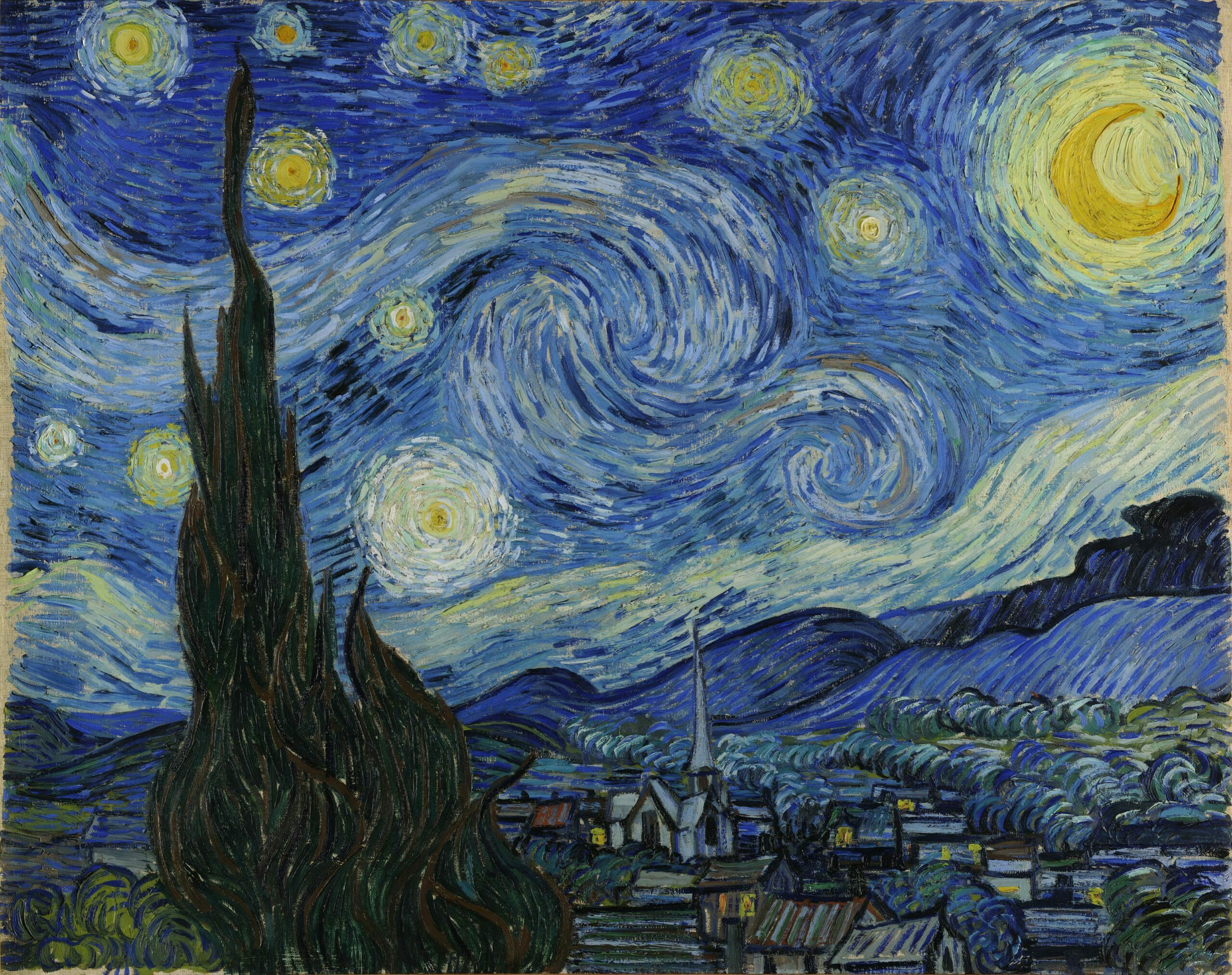








































Description


The Starry Night is the painting Vincent van Gogh made in June 1889 at the Saint-Paul-de-Mausole asylum near Saint-Rémy in Provence: a swirling sky full of stars and a crescent moon above a quiet village, with a dark cypress rising like a flame in the foreground. The original measures 73.7 x 92.1 cm and has hung in the Museum of Modern Art (MoMA) in New York since 1941. We paint it by hand in oil on canvas, in 15 sizes from 50 x 40 to 190 x 151 cm or to your own measurement, and send you a photograph of the finished work for approval before dispatch.
| Title: | The Starry Night |
| Other titles: | Starry Night · De sterrennacht · La Nuit étoilée |
| Painter: | Vincent van Gogh (1853–1890) |
| Year painted: | June 1889, Saint-Rémy-de-Provence |
| Original size: | 73.7 cm x 92.1 cm |
| Original technique: | Oil on canvas |
| Painting style: | Post-Impressionism |
| Located at: | The Museum of Modern Art (MoMA), New York (inv. 472.1941) |
| Our reproduction: | Hand-painted oil on canvas, 15 sizes or made to measure |
The Starry Night – Vincent van Gogh
What does The Starry Night show?
The view runs across a dark foreground to low hills and a village under the night sky. On the left a tall cypress rises from the bottom edge almost to the top of the canvas, dark green and brown, its outline curling like a flame. To its right lies the village: houses with lit windows and, among them, a church whose pointed steeple rises above the roofs. Behind it roll the blue hills of the Alpilles.
Most of the canvas is sky. A great swirl winds across it, stars ringed with yellow and white halos are scattered over it, and at the top right a crescent moon glows in a wide yellow aura. Everything is laid down in short, curved strokes that follow the forms, so the sky seems to move. The palette is simple: blue, yellow, white and dark green.
How did The Starry Night come about in Saint-Rémy?
On 8 May 1889 Van Gogh admitted himself to the Saint-Paul-de-Mausole asylum, a former monastery outside Saint-Rémy. It was less than half full, so he had a bedroom upstairs and a ground-floor room as a studio. The bedroom window faced east, onto an enclosed wheat field and the hills, and he painted that view more than twenty times.
The Starry Night is the only night scene in that series. In early June he wrote to his brother Theo that he had watched the countryside from his window for a long time before sunrise, with nothing in the sky but the morning star. He painted the canvas by day in the studio; in the bedroom he was only allowed to sketch. Around 18 June he told Theo he had a new study of a starry sky. The village was not visible from the window; he added it from a drawing made above Saint-Rémy.
What do the cypress, the stars and the swirls mean?
Van Gogh wrote little about the painting, so its meaning stays open. In the south of France the cypress is the tree of cemeteries and mourning, often read as a bridge between earth and sky. His letters, though, show he admired cypresses for their shape and colour; here he enlarged the tree and pushed it to the front.
The brightest star, just right of the cypress, is Venus, the morning star, which really was visible over Provence that spring. The moon is stylised and does not match the moon in the sky at the time. Some link the swirls to astronomical drawings of nebulae; others see the painter’s unrest in them. The pointed steeple looks more like a church of his native Netherlands than one in Provence, and is often read as a memory of the north.
Where does the original hang, and how did it reach New York?
The original hangs in the Museum of Modern Art (MoMA) in New York, which holds it under accession number 472.1941. The museum acquired it on 10 June 1941 through the Lillie P. Bliss Bequest, by exchange, and has rarely lent it out since. It is in neither Paris nor Amsterdam.
Before that it stayed in Europe for half a century: it passed to Theo, then to his widow Jo van Gogh-Bonger, was in Rotterdam from 1906 to 1938, and was sold to the museum by the dealer Paul Rosenberg.
The Starry Night or Starry Night over the Rhône – which one is which?
We paint two of Van Gogh’s night skies, which are often confused. This page is The Starry Night of 1889: the swirling sky, the cypress and the village painted in Saint-Rémy, with the original in New York. The other is Starry Night over the Rhône, painted in Arles in September 1888: a calm sky with the Plough above the river, the reflections of gas lamps on the water and a couple on the bank, with the original in the Musée d’Orsay in Paris.
For the dramatic, moving sky, choose this one; for a calm, romantic night by the water, choose the Rhône. From the same year in Saint-Rémy we also paint Cypresses and Irises, and from Arles the night scene Café Terrace at Night.
In Saint-Rémy in September 1889 he also painted the Pietà (after Delacroix), and we paint it by hand as well.
How is our hand-painted Starry Night made?
The painter first draws the cypress, hills, village, stars and moon, then lays in the blues of the sky and the swirls, and last the rings around the stars. Our oil painting reproduction is painted by hand in oil on canvas with real impasto: the paint goes on thickly, so the brushstrokes stand up from the canvas as they do in the original, short, curved and laid side by side, and the sky flows in the same direction as Van Gogh’s.
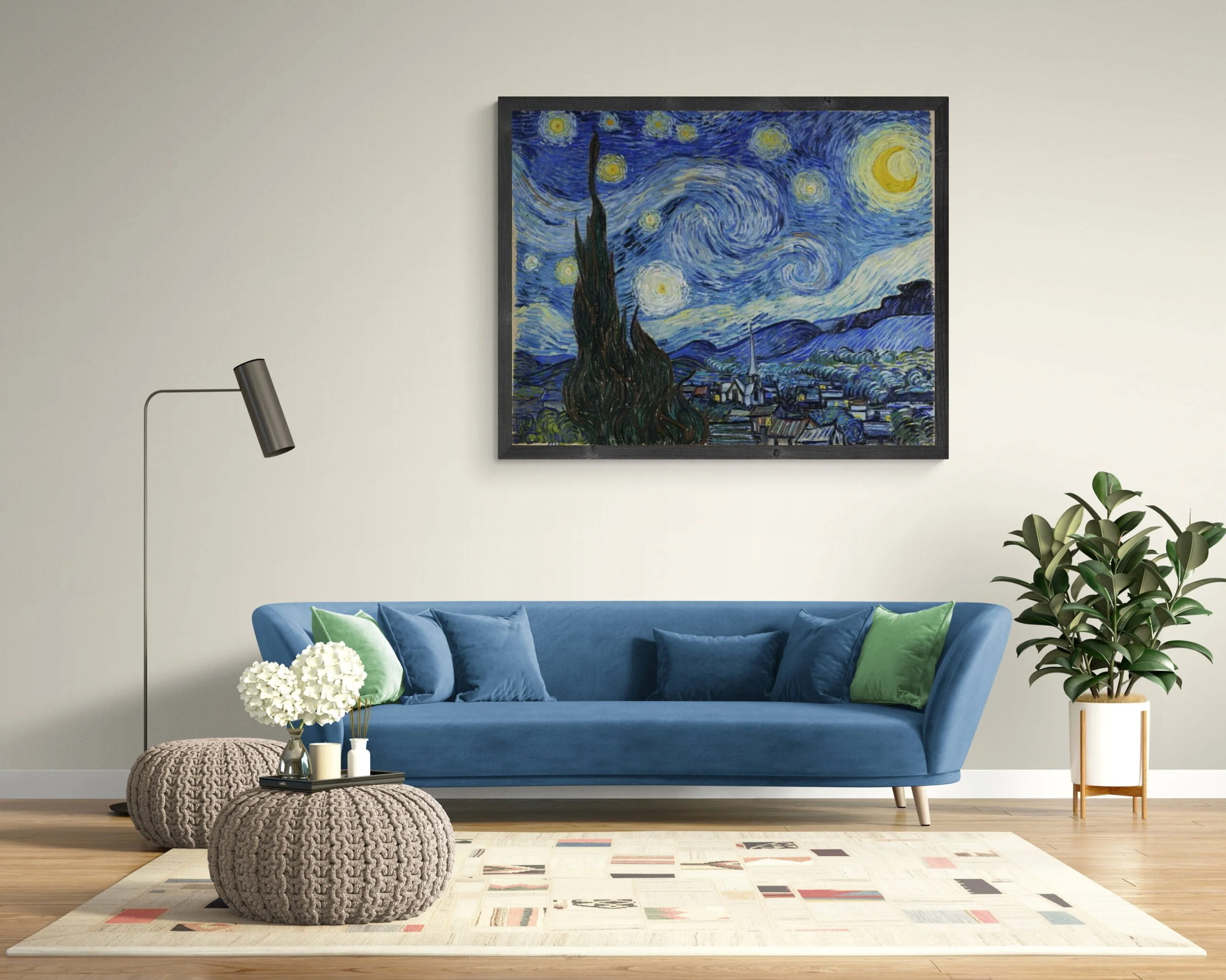
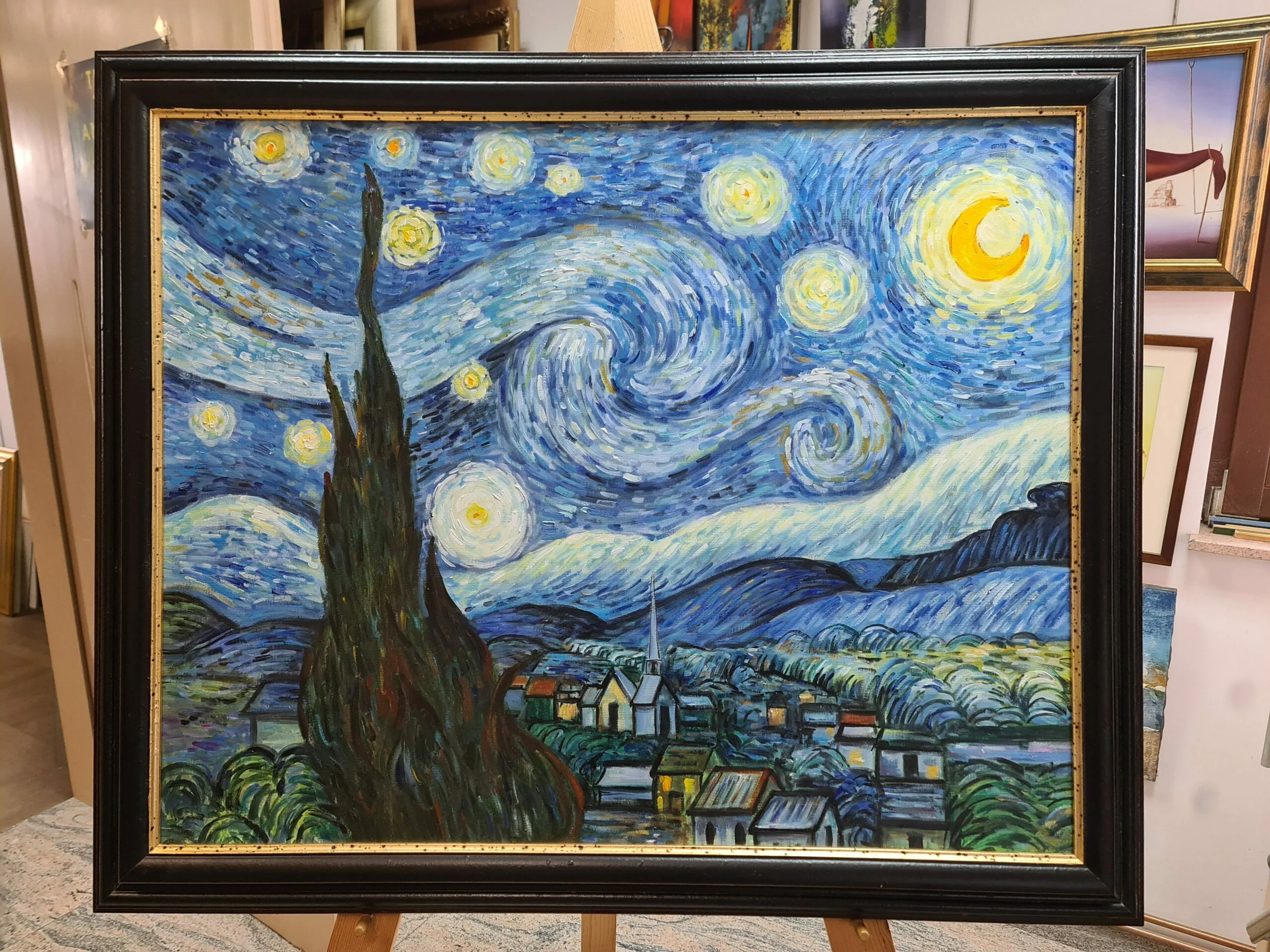
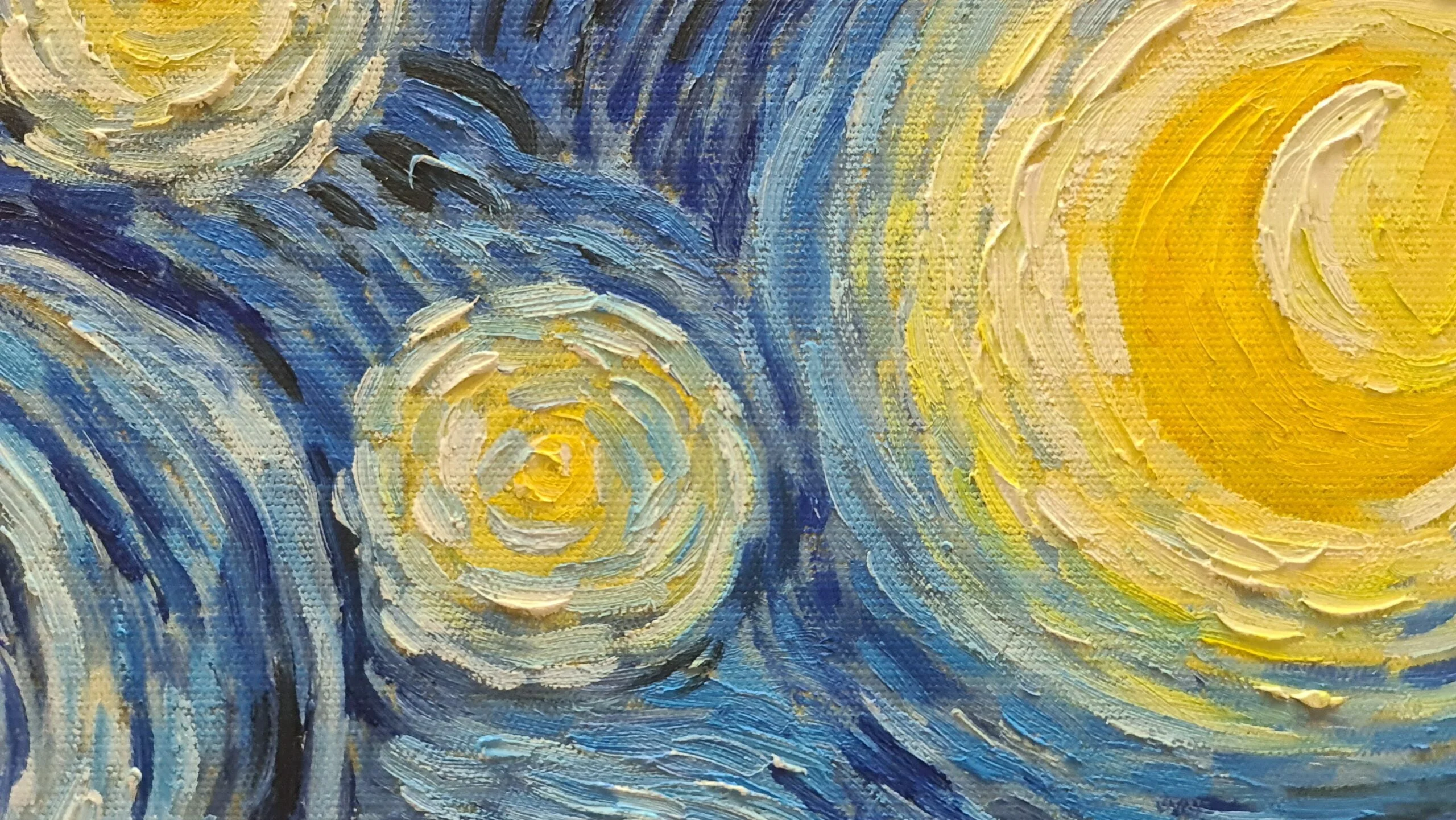
The first photograph is a visualisation in a living room above a blue sofa, to help you choose a size. The second photograph shows the finished painting in a dark frame with a gold inner edge, on an easel in our workshop, as you receive it. The third photograph is a close-up of the crescent moon and a star, with the curved strokes circling the light. The fourth photograph shows the blue sky closer still, where the impasto is easiest to see: the thick strokes stand up from the canvas, with its weave visible between them. The fifth photograph shows the village and its steeple up close.
Every painting is a hand-painted copy made for your order, so no two are quite the same.
Which size for which wall?
Short answer: 120 x 100 cm above a sofa or a double bed, 70 x 60 or 90 x 70 cm above a chest of drawers or in a smaller room, and 150 x 120 cm for a large empty wall. The landscape format suits long furniture.
There are 15 sizes: 50 x 40, 55 x 45, 60 x 50, 70 x 60, 80 x 65, 90 x 70, 92 x 73, 100 x 80, 110 x 90, 120 x 100, 150 x 120, 160 x 127, 170 x 134, 180 x 142 and 190 x 151 cm. The 92 x 73 cm size is practically the same as the original, which measures 92.1 x 73.7 cm, so on your wall it works just as it does in the museum. The smallest suit a hallway or a study, the largest a big living space or a staircase. A painting for the living room should cover about two thirds of the furniture below it: 120 cm above a 180 cm sofa.
Hang it with the centre of the canvas about 150 cm above the floor, and 20 to 30 cm above a sofa or a headboard.
What if I need a custom size or a frame?
If none of the 15 sizes fits your wall, we paint it to measure. We recommend keeping the proportions close to the original, otherwise the sky gets squeezed or stretched. Send us the width and height you want and we will quote a price and a lead time. Every painting we make is stretched over a wooden stretcher and ready to hang.
For the moulding, use our 3D application: it shows each of our frame profiles on this subject – the application is for choosing the frame only. If you would like to see how the painting will look on your own wall, that is our separate room placement service. A dark frame with a gold edge suits the night sky, as you see in the second photograph.
How does delivery work, and what is the guarantee?
Every painting is made to order in our studio in Slovenia, so allow 15 to 45 days depending on the size you choose. We ship it stretched and protected, framed if you chose a frame, across the EU with no customs. Before dispatch you receive a photograph of the finished work to approve; if anything is not right, we correct it while the canvas is still in our workshop. Our returns policy applies to every order.
More famous Van Gogh paintings are in the Vincent van Gogh gallery, and there is more about the painter in our article on Vincent van Gogh. For a gift, a wall art voucher lets the recipient choose size and subject.
Frequently asked questions
Is the original Starry Night in Paris or in Amsterdam?
Neither: the original is in the Museum of Modern Art (MoMA) in New York. The Musée d’Orsay in Paris has a different painting, Starry Night over the Rhône of 1888, which is why the two names get mixed up. The Van Gogh Museum in Amsterdam holds many of his works, but not The Starry Night.
When and where did Van Gogh paint The Starry Night?
In June 1889, at the Saint-Paul-de-Mausole asylum near Saint-Rémy in Provence, where he had admitted himself a month earlier. Around 18 June he told his brother he had a new study of a starry sky. He painted it by day in his ground-floor studio, from the view out of his bedroom window.
Is the village in The Starry Night real?
Only partly. From his bedroom window Van Gogh saw a wheat field, a wall and the hills, but no village. He added it from a drawing he made above Saint-Rémy, and specialists consider the pointed steeple more Dutch than Provençal. So the village is a mix of a real place and a memory.
Which is the brightest star in The Starry Night?
It is Venus, the morning star, just to the right of the cypress. In early June 1889 Van Gogh wrote that before sunrise he had seen from his window nothing but the morning star, which looked very big. Researchers have confirmed that Venus really was visible over Provence then, and close to its brightest.
What did Van Gogh himself think of The Starry Night?
He was not impressed. When he sent paintings to his brother in the autumn of 1889, he called it only a night study and did not count it among the good ones, and in a letter at the end of 1889 he called it a failure. Today it is often called a touchstone of modern art.
How big is the original Starry Night?
The original measures 73.7 x 92.1 cm, which is not large: a format like that already hangs well above an ordinary chest of drawers. Our 92 x 73 cm size is practically the same as the original, and there are smaller and larger sizes up to 190 x 151 cm, as well as custom sizes.
Which colours did Van Gogh use for The Starry Night?
Analysis has found ultramarine and cobalt blue in the sky, and Indian yellow and zinc yellow in the stars and the moon. The palette is very limited; the effect comes from the contrast between the blues and the yellows. In our painting the painter follows exactly these blue and yellow tones.
Why is The Starry Night so well known?
It has been described as a touchstone of modern art and one of the most recognisable paintings in the Western canon. Its swirling sky put feeling into the painting rather than an exact record, and Don McLean’s song Vincent opens with the words Starry, starry night. There is more on the painting’s history on Wikipedia.
Is the original Starry Night for sale, and what is it worth?
No, the original is not for sale. It has been in MoMA’s permanent collection in New York since 1941, so it has no market price, and the museum rarely lends it out. What we can state is the price of our hand-painted version, shown on this page for the size you choose.
Is your Starry Night a print?
No. Each one is painted by hand in oil on canvas, with the paint laid on thickly in impasto, as Van Gogh did. In the third and fourth photographs you can see the strokes and the canvas weave up close. So what you receive is a real canvas painting, which we photograph before dispatch and send you the photograph to approve.
Does your Starry Night have the raised brushstrokes of the original?
Yes. We paint The Starry Night in impasto, so the brushstrokes stand up from the canvas as on Van Gogh’s original. You see them best in the fourth photograph, where the thick strokes of the blue sky catch the light. A print cannot have this relief: its surface is flat.
- Subject: a swirling night sky with stars and a crescent moon above a village, a dark cypress in front.
- Original: June 1889, 73.7 x 92.1 cm, MoMA, New York.
- Ours: a Van Gogh reproduction painted by hand in oil on canvas, in 15 sizes from 50 x 40 to 190 x 151 cm or made to measure.
- Worth knowing: you receive a photograph of the finished work for approval before dispatch.