







































Description
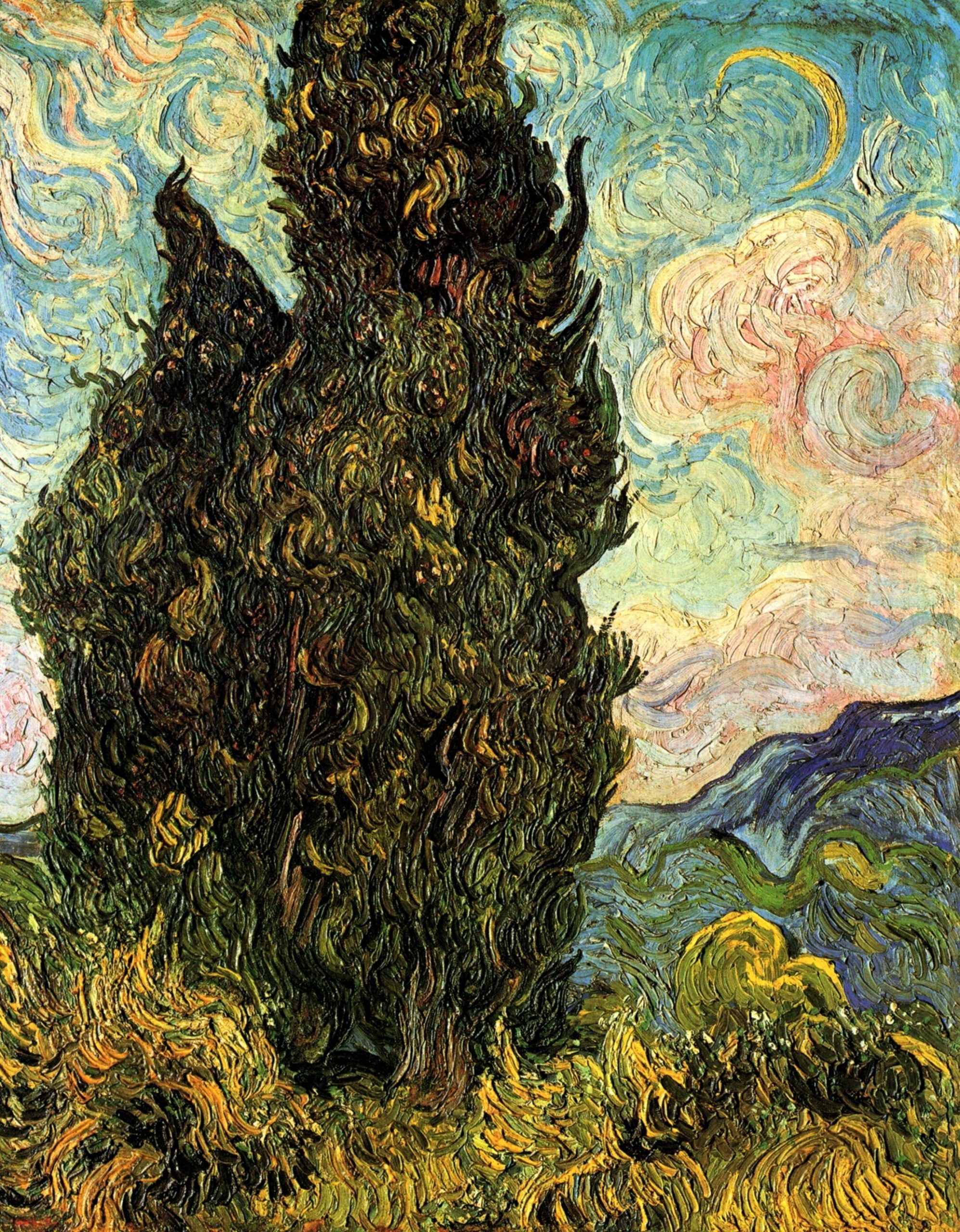
Cypresses is the painting Vincent van Gogh made in June 1889 at the asylum in Saint-Rémy-de-Provence: two tall dark green cypresses rise almost out of the canvas against a turquoise sky with swirling clouds and a thin crescent moon. The original measures 93.4 x 74 cm and hangs in The Metropolitan Museum of Art in New York. We paint it by hand in oil on canvas, in 16 sizes from 40 x 50 to 151 x 190 cm or to your own measurement, and send you a photograph of the finished work for approval before dispatch.
| Title: | Cypresses |
| Other titles: | Cipressi · Zypressen · Ciprusok |
| Painter: | Vincent van Gogh (1853–1890) |
| Year painted: | June 1889, Saint-Rémy-de-Provence |
| Original size: | 93.4 cm x 74 cm |
| Original technique: | Oil on canvas |
| Painting style: | Post-Impressionism |
| Located at: | The Metropolitan Museum of Art, New York (accession no. 49.30) |
| Our reproduction: | Hand-painted oil on canvas, 16 sizes or made to measure |
Cypresses – Vincent van Gogh
What does Cypresses show?
Two cypresses stand side by side and fill most of the canvas. The taller one does not even fit: the top edge cuts it off, so the tree seems to keep growing beyond the frame. Their dark green masses are painted in short curling strokes, like flames, and at the bottom you can just see the trunks. On the right, behind the trees, lie low blue hills; in front of them is a strip of yellow-green grass and bushes, dotted with small white flowers.
The sky takes up the rest. It is turquoise, crossed by white and pink clouds that turn in spirals, and in the upper right corner hangs a thin yellow crescent moon. Everything moves: the trees, the clouds and the grass are drawn with the same rhythmic brush, so the dark trees and the light sky belong to one surface.
How did Van Gogh paint the cypresses?
He described it himself. On 25 June 1889 he wrote to his brother Theo that he had two studies of cypresses on the go, “of that difficult shade of bottle green”, and that he had worked their foregrounds “with thick impastos of white lead which gives firmness to the ground”. Only then did he lay other colours on top. The painting on this page is one of these two studies; the other is a second canvas of cypresses from the same days.
The paint here really is thick. The grass at the bottom and the clouds stand up from the canvas, and the trees are built from layer upon layer of greens, from almost black to a light yellow-green. A week after that letter he sent Theo drawings of both cypress paintings, and he drew a small sketch of this one in a letter.
Why did the cypresses matter so much to Van Gogh?
In the same letter he explained why. “The cypresses still preoccupy me,” he wrote, “I’d like to do something with them like the canvases of the sunflowers, because it astonishes me that no one has yet done them as I see them.” For him the tree was “beautiful as regards lines and proportions, like an Egyptian obelisk”, and its green had “such a distinguished quality”.
He also saw the difficulty. In a sun-drenched landscape the cypress is the dark patch, “one of the most interesting dark notes, the most difficult to hit off exactly” that he could imagine, and it has to be seen “against the blue, in the blue, rather”. That is exactly what this canvas does: the darkest form in the painting stands in the middle of the brightest colours. He had arrived at the asylum only weeks before, and he painted this canvas soon after his arrival.
Where does the original hang?
The original is in The Metropolitan Museum of Art in New York. The museum lists it as Cypresses, 1889, oil on canvas, 93.4 x 74 cm, in its department of European Paintings, under accession number 49.30. It was bought for the museum in 1949 through the Rogers Fund.
Van Gogh did not keep the painting to himself. In 1890 it was shown in Paris at the Salon des Indépendants, the exhibition of independent artists, a few months before his death. More about the painting is on Wikipedia.
Which cypress painting should you choose?
Van Gogh painted cypresses again and again that year, and several of these canvases are in our range. Cypresses is the close-up: two trees, a strip of grass and a small piece of sky, in a tall format. A Wheat Field with Cypresses puts the same dark trees into a wide summer landscape of golden wheat, hills and clouds, so it suits a long wall above a sofa better.
In the same June weeks of 1889 he was also working on The Starry Night, where a single cypress rises in the foreground against the night sky. From the first weeks at the asylum, in May 1889, come the Irises from the garden, and from September the same year the Pietà (after Delacroix). For a tall, narrow wall choose Cypresses; for a night scene, The Starry Night.
How is our hand-painted Cypresses made?
The painter first draws the two trees, the line of the hills and the moon, and checks the proportions against the original, because the taller tree has to touch the top edge exactly as Van Gogh placed it. Then come the sky and the clouds, the dark greens of the trees layer by layer, and last the grass and the white flowers in the foreground. Our oil painting reproduction is painted by hand in oil on canvas with real impasto: the paint goes on thickly, so the brushstrokes stand up from the canvas as they do in the original and catch the light.
On this subject the relief matters more than usual, because Van Gogh himself built the foreground with thick impastos and the curling strokes of the trees are pure texture. A print shows only a flat surface; on our painting the strokes are real.
Every painting is a hand-painted copy made for your order, so no two are quite the same. Before dispatch we photograph it, sending you the photograph to approve.
Which size for which wall?
Short answer: 60 x 80 or 73 x 92 cm above a chest of drawers or a desk, 80 x 100 or 92 x 111 cm for a large wall in the living room, and 120 x 150 cm for a high empty wall or a staircase. The tall format suits a narrow wall, the space beside a window or a hallway.
There are 16 sizes: 40 x 50, 50 x 60, 50 x 62, 56 x 70, 60 x 80, 68 x 85, 73 x 92, 80 x 100, 92 x 111, 100 x 130, 112 x 137, 120 x 150, 127 x 160, 134 x 170, 142 x 180 and 151 x 190 cm (width x height). The original is 74 cm wide and 93.4 cm high; our 73 x 92 cm size is the closest to it, so the trees on your wall are as large as they are in the museum. A painting for the living room should cover about two thirds of the width of the furniture below it; an upright canvas can be narrower when it hangs above a slim piece of furniture or on its own between two doors.
Hang it with the centre of the canvas about 150 cm above the floor. Above a sofa or a headboard, leave 20 to 30 cm between the furniture and the bottom edge.
What if I need a custom size or a frame?
If none of the 16 sizes fits your wall, we paint it to measure. We recommend keeping the proportions close to the original, otherwise the trees get squeezed or stretched. Send us the width and height you want and we will quote a price and a lead time. Every painting we make is stretched over a wooden stretcher and ready to hang.
For the moulding, use our 3D application: it shows each of our frame profiles on this subject, so you can compare gold, silver, black, white and natural wood – the application is for choosing the frame only. Seeing the painting on your own wall is our separate room placement service. The dark greens and the turquoise sky suit a natural wood or a simple gold profile.
How does delivery work, and what is the guarantee?
Every painting is made to order in our studio in Slovenia, so allow 15 to 45 days depending on the size you choose. We ship it stretched and protected, framed if you chose a frame, across the EU with no customs. Before dispatch you receive a photograph of the finished work to approve, and we correct anything that is not right. Our returns policy applies to every order.
More famous Van Gogh paintings are in the Vincent van Gogh gallery, and there is more about the painter in our article on Vincent van Gogh. If it is a gift and you are not sure of the subject or the size, a wall art voucher lets the recipient choose.
Frequently asked questions
Where is the original Cypresses by Van Gogh today?
In The Metropolitan Museum of Art in New York, in its department of European Paintings. The museum lists it under accession number 49.30 as Cypresses, 1889, oil on canvas, and it came into the collection in 1949 through the Rogers Fund. In catalogues of Van Gogh’s work it carries the numbers F613 and JH1746.
When and where did Van Gogh paint Cypresses?
In June 1889, at the Saint-Paul asylum near Saint-Rémy-de-Provence, a few weeks after he had arrived there in May. On 25 June he wrote to Theo that he had two studies of cypresses on the go; this is one of them. The same letter describes their bottle green and the thick white lead he laid into the foreground.
Why did Van Gogh paint Cypresses?
Because the trees fascinated him. He wrote that he wanted to do something with cypresses like his canvases of sunflowers, as it astonished him that no one had yet painted them as he saw them. He found the tree beautiful in its lines and proportions, “like an Egyptian obelisk”, with a green of a distinguished quality.
What do the trees in Cypresses mean?
In his letters Van Gogh did not write about a hidden meaning. He wrote about seeing: the cypress is the dark patch in a sun-drenched landscape, one of the most interesting dark notes and the hardest to get exactly right, and it has to be seen against the blue. The painting is his answer to that challenge, a dark form set in bright colour.
Is the tree in Cypresses the same as in The Starry Night?
They come from the same weeks. The editors of his letters place both among the twelve canvases he had on the go in late June 1889, and both show the cypresses of the countryside around Saint-Rémy. In The Starry Night a single cypress rises in the foreground against the night sky; here two cypresses stand in daylight, with a crescent moon in a turquoise sky.
Did Van Gogh paint more than one Cypresses?
Yes. In June 1889 he had two studies of cypresses on the go at the same time: this one, now in The Metropolitan Museum of Art, and a second canvas of cypresses. A week later he sent his brother drawings of both. Cypresses also appear in many other works from Saint-Rémy, such as his wheat fields with cypresses and The Starry Night.
Why are the cypresses so dark in Cypresses?
Because that is how Van Gogh saw them. He called their colour “that difficult shade of bottle green” and wrote that in a sunlit landscape the cypress is the dark patch, one of the most interesting dark notes he could imagine. He built the trees from many layers of green, from almost black to light yellow-green, so they stay dark but alive.
How big is the original Cypresses?
The original is 93.4 cm high and 74 cm wide, a tall format that already works well on a narrow wall or above a chest of drawers. Our 73 x 92 cm size is the closest to the original, and there are smaller and larger sizes from 40 x 50 up to 151 x 190 cm, as well as custom sizes for a particular wall.
Is your Cypresses a print?
No. It is a canvas painting painted by hand in oil, stroke by stroke, by a painter working from the original, and stretched on a wooden stretcher ready to hang. Before we send it, you receive a photograph of the finished work to approve. A print reproduces the colours on a flat surface; our version has real paint and real brushstrokes.
Does your Cypresses have the raised brushstrokes of the original?
Yes. We paint our Cypresses in impasto: the paint goes on thickly, so the brushstrokes stand up from the canvas as on Van Gogh’s original. You see it best in the curling strokes of the trees, the spiralling clouds and the grass in the foreground, which Van Gogh himself built with thick white lead. A print cannot have this relief, because its surface is flat.
- Subject: two tall dark green cypresses against a turquoise sky with swirling clouds and a crescent moon.
- Original: June 1889, Saint-Rémy, 93.4 x 74 cm, The Metropolitan Museum of Art, New York.
- Ours: a Van Gogh reproduction painted by hand in oil on canvas, in 16 sizes from 40 x 50 to 151 x 190 cm or made to measure.
- Worth knowing: you receive a photograph of the finished work for approval before dispatch.