



Description
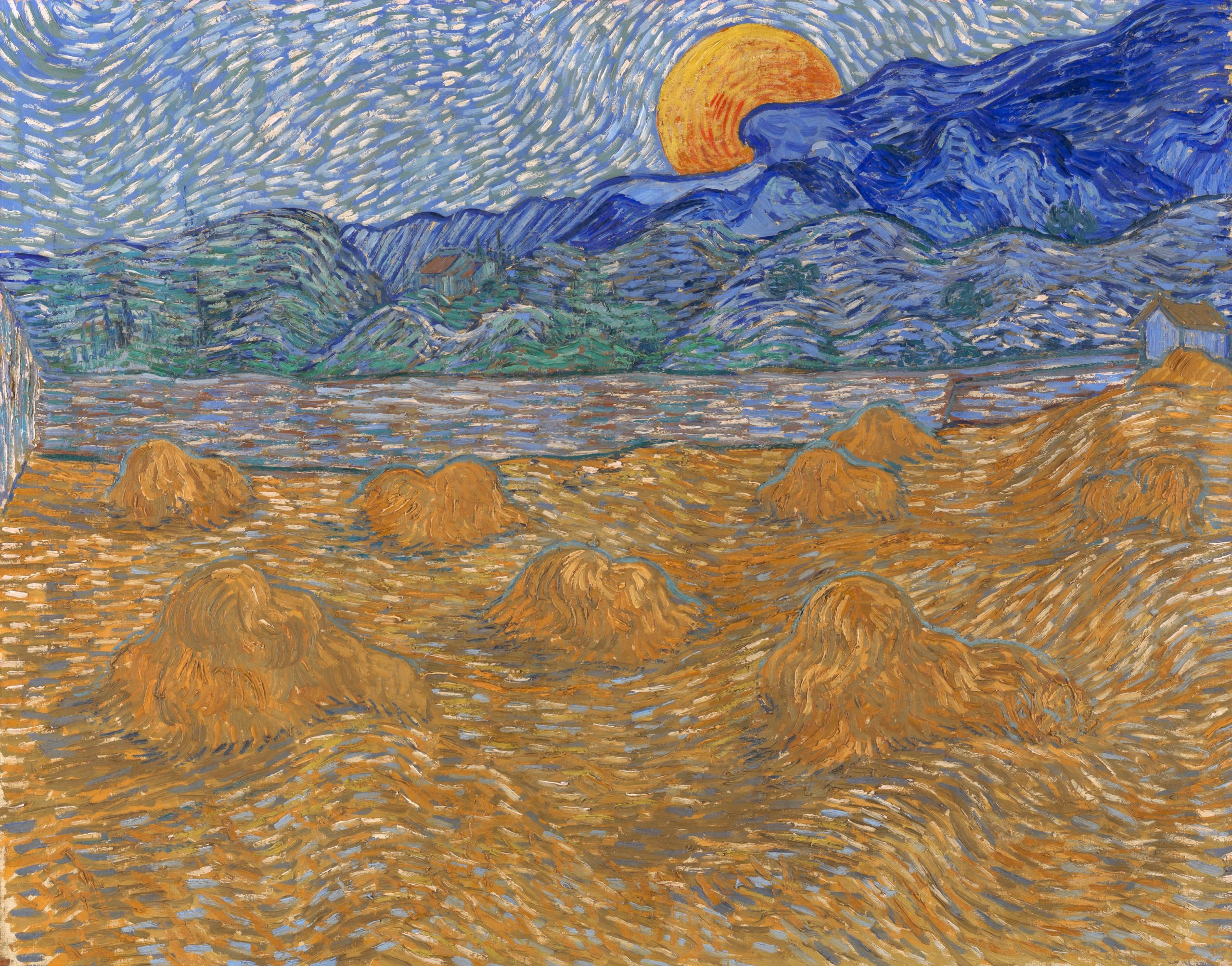
Landscape with Wheat Sheaves and Rising Moon is the painting Vincent van Gogh made in Saint-Rémy-de-Provence in July 1889: a large orange moon coming up behind blue mountains, a pale sky full of short curving strokes, and in front a harvested field of golden stubble with round wheat sheaves set out across it. The original measures 72 x 91.3 cm and belongs to the Kröller-Müller Museum in Otterlo, in the Netherlands. We paint it by hand in oil on canvas, in 17 sizes from 50 x 40 to 190 x 151 cm or to your own measurements, and send you a photograph of the finished painting for approval before dispatch.
| Title: | Landscape with Wheat Sheaves and Rising Moon |
| Other titles: | Wheatfield with Sheaves and Rising Moon · Landschap met korenschelven en opkomende maan |
| Painter: | Vincent van Gogh (1853–1890) |
| Year painted: | July 1889, Saint-Rémy-de-Provence |
| Original size: | 72 cm x 91.3 cm |
| Original technique: | Oil on canvas |
| Painting style: | Post-Impressionism |
| Located at: | Kröller-Müller Museum, Otterlo (inv. no. KM 107.656) |
| Our reproduction: | Hand-painted oil on canvas, 17 sizes or made to measure |
Landscape with Wheat Sheaves and Rising Moon – Vincent van Gogh
What does Landscape with Wheat Sheaves and Rising Moon show?
The painting shows a field in the evening, just as the moon comes up. In the upper part of the landscape-format canvas, a little to the right of the centre, a big round moon in orange and yellow rises from behind a ridge of mountains; its lower edge is still hidden by the blue slope. The Kröller-Müller Museum names the mountains: they are the Alpilles, the low range near Saint-Rémy. Below the ridge lie lower hills in blue, green and grey-violet.
Across the middle of the canvas runs a long, low band in grey and blue, a wall that closes off the field, with a small house at its right end. The whole lower half is the field itself: golden and ochre stubble after the harvest, with about ten round wheat sheaves in rows, each in curving strokes of yellow, orange and brown. Nearly every part of the surface, sky, hills and field, is made of short, curving, comma-like strokes that run in the same direction, so the whole landscape seems to move.
Why does the night look so light?
Because part of the paint has changed. According to the Kröller-Müller Museum, Van Gogh worked on the canvas for a long time, and in the final phase he painted a maze of small, light purple brushstrokes over the whole scene to strengthen the effect of the night light. Over time these strokes have discoloured to much whiter stripes. The museum notes that this makes the scene less nocturnal than he had intended.
That is why the sky now reads as pale blue and white rather than dark. Van Gogh described the colours himself in a letter to his brother Theo written in Saint-Rémy on 14 or 15 July 1889: in his words, the painting was dull ochre-yellow and violet.
What does the painting mean?
In the museum’s reading, Van Gogh had long been toying with the idea of painting a night sky. Two writers he admired, Walt Whitman and Thomas Carlyle, described the starry night as a manifestation of eternity and as the open secret of the mystery of the universe, and the museum says Van Gogh wanted to bring a personal sentiment into this painting.
The motif itself is a real place. In the same letter to Theo he wrote that he had a moonrise on the go over the same field as the sketch he had drawn in a letter to Gauguin, but with stacks in place of the wheat. The notes of the letters edition explain that this sketch was made after his painting Reaper, so the moon rises over the field of that harvest painting. You can read the letter and its notes on vangoghletters.org, letter 790.
Where is the original today?
The original belongs to the Kröller-Müller Museum in Otterlo, in the Netherlands. The museum lists it as Landscape with Wheat Sheaves and Rising Moon, July 1889, oil on canvas, with the identifier KM 107.656. The letters edition gives its size as 72 x 91.3 cm and the catalogue numbers F 735 and JH 1761.
According to the museum, Van Gogh painted this landscape largely in his studio, following Gauguin’s advice to work from imagination and memory, and in the end was not very satisfied with it.
Landscape with Wheat Sheaves and Rising Moon or another painting from Saint-Rémy – which to choose?
Several of the Van Gogh landscapes in our range were painted in Saint-Rémy in 1889. The Starry Night, painted there in June 1889, is a night scene with swirling stars and a crescent moon over a village. A Wheat Field with Cypresses, also from 1889, shows ripe wheat with tall dark cypresses under a blue sky with white clouds. Choose Landscape with Wheat Sheaves and Rising Moon if you want a warm golden field with a single strong light in the sky, in a wide format that suits a sofa wall or a long sideboard.
Olive Trees with Yellow Sky and Sun, painted in Saint-Rémy in November 1889, is one of the olive-grove paintings, with a large pale sun in a yellow sky. The Sower is another field subject, a man sowing seed. You will find more of Van Gogh’s famous works among all our Vincent van Gogh paintings.
How is our hand-painted Landscape with Wheat Sheaves and Rising Moon made?
The painter first sets out the line of the mountains, the round moon, the long wall and the positions of the sheaves. Then come the pale sky in short curving strokes, the blue ridge and the green hills, the orange moon with its yellow centre, and last the golden field and the sheaves, stroke by stroke in the same rhythm as the original. Our oil painting reproduction is painted by hand on canvas, with real impasto: the paint goes on thickly, so the brushstrokes stand up from the canvas as they do in the original and catch the light.
Here the whole surface is made of separate strokes, so the relief shows everywhere, above all in the stubble and the sheaves. A print is completely flat; on our painting each stroke can be seen and felt.
Every painting is a hand-painted copy made for your order, so no two are quite the same.
Which size for which wall?
Short answer: 80 x 60 or 91 x 72 cm above a sideboard, a desk or a bed, 120 x 100 or 140 x 105 cm above a sofa, and 190 x 151 cm for a large wall in an open living area.
There are 17 sizes: 50 x 40, 60 x 50, 70 x 55, 80 x 60, 85 x 67, 91 x 72, 100 x 80, 105 x 85, 110 x 90, 120 x 100, 130 x 102, 140 x 105, 150 x 120, 160 x 127, 170 x 134, 180 x 142 and 190 x 151 cm (width x height). The original is 91.3 cm wide and 72 cm high, so our 91 x 72 cm size is practically the same size as the canvas in Otterlo. With its golden field and blue mountains, it sits well on a white, cream or light grey wall, and on a soft blue one that picks up the sky. A 50 x 40 cm size fits above a bedside table or in a narrow hallway. A painting for the living room should take up about two thirds of the width of the furniture below it.
Hang it with the centre of the canvas about 150 cm above the floor, leaving 20 to 30 cm between the top of the furniture and the bottom of the canvas.
What if I need a custom size or a frame?
If none of the 17 sizes fits your wall, we paint it to measure. Keep the proportions close to the original, otherwise the moon becomes an oval and the row of sheaves gets squeezed or stretched. Send us the width and height you want and we will quote you a price and a delivery time. Every painting we make is mounted on a wooden stretcher, ready to hang.
Our 3D app shows each of our frame profiles on this painting, so you can compare gold, silver, black, white and natural wood. The app is for choosing the frame only. To see the painting on your own wall, use our separate room placement service. A gold frame picks up the moon and the golden field, and a dark wood or black frame deepens the blue of the mountains.
How does delivery work, and what is the guarantee?
Every painting is made to order in our studio in Slovenia, so allow 15 to 45 days depending on the size you choose. We ship it on its stretcher, carefully packed (and framed, if you chose a frame), across the EU with no customs duty. Before dispatch we send you a photograph of the finished painting to approve, and we correct anything that is not right. Our returns policy applies to every order.
There is more about the painter and his years in the south of France in our article on Vincent van Gogh. If you are giving it as a present and are not sure of the size, a wall art voucher lets the recipient choose.
Frequently asked questions
Where is the original of Landscape with Wheat Sheaves and Rising Moon today?
In the Kröller-Müller Museum in Otterlo, in the Netherlands. The museum lists it as Landscape with Wheat Sheaves and Rising Moon, July 1889, oil on canvas, with the identifier KM 107.656. The edition of Van Gogh’s letters gives it the catalogue numbers F 735 and JH 1761 and the title Wheatfield with sheaves and rising moon, with a size of 72 x 91.3 cm.
When and where did Van Gogh paint Landscape with Wheat Sheaves and Rising Moon?
In July 1889, in Saint-Rémy-de-Provence in the south of France. The Kröller-Müller Museum gives the same date. In a letter to his brother Theo written in Saint-Rémy on 14 or 15 July 1889, Van Gogh said he had a moonrise on the go, so the painting was under way in the middle of that month.
What did Van Gogh write about Landscape with Wheat Sheaves and Rising Moon?
He described it in his letter 790 to Theo. In his words, it was a moonrise over the same field as the sketch in his letter to Gauguin, but with stacks in place of the wheat, and its colours were dull ochre-yellow and violet. The notes of the letters edition say that the sketch for Gauguin was made after his painting Reaper.
Why is the sky so pale in Landscape with Wheat Sheaves and Rising Moon?
Because some of the paint has faded. The Kröller-Müller Museum explains that in the final phase Van Gogh painted a maze of small, light purple strokes over the scene to strengthen the night effect. These have discoloured over time to much whiter stripes, so the landscape now looks less nocturnal than he intended, with a sky that reads as pale blue.
Did Van Gogh paint Landscape with Wheat Sheaves and Rising Moon from nature?
Only partly. According to the Kröller-Müller Museum, he painted this landscape largely in his studio. He believed painting from reality was the most important thing, but Gauguin had encouraged him, during their brief time working together, to work from imagination and memory. In the museum’s account he found the result exaggerated and too far-fetched.
How big is the original of Landscape with Wheat Sheaves and Rising Moon?
The original is 72 cm high and 91.3 cm wide, a landscape format. Our 91 x 72 cm size is practically the same, and there are smaller and larger sizes from 50 x 40 up to 190 x 151 cm, as well as custom sizes painted to measure. Above a sofa, 120 x 100 or 140 x 105 cm is a good choice, and 80 x 60 cm suits a desk or a bedroom wall.
Does your Landscape with Wheat Sheaves and Rising Moon have the raised brushstrokes of the original?
Yes. We paint it in impasto, building up each brushstroke in thick oil, so the surface is raised like Van Gogh’s original. You see this best in the short curving strokes of the sky, in the round orange moon and in the golden stubble and the sheaves, where the relief catches the light and changes as you walk past the painting.
Is Landscape with Wheat Sheaves and Rising Moon a good gift?
It suits someone who is drawn to the night sky, to the countryside of Provence or to Van Gogh’s year in Saint-Rémy, and it works well in a living room, a dining room or above a bed. As a canvas painting in gold, orange and blue, it brings warm colour into a calm room, and a voucher lets the recipient choose the size.
- Subject: an orange moon rising over the blue Alpilles, a long wall and a harvested golden field with round wheat sheaves, all in short curving strokes.
- Original: July 1889, Saint-Rémy-de-Provence, 72 x 91.3 cm, Kröller-Müller Museum, Otterlo.
- Ours: a Van Gogh reproduction painted by hand in oil on canvas, in 17 sizes from 50 x 40 to 190 x 151 cm or made to measure.
- Worth knowing: our 91 x 72 cm size is practically the size of the original in Otterlo.