







































Description
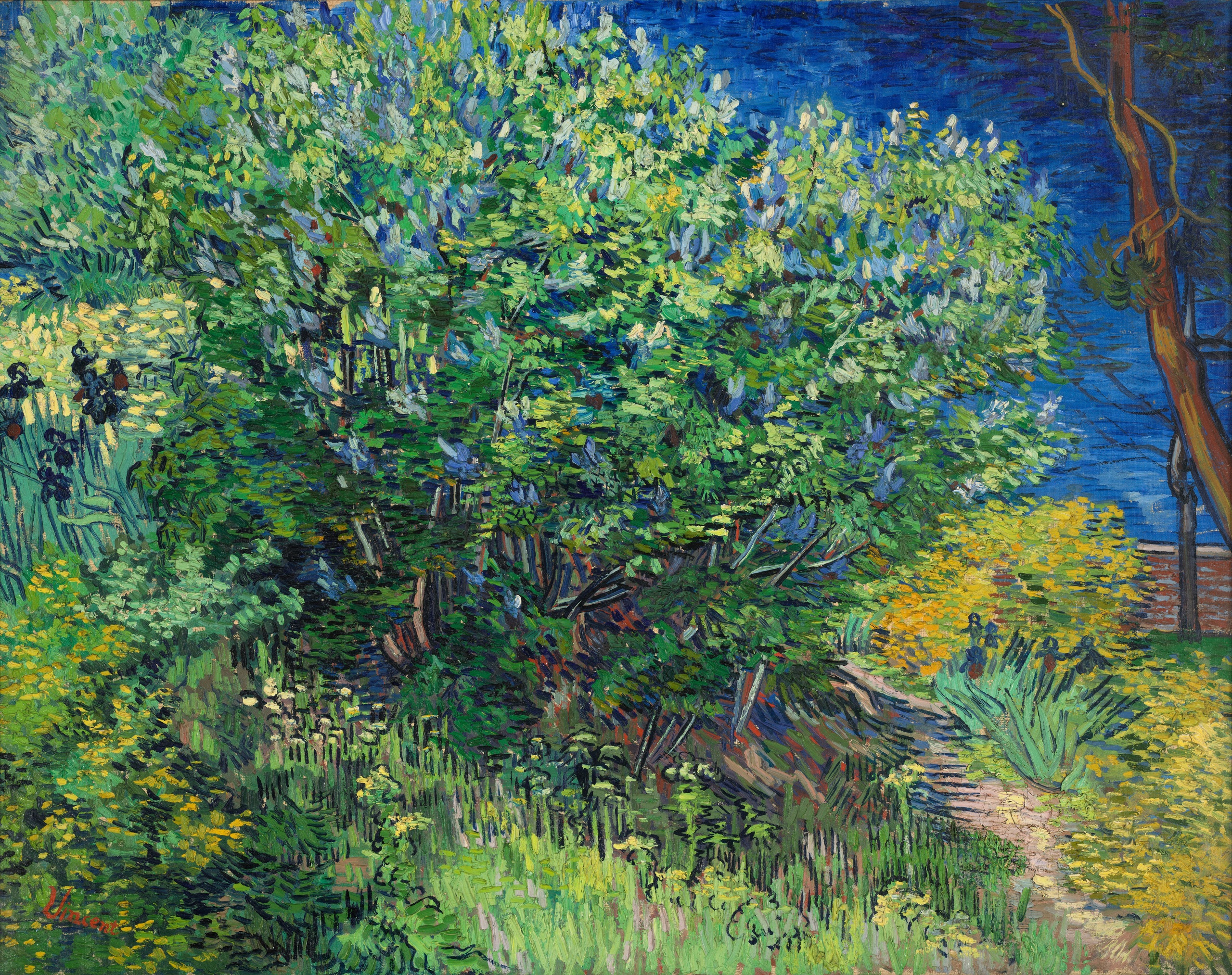
Lilac Bush is the painting Vincent van Gogh made in May 1889 in the garden of the Saint-Paul asylum at Saint-Rémy-de-Provence: a large lilac bush with pale violet blossom fills the middle of the canvas, dense greens crowd around it, dark violet irises stand at the left edge, a slender tree trunk rises on the right and a strip of deep blue sky shows at the top right. The original, oil on canvas, measures 73 x 92 cm and is in the State Hermitage Museum in Saint Petersburg. We paint it by hand in oil on canvas, in 17 sizes from 50 x 40 to 190 x 151 cm or to your own measurements, and send you a photograph of the finished painting for approval before dispatch.
| Title: | Lilac Bush |
| Other titles: | Lilacs · Lillà |
| Painter: | Vincent van Gogh (1853–1890) |
| Year painted: | May 1889, Saint-Rémy-de-Provence |
| Original size: | 73 cm x 92 cm |
| Original technique: | Oil on canvas |
| Painting style: | Post-Impressionism |
| Located at: | State Hermitage Museum, Saint Petersburg (accession no. ГЭ-6511) |
| Our reproduction: | Hand-painted oil on canvas, 17 sizes or made to measure |
Lilac Bush – Vincent van Gogh
What does Lilac Bush show?
A single lilac bush takes up most of the canvas. It grows as a broad, rounded mass from the left edge to beyond the middle, built of small strokes of dark green in the shadows and yellow-green where the light falls. Over its upper half sit the blossoms, pale violet and lilac-blue clusters dabbed on in short touches. Under the leaves, low in the centre, you can make out the bush’s dark, twisted stems, painted in brown and red.
Around the bush the garden is overgrown. At the left edge, dark violet irises rise on tall pointed leaves. On the right a slender reddish-brown trunk climbs out of the frame, and behind it a strip of deep blue sky fills the top right corner. Below the trunk a shrub glows golden yellow, and a pale path curves down towards the bottom right. The foreground is long grass in yellow-green and green, laid in upright strokes and dotted with small white and yellow flowers.
Why did Van Gogh paint a lilac bush in the asylum garden?
Because the garden was the subject closest to hand: in May 1889 Van Gogh entered the asylum of Saint-Paul-de-Mausole near Saint-Rémy as a patient, and according to the English Wikipedia article on this painting he began painting almost as soon as he had arrived. Among his first subjects were the irises and the lilac bush in the hospital garden.
He mentions both in a letter to his brother Theo and Theo’s wife Jo, dated 9 May 1889: ‘I have two others on the go – violet irises and a lilac bush. Two subjects taken from the garden.’ The editors of his letters identify the lilac bush as this painting and the irises as the canvas known as Irises. In the same letter he notes that the other patients all come to watch when he works in the garden.
How does the Hermitage read Lilac Bush?
The State Hermitage Museum, which owns the original, sees in it a debt to Impressionism and a step beyond it. In the museum’s words, the broken, separate brushstrokes and vibrant forms recall the lessons of Impressionism, yet with a spatial dynamism unknown to the Impressionists. The museum describes the bush as full of powerful, vivid energy and dramatic expression, and finds in this fragment of an overgrown garden all of nature’s life-giving forces.
The painting itself is a close view rather than a wide landscape: no horizon and no building, only the bush, the flowers around it and a corner of sky. Short strokes run in different directions across the leaves, while the grass below stands upright.
Where is the original today, and how did it get there?
The original is in the State Hermitage Museum in Saint Petersburg, under the museum number ГЭ-6511. It is oil on canvas, 73 cm high and 92 cm wide.
According to the Hermitage, the painting was originally in the Sergei Shchukin collection. It later belonged to the State Museum of New Western Art in Moscow, which handed it over to the Hermitage in 1930.
Lilac Bush or another Van Gogh from Saint-Rémy – which should you choose?
All four paintings linked here come from Van Gogh’s year at Saint-Rémy. Irises is the other garden subject from his letter of 9 May 1889, the irises in the same asylum garden, seen close up. Hospital at Saint-Rémy, from 1889, shows the asylum itself, with tall pine trees in front of its long yellow building. A Path at Saint-Rémy, also from 1889, shows a country road with a woman walking along it, and Olive Trees with the Alpilles in the Background is an olive grove with the mountains near Saint-Rémy behind it.
Choose this lilac bush for soft green and violet, Irises for flowers in close-up, Hospital at Saint-Rémy for the place where he lived, and the path or the olive grove for open country.
How is our hand-painted Lilac Bush made?
The painter first sketches the outline of the bush, the line of the path, the trunk on the right and the edge of the sky, and checks the proportions against the original. Then come the dark greens in the shadows of the bush, the lighter greens over them, and after that the deep blue sky and the yellow shrub. The pale violet blossoms, the irises at the left, the white and yellow flowers in the grass and the stems under the bush are added last. Our oil painting reproduction is painted by hand on canvas, with real impasto: the paint goes on thickly, so the brushstrokes stand up from the canvas as they do in the original and catch the light.
On our version the relief shows most in the small dabs of the blossoms, in the crowded strokes of the leaves and in the long upright strokes of the grass. A print is completely flat; on our painting every brushstroke stands out in real paint.
Every painting is a hand-painted copy made for your order, so no two are quite the same.
Which size for which wall?
Short answer: 50 x 40 or 60 x 50 cm for a narrow wall in a hallway or beside a door, 92 x 73 or 100 x 80 cm above a chest of drawers or a bed, and 150 x 120 or 160 x 127 cm above a sofa or on a large wall.
There are 17 sizes: 50 x 40, 60 x 50, 70 x 55, 80 x 60, 85 x 67, 92 x 73, 100 x 80, 105 x 85, 110 x 90, 120 x 100, 130 x 102, 140 x 105, 150 x 120, 160 x 127, 170 x 134, 180 x 142 and 190 x 151 cm (width x height). The original is 92 cm wide and 73 cm high, so our 92 x 73 cm size is the size of the original, and 100 x 80, 150 x 120 and 190 x 151 cm stay close to its proportions. The greens and the pale violet blossom look best on a white, cream or light grey wall and sit well with natural wood. A painting for the living room should cover about two thirds of the width of the furniture below it.
Hang it with the centre of the canvas about 150 cm above the floor. Above a sofa, a bed or a sideboard, leave 20 to 30 cm between the top of the furniture and the bottom of the canvas.
What if I need a custom size or a frame?
If none of the 17 sizes fits your wall, we paint it to measure in any width and height you need. Send us the width and height you want and we will quote you a price and a delivery time. Every painting we make is mounted on a wooden stretcher, ready to hang.
Our 3D app shows each of our frame profiles on this painting, so you can compare gold, silver, black, white and natural wood. The app is for choosing the frame only. To see the painting on your own wall, use our separate room placement service. A gold frame picks up the yellow shrub and the light on the leaves, while a white or natural wood one keeps the greens and the violet fresh.
How does delivery work, and what is the guarantee?
Every painting is made to order in our studio in Slovenia, so allow 15 to 45 days depending on the size you choose. We ship it on its stretcher, carefully packed (and framed, if you chose a frame), across the EU with no customs duty. Before dispatch we send you a photograph of the finished painting to approve. Our returns policy applies to every order.
You will find more of Van Gogh’s famous works among all our Vincent van Gogh paintings, and more about the painter in our article on Vincent van Gogh. If it is a present and you are not sure of the size, a wall art voucher lets the recipient choose.
Frequently asked questions
Where is the original Lilac Bush today?
In the State Hermitage Museum in Saint Petersburg, under the museum number ГЭ-6511. According to the Hermitage, it entered the museum in 1930, handed over from the State Museum of New Western Art in Moscow, and was originally in the collection of Sergei Shchukin. The original is oil on canvas and measures 73 x 92 cm.
When and where did Van Gogh paint Lilac Bush?
In May 1889, in the garden of the Saint-Paul-de-Mausole asylum near Saint-Rémy-de-Provence, which he had recently entered as a patient. Wikipedia notes that he began painting almost as soon as he arrived and that the irises and the lilac bush in the garden were among his first subjects there. He mentions the lilac bush in a letter of 9 May 1889.
What did Van Gogh write about Lilac Bush?
Only a line, written in his first days there. In a letter of 9 May 1889 to his brother Theo and Theo’s wife Jo he wrote: ‘I have two others on the go – violet irises and a lilac bush. Two subjects taken from the garden.’ The editors of the letters identify the lilac bush he mentions as this painting, now in the Hermitage.
Was Lilac Bush painted at the same time as Irises?
Yes. Both were on his easel in the first days of May 1889, and his letter of 9 May names them together as two subjects taken from the asylum garden. The editors of his letters identify them as Irises (F 608, JH 1691) and Lilacs, our lilac bush (F 579, JH 1692). Wikipedia also counts the irises and the lilac bush in the hospital garden among his first subjects at Saint-Rémy.
Who owned Lilac Bush before the Hermitage?
According to the Hermitage, the painting was originally in the Sergei Shchukin collection. It then belonged to the State Museum of New Western Art in Moscow, which handed it over to the Hermitage in Saint Petersburg in 1930. It has stayed in the Hermitage collection since then.
How big is the original Lilac Bush?
73 cm high and 92 cm wide, a landscape format of medium size. Our 92 x 73 cm size is the size of the original. There are 17 sizes from 50 x 40 to 190 x 151 cm, and we also paint it to measure in any width and height; proportions close to the original keep the bush and the sky in balance.
Which size of Lilac Bush suits a living room?
Above a sofa, choose 150 x 120 or 160 x 127 cm, so that the canvas painting covers a good part of the width of the sofa and the blossom and the irises read clearly from across the room. On a narrower wall or above a sideboard, 92 x 73 or 100 x 80 cm works well. For a very large wall, choose our largest size, 190 x 151 cm.
Does your Lilac Bush have the raised brushstrokes of the original?
Yes. We paint it in impasto, building up each brushstroke in thick oil, so the surface is raised like Van Gogh’s original. You see this best in the small dabs of pale violet blossom, in the dense strokes of the leaves and in the long strokes of the grass, where the relief catches the light from the side.
- Subject: a lilac bush in flower in the asylum garden at Saint-Rémy, with irises at the left, a tree trunk and a strip of blue sky on the right, and a path and long grass in the foreground.
- Original: May 1889, Saint-Rémy, oil on canvas, 73 x 92 cm, State Hermitage Museum, Saint Petersburg.
- Ours: a Van Gogh reproduction painted by hand in oil on canvas, in 17 sizes from 50 x 40 to 190 x 151 cm or made to measure.
- Worth knowing: each painting is made to order, so allow 15 to 45 days, and our 3D app lets you try every frame on this painting before you order.