







































Description

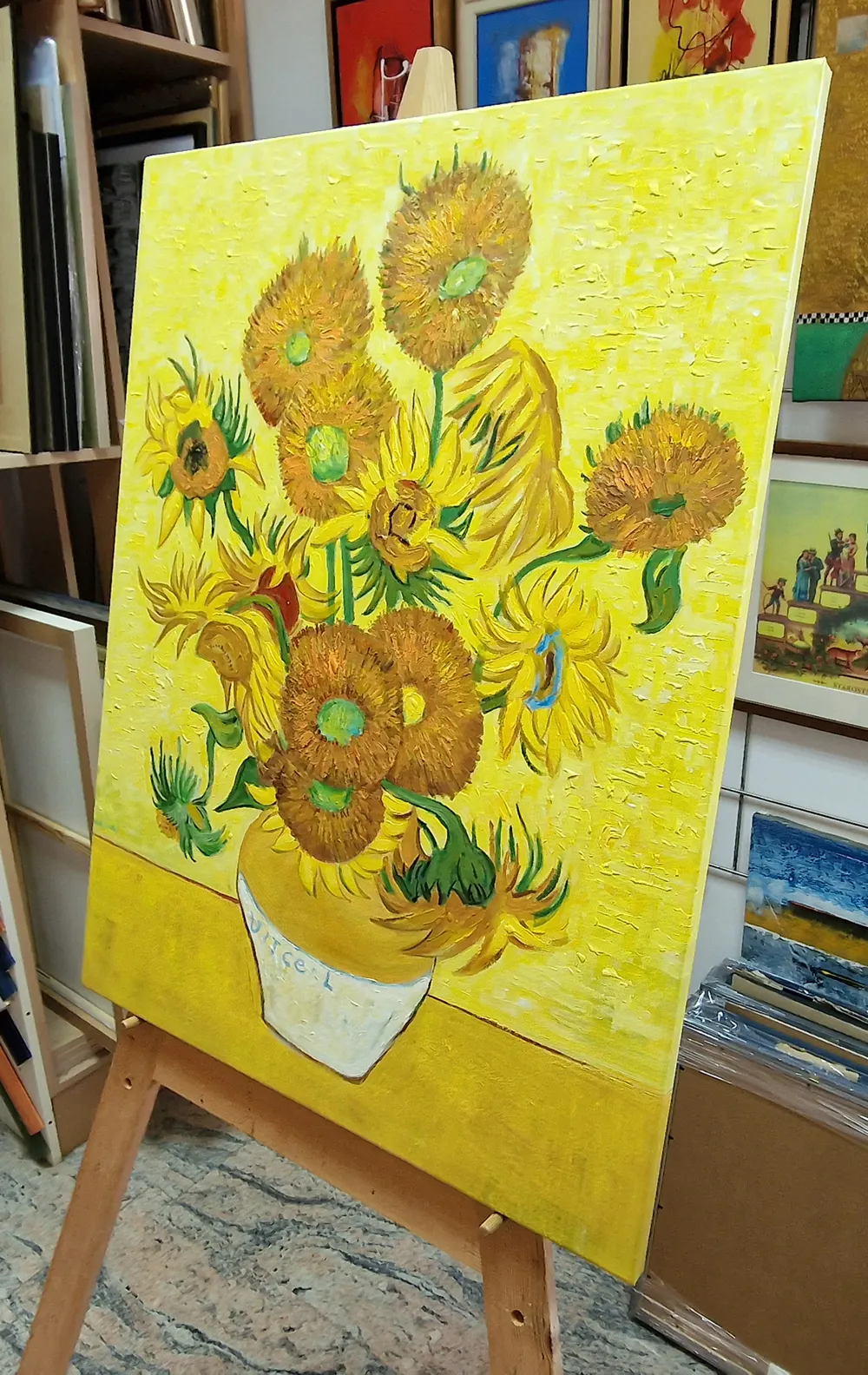
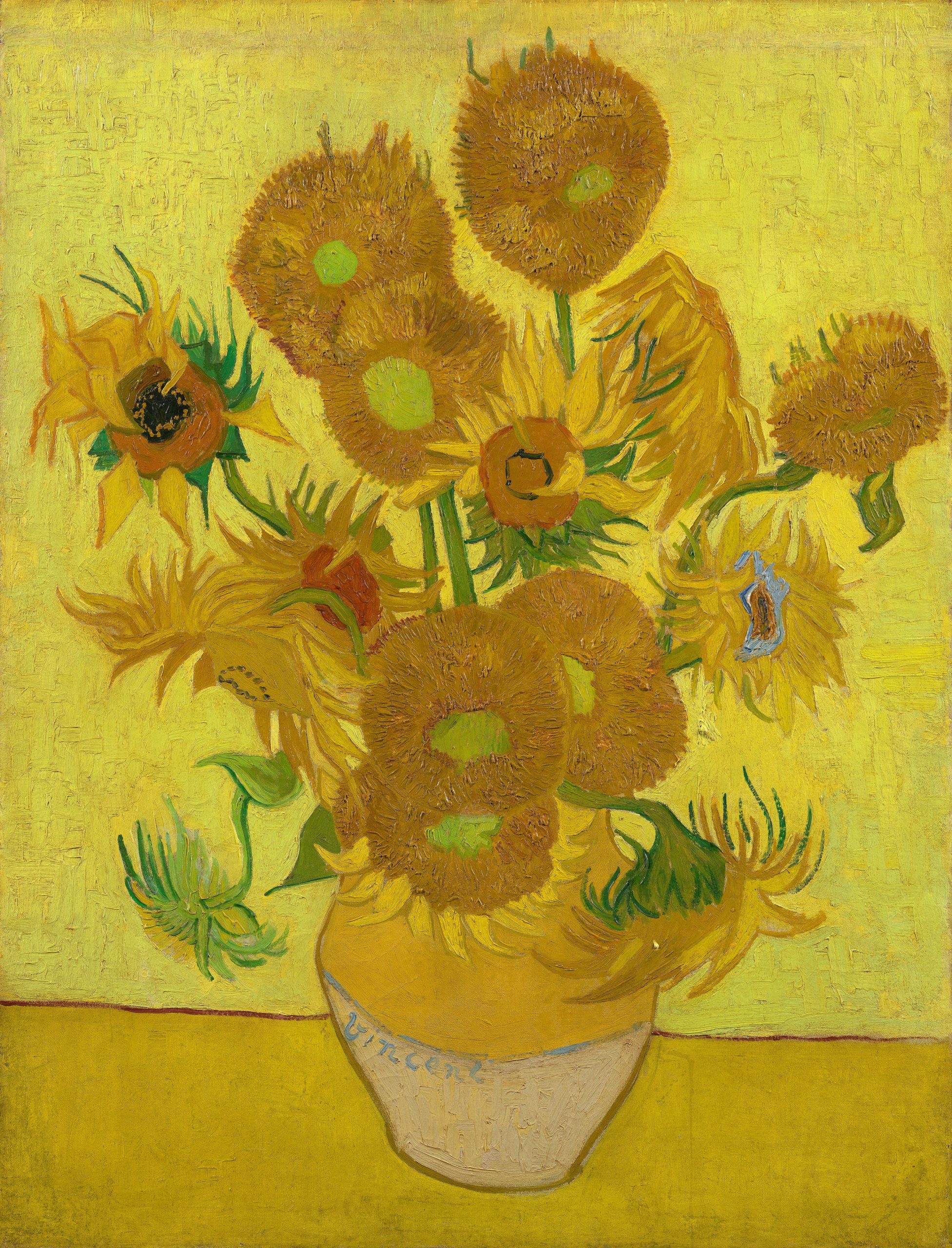
Sunflowers I is the painting Vincent van Gogh made in August 1888 in Arles, in the south of France: fifteen sunflowers in a vase, from full bloom to wilting, against a pale yellow background, almost all of it in shades of yellow. The original measures 92.1 x 73 cm and has hung in the National Gallery in London since 1924. We paint it by hand in oil on canvas, in 16 sizes from 40 x 50 to 160 x 200 cm or to your own measurement, and send you a photograph of the finished work for approval before dispatch.
| Title: | Sunflowers I |
| Other titles: | Sunflowers · Zonnebloemen · Les Tournesols |
| Painter: | Vincent van Gogh (1853–1890) |
| Year painted: | August 1888, Arles |
| Original size: | 92.1 cm x 73 cm |
| Original technique: | Oil on canvas |
| Painting style: | Post-Impressionism |
| Located at: | National Gallery, London (inv. NG3863) |
| Our reproduction: | Hand-painted oil on canvas, 16 sizes or made to measure |
Sunflowers I – Vincent van Gogh
What does Sunflowers I show?
A plain earthenware vase stands on a narrow yellow ledge, holding a bunch of fifteen sunflowers. Some are at their peak, with thick rings of petals; others are losing their petals, and a few have already wilted down to heavy seed heads. In one bunch Van Gogh gathered every stage of a flower’s life, from bloom to decay. On the vase his first name, Vincent, is written in blue.
The canvas is almost entirely yellow: from rich orange ochre in the flowers to a pale, greenish yellow background that turns into the warmer tone of the ledge. Against all that yellow there are only a few blue and green touches, such as the signature, the stems and the leaves. That is why the painting glows even in a dim room: it is carried by a single colour in countless shades.
Why did Van Gogh paint sunflowers in Arles?
In the summer of 1888 Van Gogh rented the Yellow House in Arles and waited there for his friend Paul Gauguin, with whom he hoped to share a studio. In August he wrote to his brother Theo that he was painting with the gusto of a Marseillais eating bouillabaisse, and that he wanted to decorate the studio with nothing but large sunflowers. He worked fast, because sunflowers in a vase wilt quickly.
That August he painted four versions of the vase of sunflowers, and the one we call Sunflowers I is the fourth. When Gauguin arrived in Arles in October, he is said to have called them the flower itself. From then on Van Gogh regarded sunflowers as his own subject, the way other painters were known for their own flowers.
What do the sunflowers mean?
Van Gogh wrote that these paintings change their aspect and grow in richness the longer you look at them. Because flowers in full bloom and flowers already wilting share one vase, many read the painting as a reminder of transience, the cycle of life from flower to seed. The Van Gogh Museum in Amsterdam adds that the sunflowers were perhaps also meant as a sign of friendship, since he painted them for Gauguin’s room.
In January 1889 he painted three more repetitions. He also thought of hanging two sunflower canvases to the left and right of his portrait of a woman rocking a cradle, La Berceuse, as a kind of triptych.
Where does the original hang, and how did it reach London?
The original hangs in the National Gallery in London, which holds it under inventory number NG3863. The gallery bought it in 1924 with the Courtauld Fund.
Van Gogh painted the vase of sunflowers seven times in 1888 and 1889. Five of these paintings are in public museums today, in Amsterdam, Munich, London, Tokyo and Philadelphia; one is in a private collection, and one was destroyed on 6 August 1945 in an air raid on the Japanese city of Ashiya. The version now in Tokyo was sold in 1987 for about 39.9 million dollars, a record at the time.
Sunflowers I or Sunflowers II – which one is which?
We paint two of Van Gogh’s vases of sunflowers. This page is Sunflowers I, the fourth version of August 1888: fifteen flowers on a yellow ground, with the original in London. The other is Sunflowers II, the third version from the same month: twelve flowers on a blue-green ground; its original measures 92 x 73 cm and hangs in the Neue Pinakothek in Munich.
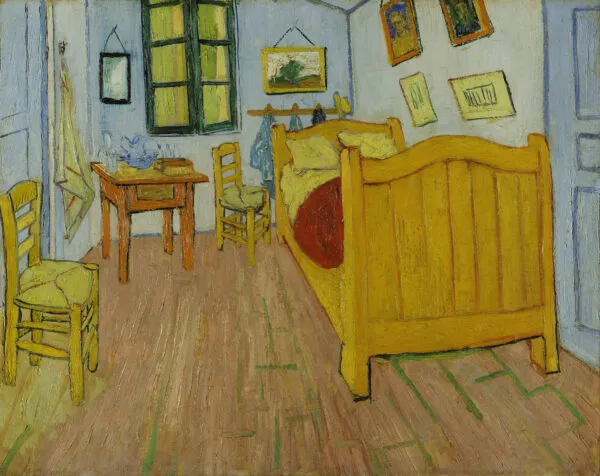
For a warm canvas that is all yellow and fills a room with light, choose Sunflowers I. If you prefer a strong contrast of yellow flowers on a cool turquoise ground, Sunflowers II is the right choice. From the same year in Arles we also paint Bedroom in Arles, his room in the same Yellow House, and the night scene Starry Night over the Rhône, and from the following year another flower painting, Irises.
In the same Yellow House in Arles, at the end of 1888, Van Gogh also painted his own chair, Van Gogh’s Chair, and we paint it by hand as well.
How is our hand-painted Sunflowers I made?
The painter first draws the vase, the ledge and the position of all fifteen flowers. Then come the pale yellow background and the warmer ledge, and after that the flowers are built up: petals in short strokes, seed heads in dense dabs and swirls of paint. Our oil painting reproduction is painted by hand in oil on canvas with real impasto: the paint goes on thickly, so the brushstrokes stand up from the canvas, as on Van Gogh’s original.
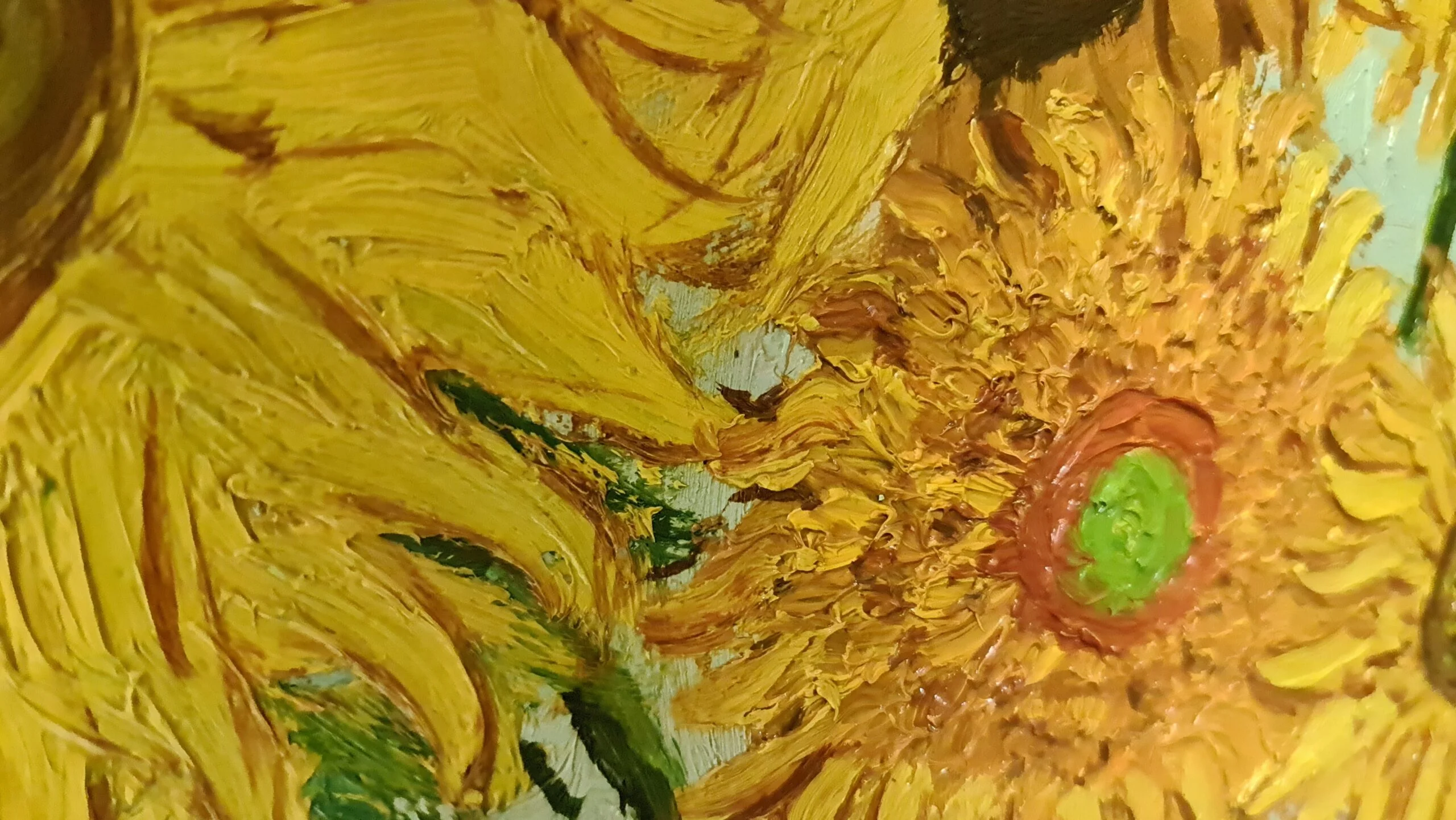
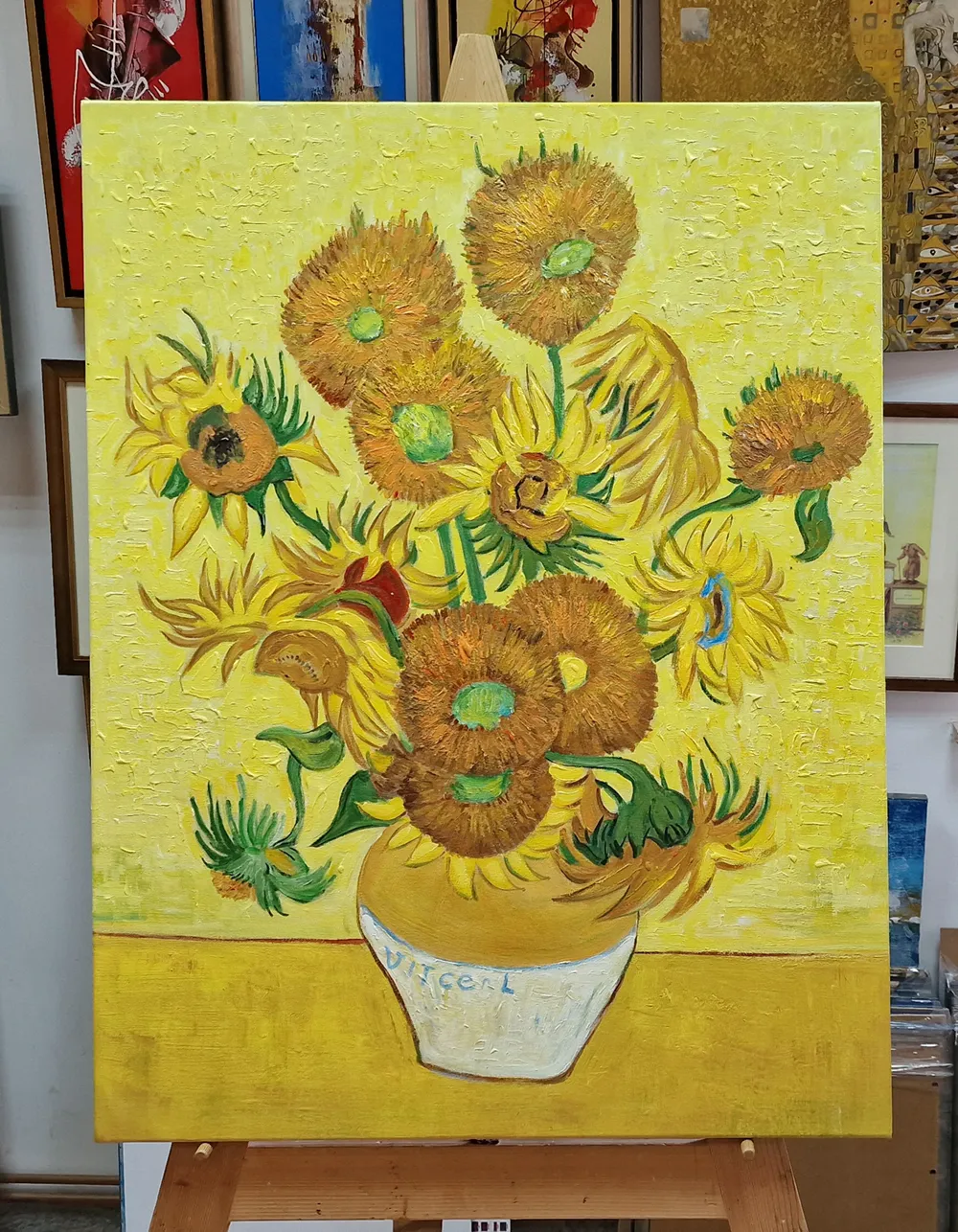
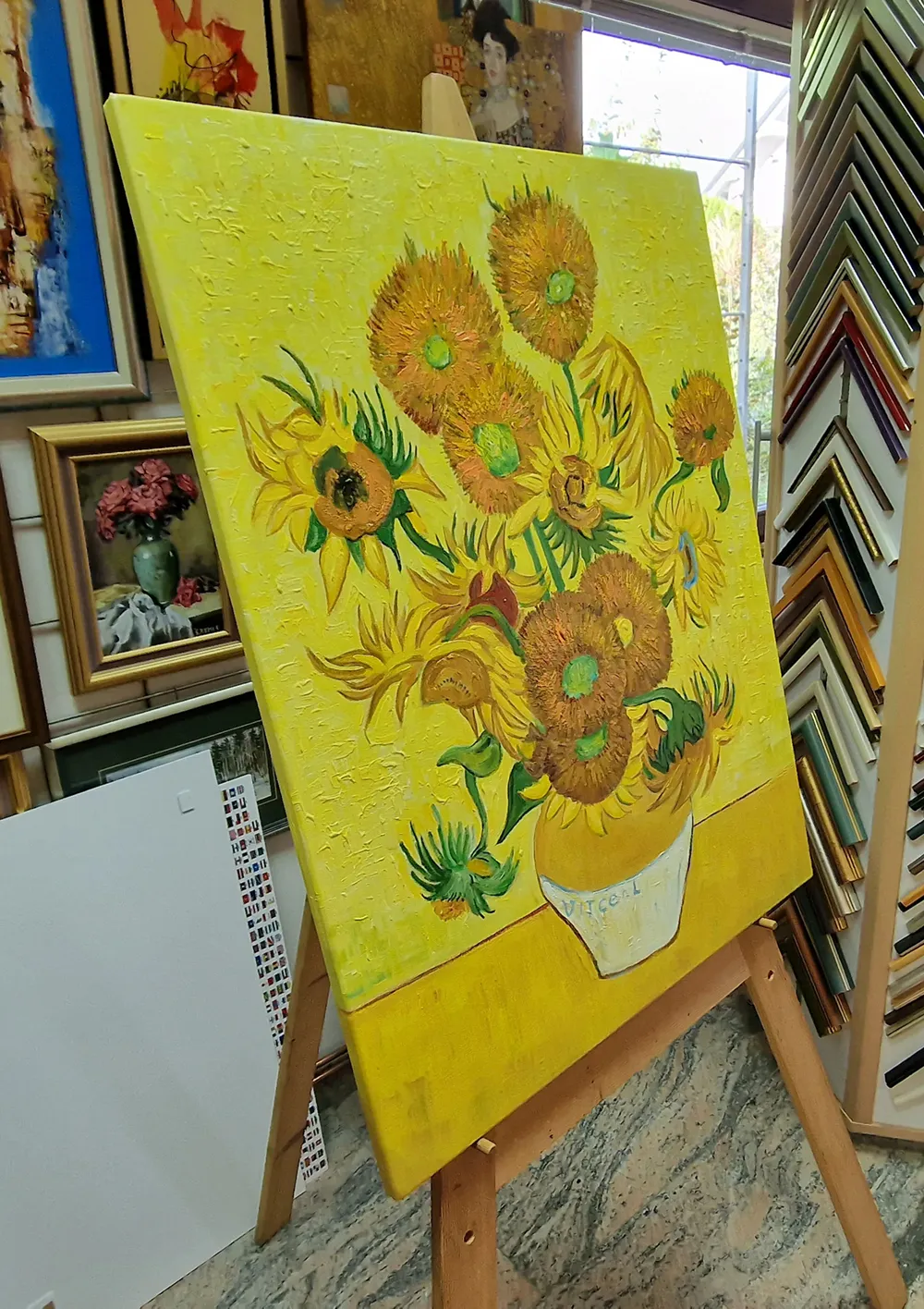
The first photograph shows the painting in a room setting, above a light sideboard, to help you choose a size. The second photograph is a close-up of the petals, where the thick, raised layer of paint is easy to see. The third photograph shows the finished canvas, unframed, on an easel in our workshop, from the front. The fourth photograph shows the same canvas from the side, so you can see how the paint stands out from the surface, with frame mouldings behind it. The fifth photograph shows it from another angle on the easel.
Every painting is a hand-painted copy made for your order, so no two are quite the same. A print shows only a flat surface; the layers of paint you see in the second and fourth photographs are real on our painting.
Which size for which wall?
Short answer: 60 x 80 cm above a chest of drawers or in a hallway, 80 x 100 or 100 x 130 cm above a sofa or a bed, and 120 x 160 cm or larger for a big empty wall or a staircase.
There are 16 sizes, from the smallest at 40 x 50 cm to the largest at 160 x 200 cm. The 73 x 95 cm size is the closest to the original, which is 73 cm wide and 92.1 cm high, so on your wall it looks almost as it does in the gallery. The smaller sizes, 40 x 50 or 50 x 65 cm, suit a kitchen, a study or a hallway, the middle sizes go above furniture, and the largest need a big room with a high ceiling. A painting for the living room should cover about two thirds of the width of the furniture below it: above a 150 cm sofa that means 100 x 130 cm.
Hang it with the centre of the canvas about 150 cm above the floor, and 20 to 30 cm above a sofa or a headboard.
What if I need a custom size or a frame?
If none of the 16 sizes fits your wall, we paint it to measure. We recommend keeping the proportions close to the original, otherwise the vase gets squeezed or stretched. Send us the width and height you want and we will quote a price and a lead time. Every painting we make is stretched over a wooden stretcher and ready to hang, even without a frame, as you can see in the third photograph.
For the moulding, use our 3D application: it shows each of our frame profiles on this subject, so you can compare gold, silver, black, white and natural wood before you decide – the application is for choosing the frame only. If you would like to see how the painting will look on your own wall, that is our separate room placement service. A warm gold frame or natural wood suits the yellow sunflowers well.
How does delivery work, and what is the guarantee?
Every painting is made to order in our studio in Slovenia, so allow 15 to 45 days depending on the size you choose. We ship it stretched and protected, framed if you chose a frame, across the EU with no customs. Before dispatch you receive a photograph of the finished work to approve; if anything is not right, we correct it while the canvas is still in our workshop. Our returns policy applies to every order.
More famous Van Gogh paintings are in the Vincent van Gogh gallery, and there is more about the painter in our article on Vincent van Gogh. Sunflowers also make a good gift for a new home; if you are not sure which size is right, a wall art voucher lets the recipient choose size and subject.
Frequently asked questions
Where does the original Sunflowers I hang?
The original hangs in the National Gallery in London, which holds it under inventory number NG3863. The gallery bought it in 1924 with the Courtauld Fund. Other versions of the vase of sunflowers are in Amsterdam, Munich, Tokyo and Philadelphia, so it helps to know which one you mean: Sunflowers I is the London one, with fifteen flowers on yellow.
When and where did Van Gogh paint Sunflowers I?
In August 1888 in Arles, where he had rented the Yellow House. He painted the sunflowers as a decoration for the studio he hoped to share with Paul Gauguin, and he worked quickly, before the flowers wilted. Sunflowers I is the fourth version he painted that month.
How many sunflower paintings did Van Gogh make, and which one is Sunflowers I?
He painted the vase of sunflowers seven times: four times in August 1888 and three more times in January 1889. Five are in museums today, one is in a private collection, and one burned in Japan in 1945. Sunflowers I is the fourth version of August 1888, the one with fifteen flowers in the National Gallery. There is more on the whole series on Wikipedia.
How many flowers are there in Sunflowers I?
There are fifteen sunflowers, each at a different stage of life. Some are in full bloom, others are dropping their petals, and a few have already wilted down to seed heads. In our hand-painted version the painter keeps all fifteen flowers in the same places as on the original.
What do the flowers in Sunflowers I mean?
Van Gogh himself wrote that these paintings grow richer the longer you look at them. Flowers from bloom to decay are often read as a reminder of transience, and the Van Gogh Museum adds that the sunflowers were perhaps also a sign of friendship, since he painted them for Gauguin. He regarded sunflowers as his own personal subject.
What is the difference between Sunflowers I and Sunflowers II?
Sunflowers I has fifteen flowers on a pale yellow ground and hangs in London; Sunflowers II has twelve flowers on a blue-green ground and hangs in Munich. Both were painted in August 1888 in Arles and are almost the same size. The first is warmer and uniformly yellow, the second more contrasting because of its cool background.
Why does the vase in Sunflowers I say Vincent?
That is the painter’s signature. Van Gogh often signed his paintings with his first name alone, and here he wrote it in blue right on the vase, where it becomes part of the composition. On our hand-painted version the signature is on the vase too, in blue and in the same place.
Is the original Sunflowers I for sale, and what is it worth?
No, the original is not for sale. It has belonged to the National Gallery in London since 1924, so it has no market price. For comparison, the version now in Tokyo was sold in 1987 for about 39.9 million dollars, a record at the time. What we can state is the price of our hand-painted version, shown with the size you choose.
Is your Sunflowers I a print?
No. Each one is painted by hand in oil on canvas, with the paint laid on thickly, as Van Gogh did. In the second and fourth photographs you can see the strokes up close. So what you receive is a real canvas painting, which we photograph before dispatch and send you the photograph to approve.
Does your Sunflowers I have the raised brushstrokes of the original?
Yes. We paint Sunflowers I in impasto, so the brushstrokes stand up from the canvas as on Van Gogh’s original, most of all in the petals and the seed heads. You see them best in the second photograph, which shows the flowers up close. A print cannot have this relief, because its surface is completely flat.
- Subject: fifteen sunflowers in a vase on a pale yellow ground, from bloom to wilting.
- Original: August 1888, Arles, 92.1 x 73 cm, National Gallery, London.
- Ours: a Van Gogh reproduction painted by hand in oil on canvas, in 16 sizes from 40 x 50 to 160 x 200 cm or made to measure.
- Worth knowing: you receive a photograph of the finished work for approval before dispatch.