Description
A Path at Saint-Rémy is the painting Vincent van Gogh made in 1889 at Saint-Rémy-de-Provence: a country road in rippling bands of blue and white runs into the landscape, a woman in a long pale yellow skirt walks along it towards a house with a red roof, olive trees bend over it on the left and yellow foliage fills the right. The original measures 32.5 x 40.5 cm and is in the Kasama Nichidō Museum of Art in Kasama, Japan. We paint it by hand in oil on canvas, in 17 sizes from 41 x 33 to 190 x 151 cm or to your own measurements, and send you a photograph of the finished painting for approval before dispatch.
| Title: | A Path at Saint-Rémy |
| Other titles: | A Road at Saint-Remy with Female Figure |
| Painter: | Vincent van Gogh (1853–1890) |
| Year painted: | 1889, Saint-Rémy-de-Provence |
| Original size: | 32.5 cm x 40.5 cm |
| Original technique: | Oil on canvas |
| Painting style: | Post-Impressionism |
| Located at: | Kasama Nichidō Museum of Art, Kasama, Japan |
| Our reproduction: | Hand-painted oil on canvas, 17 sizes or made to measure |
A Path at Saint-Rémy – Vincent van Gogh
What does A Path at Saint-Rémy show?
The painting shows a country road that starts at the bottom edge and runs into the landscape, with a woman walking along it. The road is not a smooth surface: it is laid in wide, curving bands of dark blue, white and grey-green, so that it seems to ripple towards you. The woman is a little left of centre, a small figure in a dark top and a long pale yellow skirt. At the far end of the road, a white house with a red roof shows between the trees.
On the left, olive trees with twisted grey trunks and grey-green crowns lean towards the road, and the bank below them is built from yellow and orange-brown strokes. The right half is filled by a dense mass of foliage in yellow, ochre and olive green, painted in short curving strokes that all seem to run the same way. Behind the house, darker trees and a patch of red-orange leaves close the view, and at the top a strip of turquoise-blue sky is crossed by dark and white diagonal strokes.
Why does the whole landscape seem to move?
Because every part of it is painted in the same thick, directional strokes. In Wikipedia’s description, the road, the vegetation and the sky are all rendered in the thick, characteristic brushstrokes of Van Gogh’s later works. There is no flat area of colour anywhere: the road is made of curving bands, the trees of short hooked marks, the sky of slanting dashes.
Wikipedia also reads the season and the weather in it: the yellow of the vegetation on both sides of the road shows that autumn has set in, and autumn seems to have brought its winds. Seen that way, the bending olive trees on the left and the swirling leaves on the right are a landscape in the wind, and the small figure walks on through it.
What does the painting mean?
In the reading of the Wikipedia article on A Road at Saint-Remy with Female Figure, there is a contrast between the windy yellow and green vegetation, which dominates the female figure, and the open blue sky above. The woman is small next to the trees around her, and she walks away from us towards the house at the end of the road, which gives the whole scene its direction.
The painting belongs to the year Van Gogh spent at Saint-Rémy-de-Provence in the south of France. From May 1889 until May 1890 he was a self-admitted patient at the Saint-Paul asylum there, and for much of that time he was confined to its grounds. When he could leave them, he painted olive trees and the landscape around the town, and this road with its olive trees on the left is part of that landscape.
Where is the original today?
The original is in the Kasama Nichidō Museum of Art in Kasama, a town in Ibaraki Prefecture in Japan. According to Wikipedia it is an oil on canvas from 1889, 32.5 cm high and 40.5 cm wide, numbered F728 in the catalogue of Jacob Baart de la Faille and JH1875 in the catalogue of Jan Hulsker.
The museum names the painting, under a Japanese title that means the road at Saint-Rémy, as one of the works that represent its collection, together with a painting by Edgar Degas and one by Tsuguharu Foujita. In English it is usually called A Road at Saint-Remy with Female Figure; our shop title, A Path at Saint-Rémy, refers to the same canvas.
A Path at Saint-Rémy or another painting from Saint-Rémy – which to choose?
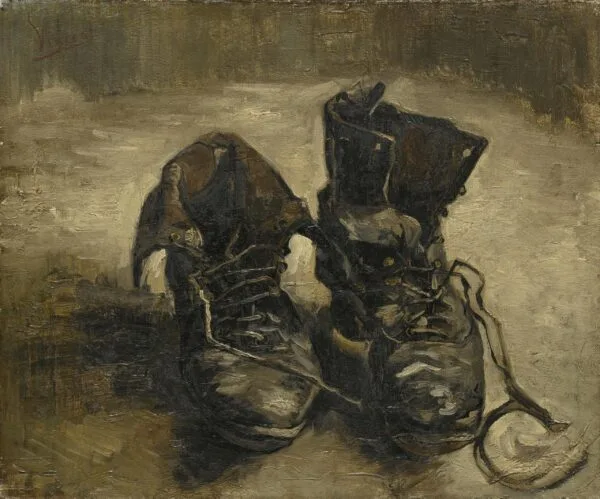
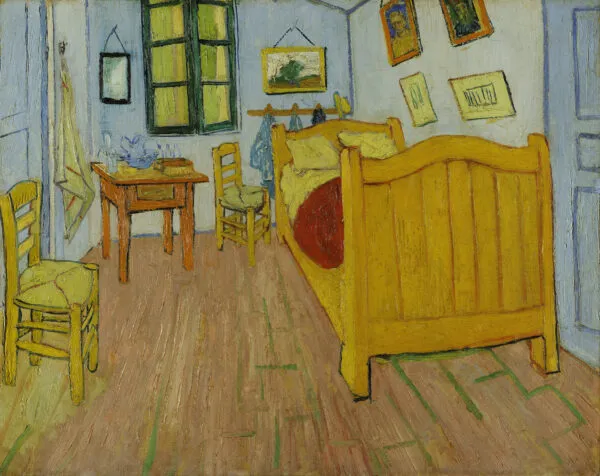
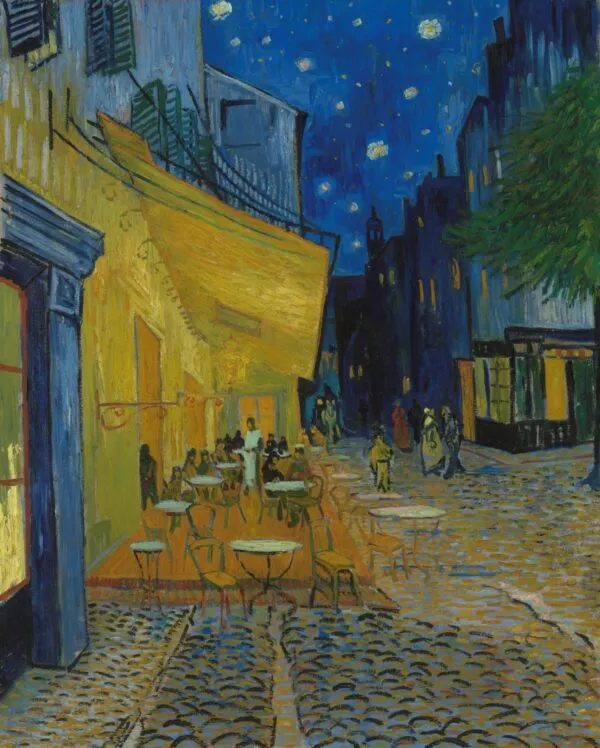
The four paintings linked here were all painted in 1889 in Saint-Rémy. Hospital at Saint-Rémy shows the garden of the Saint-Paul asylum, with tall pines in front of the yellow building, and Irises shows irises in that same garden, seen close up. Cypresses and Olive Trees with the Alpilles in the Background come from the landscape around the town, like this road.
Choose A Path at Saint-Rémy if you want a road that leads you into the painting, with a woman on her way to a house at the end of it, and a landscape of yellow leaves and olive trees in wind. The original is a small canvas, so it also works well in a smaller size, next to a larger Saint-Rémy landscape or on its own on a narrow wall.
How is our hand-painted Path at Saint-Rémy made?
The painter first sets out the edges of the road, the line of the olive trunks, the house and the figure. Then come the bands of the road, the yellow mass of foliage and the strip of sky, and last the hooked strokes of the leaves, the red roof and the woman in her pale skirt. Our oil painting reproduction is painted by hand on canvas, with real impasto: the paint goes on thickly, so the brushstrokes stand up from the canvas as they do in the original and catch the light.
On this painting the relief matters most in the curving bands of the road, in the yellow foliage on the right and in the twisted olive trunks. A print is completely flat; on our painting every brushstroke stands out in real paint.
Every painting is a hand-painted copy made for your order, so no two are quite the same.
Which size for which wall?
Short answer: 41 x 33 cm for a small wall, a shelf or above a desk, 70 x 60 or 80 x 65 cm above a sideboard or a bed, 120 x 100 or 135 x 109 cm above a sofa, and 190 x 151 cm for a large wall. The landscape format suits a long wall above furniture, a hallway or a study.
There are 17 sizes: 41 x 33, 50 x 40, 55 x 45, 60 x 50, 70 x 60, 80 x 65, 90 x 71, 100 x 80, 105 x 85, 110 x 90, 120 x 100, 135 x 109, 150 x 120, 160 x 127, 170 x 134, 180 x 142 and 190 x 151 cm (width x height). The original is 40.5 cm wide and 32.5 cm high, so our 41 x 33 cm size is almost exactly its size; every larger size enlarges a small canvas, and the strokes grow with it. With its yellows, olive greens and the blue of the road and sky, it sits well on a white, light grey or warm cream wall. A painting for the living room should take up about two thirds of the width of the furniture below it.
Hang it with the centre of the canvas about 150 cm above the floor, leaving 20 to 30 cm between the top of the furniture and the bottom of the canvas.
What if I need a custom size or a frame?
If none of the 17 sizes fits your wall, we paint it to measure. Keep the proportions close to the original, otherwise the road gets squeezed or the house pushed to the side. Send us the width and height you want and we will quote you a price and a delivery time. Every painting we make is mounted on a wooden stretcher, ready to hang.
Our 3D app shows each of our frame profiles on this painting, so you can compare gold, silver, black, white and natural wood. The app is for choosing the frame only. To see the painting on your own wall, use our separate room placement service. A gold frame picks up the yellow foliage, and a dark wood frame deepens the blue bands of the road.
How does delivery work, and what is the guarantee?
Every painting is made to order in our studio in Slovenia, so allow 15 to 45 days depending on the size you choose. We ship it on its stretcher, carefully packed (and framed, if you chose a frame), across the EU with no customs duty. Before dispatch we send you a photograph of the finished painting to approve, and we correct anything that is not right. Our returns policy applies to every order.
You will find more of Van Gogh’s famous works among all our Vincent van Gogh paintings, and there is more about the painter in our article on Vincent van Gogh. If you are giving it as a present and are not sure of the size, a wall art voucher lets the recipient choose.
Frequently asked questions
Where is the original of A Path at Saint-Rémy today?
In the Kasama Nichidō Museum of Art in Kasama, in Ibaraki Prefecture, Japan. According to Wikipedia it is an oil on canvas from 1889 measuring 32.5 x 40.5 cm. The museum names it, under a Japanese title that means the road at Saint-Rémy, as one of the works that represent its collection, together with a painting by Edgar Degas and one by Tsuguharu Foujita.
When and where did Van Gogh paint A Path at Saint-Rémy?
In 1889 at Saint-Rémy-de-Provence in the south of France. From May 1889 until May 1890 he was a self-admitted patient at the Saint-Paul asylum there. For much of the stay he was confined to its grounds, and when he could leave them he painted olive trees and the landscape around the town, such as this road with its olive trees and yellow leaves.
What is the woman doing in A Path at Saint-Rémy?
She is walking along a small road at Saint-Rémy towards a house at the end of it, as Wikipedia describes it. Olive trees with twisted trunks lean in from the left, a mass of yellow and ochre foliage fills the right, and the road itself is painted in curving bands of dark blue, white and grey-green. At the far end a white house with a red roof shows between the trees.
Why is A Path at Saint-Rémy so full of yellow?
Because, as Wikipedia reads it, autumn has set in: the vegetation on both sides of the road has turned yellow, and the season seems to have brought its winds. The yellow and ochre leaves on the right and the yellow bank on the left frame the road, and against them the blue bands of the road and the strip of blue sky stand out.
What other titles does A Path at Saint-Rémy have?
In English it is usually called A Road at Saint-Remy with Female Figure, the title of its Wikipedia article. The museum uses a Japanese title that means the road at Saint-Rémy. It is F728 in Jacob Baart de la Faille’s catalogue and JH1875 in Jan Hulsker’s.
How big is the original of A Path at Saint-Rémy?
The original is small: 32.5 cm high and 40.5 cm wide, a landscape format. Our 41 x 33 cm size is almost exactly its size, and there are larger sizes up to 190 x 151 cm, as well as custom sizes painted to measure. Above a sofa, 120 x 100 or 135 x 109 cm is a good choice, and 70 x 60 cm suits a sideboard or a bed.
Does your A Path at Saint-Rémy have the raised brushstrokes of the original?
Yes. We paint it in impasto, building up each brushstroke in thick oil, so the surface is raised like Van Gogh’s original. You see this best in the curving bands of the road, in the hooked strokes of the yellow leaves and in the twisted olive trunks, where the relief catches the light and changes as you walk past the painting.
Is A Path at Saint-Rémy a good gift?
It suits someone who is drawn to Van Gogh’s year in Provence, to country roads and olive trees, or to autumn colours, and it works well in a hallway, a study or above a sideboard. As a canvas painting in yellow, olive green and blue, it brings warm colour and movement into a room, and a voucher lets the recipient choose the size.
- Subject: a country road in curving bands of blue and white, a woman in a pale yellow skirt walking towards a red-roofed house, olive trees on the left and yellow foliage on the right.
- Original: 1889, Saint-Rémy-de-Provence, 32.5 x 40.5 cm, Kasama Nichidō Museum of Art, Kasama, Japan.
- Ours: a Van Gogh reproduction painted by hand in oil on canvas, in 17 sizes from 41 x 33 to 190 x 151 cm or made to measure.
- Worth knowing: our 41 x 33 cm size is almost exactly the size of the small original in Kasama.