







































Description
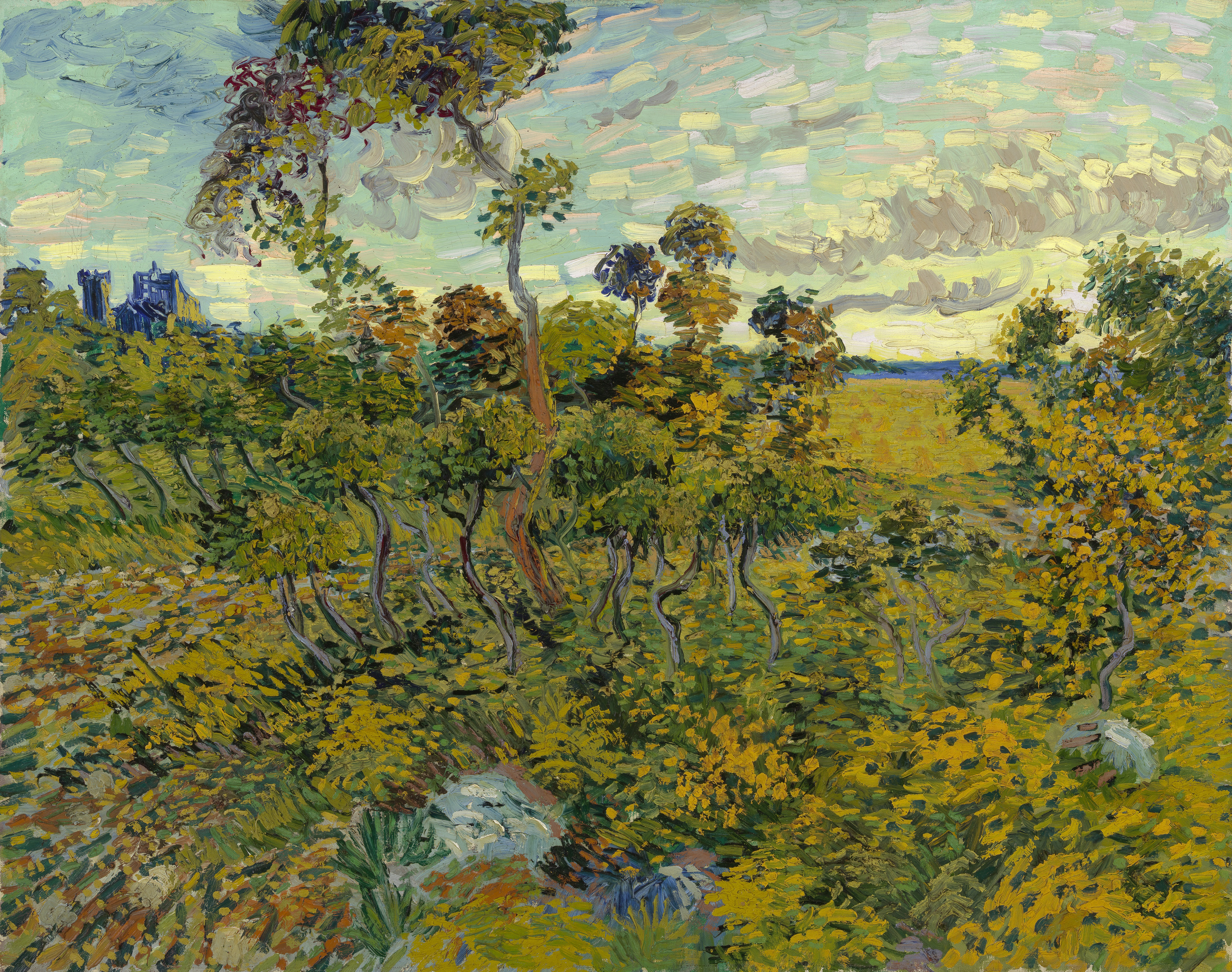
Sunset at Montmajour is the landscape Vincent van Gogh painted near Arles on 4 July 1888: dense scrub and small, crooked trees across a stony heath, a tall thin tree left of centre, a yellow field in the distance on the right and, faint at the top left, the ruins of Montmajour Abbey under a pale evening sky. The original, oil on canvas, measures 73.3 x 93.3 cm and is in a private collection; the Van Gogh Museum in Amsterdam confirmed it as his work in 2013. We paint it by hand in oil on canvas, in 18 sizes from 40 x 30 to 190 x 151 cm or to your own measurements, and send you a photograph of the finished painting for approval before dispatch.
| Title: | Sunset at Montmajour |
| Other titles: | Coucher de soleil à Montmajour · Zonsondergang bij Montmajour |
| Painter: | Vincent van Gogh (1853–1890) |
| Year painted: | 4 July 1888, Arles |
| Original size: | 73.3 cm x 93.3 cm |
| Original technique: | Oil on canvas |
| Painting style: | Post-Impressionism |
| Located at: | Private collection |
| Our reproduction: | Hand-painted oil on canvas, 18 sizes or made to measure |
Sunset at Montmajour – Vincent van Gogh
What does Sunset at Montmajour show?
Almost the whole lower part of the canvas is a thicket. Low oaks and bushes in olive green, yellow-green and ochre crowd across the foreground and the middle ground, and their thin trunks lean and bend in every direction. Left of centre a tall, slender tree rises above the rest, its few branches reaching into the sky. At the bottom left, pale grey stones show through the scrub, and a smaller stone lies on the right.
On the right the thicket opens onto the distance: a flat field of warm yellow, with a thin band of blue on the horizon behind it. Faint at the top left, beyond the trees, stand the blue-violet ruins of Montmajour Abbey. The sky is pale, from yellow-green to cream, laid in short curving strokes, with light bands of grey-violet cloud on the right.
How did Van Gogh describe Sunset at Montmajour in his letter?
He wrote about it to his brother Theo the next day. In his letter to Theo of 5 July 1888 he says: ‘Yesterday, at sunset, I was on a stony heath where very small, twisted oaks grow, in the background a ruin on the hill, and wheatfields in the valley.’ It was romantic, he went on, it couldn’t be more so, à la Monticelli, with the sun pouring its very yellow rays over the bushes and the ground, ‘absolutely a shower of gold’. The fields seemed purple, the distances blue.
He was not pleased with his own work. He brought back a study of it too, he wrote, ‘but it was well below what I’d wished to do’. The editors of the letters identify the ruin as Montmajour Abbey near Arles and the study he mentions as this painting.
Why was Sunset at Montmajour long thought not to be a Van Gogh?
Because for decades nobody could prove it was his. The English Wikipedia article on Sunset at Montmajour tells the story. The painting was listed in 1890 among Theo’s collection of his brother’s works, and in 1901 Theo’s widow, Johanna van Gogh-Bonger, sold it to a Paris art dealer. In 1908 the dealer sold it to Christian Nicolai Mustad, a Norwegian industrialist, who believed it was a Van Gogh and put it up in his home. According to Mustad’s family, the French ambassador to Sweden, a guest in the house, told him it was probably not by Van Gogh, and Mustad took it down. It stayed in his attic until his death, when it reappeared as part of his estate.
In the 1990s it was shown to staff of the Van Gogh Museum, who rejected it because it was not signed. In 2011, with better methods of research, the museum began a two-year investigation of its style and materials. The paints turned out to be the same range Van Gogh used in that period, and his letter of 5 July 1888 described the very scene. On 9 September 2013 the Van Gogh Museum announced at a public unveiling that the work was a painting by Van Gogh. Wikipedia calls it the first full-sized painting by Van Gogh to be newly confirmed since 1928.
Where is the original today?
The original is in a private collection. Wikipedia writes that from 1908, when Mustad bought it, it stayed with him and then in his estate for more than 100 years, and that after it was re-examined and authenticated it was sold to its current private owner. It is oil on canvas, 73.3 cm high and 93.3 cm wide, and it carries no signature, which is one reason it was doubted for so long.
Because the original belongs to a private collection and not to a public museum, only a painted copy can bring this evening at Montmajour to your own wall.
Sunset at Montmajour or another Van Gogh – which should you choose?
Its closest companions in our range were all painted in 1888, in and around Arles. The Harvest is a wide view of fields at harvest time near Arles. Farmhouse in Provence shows a farmhouse in the Provençal countryside. The Red Vineyard shows people at work in a vineyard near Arles, and Starry Night over the Rhône is a view of the river at Arles under a sky full of stars.
Choose this sunset for a wild landscape of trees and scrub with a ruin on the horizon, The Harvest for open fields, The Red Vineyard for figures at work and Starry Night over the Rhône for a night scene.
How is our hand-painted Sunset at Montmajour made?
The painter first sketches the line of the horizon, the tall thin tree, the main clumps of bushes and the ruin at the top left, and checks the proportions against the original. Then comes the pale sky with its curving strokes and bands of cloud, after it the yellow field and the blue distance, then the thicket of trees and bushes in short strokes, and last the bent trunks, the pale stones and the small touches of orange in the foreground. Our oil painting reproduction is painted by hand on canvas, with real impasto: the paint goes on thickly, so the brushstrokes stand up from the canvas as they do in the original and catch the light.
On our version the relief shows most in the dense strokes of the scrub, in the curving strokes of the sky and in the thin trunks drawn with the brush. A print is completely flat; on our painting every brushstroke stands out in real paint.
Every painting is a hand-painted copy made for your order, so no two are quite the same.
Which size for which wall?
Short answer: 40 x 30 or 64 x 50 cm for a narrow wall in a hallway or beside a door, 93 x 74 or 100 x 80 cm above a chest of drawers or a bed, and 150 x 120 or 160 x 127 cm above a sofa or on a large wall.
There are 18 sizes: 40 x 30, 50 x 40, 64 x 50, 70 x 55, 80 x 60, 90 x 68, 93 x 74, 100 x 80, 110 x 85, 120 x 90, 125 x 99, 135 x 105, 145 x 113, 150 x 120, 160 x 127, 170 x 134, 180 x 142 and 190 x 151 cm (width x height). The original is 93.3 cm wide and 73.3 cm high, so our 93 x 74 cm size matches it almost exactly, and 100 x 80, 125 x 99 and 190 x 151 cm stay close to its proportions. The olive greens, ochres and the pale evening sky look best on a white, cream or light grey wall and sit well with natural wood. A painting for the living room should cover about two thirds of the width of the furniture below it.
Hang it with the centre of the canvas about 150 cm above the floor. Above a sofa, a bed or a sideboard, leave 20 to 30 cm between the top of the furniture and the bottom of the canvas.
What if I need a custom size or a frame?
If none of the 18 sizes fits your wall, we paint it to measure in any width and height you need. Send us the width and height you want and we will quote you a price and a delivery time. Every painting we make is mounted on a wooden stretcher, ready to hang.
Our 3D app shows each of our frame profiles on this painting, so you can compare gold, silver, black, white and natural wood. The app is for choosing the frame only. To see the painting on your own wall, use our separate room placement service. A gold frame picks up the yellow field and the evening light, while a natural wood or a dark one goes with the olive greens and ochres of the scrub.
How does delivery work, and what is the guarantee?
Every painting is made to order in our studio in Slovenia, so allow 15 to 45 days depending on the size you choose. We ship it on its stretcher, carefully packed (and framed, if you chose a frame), across the EU with no customs duty. Before dispatch we send you a photograph of the finished painting to approve. Our returns policy applies to every order.
You will find more of Van Gogh’s famous works among all our Vincent van Gogh paintings, and more about the painter in our article on Vincent van Gogh. If it is a present and you are not sure of the size, a wall art voucher lets the recipient choose.
Frequently asked questions
Where is the original Sunset at Montmajour today?
In a private collection. According to Wikipedia, the painting stayed for more than 100 years with Christian Nicolai Mustad, who bought it in 1908, and then in his estate, and after it was re-examined and authenticated, with the Van Gogh Museum in Amsterdam confirming it in 2013, it was sold to its current private owner.
When and where did Van Gogh paint Sunset at Montmajour?
On 4 July 1888, near Arles in the south of France. He wrote to his brother Theo the next day, on 5 July, that ‘yesterday, at sunset’ he had been on a stony heath with very small, twisted oaks, a ruin on the hill in the background and wheatfields in the valley. The ruin is Montmajour Abbey, near Arles.
How was Sunset at Montmajour confirmed as a Van Gogh?
Through a two-year investigation by the Van Gogh Museum, begun in 2011. The paints matched the range Van Gogh used in that period, and his letter of 5 July 1888 described the same scene. On 9 September 2013 the museum announced at a public unveiling that the painting was his work, after its staff had rejected it in the 1990s because it was not signed.
Was Sunset at Montmajour really kept in an attic?
Yes, as Wikipedia tells it. Christian Nicolai Mustad, a Norwegian industrialist, bought it in 1908 from a Paris dealer. According to his family, a guest, the French ambassador to Sweden, told him it was probably not by Van Gogh, so he took it down, and it stayed in his attic until his death, when it reappeared as part of his estate.
What is the ruin in Sunset at Montmajour?
Montmajour Abbey, near Arles. The editors of Van Gogh’s letters identify the ruin on the hill in his letter of 5 July 1888 as Montmajour Abbey, and Wikipedia describes the painting as a landscape of garrigue with the ruins of the abbey in the background. In the painting the ruins stand faint and blue-violet at the top left, beyond the trees.
How big is the original Sunset at Montmajour?
73.3 cm high and 93.3 cm wide, a landscape format of medium size. Our 93 x 74 cm size is almost exactly the size of the original. There are 18 sizes from 40 x 30 to 190 x 151 cm, and we also paint it to measure in any proportions.
Which size of Sunset at Montmajour suits a living room?
Above a sofa, choose 150 x 120 or 160 x 127 cm, so that the canvas painting covers a good part of the width of the sofa and the yellow field and the ruin read clearly from across the room. On a narrower wall or above a sideboard, 93 x 74 or 100 x 80 cm works well. For a very large wall, choose our largest size, 190 x 151 cm.
Does your Sunset at Montmajour have the raised brushstrokes of the original?
Yes. We paint it in impasto, building up each brushstroke in thick oil, so the surface is raised like Van Gogh’s original. You see this best in the dense short strokes of the scrub, in the curving strokes of the pale sky and in the thin trunks, where the relief catches the light from the side.
- Subject: a stony heath near Arles at sunset: dense scrub and small trees, a tall thin tree, a yellow field on the right and the ruins of Montmajour Abbey at the top left.
- Original: 4 July 1888, Arles, oil on canvas, 73.3 x 93.3 cm, private collection; confirmed by the Van Gogh Museum in 2013.
- Ours: a Van Gogh reproduction painted by hand in oil on canvas, in 18 sizes from 40 x 30 to 190 x 151 cm or made to measure.
- Worth knowing: each painting is made to order, so allow 15 to 45 days, and our 3D app lets you try every frame on this painting before you order.