







































Description
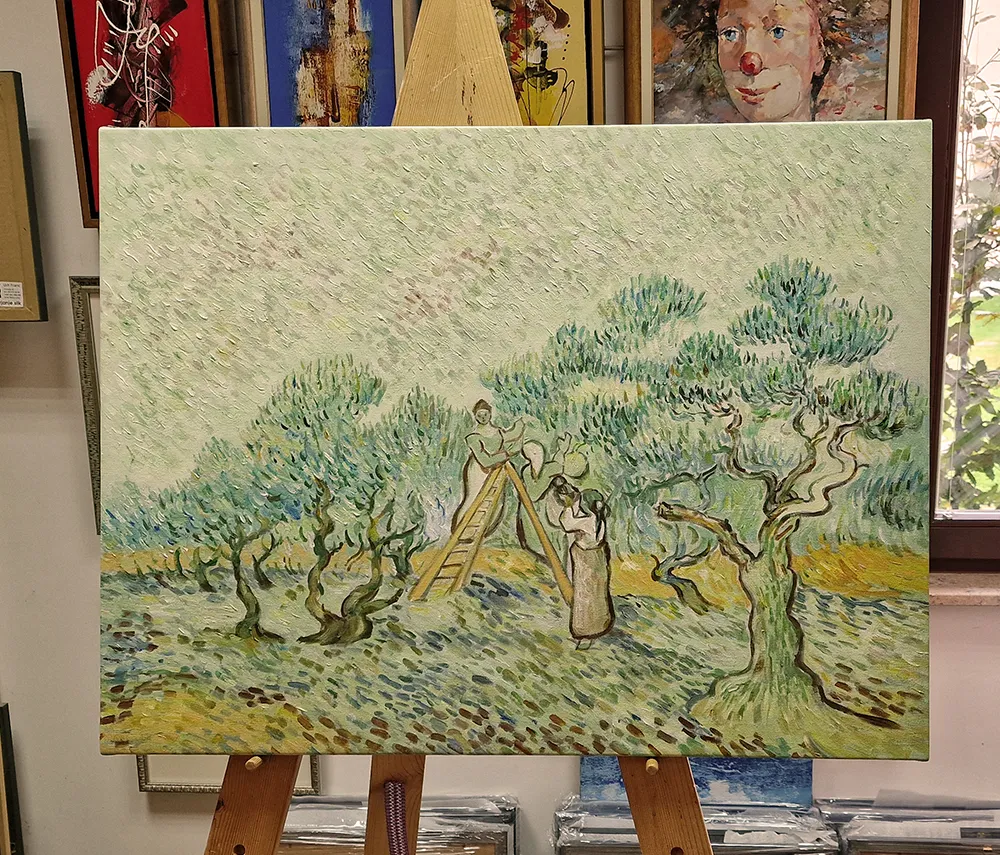
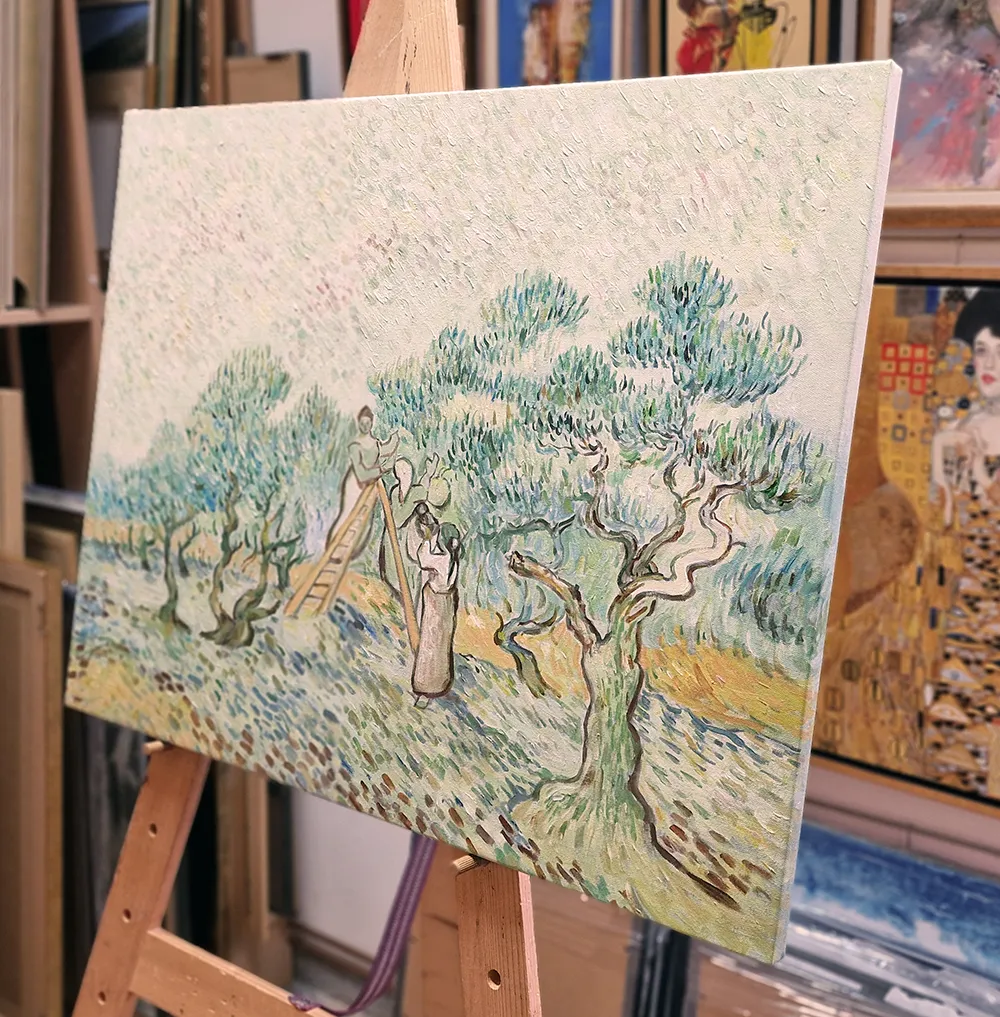
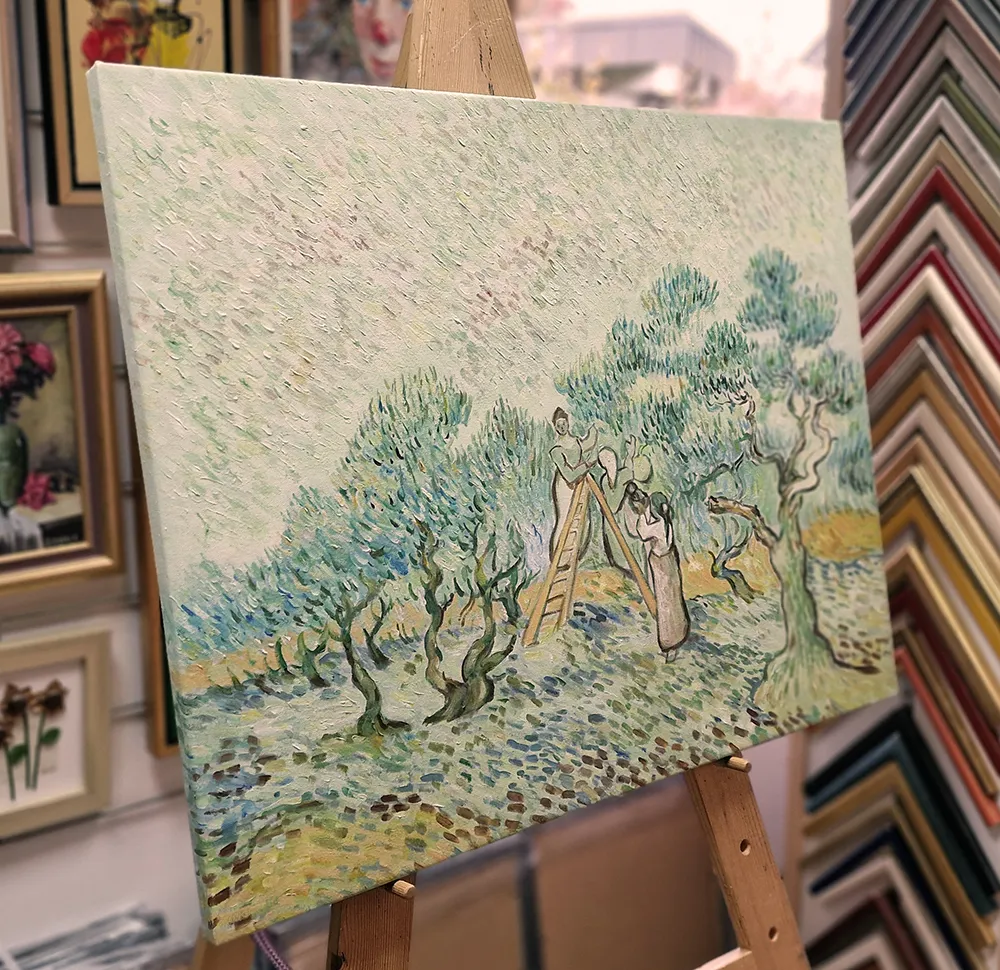
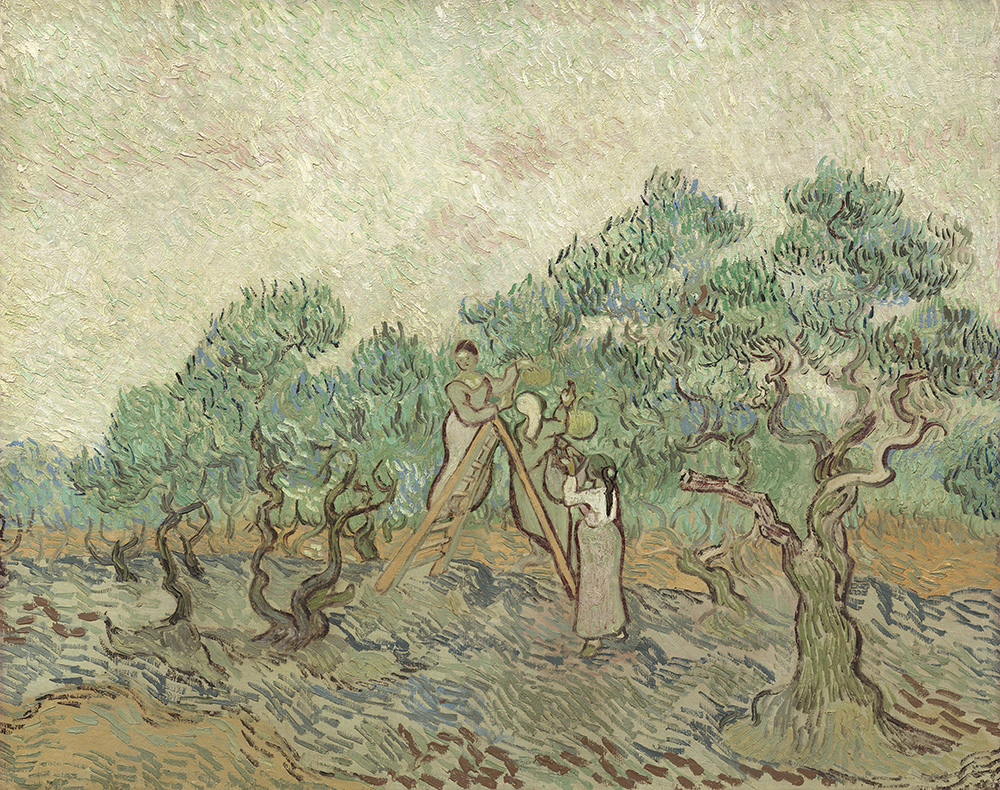
The Olive Orchard is the painting of three women picking olives from a wooden ladder among silver-green trees, which Vincent van Gogh made at Saint-Rémy-de-Provence in 1889. The original measures 73 x 92 cm and belongs to the National Gallery of Art in Washington. We paint it by hand in oil on canvas, in 17 sizes from 50 x 40 to 160 x 125 cm or to your own measurements, and send you a photograph of the finished painting to approve before dispatch.
| Title: | The Olive Orchard |
| Other titles: | Olive Pickers · The Olive Garden · La Cueillette des olives · Olivenpflücker |
| Painter: | Vincent van Gogh (1853–1890) |
| Year painted: | December 1889, Saint-Rémy-de-Provence |
| Original size: | 73 cm x 92 cm |
| Original technique: | Oil on canvas |
| Painting style: | Post-Impressionism |
| Located at: | National Gallery of Art, Washington (accession no. 1963.10.152) |
| Our reproduction: | Hand-painted oil on canvas, 17 sizes or made to measure |
The Olive Orchard – Vincent van Gogh
What does The Olive Orchard show?
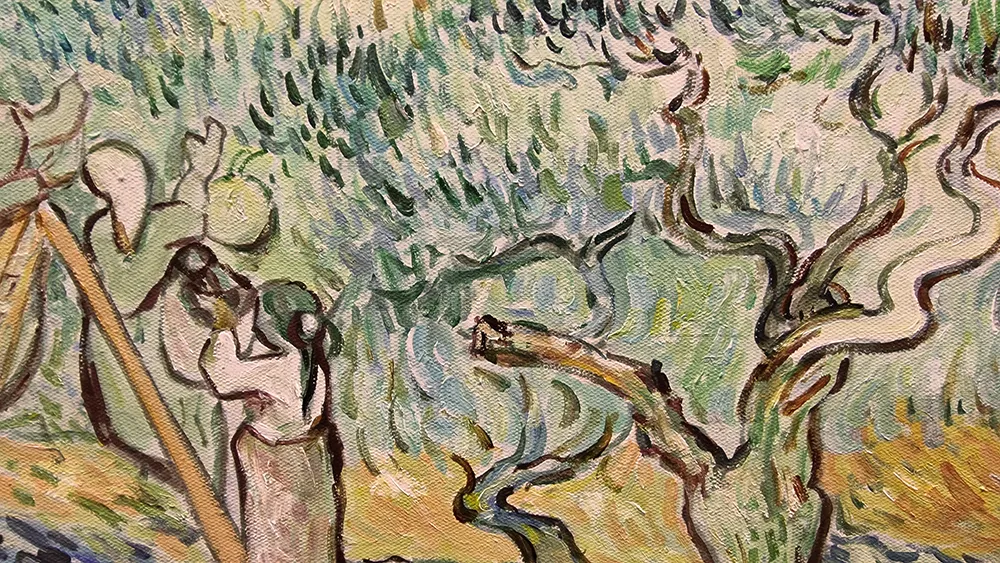
The painting shows an olive grove in Provence at harvest time. Just left of the centre a wooden ladder leans into a tree. One woman stands on it facing you and reaches into the branches, a second leans against the right side of the ladder with her back to you and her hair covered by a cloth, and a third stands at the foot of the ladder, turning away to the right. All three wear long skirts, outlined in dark brown.
Around them the olive trees twist out of the ground: low, gnarled trunks outlined in brown and crowns built of short strokes of pine green, light green and a little silvery blue. The horizon sits about a third of the way up, and above it the sky is laid in separate strokes of ivory and pale mint green with a few touches of shell pink. The ground is sage green, slate blue and brown.
Who are the women picking olives in the painting?
They are women at work in the olive harvest near the asylum of Saint-Paul at Saint-Rémy-de-Provence, where Van Gogh lived at his own request from May 1889 to May 1890. According to Wikipedia he painted at least fifteen olive groves there in 1889, and in December three versions of women picking olives.
The harvest was a deliberate choice. When Paul Gauguin and Émile Bernard each painted Christ in the Garden of Olives, Van Gogh found that in their paintings nothing was observed, and he wrote that he would not paint a Christ in the Garden of Olives, but the olive harvest as one might see it today.
What does The Olive Orchard mean?
Wikipedia reads Van Gogh’s olive pickers as paintings about the relationship between people and nature: they show one of the cycles of life, the harvest, and an example of how people, through contact with nature, can connect with the divine. The way the trees seem to wrap around the women, with figures and landscape almost one, points to a bond between nature and people.
The colours say the same: the tan and pale green of the dresses come back in the trunks and leaves. Van Gogh described this canvas, in a letter quoted by Wikipedia, as painted in a very discreet colour scheme.
Where does the original hang, and how did it get there?
The original belongs to the National Gallery of Art in Washington, D.C., under accession number 1963.10.152, as part of the Chester Dale Collection. The museum lists it as The Olive Orchard, 1889, oil on canvas, 73 x 92 cm, and Wikipedia gives it the number F656 in the catalogue of Van Gogh’s work.
The museum’s provenance starts with Jo van Gogh-Bonger, the painter’s sister-in-law, in Amsterdam. In 1905 she sold it to the dealer Paul Cassirer in Berlin, as one of a batch of eight canvases for a total of 8,259.50 guilders, and the same year it went to the Berlin collector Julius Stern. After his estate sale in 1916 it passed through other owners, and on 23 May 1931 Chester Dale of New York bought it through the Paris dealer Étienne Bignou. He left it to the National Gallery of Art in 1963.
The Olive Orchard or another olive painting – which to choose?
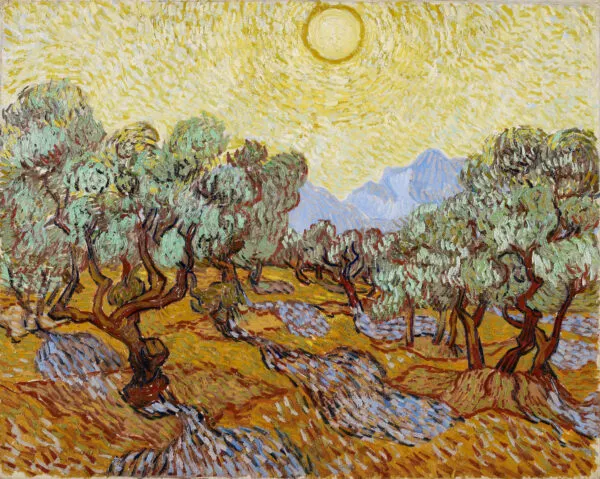
Of the olive paintings in our range, this one has figures in it and is the softest in colour: green, tan and ivory under a pale sky. Olive Trees with Yellow Sky and Sun, painted at Saint-Rémy in November 1889, is the warmest, with orange earth and a large pale sun. Olive Trees with the Alpilles in the Background, also from Saint-Rémy in 1889, is cooler: green trees, a blue sky with a large pale cloud and dark blue, rocky mountains.
If you want flowers rather than trees, Irises was also painted at Saint-Rémy, and Road with Cypress and Star sets a dark cypress, a road and a star in the evening sky. Choose The Olive Orchard for a calm, figurative scene, the yellow-sky version for warmth, the Alpilles version for blue and green.
The other two versions of the olive pickers are in Athens and in the Metropolitan Museum of Art in New York (the Met version has a pink sky); ours follows the Washington canvas.
How is our hand-painted The Olive Orchard made?
The painter first sets out the horizon, the ladder, the three figures and the trunks, then lays in the pale sky in short, separate strokes, the green and blue ground, the crowns of the trees and finally the dark outlines of the women and the branches. Our oil painting reproduction is painted by hand in oil on canvas with real impasto: the paint goes on thickly, so the brushstrokes stand up from the canvas as they do on the original and catch the light.
The first photograph shows our finished painting from the front, on an easel in our studio, stretched and unframed. The second photograph shows the same painting at an angle from the right, where you can see the painted edge of the canvas, and the third photograph shows it from the left, next to a wall of frame moulding samples. The fourth photograph is a close-up of the women at the ladder and the twisted trunk beside them, where the thick, raised paint is easy to see.
Every painting is a hand-painted copy made for your order, so no two are quite the same. Before dispatch we photograph it, sending you the photograph to approve.
Which size of The Olive Orchard for which wall?
Short answer: 70 x 55 or 75 x 60 cm above a chest of drawers, a desk or a bed in a smaller room, 120 x 100 or 130 x 105 cm above a sofa or a sideboard, and 160 x 125 cm for a large empty wall. The landscape format suits a living room, a dining room, a hallway or a bedroom.
There are 17 sizes: 50 x 40, 60 x 50, 70 x 55, 75 x 60, 80 x 65, 85 x 70, 92 x 73, 100 x 80, 105 x 85, 110 x 90, 115 x 93, 120 x 100, 130 x 105, 140 x 110, 145 x 119, 150 x 124 and 160 x 125 cm (width x height). The original is 92 cm wide and 73 cm high, so our 92 x 73 cm size is the same size as the canvas in Washington. A painting for the living room should take up about two thirds of the width of the furniture below it. Its soft greens and ivory sit well on a white, cream, light grey or sage green wall.
Hang it with the centre of the canvas about 150 cm above the floor, and leave 20 to 30 cm between the furniture and the lower edge.
What if I need a custom size or a frame?
If none of the 17 sizes fits your wall, we paint it to measure. Keep the proportions close to the original, otherwise the ladder and the women get squeezed or stretched. Send us the width and height you want and we will quote a price and a lead time. Every painting we make is stretched over a wooden stretcher and ready to hang.
For the moulding, use our 3D application: it shows each of our frame profiles on this subject – the application is for choosing the frame only. Seeing the painting on your own wall is our separate room placement service. A light natural wood or pale gold frame picks up the tan of the dresses and the earth; a white or silver frame keeps the greens cool. To look after it, keep it out of direct sun and away from radiators, and dust it now and then with a soft, dry brush.
How does delivery work, and what is the guarantee?
Every painting is made to order in our studio in Slovenia, so allow 15 to 45 days depending on the size you choose. We ship it stretched and protected, framed if you chose a frame, across the EU with no customs. Before dispatch you receive a photograph of the finished work to approve, and we correct anything that is not right. Our returns policy applies to every order.
You will find more famous Van Gogh paintings in our Vincent van Gogh gallery, and more about the painter in our article on Vincent van Gogh. If you are giving it as a gift and are unsure of the size, a wall art voucher lets the recipient choose.
Frequently asked questions
Where is the original of The Olive Orchard today?
In the National Gallery of Art in Washington, D.C. The museum lists it as The Olive Orchard, 1889, oil on canvas, 73 x 92 cm, accession number 1963.10.152, in the Chester Dale Collection. Chester Dale bought it in 1931 and left it to the museum in 1963. Wikipedia gives it the number F656 in the catalogue of Van Gogh’s work.
When and where did Van Gogh paint The Olive Orchard?
In 1889 at Saint-Rémy-de-Provence, in the south of France, while he was living at the asylum of Saint-Paul at his own request. The National Gallery of Art gives the year 1889; Wikipedia dates it to December 1889 and says he painted it in his studio, after a first version made on the spot in the grove.
What does The Olive Orchard by Van Gogh mean?
It is usually read as a painting about people and nature. Wikipedia says his olive pickers show one of the cycles of life, the harvest, and how people can reach the divine through contact with nature. Here the trees seem to wrap around the women, and their clothes share the colours of the grove. Van Gogh chose to paint the real olive harvest instead of a biblical scene.
How many versions of The Olive Orchard did Van Gogh paint?
Three versions of women picking olives, all from December 1889, according to Wikipedia: a first study made on the spot in deeper tones, now in Athens; a second, the most resolved and stylized, for his mother and sister, now in the Metropolitan Museum of Art; and this third one, in Washington. The series is described on Wikipedia.
What is the difference between The Olive Orchard and Women Picking Olives in the Met?
They show the same scene: three women and a ladder in an olive grove. The Met’s Women Picking Olives has a pink sky with strong, curling strokes and was intended for his mother and sister. The Washington canvas has an ivory and pale green sky with only touches of pink, and Van Gogh described it as painted in a very discreet colour scheme. Our painting follows the Washington version.
How big is the original The Olive Orchard?
The original is 73 cm high and 92 cm wide, a landscape format that hangs well above a sofa, a sideboard or a dining table. Our 92 x 73 cm size matches it, so the painting on your wall is as large as the one in Washington. There are smaller and larger sizes from 50 x 40 to 160 x 125 cm, and paintings made to your own measurements.
Is The Olive Orchard a good painting to give as a gift?
It is a calm, gentle gift that suits many homes: a bedroom, a reading corner, a dining room, a house in the country, someone who grows olives or has spent holidays in Provence, or anyone who wants a quiet canvas painting with people at work in nature. If you are unsure of the size, a voucher lets the recipient choose it.
Does your copy of The Olive Orchard have the raised brushstrokes of the original?
Yes. We paint our copy in impasto: the paint goes on thickly, so the brushstrokes stand up from the canvas as on Van Gogh’s original. You see it best in the short strokes of the leaves and the outlines of the women, as in the fourth photograph, and in the pale strokes of the sky. A print cannot have this relief, because its surface is flat.
- Subject: three women picking olives from a wooden ladder among twisted, silver-green olive trees under a pale ivory and mint sky.
- Original: December 1889, Saint-Rémy-de-Provence, 73 x 92 cm, National Gallery of Art, Washington.
- Ours: a Van Gogh reproduction painted by hand in oil on canvas, in 17 sizes from 50 x 40 to 160 x 125 cm or made to measure.
- Worth knowing: you receive a photograph of the finished work for approval before dispatch.