







































Description
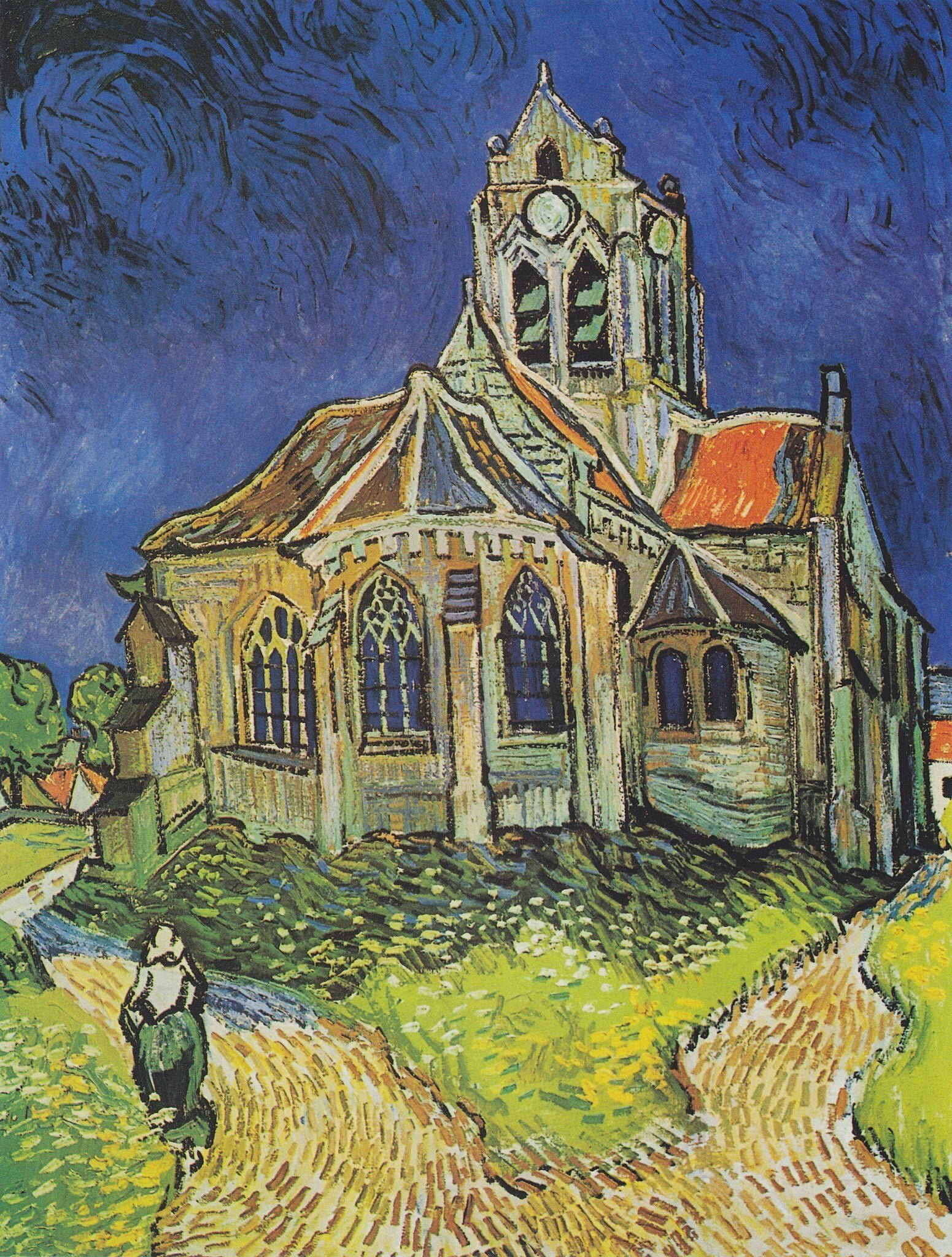
The Church at Auvers-sur-Oise is the painting Vincent van Gogh made of the village church of Auvers in June 1890, in the last weeks of his life: the Gothic church seen from the back, its walls in violet, blue and ochre against a deep cobalt sky, an orange roof, and a sandy path that forks around it in the sunlit foreground, where a peasant woman walks along the left-hand path. The original measures 94 x 74 cm and hangs in the Musée d’Orsay in Paris. We paint it by hand in oil on canvas, in 16 sizes from 40 x 50 to 127 x 165 cm or to your own measurement, and send you a photograph of the finished work for approval before dispatch.
| Title: | The Church at Auvers-sur-Oise |
| Other titles: | The Church at Auvers · The Church in Auvers-sur-Oise, View from the Chevet · L’église d’Auvers-sur-Oise, vue du chevet |
| Painter: | Vincent van Gogh (1853–1890) |
| Year painted: | June 1890, Auvers-sur-Oise |
| Original size: | 94 cm x 74 cm |
| Original technique: | Oil on canvas |
| Painting style: | Post-Impressionism |
| Located at: | Musée d’Orsay, Paris (inv. RF 1951 42) |
| Our reproduction: | Hand-painted oil on canvas, 16 sizes or made to measure |
The Church at Auvers-sur-Oise – Vincent van Gogh
What does The Church at Auvers-sur-Oise show?
The painting shows the parish church of Auvers-sur-Oise, a village north-west of Paris, seen from the back, from the side of the apse. The church fills most of the upright canvas. Its stone walls are painted in violet, blue, green and ochre with dark outlines, and the tall pointed windows of the apse are a deep blue. Above them rise the roofs, one of them a bright orange, and the square tower with its pointed top and round openings. Hardly a line is straight: the walls, the roofs and the tower lean and bend.
Behind the church the sky is a deep, dark blue, painted in curving strokes that grow almost black in the upper corners. In front of it lies a sunlit slope of green grass dotted with small white and yellow flowers, and a sandy path that divides in two and runs around both sides of the building. On the left-hand path a peasant woman in a white head covering and a long dark skirt walks away from us. On the far left stand small houses with red roofs and round green trees.
Why is the church dark while the path is in sunlight?
The light in the painting falls on the ground, not on the building. The foreground is brightly lit by the sun, while the church sits in its own shadow. Wikipedia quotes the writer Kathleen Erickson, for whom the church neither reflects nor emanates any light of its own.
Van Gogh described the colours himself in a letter to his sister Wil on 5 June 1890. In his words, the building appears violet-hued against a sky of simple deep blue, pure cobalt; the stained-glass windows look like ultramarine blotches, and the roof is violet and partly orange. In the foreground, he wrote, there are some green plants in bloom, and sand with the pink flow of sunshine in it.
What does the painting mean?
Van Gogh linked this painting to his own past. In the same letter to Wil he wrote that it was once again nearly the same thing as the studies he had made in Nuenen of the old tower and the cemetery, only that now the colour was probably more expressive and more sumptuous. Nuenen is the village in the south of the Netherlands where he painted in the mid-1880s. Wikipedia counts this church among the Auvers works that recall his Nuenen period.
Some writers also see the dark church as a comment on organised religion, but Van Gogh himself did not write that about it. The painting and its letters are summed up in the Wikipedia article on The Church at Auvers.
Where does the original hang?
The original belongs to the Musée d’Orsay in Paris, which lists it as L’église d’Auvers-sur-Oise, vue du chevet, 1890, oil on canvas, under the inventory number RF 1951 42. According to the German Wikipedia, the painting first belonged to Dr Paul Gachet, who left it to his son. From the son it came in 1952 to the Jeu de Paume collection of the Louvre, and in 1986 it moved to the Musée d’Orsay.
The church itself still stands. It is the Église Notre-Dame-de-l’Assomption in Auvers-sur-Oise, about 27 km north-west of Paris, an early Gothic building.
The Church at Auvers-sur-Oise or another painting from Auvers – which to choose?
Van Gogh spent the last weeks of his life in Auvers-sur-Oise, from May to July 1890. Wheat Field with Crows, also painted in Auvers in 1890, is a wide landscape of wheat under a dark sky, with a path running into the field. Portrait of Dr. Gachet, from 1890 as well, shows the doctor who looked after him there. Choose The Church at Auvers-sur-Oise if you want a building rather than a landscape or a portrait, in an upright format that suits a narrow or a high wall.
The Starry Night, painted in Saint-Rémy in 1889, also sets a village church spire against a swirling blue sky, but at night. The Yellow House, painted in Arles in 1888, is another portrait of a building under a deep blue sky, the house in Arles where Van Gogh lived and worked.
How is our hand-painted The Church at Auvers-sur-Oise made?
The painter first sets out the outline of the church, the tower and the fork of the path. Then come the deep blue sky in curving strokes, the walls and windows in violet, blue and ochre, the orange roof, and last the green grass, the flowers and the sandy path in short, broken strokes, with the small figure of the woman. Our oil painting reproduction is painted by hand in oil on canvas with real impasto: the paint goes on thickly, so the brushstrokes stand up from the canvas as they do in the original and catch the light.
On this painting the relief matters most in the swirling sky, in the short strokes of the path and in the grass. A print shows only a flat surface; on our painting the strokes are real.
Every painting is a hand-painted copy made for your order, so no two are quite the same.
Which size for which wall?
Short answer: 60 x 80 or 68 x 85 cm above a sideboard, a desk or a bed, 90 x 115 or 100 x 130 cm above a sofa, and 127 x 165 cm for a high wall or a stairwell. The upright format also suits a narrow wall between two windows, a hallway or a study.
There are 16 sizes: 40 x 50, 50 x 62, 50 x 65, 51 x 67, 56 x 70, 60 x 80, 68 x 85, 74 x 94, 80 x 100, 84 x 110, 90 x 115, 100 x 130, 108 x 135, 113 x 146, 120 x 155 and 127 x 165 cm (width x height). The original is 74 cm wide and 94 cm high, and our 74 x 94 cm size has exactly those dimensions, so the painting on your wall is as large as the one in Paris. With its deep blue sky and green grass, it sits well on a white, light grey or cream wall, and on a warm sand-coloured one that picks up the path. A 40 x 50 cm size fits above a bedside table. A painting for the living room should take up about two thirds of the width of the furniture below it.
Hang it with the centre of the canvas about 150 cm above the floor, leaving 20 to 30 cm between the furniture and the bottom edge.
What if I need a custom size or a frame?
If none of the 16 sizes fits your wall, we paint it to measure. Keep the proportions close to the original, otherwise the church and its tower get squeezed or stretched. Send us the width and height you want and we will quote a price and a lead time. Every painting we make is stretched over a wooden stretcher and ready to hang.
For the moulding, use our 3D application: it shows each of our frame profiles on this subject, so you can compare gold, silver, black, white and natural wood – the application is for choosing the frame only. Seeing the painting on your own wall is our separate room placement service. A gold frame picks up the orange roof and the sandy path, and a black or dark wood frame deepens the blue of the sky.
How does delivery work, and what is the guarantee?
Every painting is made to order in our studio in Slovenia, so allow 15 to 45 days depending on the size you choose. We ship it stretched and protected, framed if you chose a frame, across the EU with no customs. Before dispatch you receive a photograph of the finished work to approve, and we correct anything that is not right. Our returns policy applies to every order.
You will find more famous Van Gogh paintings among all our Vincent van Gogh paintings, and there is more about the painter in our article on Vincent van Gogh. If you are giving it as a present and are not sure of the size, a wall art voucher lets the recipient choose.
Frequently asked questions
Where is the original of The Church at Auvers-sur-Oise today?
In the Musée d’Orsay in Paris. The museum lists it as L’église d’Auvers-sur-Oise, vue du chevet, 1890, oil on canvas, with the inventory number RF 1951 42. It first belonged to Dr Paul Gachet and then to his son, came to the Louvre’s collection in 1952 and moved to the Musée d’Orsay in 1986. The church it shows stands about 27 km north-west of Paris.
When and where did Van Gogh paint The Church at Auvers-sur-Oise?
In June 1890, in the village of Auvers-sur-Oise north-west of Paris, where he lived from May to July 1890. He described the painting in a letter to his sister Wil dated 5 June 1890. It is one of the last paintings of his life: he died in Auvers at the end of July 1890.
Does the church in The Church at Auvers-sur-Oise still exist?
Yes. It is the Église Notre-Dame-de-l’Assomption, the parish church of Auvers-sur-Oise, about 27 km north-west of Paris, an early Gothic building. It still stands in the village, and seen from behind the apse it can be compared with Van Gogh’s view.
Why are the colours in The Church at Auvers-sur-Oise so unusual?
Because Van Gogh chose them on purpose. He wrote to his sister Wil that the building appears violet-hued against a sky of simple deep blue, pure cobalt, with the stained-glass windows like ultramarine blotches and a violet and partly orange roof. He added that the colour was probably more expressive and more sumptuous than in his earlier studies of the old church tower in Nuenen.
What do the dark church and the sunny path mean in The Church at Auvers-sur-Oise?
There is no single answer, and Van Gogh did not explain it. Wikipedia notes that the foreground is in sunlight while the church sits in its own shadow, and cites the writer Kathleen Erickson, who links this to his earlier break with church preaching. Van Gogh himself connected the painting with his memories of Nuenen.
How big is the original of The Church at Auvers-sur-Oise?
The original is 94 cm high and 74 cm wide, an upright format. Our 74 x 94 cm size has exactly the same dimensions, and there are smaller and larger sizes from 40 x 50 up to 127 x 165 cm, as well as custom sizes painted to measure. Above a sofa, 90 x 115 or 100 x 130 cm is a good choice, and 60 x 80 cm suits a desk or a hallway.
Does your painting of The Church at Auvers-sur-Oise have the raised brushstrokes of the original?
Yes. We paint our copy in impasto: the paint goes on thickly, so the brushstrokes stand up from the canvas as on Van Gogh’s original. You see it best in the swirling strokes of the dark blue sky, in the short broken strokes of the sandy path and in the grass, where the relief catches the light and changes as you walk past the painting.
Is The Church at Auvers-sur-Oise a good gift?
It suits someone who is drawn to Van Gogh’s last months in Auvers, to French villages or to old churches, and it works well in a hallway, a study or on a narrow wall of a living room. As a canvas painting in deep blue, green and warm ochre, it brings strong colour into a calm room, and a voucher lets the recipient choose the size.
- Subject: the Gothic church of Auvers seen from the apse, in violet, blue and ochre against a deep cobalt sky, with a forked sandy path and a peasant woman.
- Original: June 1890, Auvers-sur-Oise, 94 x 74 cm, Musée d’Orsay, Paris.
- Ours: a Van Gogh reproduction painted by hand in oil on canvas, in 16 sizes from 40 x 50 to 127 x 165 cm or made to measure.
- Worth knowing: our 74 x 94 cm size has the same dimensions as the original in Paris.