







































Description
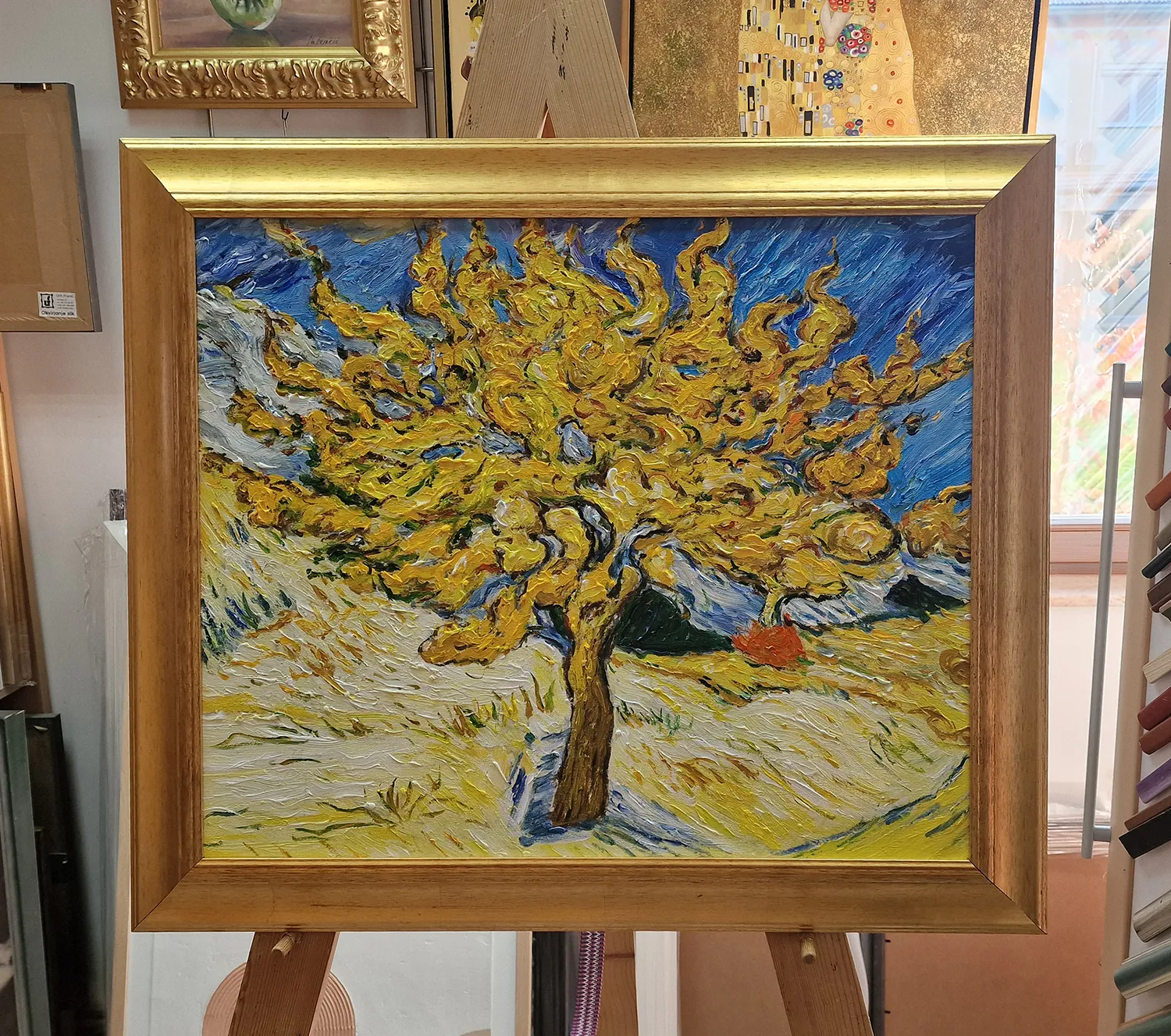
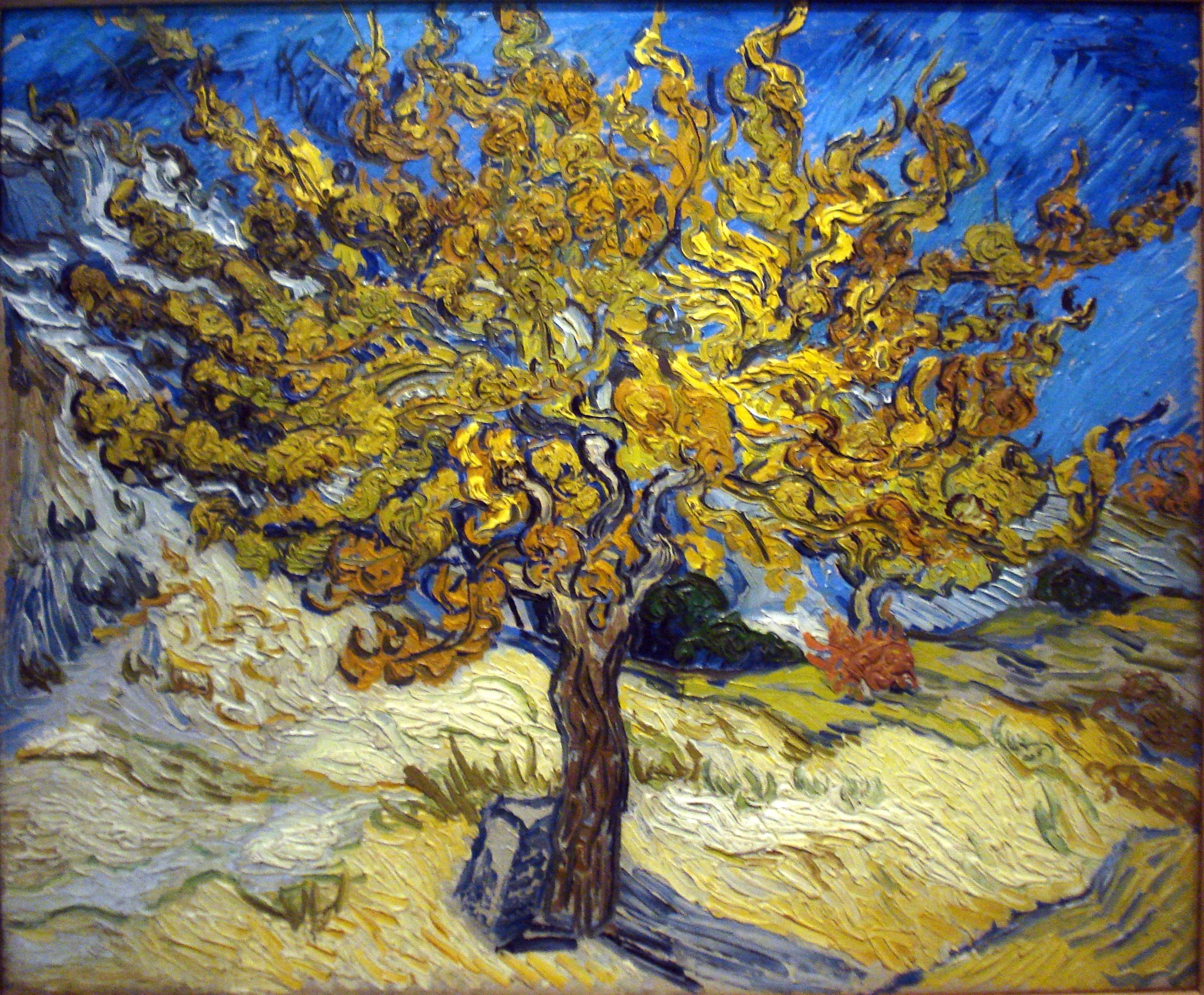
The Mulberry Tree is the autumn landscape Vincent van Gogh painted in October 1889 in Saint-Rémy-de-Provence: a single mulberry tree in blazing yellow and orange leaves rises from a pale, rocky slope against a deep blue sky. The original measures 54 x 65 cm and hangs in the Norton Simon Museum in Pasadena, California. We paint it by hand in oil on canvas, in 13 sizes from 50 x 40 to 150 x 120 cm or to your own measurement, and send you a photograph of the finished work for approval before dispatch.
| Title: | The Mulberry Tree |
| Other titles: | Mulberry Tree · Le Mûrier |
| Painter: | Vincent van Gogh (1853–1890) |
| Year painted: | October 1889, Saint-Rémy-de-Provence |
| Original size: | 54 cm x 65 cm |
| Original technique: | Oil on canvas |
| Painting style: | Post-Impressionism |
| Located at: | Norton Simon Museum, Pasadena (inv. M.1976.09.P) |
| Our reproduction: | Hand-painted oil on canvas, 13 sizes or made to measure |
The Mulberry Tree – Vincent van Gogh
What does The Mulberry Tree show?
The Mulberry Tree shows one tree that fills almost the whole canvas. Its trunk, brown with blue shadows, twists up from the lower centre, and from it the branches spread into a wide, nearly symmetrical crown of yellow, ochre and orange leaves. Each cluster of leaves is a curl of thick paint outlined in dark blue and black, so the crown reads as a mass of small flames.
Behind the tree a white, rocky slope rises on the left, painted in strokes of cream, grey and pale blue. On the right, low hills recede under the crown, with a dark green bush and a small red-orange bush not far from the trunk. The ground in front is pale yellow and cream, crossed by thin strokes of green grass, and a block of grey and blue shadow lies at the foot of the trunk. Above it all is a deep blue sky, laid on in short diagonal strokes.
Why do the leaves of The Mulberry Tree seem to move?
Because Van Gogh painted them in curling spirals. The encyclopaedia entry on the painting describes thick impasto brushwork that makes the foliage look almost three-dimensional, and curling orange and black spirals that suggest the wind moving through the branches. Nothing in the crown is a flat patch of colour: every stroke has a direction, and together they turn and lift like leaves in a gust.
The second reason is colour. The warm yellows and oranges of the tree sit directly against the cool blues and purples of the sky, and each makes the other look stronger. In 1892 the critic Charles Saunier wrote in the journal L’En-Dehors that the tree was sculpted in thick cobalt and chrome yellow.
What did The Mulberry Tree mean to Van Gogh?
Van Gogh painted The Mulberry Tree in October 1889, while he was living at the Saint-Paul-de-Mausole asylum in Saint-Rémy-de-Provence, in the south of France. That autumn he painted a series of what he called his autumn studies, and this is the one he rated above the rest.
In a letter to his brother Theo in December 1889 he described the painting as the yellow mulberry tree against a very blue sky and counted it as the best of those autumn studies. So we know exactly what the painter thought of this canvas: it was not a sketch on the way to something else, but a work he picked out himself.
Where is the original, and how did it get there?
The original hangs in the Norton Simon Museum in Pasadena, California. It belongs to the Norton Simon Art Foundation, a gift of Norton Simon in 1976, under the accession number M.1976.09.P. It is oil on canvas, 54 x 65 cm, and in the catalogues of Van Gogh’s work it carries the numbers F637 and JH1796.
Its first owner was the painter Camille Pissarro in Paris, and from him it passed by inheritance to Madame Pissarro. It then went to the dealer Ambroise Vollard, to the collector Alphonse Kann in Saint-Germain-en-Laye until 1928, and on to Michael Stewart and David Gibbs in London. In October 1961 Gibbs sold it to Marlborough Fine Art, and in November 1961 Marlborough sold it to Norton Simon.
In 1901 the painting was shown at the Bernheim-Jeune gallery in Paris, and the Austrian writer Hugo von Hofmannsthal described his visit to that exhibition in a fictitious letter titled Colours. The ownership history and the critics’ comments are collected on the Wikipedia page on The Mulberry Tree.
The Mulberry Tree or another Van Gogh from Saint-Rémy – which should you choose?
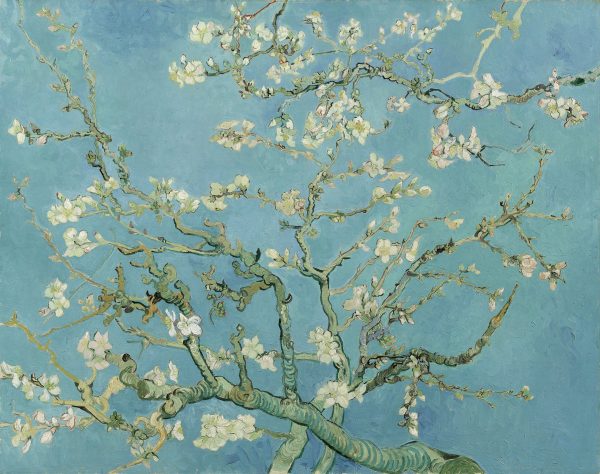
Van Gogh painted all five of these works during his year in Saint-Rémy. In 1889 he painted the purple-blue flowers of Irises, the dark, flame-like trees of Cypresses and the yellow light of Olive Trees with Yellow Sky and Sun. In 1890 followed the white flowers on a blue ground of Almond Blossom.
Choose The Mulberry Tree for warm autumn colour and a crown full of movement; choose Irises for a calmer painting of flowers; choose Almond Blossom for light, fresh blue; and choose the olive trees if you want the same strong yellow, but in the sky instead of the leaves.
How is our hand-painted The Mulberry Tree made?
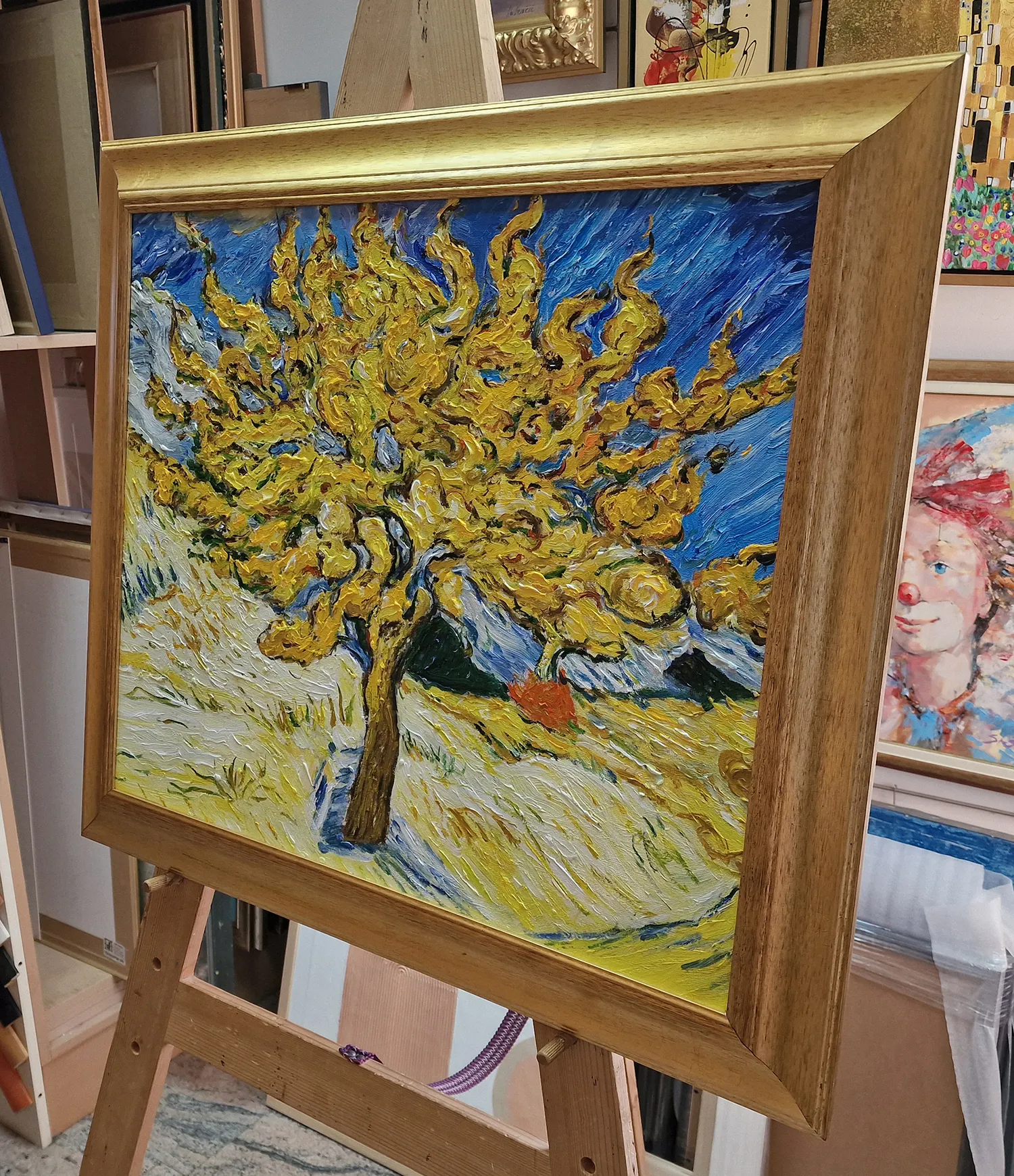
The painter first draws the trunk and the main branches, checking the proportions against the original so that the crown stays wide and balanced. Then come the slope, the hills and the sky, and last the leaves, built up curl by curl in yellow, ochre and orange and outlined in dark blue. Our oil painting reproduction is painted by hand in oil on canvas with real impasto: the paint goes on thickly, so the brushstrokes stand up from the canvas as they do in the original and catch the light on every leaf. A printed copy shows only a flat surface; on our painting the strokes are real.
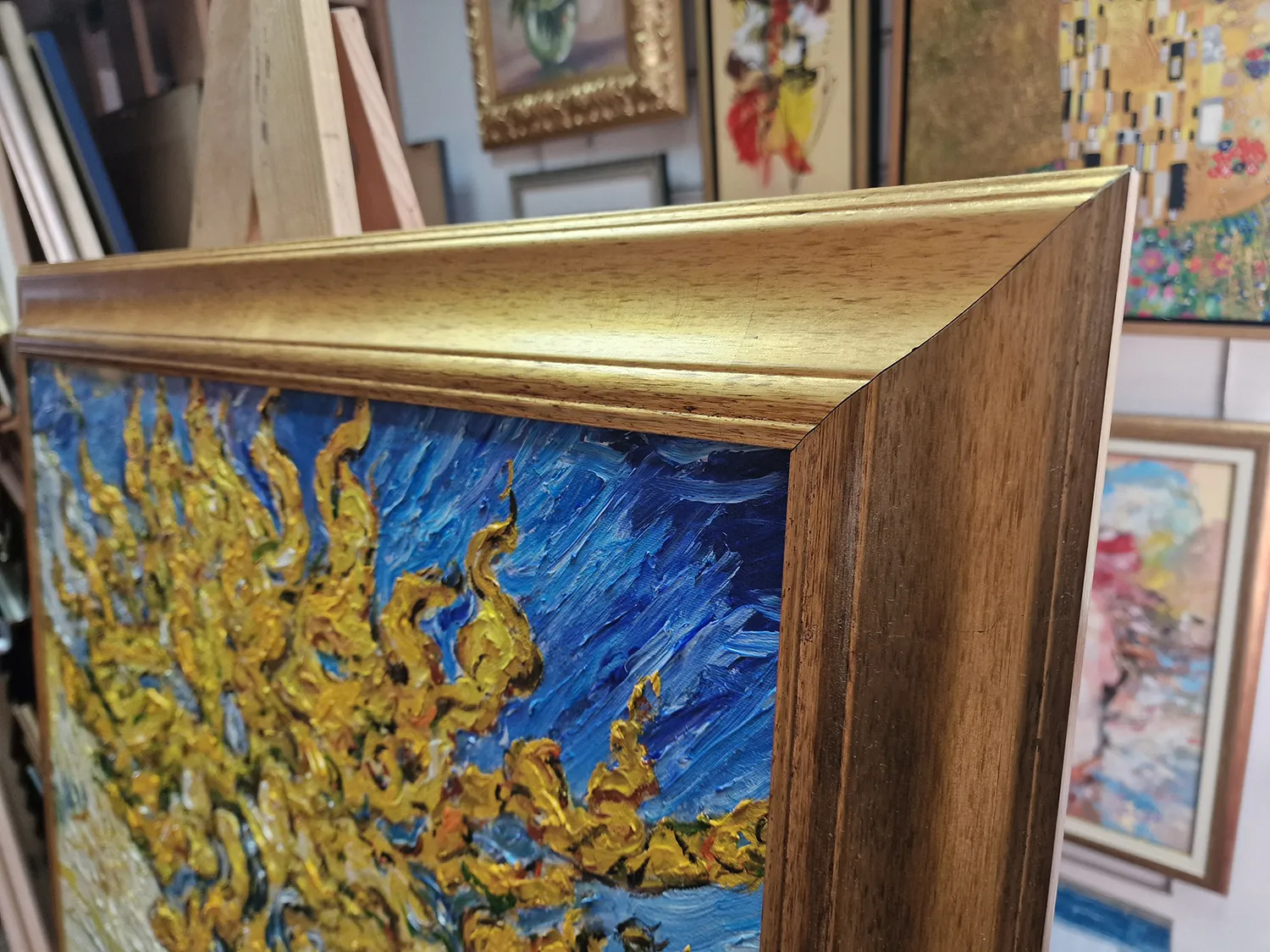
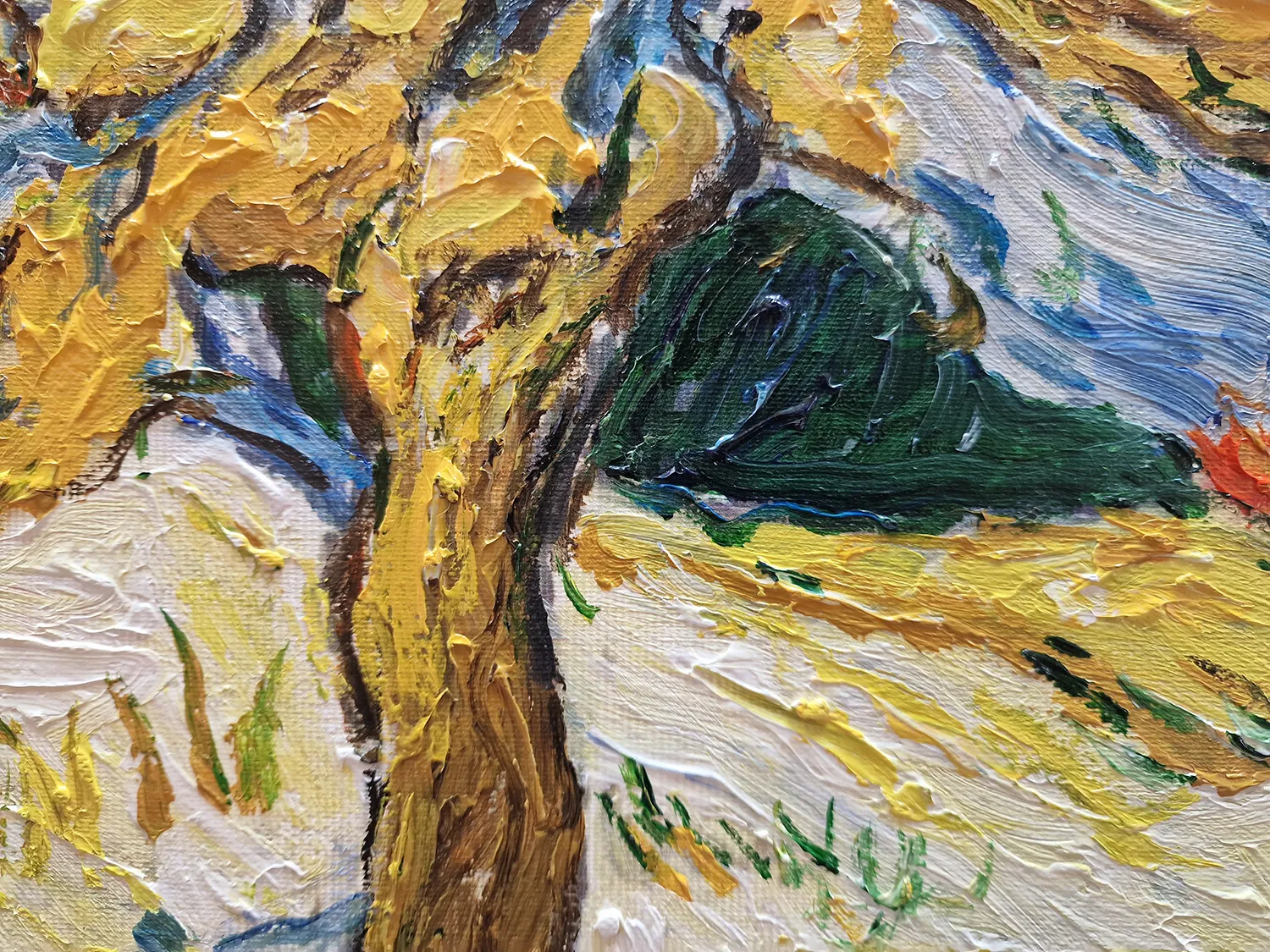
The first photograph shows our finished painting in a gold frame, from the front, on an easel in our workshop. The second photograph shows the same framed painting at an angle from the right, so you see how the leaves stand out in relief. The third photograph is a close-up of the corner of the frame, with the yellow leaves in thick paint against the blue sky. The fourth photograph is a close-up of the trunk and the dark green bush, where you can follow each brushstroke and the weave of the canvas.
Every painting is a hand-painted copy made for your order, so no two are quite the same. Before dispatch we photograph it, sending you the photograph to approve.
Which size for which wall?
Short answer: 60 x 50 or 65 x 54 cm above a chest of drawers, a desk or in a hallway, 80 x 60 or 90 x 70 cm above a bed or a sideboard, and 120 x 100 or 150 x 120 cm above a sofa or on a large empty wall.
There are 13 sizes: 50 x 40, 60 x 50, 65 x 54, 70 x 53, 70 x 56, 70 x 59, 70 x 60, 80 x 60, 80 x 62, 80 x 67, 90 x 70, 120 x 100 and 150 x 120 cm (width x height). The original is 65 cm wide and 54 cm high, so our 65 x 54 cm size gives you the painting at exactly the size it hangs in Pasadena. The yellow crown glows on a white, cream or light grey wall and looks warm against dark wood. A painting for the living room should cover about two thirds of the width of the furniture below it.
Hang it with the centre of the canvas about 150 cm above the floor, leaving 20 to 30 cm between the furniture and the bottom edge.
What if I need a custom size or a frame?
If none of the 13 sizes fits your wall, we paint it to measure. Keep the proportions close to the original, otherwise the crown and the slope get squeezed or stretched. Send us the width and height you want and we will quote a price and a lead time. Every painting we make is stretched over a wooden stretcher and ready to hang.
For the moulding, use our 3D application: it shows each of our frame profiles on this subject, so you can compare gold, silver, black, white and natural wood – the application is for choosing the frame only. Seeing the painting on your own wall is our separate room placement service. A gold frame, like the one in our photographs, picks up the yellow of the leaves, and a dark wooden frame gives the autumn colours a quieter setting.
How does delivery work, and what is the guarantee?
Every painting is made to order in our studio in Slovenia, so allow 15 to 45 days depending on the size you choose. We ship it stretched and protected, framed if you chose a frame, across the EU with no customs. Before dispatch you receive a photograph of the finished work to approve, and we correct anything that is not right. Our returns policy applies to every order.
You will find more famous Van Gogh paintings among all our Van Gogh paintings, and there is more about the painter in our article on Vincent van Gogh. If you are giving it as a present and are not sure of the size, a wall art voucher lets the recipient choose.
Frequently asked questions
Where is the original The Mulberry Tree today?
In the Norton Simon Museum in Pasadena, California. The painting belongs to the Norton Simon Art Foundation as a gift of Norton Simon in 1976, with the accession number M.1976.09.P. Norton Simon bought it in November 1961 from Marlborough Fine Art in London. In the catalogues of Van Gogh’s work it is listed as F637 and JH1796.
When and where did Van Gogh paint The Mulberry Tree?
In October 1889 in Saint-Rémy-de-Provence in the south of France, while he was living at the Saint-Paul-de-Mausole asylum. It is one of the paintings he called his autumn studies, and the yellow and orange leaves show the season in which he painted it. He was 36 years old at the time.
What did Van Gogh write about The Mulberry Tree?
He rated it highly. In a letter to his brother Theo in December 1889 he described the painting as the yellow mulberry tree against a very blue sky and called it the best of his autumn studies. It is rare to know so clearly which of his own canvases the painter himself considered his best of a season.
What is the meaning of The Mulberry Tree?
Van Gogh left no hidden meaning to decode: in his letter he wrote about colour, yellow against a very blue sky. What the painting shows is a single tree in autumn, its crown painted in curling spirals that suggest wind in the branches. Readings of the tree as a symbol of endurance or inner unrest are later interpretations, not his own words.
Who owned The Mulberry Tree before the Norton Simon Museum?
The first owner was the painter Camille Pissarro in Paris, and after him Madame Pissarro by inheritance. It later belonged to the dealer Ambroise Vollard, to the collector Alphonse Kann until 1928, and to Michael Stewart and David Gibbs in London. In 1961 it went through Marlborough Fine Art to Norton Simon, who gave it to his foundation in 1976.
Is the original The Mulberry Tree for sale, and what is it worth?
No, the original is not for sale: it belongs to the Norton Simon Art Foundation and hangs in the museum in Pasadena. The sources we checked publish no price for its 1961 purchase and no current valuation, so any figure would be a guess. What you can own is a copy painted by hand in oil, at the size you choose.
How big is the original The Mulberry Tree?
The original is 54 cm high and 65 cm wide, a medium landscape format. Our 65 x 54 cm size matches it exactly, so the painting on your wall is as large as the one in Pasadena. For more presence there are larger sizes up to 150 x 120 cm, smaller ones from 50 x 40 cm, and custom sizes as well.
Is your The Mulberry Tree a print?
No. Our version is a canvas painting painted by hand in oil by a painter, stroke by stroke, and then stretched over a wooden stretcher. Nothing is printed onto the canvas. Before dispatch we photograph the finished work and send you the photograph to approve, so you see your own painting before it leaves our studio in Slovenia.
Does your The Mulberry Tree have the raised brushstrokes of the original?
Yes. We paint our copy in impasto: the paint goes on thickly, so the brushstrokes stand up from the canvas as on Van Gogh’s original. You see it best in the curling yellow leaves and on the trunk, where the relief catches the light, as the third and fourth photographs show. A print cannot have this relief, because its surface is flat.
- Subject: a mulberry tree in yellow and orange autumn leaves on a pale, rocky slope against a deep blue sky.
- Original: October 1889, Saint-Rémy-de-Provence, 54 x 65 cm, Norton Simon Museum, Pasadena.
- Ours: a Van Gogh reproduction painted by hand in oil on canvas, in 13 sizes from 50 x 40 to 150 x 120 cm or made to measure.
- Worth knowing: you receive a photograph of the finished work for approval before dispatch.