







































Description
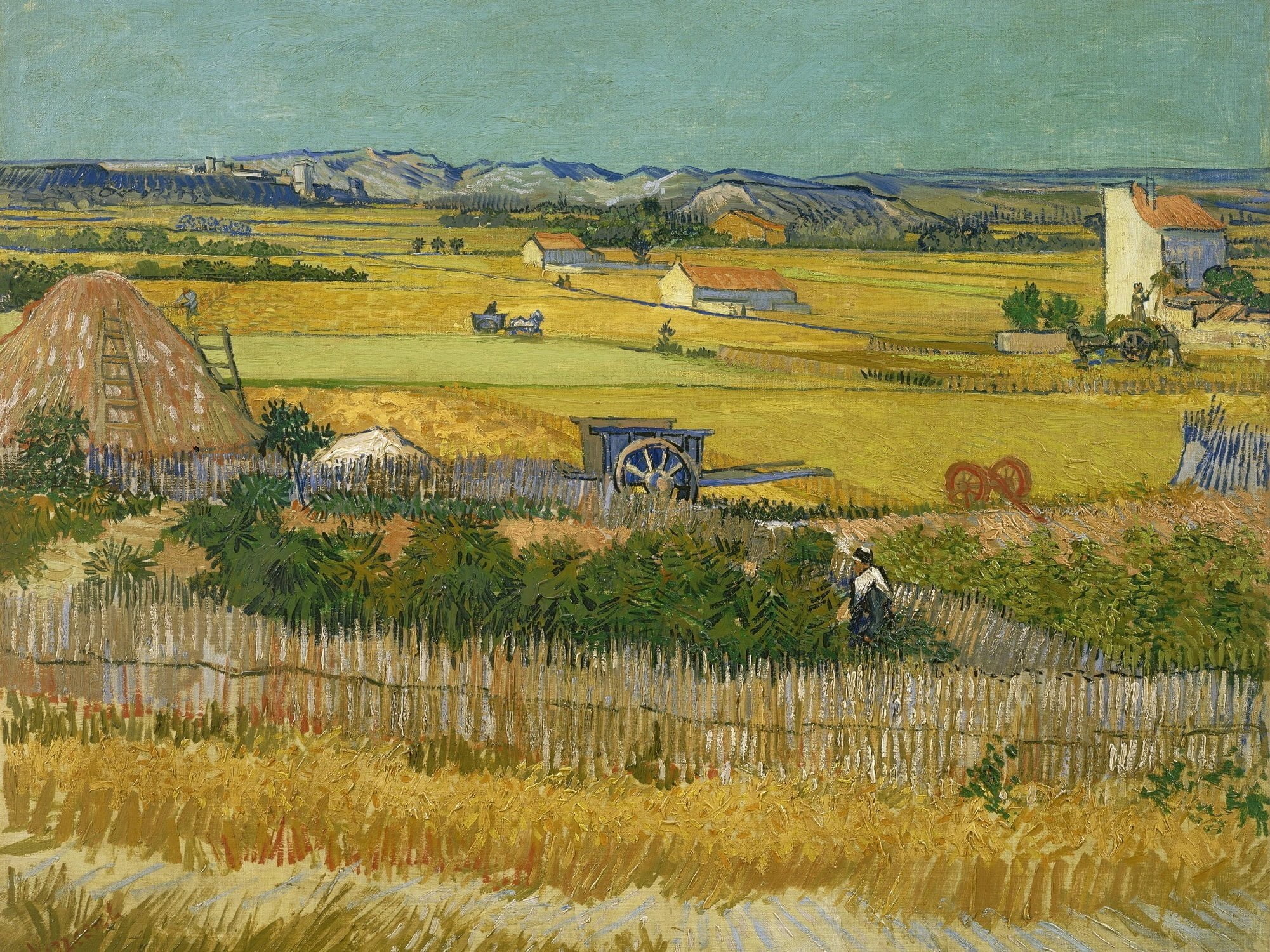
The Harvest is the painting Vincent van Gogh made near Arles in June 1888: a wide plain of yellow and green wheat fields under an azure sky, with a haystack and a ladder on the left, a blue cart in the middle and farmhouses in the distance. The original measures 73.4 x 91.8 cm and hangs in the Van Gogh Museum in Amsterdam. We paint it by hand in oil on canvas, in 17 sizes from 50 x 40 to 160 x 127 cm or to your own measurement, and send you a photograph of the finished work for approval before dispatch.
| Title: | The Harvest |
| Other titles: | La moisson |
| Painter: | Vincent van Gogh (1853–1890) |
| Year painted: | June 1888, Arles |
| Original size: | 73.4 cm x 91.8 cm |
| Original technique: | Oil on canvas |
| Painting style: | Post-Impressionism |
| Located at: | Van Gogh Museum, Amsterdam (inv. s0030V1962) |
| Our reproduction: | Hand-painted oil on canvas, 17 sizes or made to measure |
The Harvest – Vincent van Gogh
What does The Harvest show?
The Harvest is a wide view over the flat farmland near Arles, seen from a slightly raised point, so that the fields run back in bands towards low blue hills on the horizon. In the foreground a fence of thin stakes crosses the canvas above golden stubble, and behind it a small figure stands among dark green bushes. On the left rises a haystack with a ladder against it, in the centre stands an empty blue cart, and on the right a pair of red cart wheels leans against a fence.
Further back a small cart moves along a track, farm buildings with orange roofs sit among the wheat, and on the far right stands a tall white farmhouse. The Van Gogh Museum describes a half mowed wheatfield, ladders and several carts, with a reaper working in the background, under a sky it calls azure blue.
How did Van Gogh paint The Harvest in June 1888?
In June 1888 Van Gogh spent his days in the wheat fields around Arles. The Van Gogh Museum writes that he worked there for days at a time under the burning sun: ten paintings and five drawings in just over a week, until a heavy storm brought the harvest season to an end. You can almost feel the dryness and heat in the painting, as the museum puts it.
For this subject he chose a bigger canvas, the size 30, about 73 x 92 cm, which he wrote cost him 4 francs each in Arles. He also described the colours of the season to Theo: old gold, bronze and copper in everything, which with the green blue of the sky, heated white-hot, gave an exceedingly harmonious colour, with broken tones in the manner of Delacroix.
What does The Harvest mean?
The museum explains that Van Gogh wanted to show peasant life and work on the land, a recurring theme in his art, and that he painted several stages of the harvest. Here they sit side by side: wheat still standing, a field half mowed, a haystack and carts. Because a reaper works in the background, he titled the work La moisson, The Harvest. The people are tiny; the subject is the work and the land.
It also mattered to him as a painter. In his letter to Theo of 12 or 13 June 1888, which can be read in full at the Van Gogh Letters project, he wrote that the last canvas absolutely kills all the rest; in his words, only a still life with coffee pots, cups and plates in blue and yellow could stand beside it. He put it on the red brick floor of his studio, and its colour did not become hollow or white-looking. The museum adds that he considered it one of his most successful paintings.
Where does the original hang?
The original hangs in the Van Gogh Museum in Amsterdam, which lists it as The Harvest, Arles, June 1888, oil on canvas, 73.4 x 91.8 cm, under the object number s0030V1962. It belongs to the Vincent van Gogh Foundation.
Van Gogh gave the canvas to Paul Eugène Milliet to take to Theo in Paris in mid-August 1888. After Theo died in January 1891 it passed to his widow, Jo van Gogh-Bonger, and their son, who transferred it to the foundation in 1962. Until the museum opened on 2 June 1973 it was on loan to the Stedelijk Museum; since then it has been in the Van Gogh Museum.
The Harvest or another Van Gogh landscape – which should you choose?
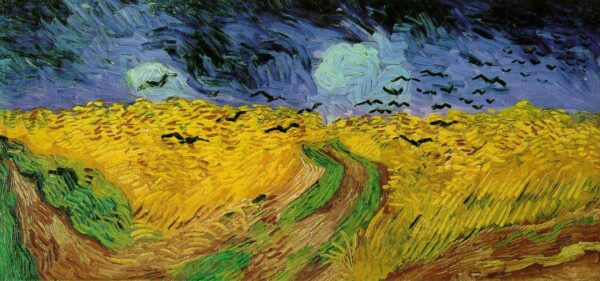
The Sower, also painted in Arles in 1888, shows the other end of the farming year, a man sowing a field. The Yellow House shows the house in Arles where he lived and worked, and Starry Night over the Rhône, from the same year, turns from the summer day to the river at night. Wheat Field with Crows is a wheat field too, but painted in Auvers-sur-Oise in 1890, under a dark, stormy sky.
Choose The Harvest for a bright, calm summer landscape full of detail, Wheat Field with Crows for drama, and Starry Night over the Rhône for the blue of the night rather than the gold of the day.
How is our hand-painted The Harvest made?
The painter first draws the horizon and the bands of the fields, places the haystack, the cart, the farmhouses and the fence, and checks the perspective against the original, so that the plain keeps its depth. Then come the sky in short blue strokes, the yellow and green fields, the dark bushes and last the small details: the ladder, the cart wheels and the figure. Our oil painting reproduction is painted by hand in oil on canvas with real impasto: the paint goes on thickly, so the brushstrokes stand up from the canvas as they do in the original and catch the light.
On this painting the relief matters most in the stubble of the foreground, laid on in long parallel strokes, in the bushes and in the haystack. A print shows only a flat surface; on our painting the strokes are real.
Every painting is a hand-painted copy made for your order, so no two are quite the same. Before dispatch we photograph it, sending you the photograph to approve.
Which size for which wall?
Short answer: 80 x 60 or 92 x 73 cm above a sideboard or a bed, 120 x 100 or 140 x 105 cm above a sofa, and 160 x 127 cm for a large empty wall. The landscape format suits a living room, a dining room, a hallway or a kitchen.
There are 17 sizes: 50 x 40, 60 x 50, 70 x 55, 80 x 60, 80 x 65, 85 x 67, 92 x 73, 100 x 80, 105 x 85, 110 x 90, 115 x 93, 120 x 100, 130 x 102, 140 x 105, 145 x 113, 150 x 120 and 160 x 127 cm (width x height). The original is 91.8 cm wide and 73.4 cm high; our 92 x 73 cm size is the closest to it, so the painting on your wall is almost exactly as large as in the museum. This light, warm painting works on a white, cream or pale grey wall, and on a soft green or blue one that repeats its fields and sky. A painting for the living room should cover about two thirds of the width of the furniture below it.
Hang it with the centre of the canvas about 150 cm above the floor, leaving 20 to 30 cm between the furniture and the bottom edge.
What if I need a custom size or a frame?
If none of the 17 sizes fits your wall, we paint it to measure. Keep the proportions close to the original, otherwise the fields and the haystack get squeezed or stretched. Send us the width and height you want and we will quote a price and a lead time. Every painting we make is stretched over a wooden stretcher and ready to hang.
For the moulding, use our 3D application: it shows each of our frame profiles on this subject, so you can compare gold, silver, black, white and natural wood – the application is for choosing the frame only. Seeing the painting on your own wall is our separate room placement service. A gold or natural wood frame picks up the wheat and the straw, and a white frame keeps the painting light.
How does delivery work, and what is the guarantee?
Every painting is made to order in our studio in Slovenia, so allow 15 to 45 days depending on the size you choose. We ship it stretched and protected, framed if you chose a frame, across the EU with no customs. Before dispatch you receive a photograph of the finished work to approve, and we correct anything that is not right. Our returns policy applies to every order.
More famous Van Gogh paintings are in the Vincent van Gogh gallery, and there is more about the painter in our article on Vincent van Gogh. If you are giving it as a present and are not sure of the size, a wall art voucher lets the recipient choose.
Frequently asked questions
Where is the original The Harvest by Van Gogh today?
In the Van Gogh Museum in Amsterdam. The museum lists it as The Harvest, Arles, June 1888, oil on canvas, 73.4 x 91.8 cm, object number s0030V1962, in the collection of the Vincent van Gogh Foundation. Van Gogh sent it to Theo in Paris in August 1888, and it stayed in the family until it came to the museum.
When and where did Van Gogh paint The Harvest?
In June 1888, in the wheat fields around Arles in the south of France. The Van Gogh Museum writes that in just over a week he completed ten paintings and five drawings there, working under the burning sun until a heavy storm ended the harvest season. He wrote about this canvas to Theo on 12 or 13 June 1888.
What is the meaning of The Harvest by Van Gogh?
It is a painting about work on the land. The museum explains that Van Gogh wanted to show peasant life and work in the fields, a recurring theme in his art, and painted several stages of the harvest. A half mowed field, ladders, carts and a reaper tell the whole job of bringing in the wheat in one wide view.
Why did Van Gogh call it The Harvest?
Because of the work going on in it. According to the Van Gogh Museum, a reaper works in the background, which is why Van Gogh titled it La moisson, French for the harvest. The figures are small and easy to miss, so look for them among the fields, the haystack and the carts.
What did Van Gogh himself say about The Harvest?
He was very pleased with it. In a letter to Theo of 12 or 13 June 1888 he wrote that the last canvas absolutely kills all the rest, and that only a still life with coffee pots, cups and plates in blue and yellow could stand beside it. The museum notes that he considered it one of his most successful paintings.
How big is the original The Harvest?
The original is 73.4 cm high and 91.8 cm wide, a landscape format that suits a wall above a sofa, a sideboard or a dining table. Our 92 x 73 cm size is practically the same, and there are smaller and larger sizes from 50 x 40 up to 160 x 127 cm, as well as custom sizes.
Is The Harvest a good painting to give as a gift?
It is a warm, bright gift that suits many homes: a house in the country, a kitchen or a dining room, someone who grew up on a farm or has spent summers in Provence, or anyone who wants a cheerful canvas painting full of light. Its subject, bringing in the harvest, also makes it a fitting present for a new home.
Does your copy of The Harvest have the raised brushstrokes of the original?
Yes. We paint our copy in impasto: the paint goes on thickly, so the brushstrokes stand up from the canvas as on Van Gogh’s original. You see it best in the stubble of the foreground, the haystack, the bushes and the short strokes of the sky, where the relief catches the light. A print cannot have this relief, because its surface is flat.
- Subject: the wheat fields near Arles at harvest time, with a haystack, a blue cart and farmhouses under an azure sky.
- Original: June 1888, Arles, 73.4 x 91.8 cm, Van Gogh Museum, Amsterdam.
- Ours: a Van Gogh reproduction painted by hand in oil on canvas, in 17 sizes from 50 x 40 to 160 x 127 cm or made to measure.
- Worth knowing: you receive a photograph of the finished work for approval before dispatch.