







































Description
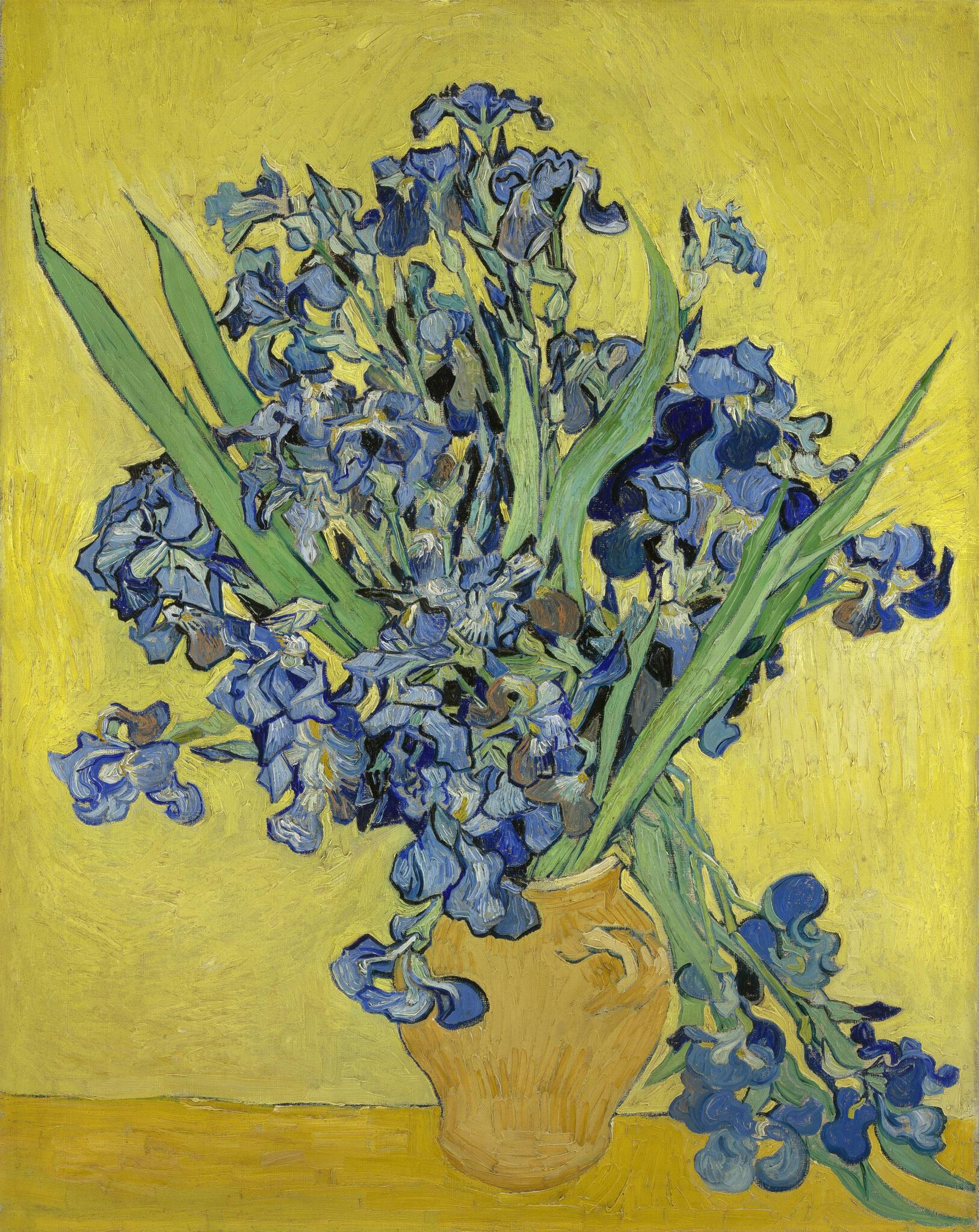
Vase with Irises Against a Yellow Background is the still life Vincent van Gogh painted in May 1890 in the psychiatric hospital at Saint-Rémy-de-Provence: a large bouquet of blue-violet irises with long green leaves in an ochre vase, standing on a yellow base against a lemon-yellow wall. The original, oil on canvas, measures 92.7 x 73.9 cm and hangs in the Van Gogh Museum in Amsterdam. We paint it by hand in oil on canvas, in 16 sizes from 40 x 50 to 127 x 160 cm or to your own measurement, and send you a photograph of the finished work for approval before dispatch.
| Title: | Vase with Irises Against a Yellow Background |
| Other titles: | Irises · Irises in a vase |
| Painter: | Vincent van Gogh (1853–1890) |
| Year painted: | May 1890, Saint-Rémy-de-Provence |
| Original size: | 92.7 cm x 73.9 cm |
| Original technique: | Oil on canvas |
| Painting style: | Post-Impressionism |
| Located at: | Van Gogh Museum, Amsterdam (inv. s0050V1962) |
| Our reproduction: | Hand-painted oil on canvas, 16 sizes or made to measure |
Vase with Irises Against a Yellow Background – Vincent van Gogh
What does the painting show?
A tall bunch of irises fills almost the whole canvas. The blooms open in every direction, blue and violet with touches of white, and long sword-shaped leaves fan out to the left and to the right. The bouquet stands in a rounded ochre vase with a small handle, on a yellow base at the bottom edge, and behind it there is nothing but a lemon-yellow wall.
On the right the flowers lean out over the rim, a few stems hang down beside the vase and loose blooms lie on the base, as if the bunch were too heavy for its container. Van Gogh drew many petals and leaves with darker outlines, so every flower keeps its own shape against the yellow.
Why is the background yellow?
Because Van Gogh wanted the strongest possible clash of colour. The Van Gogh Museum describes the painting as mainly a study in colour: he set out to achieve a powerful colour contrast, and by placing the purple flowers against a yellow background he made their decorative forms stand out even more strongly. Yellow and violet sit opposite each other on the colour wheel.
He explained the idea himself in a letter to his brother Theo of 11 May 1890, letter 870 in the online edition of his letters. The violet bouquet, ranging in his words up to pure carmine and Prussian blue, stands out against a striking lemon yellow background, with other yellow tones in the vase and the base. He called it “an effect of terribly disparate complementaries that reinforce each other by their opposition”.
What does the painting mean?
It belongs to the last days of Van Gogh’s stay in Saint-Rémy. In the same letter of 11 May 1890 he wrote that “the whole horrible crisis has disappeared like a thunderstorm” and that he was working “with calm, unremitting ardour to give a last stroke of the brush”. He was already packing his trunk for the journey north to Paris.
It is a bunch of flowers turned into an experiment in colour, painted in the days before he left the south. One thing has changed since: the museum notes that the irises were originally purple, but as the red pigment has faded, they have turned blue.
Where does the original hang?
The original hangs in the Van Gogh Museum in Amsterdam, which lists it under the short title Irises: Saint-Rémy-de-Provence, May 1890, oil on canvas, 92.7 x 73.9 cm, object number s0050V1962. It belongs to the Vincent van Gogh Foundation.
In his letter Van Gogh wrote that the canvases would take a good month to dry and that a man who worked at the hospital would send them on after his departure. The museum records the painting with Theo in Paris after the end of June 1890. After Theo’s death in January 1891 it passed to his widow, Jo van Gogh-Bonger, and their son, Vincent Willem. It has been in the Van Gogh Museum since the museum opened on 2 June 1973.
Vase with Irises Against a Yellow Background or Irises – which one is which?
Irises is the earlier painting, from 1889, also made at the asylum in Saint-Rémy: a landscape of irises growing out of the earth, cropped close, with no vase and no wall. The painting on this page, from May 1890, is a still life: cut flowers in a vase, set against one flat colour. The museum adds that Van Gogh painted this bouquet twice; in the other still life he set purple and pink against green.
If yellow is the colour you are after, Sunflowers I and Sunflowers II build a whole painting on it, and Almond Blossom sets flowering branches against a flat blue sky. Choose the irises on yellow for one strong, bright contrast in a light room, Irises for a long wall above a sofa, and Almond Blossom for a calm bedroom.
How is our hand-painted version made?
The painter first draws the vase, the fan of leaves and the main clusters of flowers and checks the proportions against the original, so the bouquet leans exactly where Van Gogh let it fall. Then comes the yellow wall, laid in with short strokes in several yellows, then the green leaves, then the irises in blue, violet and white, and last the dark outlines around petals and leaves. Our oil painting reproduction is painted by hand in oil on canvas with real impasto: the paint goes on thickly, so the brushstrokes stand up from the canvas as they do in the original and catch the light.
On this painting the relief shows most in the petals, where the paint is laid on in thick curls, along the long leaves and in the woven strokes of the yellow wall. A print shows only a flat surface; on our painting the strokes are real.
Every painting is a hand-painted copy made for your order, so no two are quite the same. Before dispatch we photograph it, sending you the photograph to approve.
Which size for which wall?
Short answer: 40 x 50 or 49 x 60 cm for a small wall in a hallway or a study, 64 x 80 or 74 x 94 cm above a chest of drawers or a sideboard, 100 x 120 or 120 x 150 cm above a sofa, and 127 x 160 cm for a large wall in an open-plan room.
There are 16 sizes: 40 x 50, 49 x 60, 50 x 62, 54 x 65, 60 x 70, 64 x 80, 70 x 90, 74 x 94, 80 x 100, 85 x 105, 90 x 110, 100 x 120, 105 x 125, 109 x 135, 120 x 150 and 127 x 160 cm (width x height). The original is 73.9 cm wide and 92.7 cm high; our 74 x 94 cm size is almost exactly as large, so the bouquet on your wall matches the one in the museum. The 40 x 50, 64 x 80, 80 x 100 and 120 x 150 cm sizes keep the original’s proportions of about four to five. The lemon-yellow wall makes this a bright painting: it looks best on a white, light grey or deep blue wall and in a room with daylight. A painting for the living room should cover about two thirds of the width of the furniture below it.
Hang it with the centre of the canvas about 150 cm above the floor. Above a sofa, a bed or a sideboard, leave 20 to 30 cm between the furniture and the bottom edge.
What if I need a custom size or a frame?
If none of the 16 sizes fits your wall, we paint it to measure. Send us the measurements you want and we will quote a price and a lead time. Every painting we make is stretched over a wooden stretcher and ready to hang.
For the moulding, use our 3D application: it shows each of our frame profiles on this subject, so you can compare gold, silver, black, white and natural wood – the application is for choosing the frame only. Seeing the painting on your own wall is our separate room placement service. A gold or natural wood frame picks up the ochre of the vase; a narrow white frame keeps the yellow at full strength.
How does delivery work, and what is the guarantee?
Every painting is made to order in our studio in Slovenia, so allow 15 to 45 days depending on the size you choose. We ship it stretched and protected, framed if you chose a frame, across the EU with no customs. Before dispatch you receive a photograph of the finished work to approve, and we correct anything that is not right. Our returns policy applies to every order.
More famous Van Gogh paintings are in the Vincent van Gogh gallery, and there is more about the painter in our article on Vincent van Gogh. If you are giving it as a present and are not sure of the size, a wall art voucher lets the recipient choose.
Frequently asked questions
Where is the original Vase with Irises Against a Yellow Background today?
In the Van Gogh Museum in Amsterdam. The museum lists it under the short title Irises, oil on canvas, 92.7 x 73.9 cm, object number s0050V1962, in the collection of the Vincent van Gogh Foundation. It stayed in the Van Gogh family from 1890, when it reached Theo in Paris, until it passed to the foundation in 1962.
When and where did Van Gogh paint Vase with Irises Against a Yellow Background?
In May 1890, in the psychiatric hospital at Saint-Rémy-de-Provence. On 11 May he wrote to Theo that he was working on two large bouquets of violet irises and planned to leave that week; the canvases, he added, would need a good month to dry and would be sent on after him.
Why did Van Gogh paint the irises against a yellow background?
To make the colours work against each other. Yellow and violet are complementary colours, and Van Gogh described the result as an effect of terribly disparate complementaries that reinforce each other by their opposition. The Van Gogh Museum calls the painting mainly a study in colour, in which the yellow makes the decorative forms of the flowers stand out even more strongly.
Why are the irises blue when Van Gogh called them violet?
Because the paint has changed. According to the Van Gogh Museum, the irises were originally purple, but the red pigment in the paint has faded, so they have turned blue. In May 1890 the contrast with the yellow was therefore even sharper, since violet sits directly opposite yellow among the complementary colours. The blue on the canvas today is a faded violet.
How is Vase with Irises Against a Yellow Background different from Irises of 1889?
One is a still life, the other a landscape. Irises, from 1889, shows the flowers growing outdoors, cropped close, with earth around them and no vase. This painting, from May 1890, shows cut irises in a vase against a flat yellow wall. Both come from Van Gogh’s stay in Saint-Rémy, about a year apart.
Did Van Gogh paint more than one vase of irises?
Yes, two of this bouquet, both in May 1890. The Van Gogh Museum notes that in the other still life he contrasted purple and pink with green. In his letter of 11 May he described them side by side: the pink one harmonious and soft, the one on lemon yellow an effect of disparate complementaries.
How big is the original Vase with Irises Against a Yellow Background?
The original is 92.7 cm high and 73.9 cm wide, an upright format just under a metre high. Our 74 x 94 cm size comes closest to it, and there are smaller and larger sizes from 40 x 50 up to 127 x 160 cm, as well as custom sizes in any measurement you need.
Which size of Vase with Irises Against a Yellow Background suits a living room?
Above a sofa, 100 x 120 or 120 x 150 cm usually works best. As a rule, a canvas painting above furniture should cover about two thirds of its width, so a sofa 180 cm wide takes a painting about 120 cm wide. For a narrow wall beside a door or in a hallway, 49 x 60 or 64 x 80 cm is enough.
Does your Vase with Irises Against a Yellow Background have the raised brushstrokes of the original?
Yes. We paint our irises in impasto: the paint goes on thickly, so the brushstrokes stand up from the canvas as on Van Gogh’s original. You see it best in the curled strokes of the petals, along the long leaves and in the short strokes of the yellow wall, where the relief catches the light. A print cannot have this relief, because its surface is flat.
- Subject: a large bouquet of blue-violet irises with long green leaves in an ochre vase, against a lemon-yellow wall.
- Original: May 1890, Saint-Rémy-de-Provence, oil on canvas, 92.7 x 73.9 cm, Van Gogh Museum, Amsterdam.
- Ours: a Van Gogh reproduction painted by hand in oil on canvas, in 16 sizes from 40 x 50 to 127 x 160 cm or made to measure.
- Worth knowing: you receive a photograph of the finished work for approval before dispatch.