







































Description
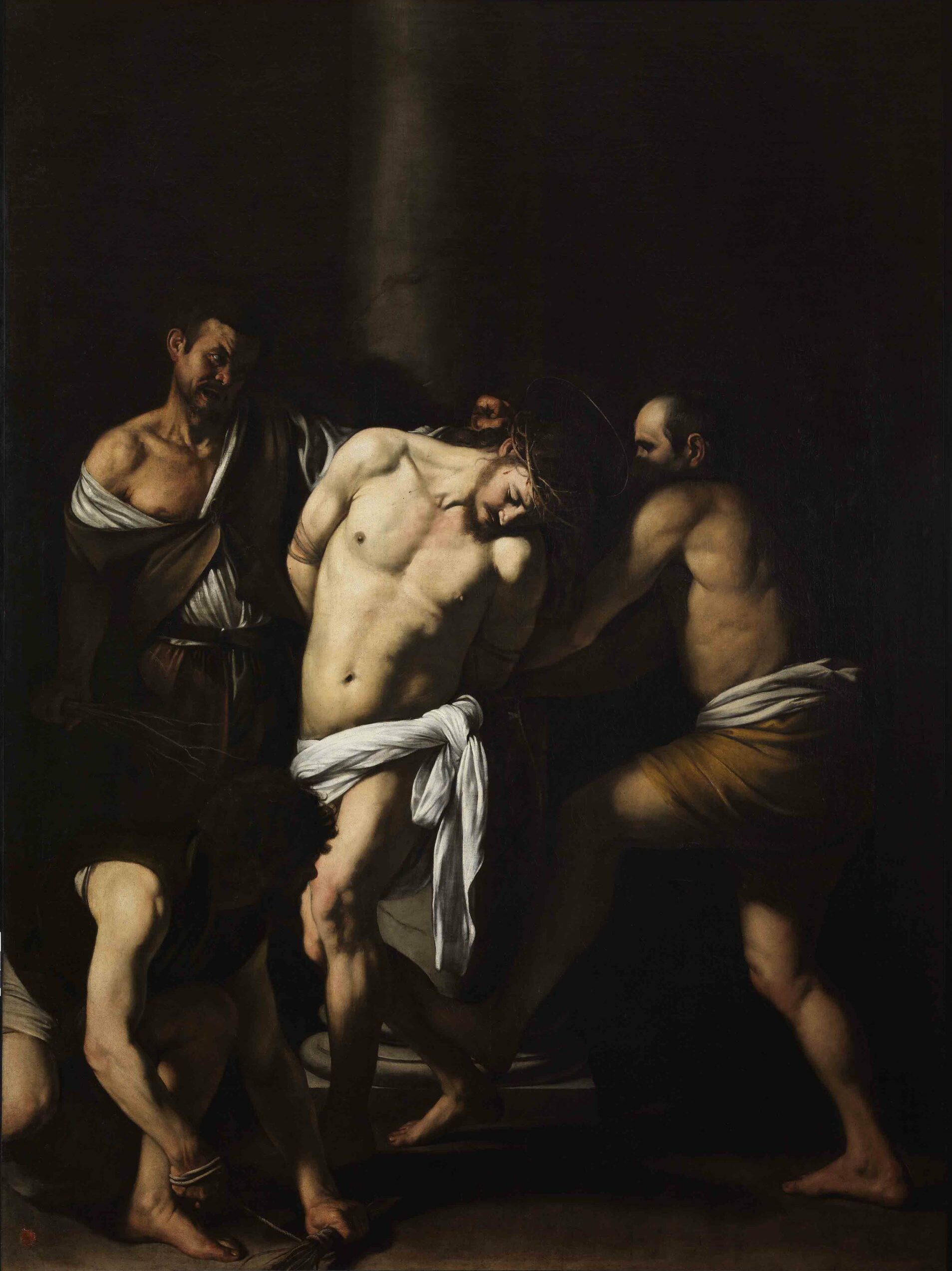
The Flagellation of Christ is an altarpiece by Caravaggio from 1607, which the painter may have reworked in 1610: Christ, in a white loincloth and a crown of thorns, is bound to a column while three men tie him and make ready to strike, one of them kneeling at the lower left, all of it set in deep darkness. The original, oil on canvas, is 286 cm high and 213 cm wide and belongs to the Museo di Capodimonte in Naples. Our painter paints it for you by hand in oil on canvas, in 8 portrait sizes from 40 x 55 to 156 x 200 cm or to your own measurement, and before dispatch we send you a photograph of the finished painting.
| Title: | The Flagellation of Christ |
| Other titles: | Flagellazione di Cristo · Die Geißelung Christi |
| Painter: | Michelangelo Merisi da Caravaggio (1571–1610) |
| Year painted: | 1607 |
| Original size: | 286 cm x 213 cm (height x width) |
| Original technique: | Oil on canvas |
| Painting style: | Baroque, tenebrism |
| Located at: | Museo di Capodimonte, Naples |
| Our reproduction: | Hand-painted oil on canvas, 8 sizes or made to measure |
The Flagellation of Christ – Caravaggio
What does The Flagellation of Christ show?
The scene is set in near-total darkness. At the centre stands Christ in a white loincloth and crown of thorns, bound to the column. The light falls mostly on him, so his body comes away from the dark ground like a carved figure.
Three men surround him. The one on the left grips his hair hard, the one on the right presses a foot into the back of his knee, which is why Christ buckles and sags. The third kneels at the lower left, bent over his task, getting everything ready for the blows.
The space is as shallow as a narrow stage, with no landscape and no onlookers: just four figures, the column and a light that pulls them out of the dark.
What is the story behind the scene?
The Gospels tell that Christ was scourged before the crucifixion, and for a long time this moment of the Passion was one of the most frequent subjects in Christian art.
In Caravaggio’s day this was no mere story from the distant past. The Church then encouraged the faithful to practise self-flagellation as a way of entering into the suffering of Christ themselves.
Caravaggio tells it through posture: a hand clenched in the hair, a foot against the knee and a body that gives way. No words are needed.
Why is The Flagellation of Christ so admired?
Caravaggio had in mind the famous fresco by Sebastiano del Piombo in the Roman church of San Pietro in Montorio. He shrank its space so drastically that the sculptural figures seem to stand on a shallow stage, yet kept the rhythmic spread of bodies across the canvas.
What was new was the sharp eye for reality. Christ sags not for the sake of a graceful pose; he sags because the man on the right drives a foot into the back of his knee and the man on the left has hold of his hair. The Wikipedia article (in English) goes into more detail.
It was painted within months of Caravaggio’s arrival in Naples, alongside The Seven Works of Mercy and the closely related Christ at the Column. These altarpieces made him the most talked-about artist in the city almost at once, and a circle of followers gathered around him, from Battistello Caracciolo to Flemish painters who carried his style to northern Europe.
Where is the original Flagellation of Christ?
According to Bellori, writing in 1672, the de Franchis (or di Franco) family commissioned it for a chapel in the Neapolitan church of San Domenico Maggiore. The family had ties to the confraternity of the Pio Monte della Misericordia, for whose church Caravaggio had already painted The Seven Works of Mercy.
In 1972 the canvas moved to the museum at Capodimonte, where it still hangs. It is dated 1607, and the painter may have returned to it and reworked it in 1610.
Do not confuse it with Christ at the Column, painted in the same period and kept in Rouen. Our reproduction follows the Naples composition with its three men around Christ.
The Flagellation of Christ or another Caravaggio?
The Flagellation of Christ is a serious canvas painting about suffering, better suited to a study, a library or a corner for quiet prayer than to a child’s room.
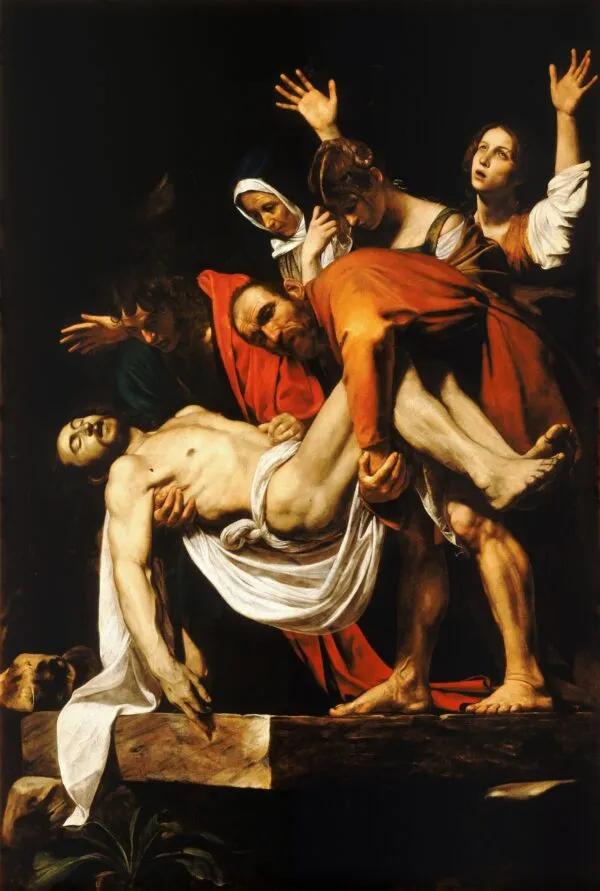
If you are looking for another scene from the Passion, see The Entombment of Christ, a later moment in the same story. As a companion piece with an equally strong diagonal, The Crucifixion of Saint Peter works well, with three labourers raising the cross.
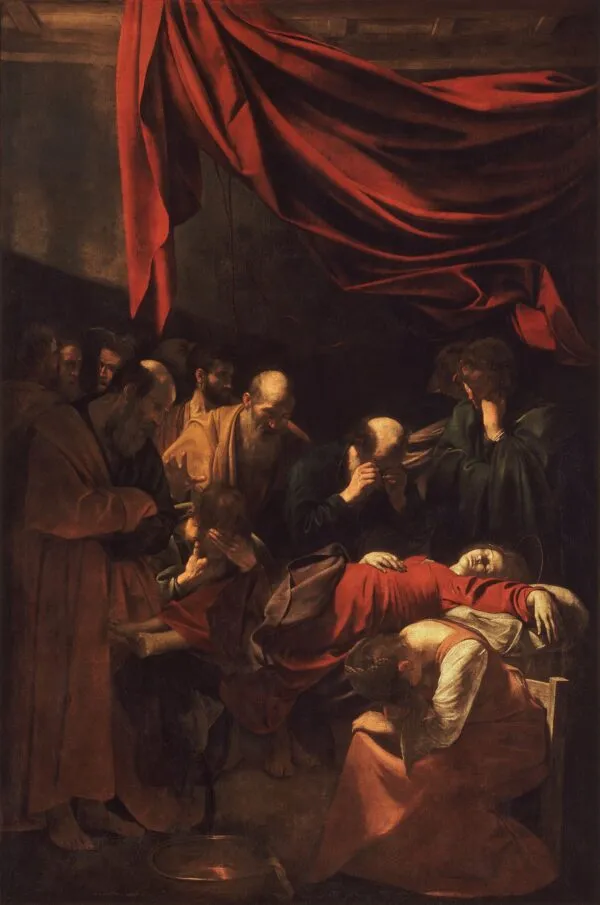
Quieter in mood are Death of the Virgin, with apostles mourning beside the dead Mary, and The Supper at Emmaus, where the risen Christ reveals himself to two disciples at table. The famous Caravaggio paintings we paint to order are all collected on the Caravaggio page.
How does our painter paint your Flagellation of Christ?
Each Flagellation is painted to order, layer by layer, in oil on canvas. The painter first lays down the dark ground and fixes where the column stands and where the light strikes Christ’s body, because the whole composition depends on that relationship.
Then he models Christ’s muscles and skin in warm light tones, along with the white loincloth and the thin branches of the crown of thorns. The three men get darker skin tones and clothing that sinks into shadow, so the centre stays clear.
This Caravaggio reproduction carries brushstrokes you can feel on its surface, something no print can offer. A dark scene like this shows best what an oil painting reproduction brings: the deep shadows stay translucent and the pale skin seems lit from within.
Which size suits your wall?
In short: 40 x 55 or 47 x 62 cm for a hallway or narrow wall, 60 x 81 or 68 x 90 cm above a chest of drawers or desk, 84 x 115 or 105 x 145 cm above a sofa or sideboard, and 120 x 160 or 156 x 200 cm for a tall wall, a stairwell or a church interior.
The eight upright sizes, given as width x height, are 40 x 55, 47 x 62, 60 x 81, 68 x 90, 84 x 115, 105 x 145, 120 x 160 and 156 x 200 cm. The original is a large altarpiece, so even our biggest size, 156 x 200 cm, is 57 cm narrower and 86 cm shorter.
As a painting for the living room, above a sofa, 84 x 115 or 105 x 145 cm works well, since the upright figure of Christ needs some height. Hang it with Christ’s face at about eye level, with some empty wall on either side.
Can I have another size or a frame?
Yes. The original is roughly 3 : 4 in proportion, so it adapts to almost any upright size without the edge cutting off the kneeling man at the lower left. Tell us the width and height you need and we will come back with a price and a date for your Flagellation.
We ship it rolled, stretched on a stretcher bar or framed; the stretching and framing are done by our workshop in Slovenia. The frame for this Passion scene is picked in our 3D application, which handles frame choice and nothing else; showing the painting on your own wall is a separate service.
A sturdy dark wooden frame or one in patinated gilding suits the dark ground and the pale body.
When and how does the painting arrive?
We start painting as soon as your order comes in, and after 15 to 45 working days your Flagellation of Christ is ready to go. Before it leaves we send you a photograph of the finished painting, and if you want a change, we make it. There are no customs within Slovenia and the EU, and every order is covered by our returns policy.
It suits a parish or a collector of sacred art as a gift. If the size should be chosen by the person receiving it, give a wall art voucher instead.
Frequently asked questions
Where is the original on display?
In Naples, at the Museo di Capodimonte, where it was moved in 1972.
Who are the men around Christ?
Three tormentors who bind him to the column and prepare the scourging; one of them kneels at the lower left.
Is this a print?
No. Our painter makes a hand-painted copy in oil on canvas for your order, brushstroke by brushstroke.
How big is the original?
It is 286 cm high and 213 cm wide; our largest size, 156 x 200 cm, is smaller.
Does it suit a living room?
Yes, if you value a serious religious subject; it also sits well in a study, a library or a hallway.
Which size goes above a 200 cm sofa?
Choose 84 x 115 or 105 x 145 cm, so that some wall stays free on each side.
Can I order a size that is not listed?
Yes. Send us the width and height and we will reply with a price and a lead time.
How long does it take?
15 to 45 working days; before dispatch you see a photograph of the finished painting.
- Subject: Christ in a white loincloth and crown of thorns, bound to a column, with three men preparing the scourging around him in deep darkness.
- Original: 1607, oil on canvas, 286 x 213 cm, Museo di Capodimonte, Naples.
- Ours: hand-painted in oil on canvas, in one of 8 portrait sizes (40 x 55 to 156 x 200 cm) or to your measurement.
- Worth knowing: the de Franchis family of Naples commissioned it for a chapel in San Domenico Maggiore.