







































Description
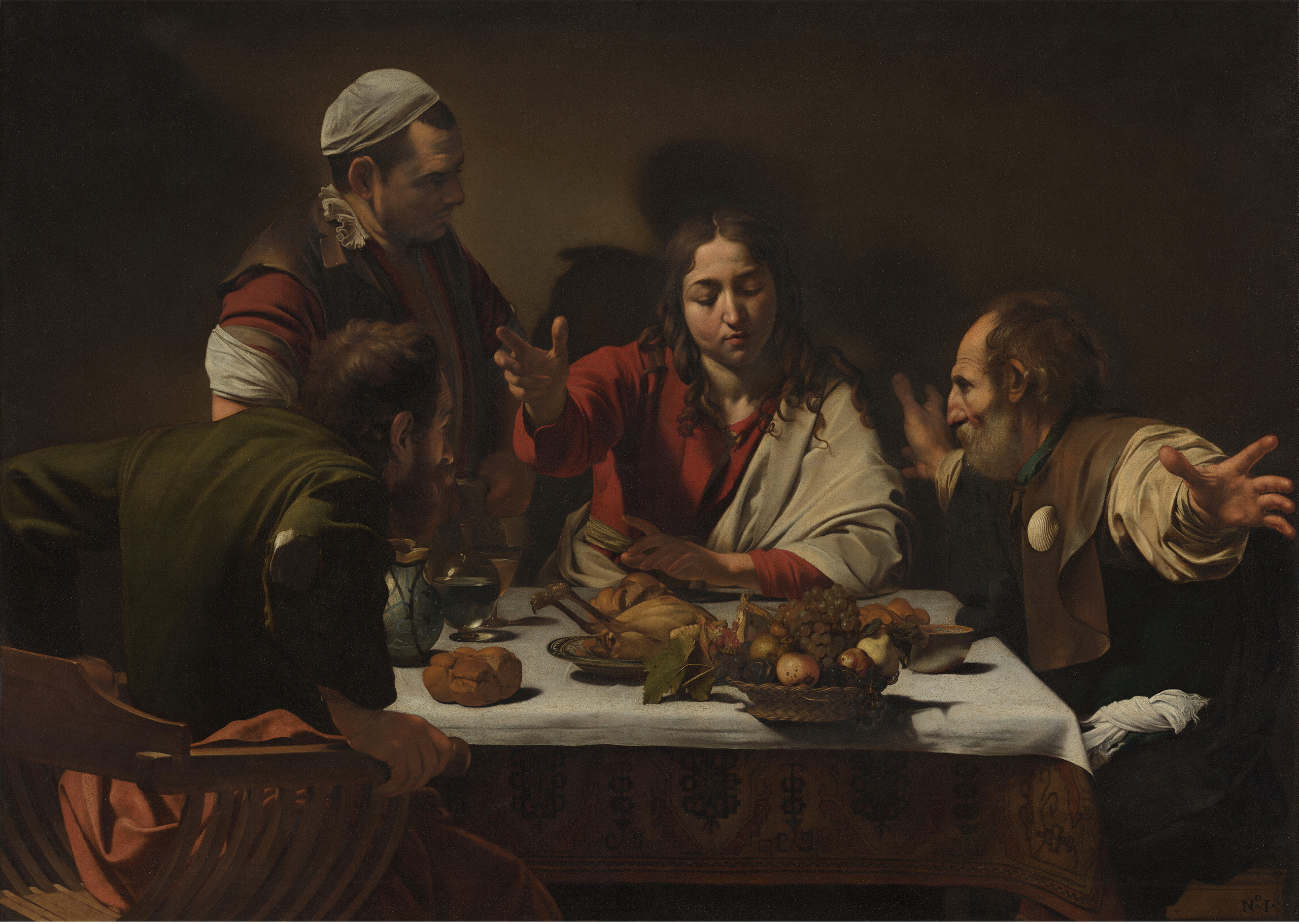
The Supper at Emmaus is Caravaggio’s painting of 1601 that catches the instant two disciples at a table recognise the risen Christ: the young, beardless Christ raises his right hand in blessing, the disciple on the right flings his arms wide, the one on the left is about to leap from his chair, and the innkeeper in a white cap has no idea what is happening. The original, oil on canvas, 141 cm high and 196.2 cm wide, belongs to the National Gallery in London. Our painter paints it by hand in oil on canvas in 8 landscape sizes, from 56 x 40 to 200 x 148 cm, or to your own measurement, and before dispatch we send you a photograph of the finished painting.
| Title: | The Supper at Emmaus |
| Other titles: | Cena in Emmaus · Das Abendmahl in Emmaus |
| Painter: | Michelangelo Merisi da Caravaggio (1571–1610) |
| Year painted: | 1601 |
| Original size: | 141 cm x 196.2 cm (height x width) |
| Original technique: | Oil on canvas |
| Painting style: | Baroque, tenebrism |
| Located at: | The National Gallery, London (inv. NG172) |
| Our reproduction: | Hand-painted oil on canvas, 8 sizes or made to measure |
The Supper at Emmaus – Caravaggio
What can you see in The Supper at Emmaus?
At a table laid with a white cloth sits Christ, young and clean-shaven, in a red tunic with a white mantle over his shoulder. He raises his right hand over the table in blessing; his left rests beside the bread.
On the right sits the disciple Cleopas. A pilgrim’s scallop shell is pinned to his coat, and he throws his arms so wide that one hand almost reaches the edge of the canvas. On the left the second disciple, dressed in green, braces himself on the arms of his chair and is just rising; his sleeve is torn at the elbow.
Behind Christ stands the innkeeper in a white cap. He looks at him, but cannot see why his guests are so startled.
On the cloth are bread, a roast bird, a carafe, a glass and a basket of fruit perched on the very edge of the table, as though it might tip off at any moment. The background is dark and bare, and the figures are painted life-size.
What is the story of Emmaus?
It comes from the Gospel of Luke (24:30–31). On the third day after the Crucifixion two of Jesus’ disciples were walking to Emmaus. A traveller they did not recognise joined them, and in the evening he sat down to supper with them.
When he took the bread, blessed it and broke it, their eyes were opened and they knew him. The next moment he had vanished from their sight.
Caravaggio paints exactly that split second in which recognition happens: one disciple jolts upright, the other spreads his arms, and the innkeeper stays outside the mystery. That is why anyone who has ever suddenly recognised someone who was in front of them all along understands the scene.
Why is this Caravaggio so famous?
It was painted in 1601, when Caravaggio was at the height of his fame. Ciriaco Mattei, brother of Cardinal Girolamo Mattei, commissioned it after the painter’s Saint Matthew canvases in the Roman church of San Luigi dei Francesi had made his name.
The National Gallery counts it among his most impressive religious pictures for a private home and calls it perhaps his most famous work. The museum also points to a detail that is easy to miss: on our side of the table one place is empty, as if it were waiting for the viewer.
Its fame also rests on the light, which pulls faces, hands and the white cloth out of the darkness, and on the still life on the table, painted so solidly that you almost want to reach for the bread. The Wikipedia article (in English) tells more about the work and how it came about.
Where does the original hang, and how did it reach London?
The original belongs to the National Gallery in London, which lists it as NG172. It is oil on canvas, 141 cm high and 196.2 cm wide.
In 1650 it is recorded at the Villa Borghese in Rome, where it had probably arrived earlier through Cardinal Scipione Borghese. Prince Camillo Borghese sold it to Durand in 1801. By 1831 it belonged to the Hon. George Vernon, and in 1839 Lord Vernon presented it to the gallery, where it still hangs.
Mind the mix-up: in 1606 Caravaggio painted a second, quieter Supper at Emmaus, now in the Pinacoteca di Brera in Milan. What you order from us is the London version of 1601.
The Supper at Emmaus or another Caravaggio?
This picture is happiest in a dining room, above a long table or wherever the household gathers for meals. The landscape format and the scene at a table connect naturally with a room like that.
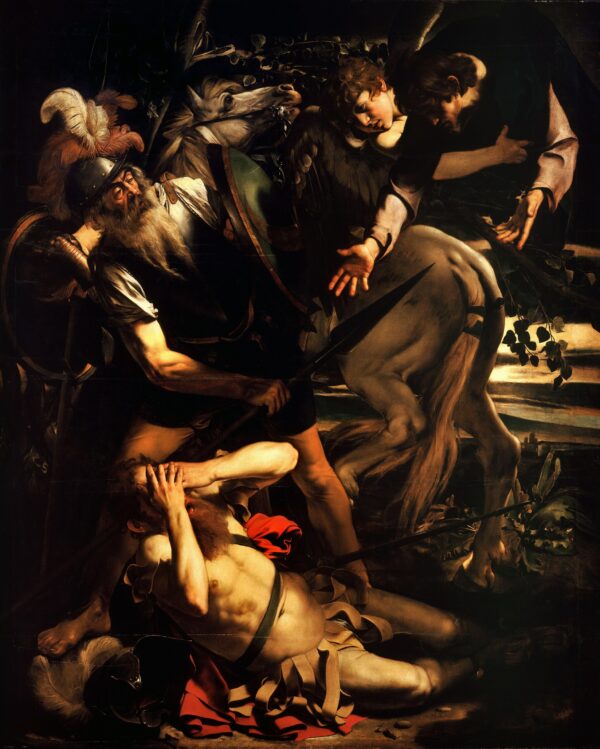
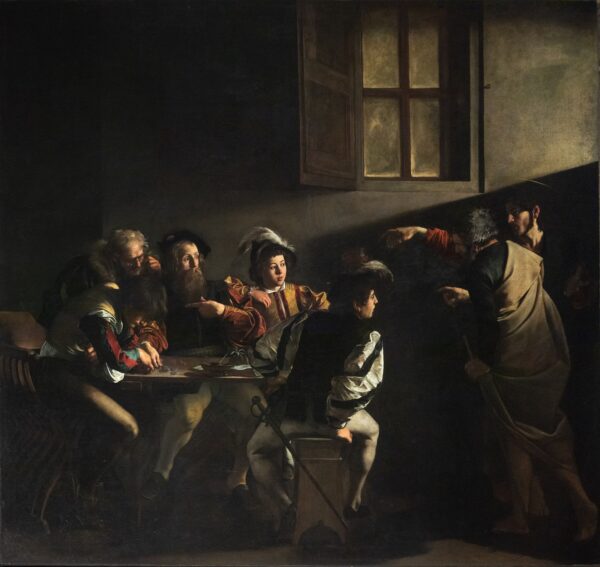
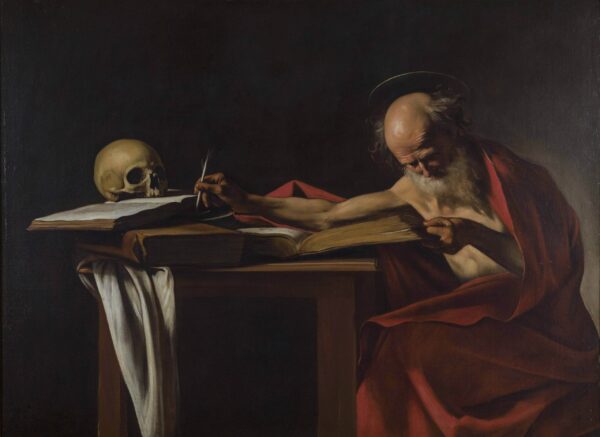
If you prefer the moment when Christ calls someone to follow him, choose The Calling of Saint Matthew. There is more movement in The Conversion of Saint Paul, while the quiet concentration of a single man fills Saint Jerome Writing.
Supper scenes, saints and quiet portraits: the famous Caravaggio paintings in our range all sit together on the Caravaggio page.
How does our painter paint your Supper at Emmaus?
Every Caravaggio reproduction we sell is begun only once you order. The painter works in oil on canvas, layer by layer, and first lays in the dark ground and the outlines of the four men around the table.
Then he builds the light: on Christ’s face and raised hand, on the red tunic, on Cleopas’ open palms and in the folds of the white cloth.
The still life comes last: the crust of the bread, the reflections on the carafe and the glass, the fruit in the basket and the shell on the coat. That is how an oil painting reproduction gains a depth and warmth that a print lacks.
Which size for which wall?
The short answer: for a smaller wall 56 x 40 or 70 x 52 cm, above a chest of drawers 80 x 59 or 101 x 74 cm, above a sofa or a dining table 114 x 82 or 140 x 105 cm, and for large walls 160 x 115 and 200 x 148 cm.
All 8 landscape sizes (width x height): 56 x 40, 70 x 52, 80 x 59, 101 x 74, 114 x 82, 140 x 105, 160 x 115 and 200 x 148 cm. The original measures 196.2 x 141 cm; the nearest size is 200 x 148 cm, which is 3.8 cm wider and 7 cm taller.
As a painting for the living room above a three-seater sofa, 140 x 105 cm is the most balanced choice. A simple rule helps: make the painting about two thirds as wide as the furniture below it, with its lower edge 20 to 30 cm above the backrest.
Can I choose another size or a frame?
Of course. The original is roughly 7 : 5 in proportion; keep that and the whole table, the basket on its edge and all four men stay on the canvas. Tell us the size you have in mind and we will send you a price and a delivery date.
We send it rolled, stretched on a stretcher bar or ready framed. Our workshop in Slovenia stretches and frames every canvas painting we ship.
You pick the frame in our 3D application, which exists only for choosing frames; seeing the painting on your own wall is a separate service. Dark, warm scenes like this one sit well in a gilded or dark brown wooden frame.
When will my painting arrive?
We start painting once your order is in; making it takes 15 to 45 working days. Before we ship it we send you a photograph of it, and if you want a correction, we make it.
Within Slovenia and the EU there are no customs duties, and our returns policy covers every order. For a gift where the recipient should choose the size, there is the wall art voucher.
Frequently asked questions
Where is the original Supper at Emmaus?
In the National Gallery in London, under the inventory number NG172.
What does the scene mean?
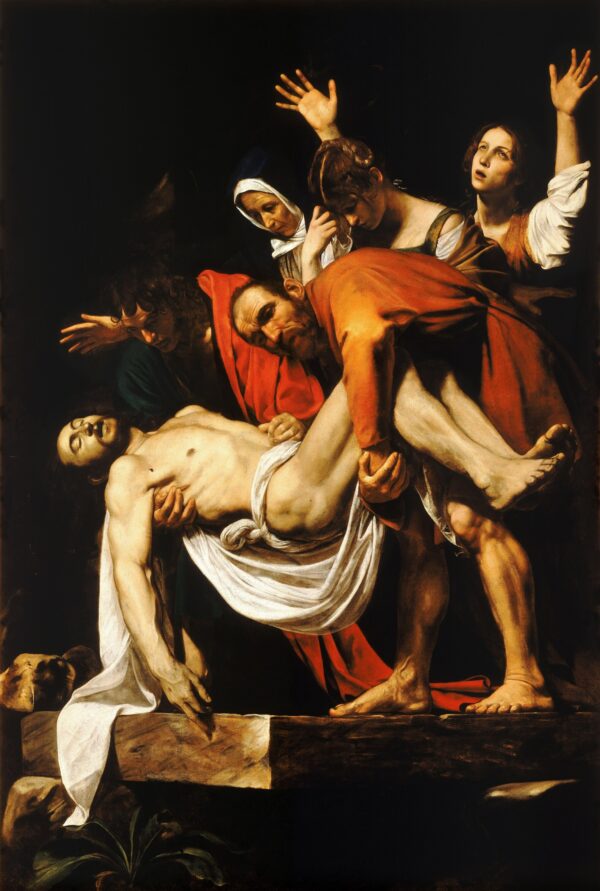
It shows the moment the disciples recognise the risen Christ. The grief at his burial, two days earlier, is the subject of The Entombment of Christ.
Is it a print?
No. You receive a hand-painted copy in oil on canvas, painted specially for you.
How large is the original?
It is 141 cm high and 196.2 cm wide; the figures are life-size.
Is this the version in Milan?
No. We offer the London version of 1601; the quieter one of 1606 hangs in the Pinacoteca di Brera.
How long will I wait for it?
Making it takes 15 to 45 working days; the photograph of the finished painting reaches you before dispatch.
Does it suit a dining room, or make a good gift?
For a dining room it could hardly be more fitting, since it shows a supper. As a housewarming or anniversary gift it is a thoughtful choice.
Can I have it in a size that is not listed?
Yes. Send us the width and height you want and we will reply with a quote.
- Subject: at supper Christ blesses the bread, the disciples suddenly know him, and the innkeeper behind him understands nothing.
- Original: 1601, oil on canvas, 141 x 196.2 cm, The National Gallery, London (NG172).
- Ours: painted by hand in oil on canvas, 8 landscape sizes from 56 x 40 to 200 x 148 cm or a size of your choosing.
- Worth knowing: Caravaggio painted a second Supper at Emmaus in 1606, now in Milan; ours is the London one.