







































Description
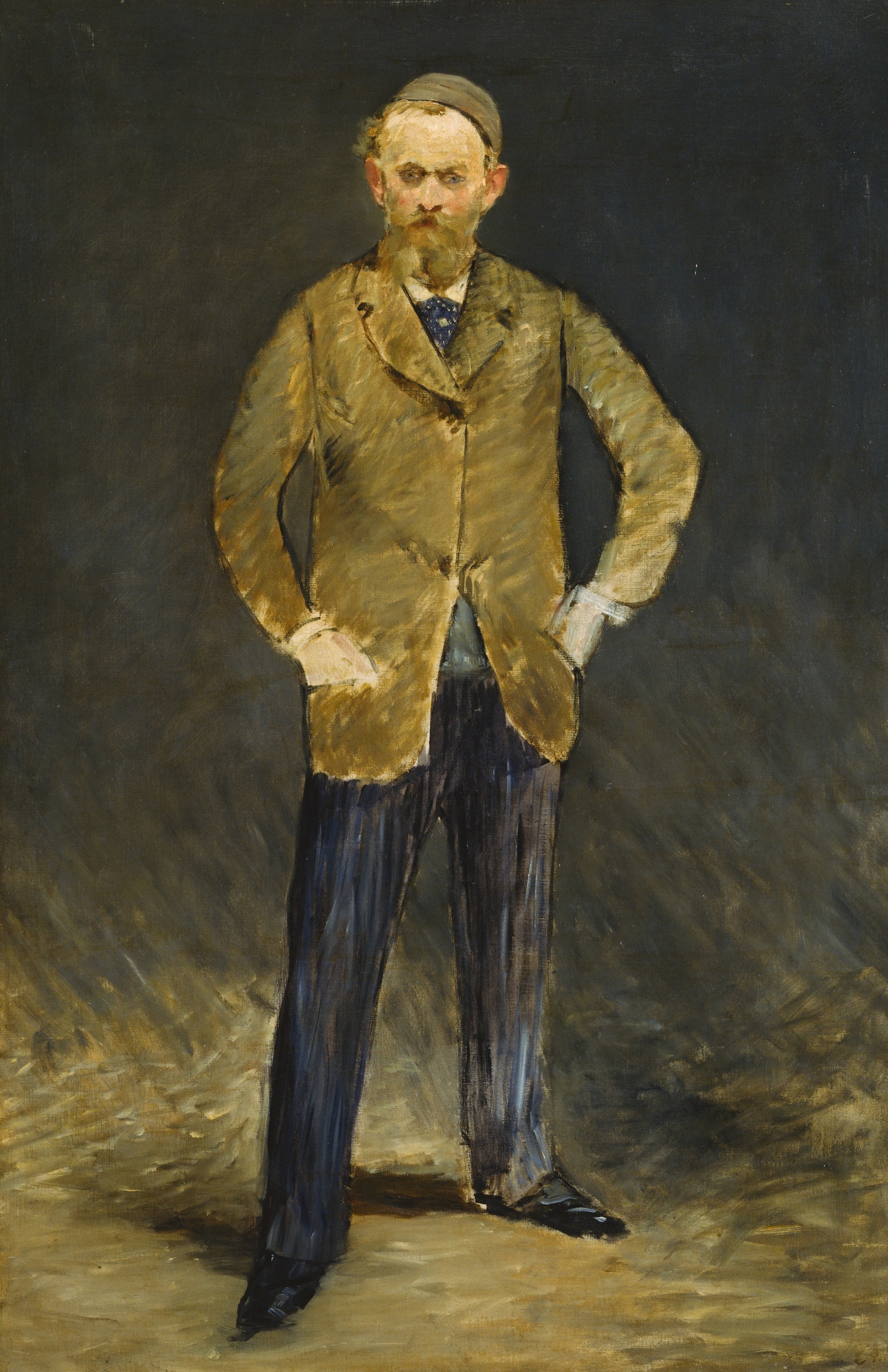
Self-Portrait is one of only two surviving self-portraits in oil by Édouard Manet, painted in 1878–79: he stands at full length, hands pushed into the pockets of a loose ochre-gold jacket, with a blue tie, dark striped trousers and a small dark skull-cap on his head. The original is oil on canvas, 95.4 x 63.4 cm, and hangs in the Artizon Museum in Tokyo. One of our painters paints it for you by hand in oil on canvas, in 8 portrait sizes from 30 x 45 to 128 x 191 cm, or made to measure. A photograph of your finished Manet reaches you before the parcel does.
| Title: | Self-Portrait |
| Other titles: | Self-Portrait with Skull-Cap · Portrait de Manet par lui-même, dit Manet à la calotte (French title) |
| Painter: | Édouard Manet (1832–1883) |
| Year painted: | 1878–79 |
| Original size: | 95.4 cm x 63.4 cm (height x width) |
| Original technique: | Oil on canvas |
| Painting style: | Realism and Impressionism |
| Located at: | Artizon Museum, Tokyo, Japan |
| Our reproduction: | Hand-painted in oil on canvas, 8 sizes or made to measure |
Self-Portrait – Édouard Manet
What does Manet’s self-portrait show?
Manet stands before an even, dark grey-brown ground and looks straight at us, sharp-eyed and a little stern. A small dark skull-cap sits on his head, a reddish-blond beard frames his face, and his cheeks and ears are flushed. His hands are in his jacket pockets, one foot is set forward, and he stands in black shoes on a pale ochre floor.
The loose jacket glows a golden ochre; beneath it you see a grey waistcoat and a white shirt with a blue tie scattered with tiny white dots. The trousers are dark blue, almost black, with long stripes running down them.
The face is painted with care, the jacket and trousers in broad, quick strokes. In places on the hands and jacket Manet left the canvas almost bare.
Why did Manet paint himself without brush or palette?
Manet shows himself not as an artist at work but as a gentleman who stands and watches. In one reading he seems to have stepped back to judge his own work, more onlooker than maker, and the hands-in-pockets stance conveys resolve.
He painted from a mirror. That is why the jacket closes the wrong way, left over right, just as he saw it reflected.
By then Manet was an established painter near the height of his career, and the Artizon Museum suggests he made the work to show pride in that reputation. His left leg had begun to trouble him, the first sign of an illness, and the museum notes that he is not resting his weight on it.
Why is this self-portrait so rare?
Only two of Manet’s self-portraits in oil survive. The other, in which he holds a palette, is in a private collection. Both date from 1878–79, when he was 46 or 47, and they are seen as two stages of one project.
It was a private work: Manet showed it only to people close to him, and his widow Suzanne called both self-portraits sketches. The plain dark ground reflects the taste for Spanish painting then current in Paris. Visible brushwork was taken at the time as a sign of unfinished work, and Manet’s readiness to leave it showing influenced the Impressionists and Van Gogh.
Born in Paris in 1832 to a wealthy family, Édouard Manet trained under Thomas Couture, copied Velázquez and Titian in the Louvre and died in 1883. He was among the first painters of the nineteenth century to take modern life as his subject, and today he is seen as the bridge between Realism and Impressionism. For his life and work, read the Wikipedia article on the painter, in English.
Where is the original, and how did it reach Tokyo?
The original, oil on canvas measuring 95.4 x 63.4 cm (height x width), belongs to the Artizon Museum of the Ishibashi Foundation in Tokyo, formerly the Bridgestone Museum of Art.
After Manet’s death, Léon Leenhoff hung the two self-portraits either side of Manet’s portrait of Faure in the role of Hamlet.
In 1972 it was bought for the Ishibashi collection and the Bridgestone Museum. In 2017 it travelled to Paris for an exhibition of masterpieces from that collection at the Musée de l’Orangerie.
Self-Portrait or another Manet?
This Manet self-portrait is a canvas painting for anyone who likes a single figure on a calm ground and a gaze you cannot dodge.
You meet the woman closest to Manet in La Nymphe surprise: the model was Suzanne Leenhoff, whom he married in 1863, and he kept the painting all his life. A woman in profile, in a fur coat before a pale blue fabric, is the subject of Autumn (Méry Laurent).
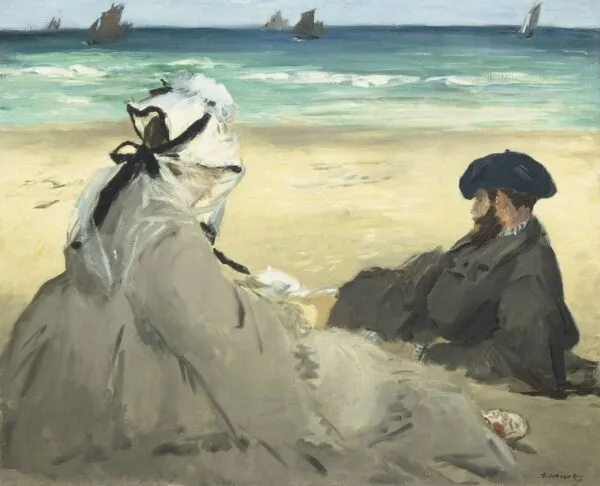
From earlier years come Boy with Cherries, a smiling boy in a red cap with his hands full of cherries, and On the Beach, Boulogne-sur-Mer, a wide beach with small figures by the sea. The rest of our famous Manet paintings, all painted to order, are gathered on the Édouard Manet page.
How do we hand-paint the Self-Portrait?
Manet’s original is an oil on canvas 95.4 cm tall and 63.4 cm wide. Ours is an oil painting reproduction: the painter transfers the figure to fresh canvas and builds it up in oil in thin layers, at the size you chose.
He first fixes the outline, the placing of the feet and the tilt of the head, because the figure has to stand firmly on the floor. Next come the dark grey-brown ground and the golden ochre jacket, and last the face with its flushed cheeks, beard and alert gaze.
Like Manet, our painter lavishes care on the face and leaves the clothes and floor loose and quick.
Which size suits your wall?
In short: 30 x 45 or 38 x 55 cm for a shelf or a narrow strip of wall, 42 x 65 and 57 x 82 cm for a home office or hallway, 70 x 110 and 81 x 120 cm above a chest of drawers or beside a bookcase, and 100 x 155 or 128 x 191 cm for a tall wall.
We paint it in 8 portrait sizes (width x height): 30 x 45, 38 x 55, 42 x 65, 57 x 82, 70 x 110, 81 x 120, 100 x 155 and 128 x 191 cm. The original measures 63.4 x 95.4 cm (width x height), so the four sizes up to 57 x 82 cm are smaller than it, 70 x 110 cm already passes it slightly, and 81 x 120, 100 x 155 and 128 x 191 cm are larger; the biggest is about twice as wide and twice as tall as the original.
As a painting for the living room it shows best at 100 x 155 cm on an empty wall, where the standing figure looks almost like a guest in the room.
Can I order another size or a frame?
Yes. If your wall needs other proportions, we keep the whole figure from skull-cap to shoes and adjust only the width of the dark ground at the sides or the strip of floor below his feet. Send us the size you need and we will quote a price and a date for your self-portrait.
Your self-portrait travels rolled, stretched on a stretcher bar or framed; the stretching and framing are done in our workshop in Slovenia. You choose the moulding in our 3D app, which is meant only for choosing the frame; seeing the painting on your own wall is a separate service. A slim gold moulding picks up the golden jacket.
When will your painting arrive?
Work on the skull-cap, face and golden jacket begins once you confirm, and the painting is ready to ship within 15 to 45 working days. Before we pack it, you get a photograph of the finished work, and we make any changes you ask for.
Delivery within Slovenia and the rest of the EU carries no customs duties, and our returns policy covers every order.
Manet’s self-portrait makes a fine gift for a painter, an art lover or a collector. If you do not know their walls, a wall art voucher leaves the size to them.
Frequently asked questions
Where can I see the original?
At the Artizon Museum in Tokyo, formerly the Bridgestone Museum of Art.
Who does the painting show?
The painter himself, Édouard Manet, at full length, in a skull-cap with his hands in his pockets.
Is it a print?
No. It is a hand-painted copy, worked with brushes in oil paint on canvas.
How big is the original?
It measures 95.4 x 63.4 cm (height x width); our sizes from 70 x 110 cm upwards are larger.
Can I order a size that is not listed?
Of course; send us the width and height for a quote.
How long do painting and delivery take?
The painting is ready to ship in 15 to 45 working days, and you see it in a photograph first.
Would it suit an office, or make a gift for a painter?
Yes. The upright figure in a golden jacket works well in an office or an entrance hall, and painters especially enjoy it as a gift.
Why is Manet not holding a brush?
He shows himself without the tools of his trade, as an onlooker; one reading sees resolve in his stance.
- Subject: Manet at full length, in a golden ochre jacket and skull-cap, hands in pockets, before a dark ground.
- Original: oil on canvas, 1878–79, 95.4 x 63.4 cm, Artizon Museum, Tokyo.
- Ours: hand-painted in oil on canvas as an Édouard Manet reproduction in 8 sizes, 30 x 45 to 128 x 191 cm, or made to measure.
- Worth knowing: one of only two surviving Manet self-portraits in oil, once shown only to his circle.