Description
Boy with Cherries is an early work by Édouard Manet, painted around 1858: a smiling fair-haired boy in a red cap leans on a stone ledge, his hands full of red cherries on green leaves. The original is oil on canvas, 65.5 x 54.5 cm, and belongs to the Calouste Gulbenkian Museum in Lisbon. Our painter paints it for you by hand in oil on canvas, in 8 portrait sizes from 36 x 43 to 137 x 170 cm, or made to measure. You receive a photograph of the finished painting before we ship it.
| Title: | Boy with Cherries |
| Other titles: | L’Enfant aux cerises (French title) · O Rapaz das Cerejas (Portuguese title) |
| Painter: | Édouard Manet (1832–1883) |
| Year painted: | about 1858 |
| Original size: | 65.5 cm x 54.5 cm (height x width) |
| Original technique: | Oil on canvas |
| Painting style: | Realism and Impressionism |
| Located at: | Calouste Gulbenkian Museum, Lisbon, Portugal |
| Our reproduction: | Hand-painted in oil on canvas, 8 sizes or made to measure |
Boy with Cherries – Édouard Manet
What does Boy with Cherries show?
Out of a dark, warm brown ground a boy with fair, tousled hair leans towards us. He wears a red cap and a dark brown jacket, with the white collar of his shirt showing at the neck. His head tilted a little, he smiles and looks us straight in the eye.
His elbows rest on a broad stone ledge that closes off the bottom of the picture. With both arms he gathers a heap of juicy red cherries with their green leaves, and a few hang by their stems over the edge. Lower right, on the stone, is Manet’s signature.
What do the cherries in the boy’s hands mean?
Manet joins two genres in one work: a child’s portrait and a still life of fruit. The ledge in the foreground shuts off the space, and the cherries lie along its edge.
The Calouste Gulbenkian Museum reads the cherries as an allegory of the senses, one that recalls Jusepe de Ribera.
The museum also sees an early modernity in it: an ordinary boy from everyday life becomes a worthy subject, in line with Charles Baudelaire’s call for painters to show the reality of their own time.
Why does Boy with Cherries matter in Manet’s work?
It is one of the early works of Édouard Manet (1832–1883), painted in Paris a few years after his training under Thomas Couture and his copies of Velázquez and Titian in the Louvre. The painting looks back to Caravaggio and seventeenth-century Dutch genre painting and belongs to the realist tradition.
Already here you meet the painter who would be one of the first nineteenth-century artists to paint modern life and a pivotal figure between Realism and Impressionism. A few years later works such as Olympia caused great controversy, and they are now seen as the start of modern art.
Manet later repainted the boy’s hands, and the museum notes that they show the handling of his mature years. For his life, see the Wikipedia article on Manet, which is about the painter and written in English.
Where is the original, and who posed for it?
The original, oil on canvas measuring 65.5 x 54.5 cm (height x width), belongs to the Calouste Gulbenkian Museum in Lisbon, inventory number 395.
Its first owner was the painter’s brother Eugène Manet; it then passed to the dealer Durand-Ruel and to Maurice Leclanché. Calouste Gulbenkian bought it in Paris in 1910 through the Bernheim-Jeune gallery.
The model was Alexandre, a boy who helped Manet, washed his brushes and sometimes posed. He died young, and Charles Baudelaire based his prose poem La Corde on him and dedicated it to Manet.
Boy with Cherries or another Manet?
This canvas painting is for anyone who loves warm colours, a child’s grin and fruit that shines as if just picked.
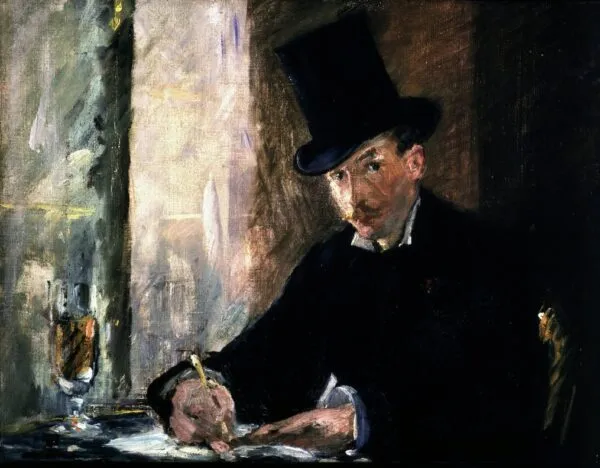
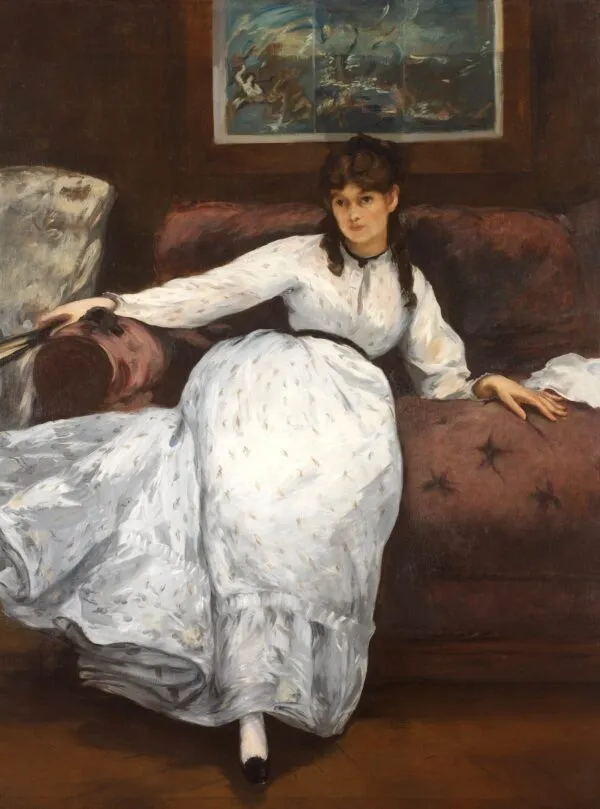
If still lifes on a dark ground appeal to you, look at Branch of White Peonies and Shears, two white blooms on a table. Another portrait set against a dark ground is Berthe Morisot Reclining, a young woman in a black dress. The painter himself, twenty years on, appears in Self-Portrait, while On the Beach, Boulogne-sur-Mer opens up a wide, pale beach with small figures and sailing boats.
We show only four here; more famous Manet paintings, each painted to order, are gathered on our Édouard Manet page.
How do we hand-paint Boy with Cherries?
Manet’s original is a medium-sized oil on canvas, 65.5 cm tall. Your oil painting reproduction is made on new canvas: our painter works it in oil on canvas, at the size you pick, building it up in layers.
He first lays in the warm brown ground and draws the ledge and the boy’s figure. Next he models the rosy-cheeked face, the fair hair and the red cap, and last come the gloss of the cherries, the green leaves and the stems hanging over the edge.
Manet repainted the hands later, in a manner unlike the rest of the work, and our painter keeps that difference.
Which size suits which wall?
In short: 36 x 43 or 46 x 55 cm for a shelf, a kitchen or a child’s room, 54 x 65 and 60 x 75 cm above a chest of drawers or in a dining room, 77 x 95 and 97 x 122 cm above a sofa, and 110 x 135 or 137 x 170 cm for a large wall.
We paint it in 8 portrait sizes (width x height): 36 x 43, 46 x 55, 54 x 65, 60 x 75, 77 x 95, 97 x 122, 110 x 135 and 137 x 170 cm. The original measures 54.5 x 65.5 cm (width x height), so 36 x 43 and 46 x 55 cm are smaller, 54 x 65 cm is almost exactly as large, and every size from 60 x 75 cm up is larger than the original.
As a painting for the living room it looks best at 77 x 95 or 97 x 122 cm, where the smile and the red of the cherries carry from the doorway.
Can I order another size or a frame?
Yes. For other proportions we keep the boy, the cherries and the edge of the ledge whole and adjust the dark ground around them. Send us the size you need for this cheerful boy, and we come back with a price and a date.
We ship it rolled, stretched on a stretcher bar or framed; our workshop in Slovenia does the stretching and framing and packs it with care. The moulding for the boy is chosen in our 3D app, a tool meant only for choosing frames; a view of the painting on your own wall is a separate service.
A gold moulding or dark walnut sits well with the warm browns.
When will my painting arrive?
Work on the boy and his cherries begins as soon as you confirm the order, and the painting is ready to ship within 15 to 45 working days. When the hand-painted copy is finished, we send you a photograph of it and make any corrections you ask for.
Parcels to Slovenia and other EU countries travel without customs duties, and our returns policy applies to this order as to any other.
The cheerful boy with his cherries makes a warm gift for a young family, a new kitchen or anyone who loves summer fruit. Not sure of the size? A wall art voucher lets the person who gets it choose the size for the boy and his cherries.
Frequently asked questions
Where can I see the original?
At the Calouste Gulbenkian Museum in Lisbon, inventory number 395.
Who is the boy in the painting?
Alexandre, a boy who helped Manet, washed his brushes and sometimes sat for him.
Is this a print?
No. Our painter applies every layer with a brush in oil on canvas, from the first underpainting to the last highlight.
How big is the original?
65.5 x 54.5 cm (height x width); our 54 x 65 cm size is nearly the same, and the larger ones exceed it.
Can I order a size that is not listed?
Of course. Write to us with the width and height you want, and we send an offer with a delivery time.
How long do painting and delivery take?
Allow 15 to 45 working days; a photograph of your boy with his cherries reaches you before the parcel leaves.
Does it suit a kitchen, a child’s room or a gift?
Yes. The warm scene with fruit brightens a kitchen or dining room, and the cheerful young face works just as well in a child’s room or as a present.
Do the cherries carry a special meaning?
The museum reads them as an allegory of the senses, recalling Jusepe de Ribera.
- Subject: a smiling boy in a red cap behind a stone ledge, his arms full of red cherries with green leaves.
- Original: oil on canvas, about 1858, 65.5 x 54.5 cm, Calouste Gulbenkian Museum, Lisbon.
- Ours: an Édouard Manet reproduction hand-painted in oil on canvas, 8 sizes from 36 x 43 to 137 x 170 cm, or made to measure.
- Worth knowing: an early Manet that joins portrait and still life in a single work.