







































Description
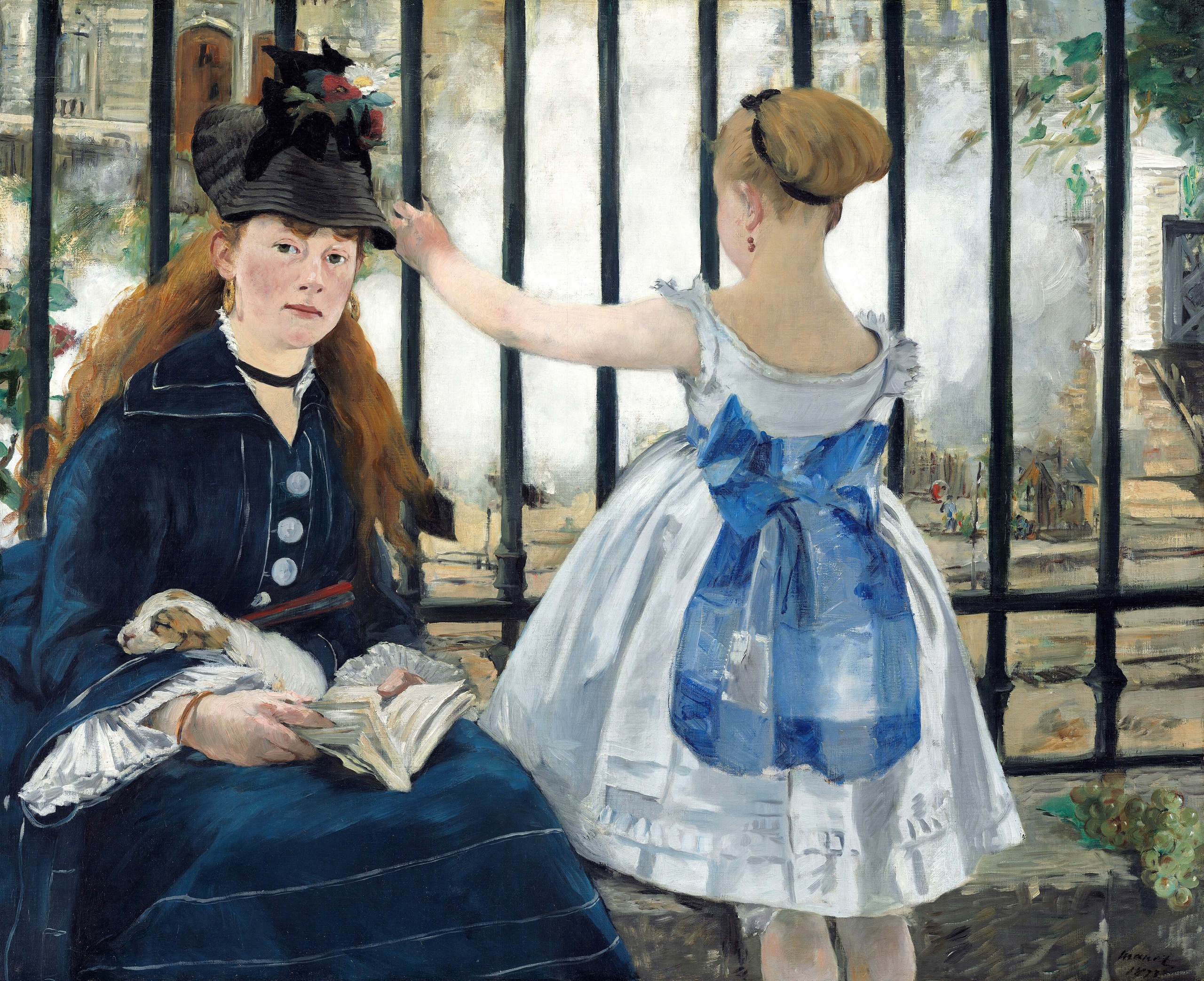
The Railway is a painting by Édouard Manet from 1873: a young woman in dark blue sits by an iron railing with a sleeping puppy and an open book in her lap and looks straight at us, while a little girl in white with a big blue bow turns her back and peers through the bars at a cloud of steam. The original, oil on canvas, 93.3 x 111.5 cm, belongs to the National Gallery of Art in Washington. We hand-paint it in oil on canvas in 8 landscape sizes from 40 x 32 to 190 x 153 cm or made to measure, and send you a photograph of the finished painting before we pack it.
| Title: | The Railway |
| Other titles: | Le Chemin de fer (French title) · Gare Saint-Lazare |
| Painter: | Édouard Manet (1832–1883) |
| Year painted: | 1873 |
| Original size: | 93.3 cm x 111.5 cm (height x width) |
| Original technique: | Oil on canvas |
| Painting style: | Realism and Impressionism |
| Located at: | National Gallery of Art, Washington, D.C., USA |
| Our reproduction: | Hand-painted in oil on canvas, 8 sizes or made to measure |
The Railway – Édouard Manet
What does The Railway show?
Two figures sit close against a row of black iron bars that crosses the whole canvas. On the left a young woman faces us in a deep blue dress with pale buttons, a black ribbon at her throat and a black hat trimmed with flowers; long red-brown hair falls over her shoulders. Her look is calm, a little guarded.
A puppy sleeps in her lap beside a closed fan and an open book, one finger kept between the pages. Next to her a small girl in a white dress with a wide blue sash stands with her back to us, hair tied up with a black ribbon, one arm raised to hold a bar as she looks down at the tracks.
The train itself is invisible: only its white steam rises behind the railing, half hiding new apartment buildings, a signal box and part of the Pont de l’Europe. A bunch of green grapes lies on a ledge at the right, and Manet signed and dated the work in the lower right corner.
Who are the woman and the girl?
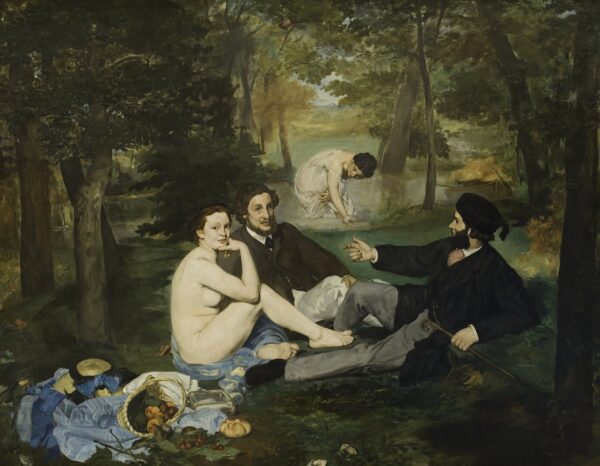
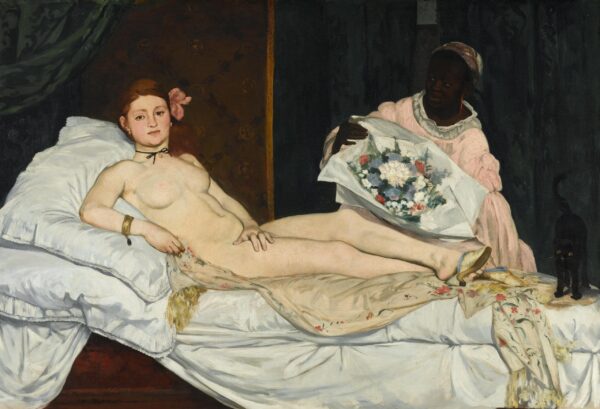
The woman is Victorine Meurent, Manet’s favourite model and a painter herself. She had already posed for Olympia and Le Déjeuner sur l’herbe, and this is the last painting in which Manet portrayed her. The girl was the daughter of his neighbour, Alphonse Hirsch.
The setting is the Gare Saint-Lazare in Paris, with the train passing below the pair. One house in the background stands on the Rue de Saint-Pétersbourg near the Place de l’Europe, where Manet had rented a place to work since July 1872.
Small echoes link the two figures: the black band in the girl’s hair answers the one around the woman’s neck. The grapes may point to autumn, and the puppy may nod to Titian’s Venus of Urbino, which Manet had already echoed in Olympia.
The art historian T. J. Clark reads it as a caught instant: the steam hangs, the child forgets time, and the woman keeps her place in the book.
Why is The Railway so famous?
At the Paris Salon of 1874 it baffled almost everyone. As the historian Isabelle Dervaux puts it, visitors and critics found the subject puzzling, the composition incoherent and the handling sketchy, and caricaturists mocked it; only a few saw the symbol of modernity it has since become.
Those faults are now its strengths. Instead of a landscape, Manet stretched an iron grating across the canvas and pressed the figures up against it, flattening the space into a narrow strip. The great machine of the age shrinks to a cloud of steam.
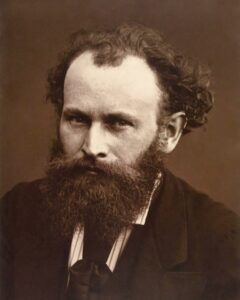
Manet (1832–1883) was one of the first painters of modern life and a pivotal figure between Realism and Impressionism. A friend of Monet, Degas and Renoir, he never showed with the Impressionists and preferred the official Salon.
The Wikipedia article on The Railway, in English, tells the full story of the painting and its owners.
Where is the original today, and how big is it?
It hangs in the National Gallery of Art in Washington, D.C., accession number 1956.10.1: an oil on canvas of 93.3 x 111.5 cm (height x width).
The baritone Jean-Baptiste Faure bought it soon after it was finished. In 1881 it passed to the dealer Paul Durand-Ruel, who showed it under several titles, ending with Gare St. Lazare, the name many still use.
On 31 December 1898 the American collector Henry Osborne Havemeyer acquired it. His wife Louisine divided a small group of works, this one included, among their three children, and after the death of her son Horace Havemeyer it went to Washington in 1956.
The Railway or another Manet?
The Railway is a canvas painting for anyone who likes quiet everyday scenes that reveal their story slowly: a glance, a sleeping dog, a child who cannot tear herself away from the trains. With none of the scandal of Manet’s nudes, it suits a family room, a hallway or an office.
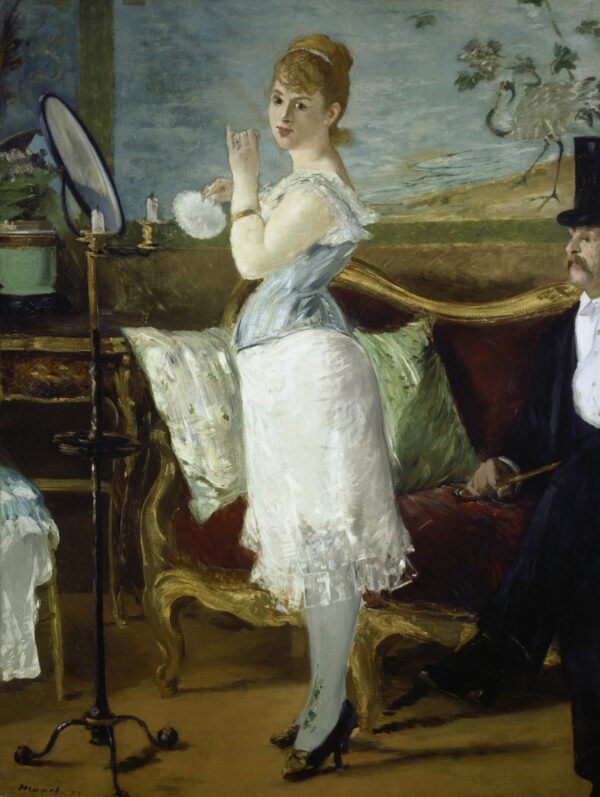
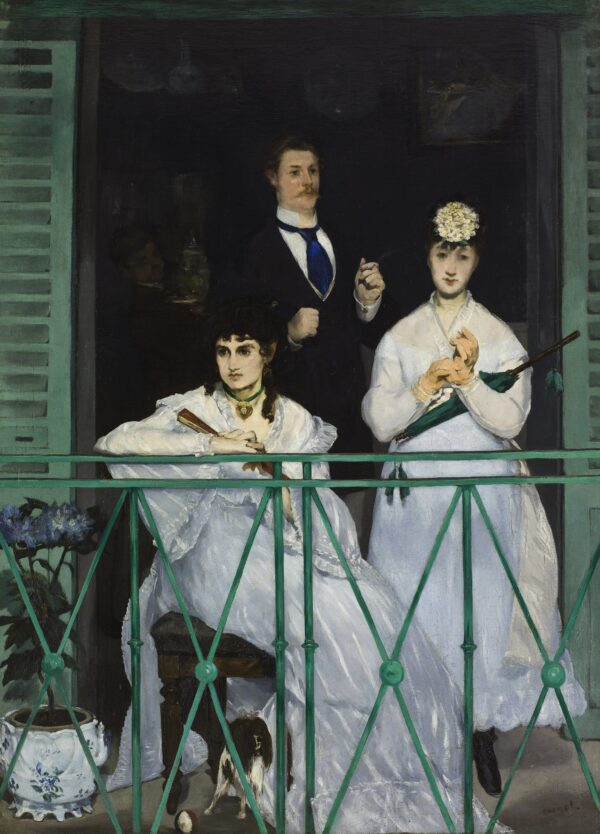
For figures framed by architecture, see The Balcony, where three people stand behind a bright green railing; for a bolder subject, Nana shows a young woman at her mirror turning towards us.
All the famous Manet paintings we paint to order are gathered on our Édouard Manet page.
How do we hand-paint The Railway on canvas?
Manet’s original is an oil on canvas just over a metre wide. Ours is an oil painting reproduction made by hand: the painter works in oil on canvas, in the size you choose, building the paint up layer by layer.
He first draws the bars and the two figures, then lays in the deep blue dress, the white frock and the greyish steam. Last come the details the eye finds first: the woman’s face, the puppy, the pages, the blue bow and the grapes. Manet’s brushwork is loose and quick here, and our painter keeps that lightness instead of smoothing it.
Which size suits which wall?
In short: up to 50 x 42 cm for a narrow wall or hallway, 65 x 52 to 90 x 78 cm above a chest of drawers or desk, 115 x 96 cm above a sofa or bed, and 150 x 120 or 190 x 153 cm for a large empty wall.
We paint The Railway in 8 landscape sizes (width x height): 40 x 32, 50 x 42, 65 x 52, 74 x 59, 90 x 78, 115 x 96, 150 x 120 and 190 x 153 cm. The original measures 111.5 x 93.3 cm (width x height), so the five sizes up to 90 x 78 cm are smaller than it, 115 x 96 cm is about the same, a few centimetres wider, and 150 x 120 and 190 x 153 cm are larger than the canvas in Washington.
As a painting for the living room it looks best at 115 x 96 cm over the sofa, with the figures at almost Manet’s own scale. Smaller sizes suit a child’s room or a reading corner.
Can I order a different size or a frame?
Yes. Every work is painted only once ordered, so we can adapt the format to your wall, keeping the woman, the girl and the railing whole and changing only the steamy edges. Tell us the measurements you have in mind and we will quote a price and a date.
It travels rolled, on a stretcher bar or framed; our workshop in Slovenia does the stretching and framing. Our 3D app is only for choosing the moulding, and seeing the painting on your own wall is a separate service.
How soon will the painting reach you?
Our painter starts once you confirm, and your painting is ready to ship within 15 to 45 working days. Before packing, a photograph of the finished work comes to you, and we make any change you request.
Orders within Slovenia and across the EU pay no customs duties, and our returns policy covers every purchase.
With its little girl and sleeping puppy, The Railway makes a warm gift for a new home or a friend who loves trains or Paris; if the size is a guess, a gift voucher leaves the choice to them.
Frequently asked questions
Where is the original on display?
In the National Gallery of Art in Washington, D.C. (1956.10.1).
Who posed for the woman?
Victorine Meurent, Manet’s favourite model and a painter herself.
Is this a print?
No, it is a hand-painted copy: our painter brushes it in oil on canvas.
How large is Manet’s canvas?
93.3 x 111.5 cm (height x width); ours run from 40 x 32 to 190 x 153 cm.
Do you take orders for sizes outside the list?
Yes; give us a width and height and we will quote you.
How long until it arrives?
Dispatch takes 15 to 45 working days, and you get a photograph of it first.
Is The Railway right for a bedroom, or as a present?
Yes, the calm scene fits a bedroom or a reading corner and makes a gentle present.
What is the girl looking at?
A train passing below the railing, seen only as white steam.
- Subject: a young woman with a puppy and a book beside an iron railing, and a girl in white watching the steam of a train.
- Original: oil on canvas, 1873, 93.3 x 111.5 cm, National Gallery of Art, Washington.
- Ours: an Édouard Manet reproduction hand-painted in oil on canvas, 8 sizes from 40 x 32 to 190 x 153 cm, or made to measure.
- Worth knowing: the work is also widely known as Gare Saint-Lazare, after the Paris station beside which it was painted.