



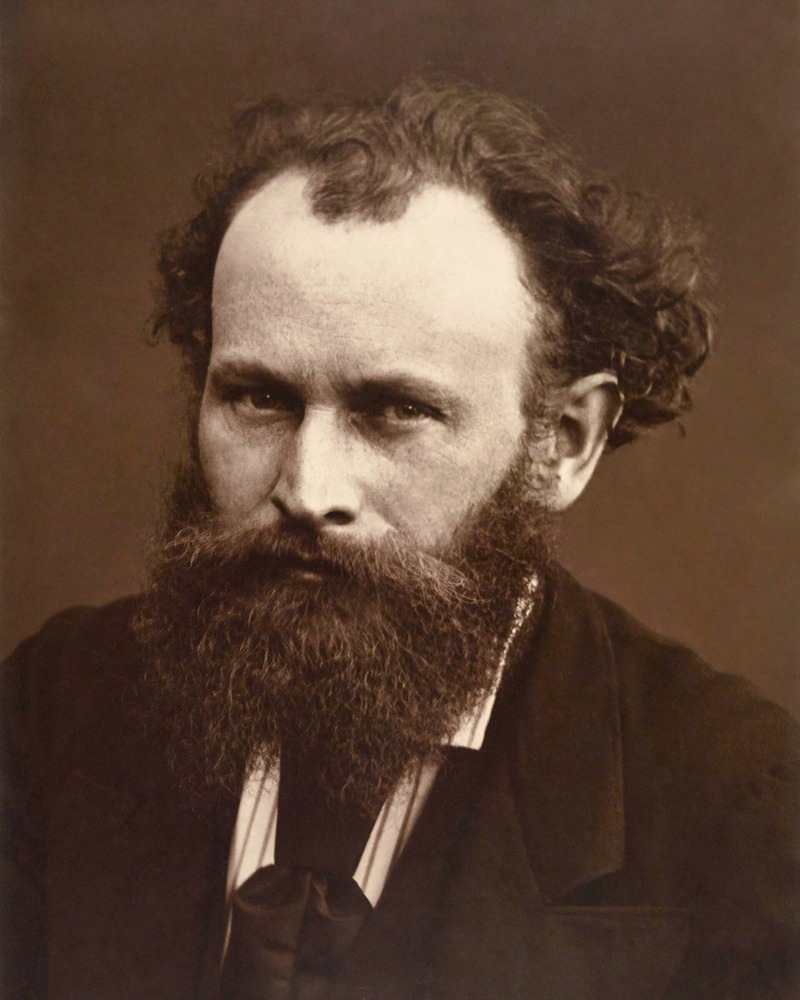
Édouard Manet (1832–1883) was a French painter, one of the first 19th-century artists to paint the modern life of his own day and a pivotal figure in the move from Realism to Impressionism. Le Déjeuner sur l’herbe and Olympia caused great scandals when they were first shown and are now seen as the start of modern art. He left 430 oil paintings, 89 pastels and more than 400 works on paper. His works are part of our collection of hand-painted reproductions of Édouard Manet paintings on canvas.
Every Manet painting in our gallery is painted by hand in oil on canvas, to order and in the size you choose; before dispatch we send you a photograph of the finished painting.
Édouard Manet paintings in our gallery
Life: the Paris judge’s son who shook the Salon
Édouard Manet was born in Paris on 23 January 1832 into a wealthy, well-connected family. His father Auguste was a judge who expected his son to go into law, while his uncle Edmond Fournier encouraged him to paint and took him to the Louvre. At his father’s suggestion he sailed on a training ship to Rio de Janeiro in 1848, and after he twice failed the naval examination his father gave in. From 1850 to 1856 he trained under the academic painter Thomas Couture and in his spare time copied Old Masters such as Velázquez and Titian in the Louvre; on short trips to Germany, Italy and the Netherlands he came under the influence of Frans Hals and of the Spaniards Velázquez and Goya. In 1861 he first showed at the Paris Salon, and in 1863 he married the Dutch-born piano teacher Suzanne Leenhoff. That same year the Salon jury rejected Le Déjeuner sur l’herbe, which he then showed at the Salon des Refusés, and in 1865 Olympia caused a scandal at the official Salon. From 1868 he was a friend of the painter Berthe Morisot, who married his brother Eugène in 1874; through her he came to know Degas, Monet, Renoir, Sisley, Cézanne and Pissarro, yet he never exhibited with the Impressionists, because he stayed loyal to the Salon. In the Franco-Prussian War he served with Degas in the National Guard during the siege of Paris, and in 1881 he was awarded the Légion d’honneur. In 1882 he showed his last major work, A Bar at the Folies-Bergère, at the Salon. He died after a long illness in Paris on 30 April 1883 and is buried in the Passy Cemetery.
Style: modern life, black and painting alla prima
Manet painted the Paris of his day: people in cafés and in the street, parties, friends and family, and after his early years he rarely turned to religious, mythological or historical subjects. Even his first works show loose brushstrokes, simplified details and hardly any transitional tones. He rejected the method he had learned from Couture, building a painting in layers on a dark ground, and painted directly, alla prima, with opaque paint on a light ground, so that he could finish a painting in a single sitting; the Impressionists took the method up, and for generations it became the usual way of painting in oils. Critics found his flat surfaces, sketch-like passages and black outlines unfinished, but as early as 1867 the novelist Émile Zola wrote that the public was not used to such simple and direct translations of reality. Under the influence of Monet and of Berthe Morisot, who talked him into painting outdoors, he used lighter colours from the early 1870s while keeping his distinctive black, which was foreign to Impressionist painting. In his last years he painted small still lifes of fruit and vegetables and flowers in glass vases; the last of the twenty known flower paintings dates from March 1883. The art historian Beatrice Farwell writes that he has been universally regarded as the father of modernism.
His most famous works
Our gallery opens with the works that set Paris talking. Le Déjeuner sur l’herbe (Luncheon on the Grass, 1863), first titled Le Bain (The Bath), shows two clothed men and a nude woman in a woodland clearing while a second woman bathes in the stream behind them; the grouping of the figures comes from Marcantonio Raimondi’s engraving of the Judgement of Paris after a drawing by Raphael. The canvas measures 208 x 264.5 cm and hangs in the Musée d’Orsay in Paris. Olympia (1863) shows a self-assured courtesan lying on white sheets and looking straight at the viewer while her Black maid brings her a bouquet; the pose follows Titian’s Venus of Urbino, except that a black cat stands at the foot of the bed where Titian had a little dog. The model was Victorine Meurent, and the French state acquired the painting in 1890 through a public subscription organised by Claude Monet; Olympia too is in the Musée d’Orsay, as is The Balcony (1868–69), inspired by Goya’s Majas on a Balcony, where the painter Berthe Morisot sits with the painter Antoine Guillemet and the violinist Fanny Claus standing beside her. The Railway (1873) is Manet’s last painting of Victorine Meurent: with a sleeping puppy and an open book in her lap she sits by an iron railing near the Gare Saint-Lazare, while the little girl beside her looks through the bars at a white cloud of steam below them; it belongs to the National Gallery of Art in Washington. Nana (1877), a young woman still dressing before a mirror with a gentleman in evening dress seated beside her, was rejected by the Salon, so Manet showed it in a shop window on the Boulevard des Capucines; today it is in the Hamburger Kunsthalle. In the Conservatory (1879) portrays his friends the Guillemets, a married couple who ran a clothing shop; in 1896 the Nationalgalerie in Berlin bought it, the first museum anywhere to buy a Manet. A Bar at the Folies-Bergère (1882), his last major work, shows the barmaid Suzon behind a marble counter in front of a huge mirror that reflects the crowded hall; it once belonged to the composer Emmanuel Chabrier, who hung it over his piano, and is now in the Courtauld Gallery in London. To see how Manet stands beside the other great masters, read our overview of the five most famous paintings in the world.
Frequently asked questions about Édouard Manet
Who was Édouard Manet?
A French painter (1832–1883), one of the first painters of modern life and a bridge between Realism and Impressionism, whose Le Déjeuner sur l’herbe and Olympia are seen as the start of modern art.
What did Édouard Manet paint?
Above all the Paris of his day: people in cafés, in the street and at balls, portraits of friends and family, nudes in dialogue with the Old Masters, scenes of war and boating and, in his last years, small still lifes of fruit and flowers in vases.
Where can I see Manet’s original paintings?
Of the works in our gallery, Le Déjeuner sur l’herbe, Olympia and The Balcony are in the Musée d’Orsay in Paris, A Bar at the Folies-Bergère in the Courtauld Gallery in London, In the Conservatory in the Alte Nationalgalerie in Berlin, Nana in the Hamburger Kunsthalle and The Railway in the National Gallery of Art in Washington.
Can I buy a hand-painted reproduction of a Manet painting?
Yes, our online gallery offers hand-painted reproductions of Édouard Manet paintings on canvas in the size you choose. The originals are oil paintings on canvas, several of them large: Le Déjeuner sur l’herbe is 264.5 cm wide, so all our sizes are smaller than it, while our largest Olympia is about as wide as the original. Each copy is painted by hand in oil on canvas; Nana is offered up to 105 x 145 cm, because the photograph we paint from allows no larger size. Before delivery we send you a photograph of the painting to approve.
Leave a Reply