







































Description
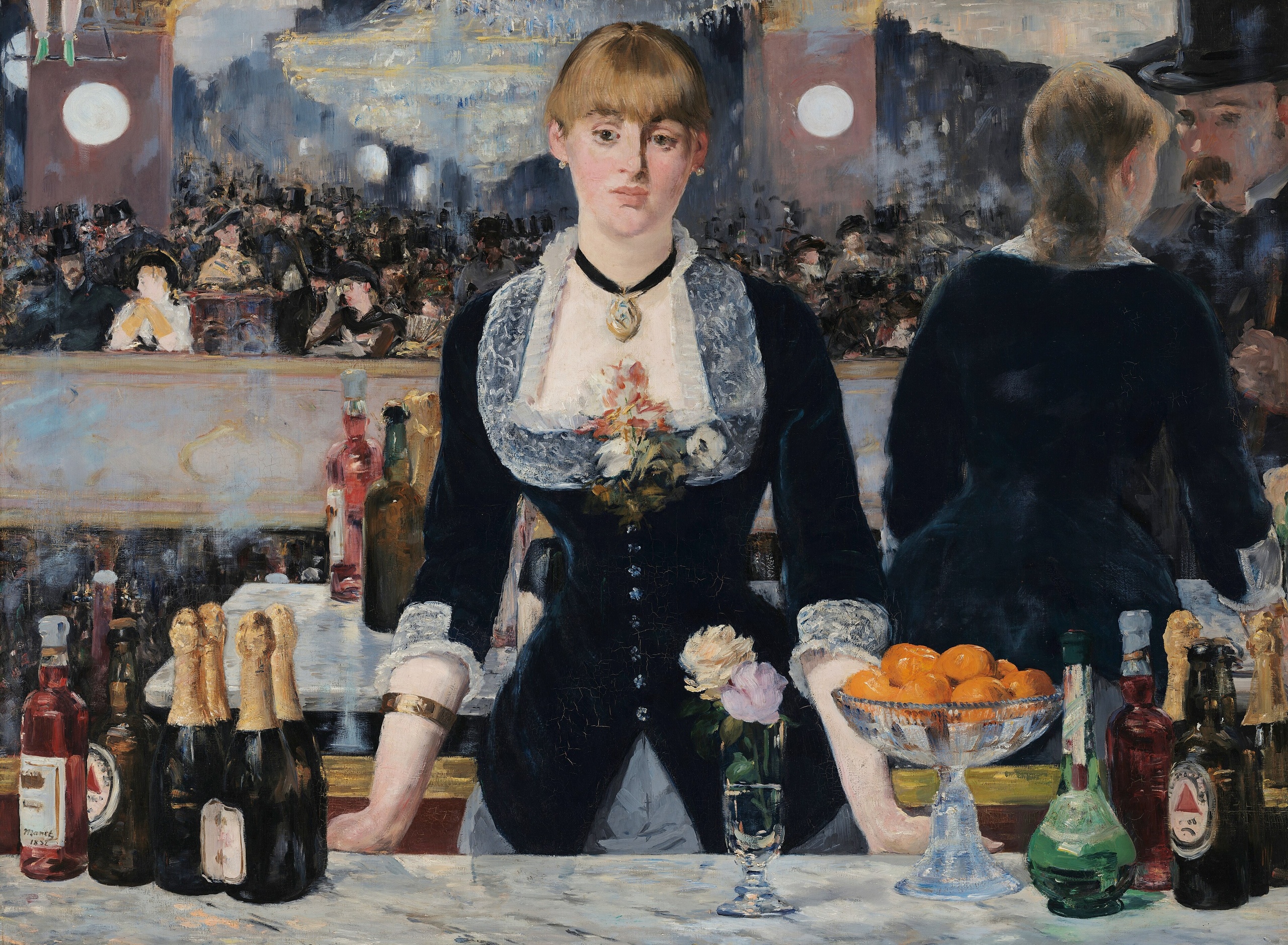
A Bar at the Folies-Bergère is the last major work of Édouard Manet, painted in 1882: a young barmaid in a dark velvet bodice stands behind a marble counter set with champagne, beer and a bowl of oranges, while a vast mirror behind her reflects the lit-up, crowded hall. The original is oil on canvas, 96 x 130 cm, and it belongs to the Courtauld Gallery in London. Our painter paints it for you by hand in oil on canvas, in 8 landscape sizes from 40 x 30 to 200 x 148 cm, or made to measure. Before it leaves us, you get a photograph of it.
| Title: | A Bar at the Folies-Bergère |
| Other titles: | Un bar aux Folies Bergère (French title) · Bar at the Folies-Bergère |
| Painter: | Édouard Manet (1832–1883) |
| Year painted: | 1882 |
| Original size: | 96 cm x 130 cm (height x width) |
| Original technique: | Oil on canvas |
| Painting style: | Realism and Impressionism |
| Located at: | Courtauld Gallery, London, United Kingdom |
| Our reproduction: | Hand-painted in oil on canvas, 8 sizes or made to measure |
A Bar at the Folies-Bergère – Édouard Manet
What does A Bar at the Folies-Bergère show?
At the centre stands a young barmaid with fair hair and a straight-cut fringe, in a near-black velvet bodice with tiny buttons, a wide lace collar and lace cuffs. She wears a black ribbon with a pendant, earrings, a gold bangle and a posy of flowers at her neckline. Her hands rest on the marble counter, and she looks straight ahead, calm and slightly absent.
On the counter stand champagne bottles in gold foil, beer bottles with a red triangle on the label, a red and a green liqueur bottle, a glass holding two roses and a crystal bowl heaped with oranges. On the label of the bottle at the far left, Manet wrote his name and the year 1882.
Behind her, a gilt-framed mirror runs the full width of the canvas. It holds a packed balcony with a lady in yellow gloves, round white lamps and a chandelier in a grey-blue haze. At the top left two feet in green shoes dangle into view, those of a trapeze artist. On the right the mirror shows the barmaid from behind and a man in a top hat who seems to be talking to her.
What is the mirror behind the barmaid hiding?
From the earliest reviews critics accused Manet of not understanding perspective: the barmaid faces us squarely, yet her reflection on the right leans towards a man who is not in front of her at all.
In 2000 the art historian Malcolm Park staged the scene in a real space and proved the view physically possible. The man stands to the left, outside the painter’s field of vision, and looks away from her, so the conversation people see in the mirror is an optical trick.
A preliminary study placed the barmaid to the right; Manet moved her to the centre but kept her reflection on the right. In the mirror she seems engaged with a customer, while face on she is withdrawn and remote. The mirror also links the work to Las Meninas by Velázquez, a painter Manet admired.
Why is this painting so famous?
It is the last major work of Édouard Manet (1832–1883), one of the first 19th-century artists to paint modern life and a pivotal figure between Realism and Impressionism. He showed it at the Paris Salon of 1882, a year after receiving the Légion d’honneur.
The Folies-Bergère was a celebrated Paris nightclub. The beer with the red triangle is British Bass Pale Ale, and some read the choice of a British brand over a German one as a sign of anti-German feeling in France after the Franco-Prussian War.
A 1934 ballet by Ninette de Valois, set to music by Chabrier, grew out of the painting. For more on Suzon, the mirror and the Salon, see the Wikipedia article on the painting, written in English.
Where is the original, and who was the barmaid?
The original, oil on canvas measuring 96 x 130 cm (height x width), belongs to the Courtauld Gallery in London, under accession number P.1934.SC.234.
Its first owner was the composer Emmanuel Chabrier, a close friend of Manet, who hung it above his piano.
The barmaid was a real woman known as Suzon, who worked at the Folies-Bergère in the early 1880s; Manet had her pose for him away from the club.
A Bar at the Folies-Bergère or another Manet?
This is a canvas painting for anyone who loves the city at night, the shine of glass and a busy crowd held still by one quiet face.
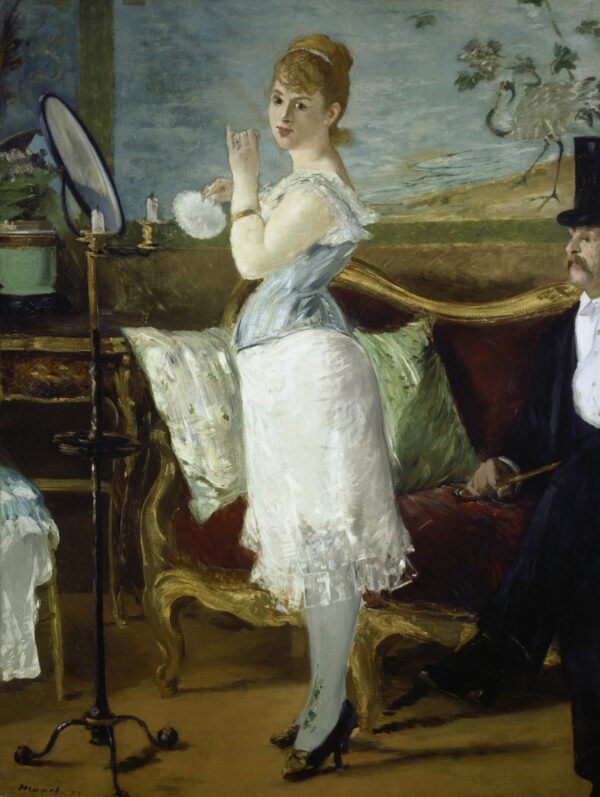
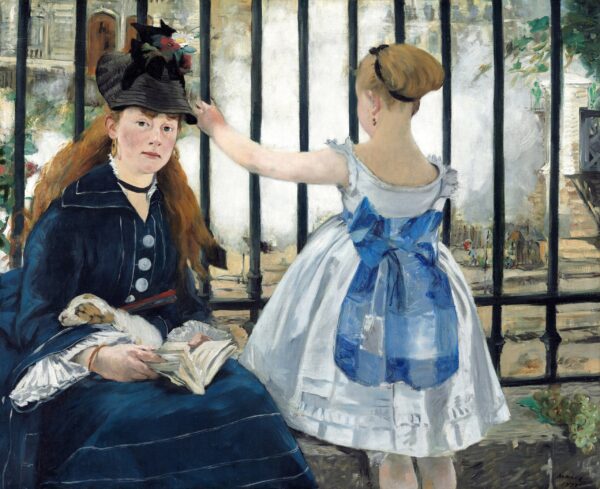
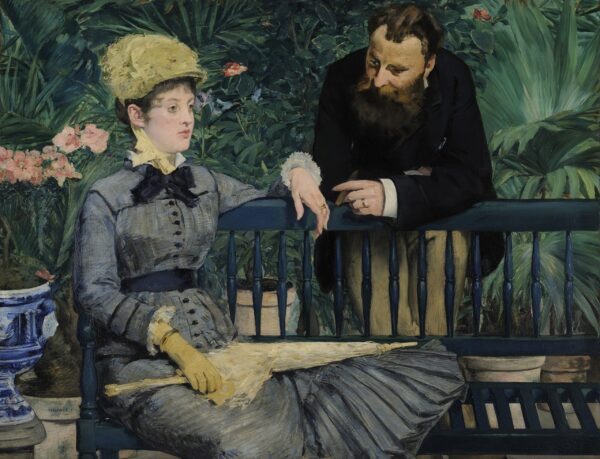
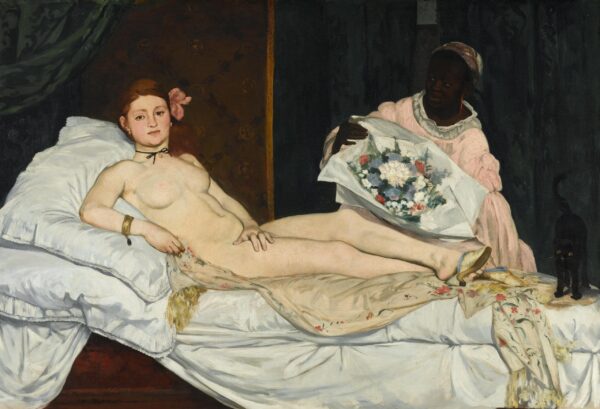
If Manet’s eye for middle-class life appeals to you, look at In the Conservatory, a married couple in a winter garden, or The Railway, a young woman and a girl by an iron railing with steam beyond. Two more women who meet the viewer’s gaze appear in Nana and Olympia.
More famous Manet paintings, each painted to order, are on our Édouard Manet page.
How do we hand-paint A Bar at the Folies-Bergère?
Manet’s original is an oil on canvas 130 cm wide. Ours is an oil painting reproduction on fresh canvas: the painter works it in oil on canvas, in the size you choose, building it up layer by layer.
He first sets down the counter edge, the gilt mirror frame and the barmaid, because the layout and the reflection on the right carry the scene. Next come the cool grey-blue hall and the dark velvet, and last the gleam of the bottles, the oranges, the lace and the lights, with the crowd kept loose as Manet left it.
Which size fits which wall?
In short: 40 x 30 or 50 x 36 cm for a shelf or a narrow wall, 63 x 48 and 87 x 62 cm above a chest of drawers or in a dining room, 98 x 70 and 120 x 90 cm above a sofa, and 160 x 115 or 200 x 148 cm for a large wall at home or in a bar or restaurant.
We paint it in 8 landscape sizes (width x height): 40 x 30, 50 x 36, 63 x 48, 87 x 62, 98 x 70, 120 x 90, 160 x 115 and 200 x 148 cm. The original measures 130 x 96 cm (width x height), so all six sizes up to 120 x 90 cm are smaller than it, 120 x 90 cm comes close, and 160 x 115 and 200 x 148 cm are larger than the original.
As a painting for the living room it works best at 120 x 90 or 160 x 115 cm above the sofa, where the bottles on the counter and the crowd in the mirror read clearly.
Can I have a different size or a frame?
Yes. For other proportions we keep the barmaid, the counter and her reflection whole and adjust only the edge of the hall. Tell us the size you need for your wall, and we will come back with a price and a delivery date.
We ship it rolled, stretched on a stretcher bar or framed; our workshop in Slovenia does the stretching and framing. You pick the moulding for your bar scene in our 3D app, which serves only to choose the frame; viewing the painting on your own wall is a separate service. A gold moulding echoes the gilt mirror.
When will the painting arrive?
The painter starts on the barmaid and her bottles as soon as you confirm the order, and the painting is ready to leave within 15 to 45 working days. Before packing we send you a photograph of it and make any corrections you ask for.
Within Slovenia and across the EU there are no customs duties, and every order is covered by our returns policy.
This Paris night-club scene suits anyone who loves Paris, a new home or a bar opening. Unsure of the wall? A wall art voucher lets the person you give it to pick the size.
Frequently asked questions
Where does the original hang?
At the Courtauld Gallery in London, under accession number P.1934.SC.234.
Who is the woman behind the counter?
A real barmaid known as Suzon, who worked at the Folies-Bergère in the early 1880s.
Will I receive a print?
No. You receive a hand-painted copy, worked by our painter with brushes in oil on canvas.
How large is the original?
It measures 96 x 130 cm (height x width); our 160 x 115 and 200 x 148 cm sizes are larger.
Can I get this work in a size not on the list?
Certainly. Write to us with the width and height you want, and we will prepare an offer with a price and a delivery time.
How long will I wait for my painting?
Between 15 and 45 working days, and before it ships you see the finished painting in a photograph.
Is it a good gift, or right for a dining room?
Yes. The lively scene with bottles and oranges brightens a dining room, and as a present it delights anyone who loves Paris.
Why does the reflection not match the scene?
Because the man stands to the left, outside the painter’s field of vision, as Malcolm Park showed with a reconstruction in 2000.
- Subject: a barmaid behind a marble counter with champagne, beer and oranges, a mirror full of the crowded hall behind her.
- Original: oil on canvas, 1882, 96 x 130 cm, Courtauld Gallery, London.
- Ours: an Édouard Manet reproduction painted by hand in oil on canvas, 8 sizes from 40 x 30 to 200 x 148 cm, or made to measure.
- Worth knowing: Manet’s last major work; its first owner was the composer Emmanuel Chabrier.