







































Description
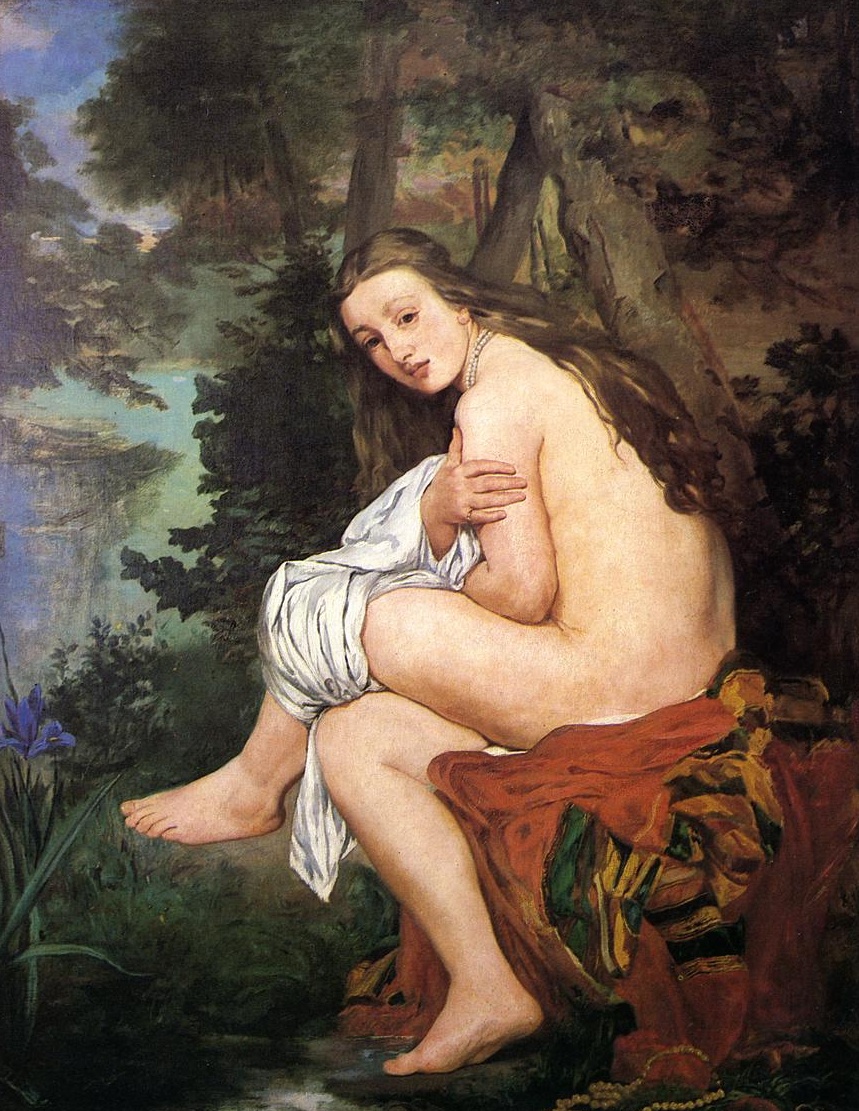
La Nymphe surprise is a key early work by Édouard Manet, painted in 1861: a young nude woman with long brown hair sits on a patterned red cloth by the water in a wooded glade, turns to look at us over her shoulder and holds a white cloth to her chest. The original is oil on canvas, 144.5 x 112.5 cm, and belongs to the National Museum of Fine Arts in Buenos Aires. Our painter paints it for you by hand in oil on canvas, in 7 portrait sizes from 30 x 40 to 68 x 90 cm, or made to measure within that range. Once the nymph is finished, we send you a photograph of her before dispatch.
| Title: | La Nymphe surprise |
| Other titles: | Surprised Nymph |
| Painter: | Édouard Manet (1832–1883) |
| Year painted: | 1861 |
| Original size: | 144.5 cm x 112.5 cm (height x width) |
| Original technique: | Oil on canvas |
| Painting style: | Realism and Impressionism |
| Located at: | National Museum of Fine Arts (Museo Nacional de Bellas Artes), Buenos Aires, Argentina |
| Our reproduction: | Hand-painted in oil on canvas, 7 sizes or made to measure |
La Nymphe surprise – Édouard Manet
What does La Nymphe surprise show?
In the middle of the canvas a young woman sits unclothed, half turned away from us. She looks back over her shoulder with dark, slightly widened eyes, as if someone had just disturbed her. Her long brown hair falls in waves almost to her waist. She wears only a string of white pearls and a ring on her little finger.
With both hands she presses a white cloth to her chest; it falls over her knee nearly to the ground. She sits on a broad red drape striped with green, yellow and black, and her bare feet almost touch the water.
Behind her rise dark trees and thick undergrowth. On the left the leaves open onto blue water and pale sky, and at the lower left a blue iris grows from the grass.
Who were the nymphs, and why does she look startled?
In Greek mythology nymphs are female spirits of nature, usually shown as young women. They live in mountains, woods, springs and rivers, and Manet’s nymph sits exactly there, by water in a wood.
Her glance is the opposite of the challenging stare of Olympia, painted a few years later: surprised and shy, as though she has only now noticed us watching her.
Several writers see a link with Rembrandt’s Susanna and the Elders: the model was called Suzanne, she was Dutch, and the pose of the figure is the same. The art historian Françoise Cachin argues instead that Manet probably drew on a 1704 painting of the same subject by Jean-Baptiste Santerre, citing the arm and the handling of the fabric. More is in the English-language Wikipedia article on the painting.
Why is it seen as a key work for Manet?
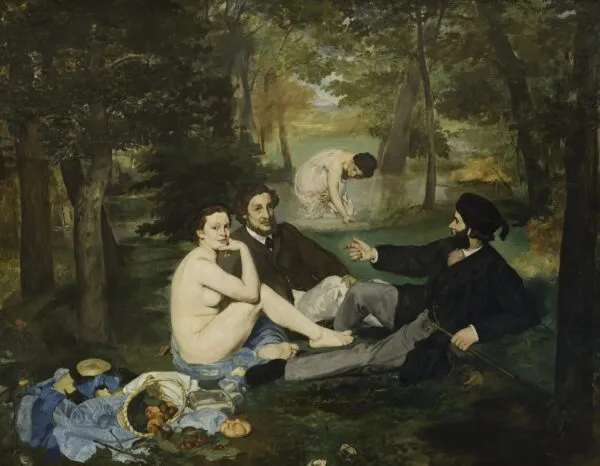
The painting marks the start of a new period in Manet’s career and, more broadly, in the history of modernism in French painting. It came two years before Le Déjeuner sur l’herbe and Olympia, which later caused a great stir and are seen as the beginning of modern art.
Édouard Manet (1832–1883), the son of a wealthy Paris family, trained under Thomas Couture and copied Velázquez and Titian in the Louvre. He was one of the first nineteenth-century artists to paint modern life, and a pivotal figure in the move from Realism to Impressionism.
Manet kept the canvas all his life, and there is evidence that, beyond its personal meaning, he counted it among his most important pictures.
Where is the original, and who posed for it?
The original, oil on canvas measuring 144.5 x 112.5 cm (height x width), belongs to the National Museum of Fine Arts in Buenos Aires (accession number 2712), where it is one of the highlights of the collection.
Manet exhibited it at the Paris Salon of 1865; the museum in Buenos Aires bought it later.
The model was Suzanne Leenhoff, a Dutch pianist three years older than Manet. In 1849 she came to his parents’ house as piano teacher to Édouard and his brother Eugène. Their relationship was kept from his family; they married in 1863, the year after his father died, and stayed married until Manet’s death in 1883.
La Nymphe surprise or another Manet?
This is a canvas painting for anyone drawn to quiet scenes in nature and an old myth told with a personal eye.
A woman in profile, Méry Laurent in a fur coat before a Japanese fabric, appears in Autumn (Méry Laurent). A smiling boy in a red cap with his hands full of cherries is the subject of Boy with Cherries, and a pale beach dotted with small figures fills On the Beach, Boulogne-sur-Mer. Still-life lovers will find two white blooms and shears in Branch of White Peonies and Shears.
Our whole shelf of famous Manet paintings, each one painted to order, is on the Édouard Manet page.
How do we hand-paint La Nymphe surprise?
Manet’s nymph is a large oil on canvas, the original standing almost one and a half metres tall. Ours is an oil painting reproduction on fresh canvas: the painter works it in oil on canvas and builds it up layer by layer.
He first lays in the seated figure, the turn of the head and the curve of the back, then the dark trees. On that ground he builds the pale, softly modelled skin and the long brown hair.
Last come the white cloth, the red drape, the pearls, the iris and the water. Because all our sizes are smaller than the original, the painter tightens the detail slightly so that the nymph’s face stays clear.
Which size fits which wall?
In short: 30 x 40 or 36 x 48 cm for a bedside table or a narrow wall, 41 x 55 and 48 x 60 cm above a chest of drawers or a bed, and 55 x 70, 61 x 80 or 68 x 90 cm above a sofa or as a room’s centrepiece.
We paint it in 7 portrait sizes (width x height): 30 x 40, 36 x 48, 41 x 55, 48 x 60, 55 x 70, 61 x 80 and 68 x 90 cm. The original measures 112.5 x 144.5 cm (width x height), so every one of our sizes is smaller; the largest, 68 x 90 cm, reaches about three fifths of its height.
We do not paint it larger than 68 x 90 cm: the only good photograph of the original that we work from is small and would not hold enough detail. As a painting for the living room it works best at 61 x 80 or 68 x 90 cm; in a bedroom 48 x 60 cm is often enough.
Can I have a different size or a frame?
Yes, within the range up to 68 x 90 cm. For other proportions we keep the nymph, the iris and the water whole and adjust only the edge of the wood. Send us the size you need; we answer with a price and a date for your nymph.
The nymph ships rolled, stretched on a stretcher bar or framed, as you prefer; our workshop in Slovenia does the stretching and framing. You pick the moulding in our 3D app, which serves only the choice of frame; a view of the nymph on your own wall is a separate service.
When will the painting arrive?
The painter starts on the nymph as soon as you confirm the order, and the painting is ready to leave within 15 to 45 working days. Before packing we send you a photograph of the finished canvas and make any changes you ask for.
The nymph travels within Slovenia and to the rest of the EU with no customs duties, and every order is covered by our returns policy.
This calm nude by the water suits a bedroom, a living room or a collector’s wall. Unsure where she will hang? A wall art voucher leaves the size to whoever receives it.
Frequently asked questions
Where can I see the original?
At the National Museum of Fine Arts in Buenos Aires, Argentina, under accession number 2712.
Who is the woman in the painting?
Suzanne Leenhoff, a Dutch pianist whom Manet married in 1863.
Is this a print?
No. It is a hand-painted copy, made by our painter with brushes in oil on canvas.
How big is the original?
It measures 144.5 x 112.5 cm (height x width), so all seven of our sizes are smaller.
Can I order it larger than 68 x 90 cm?
No, because the only good photograph of the original is small; any size up to 68 x 90 cm is possible.
How long does it take to make?
15 to 45 working days; before dispatch you get a photograph of the finished nymph.
Is a nude right for a bedroom, or as a gift?
Yes. The quiet scene by the water sits well in a bedroom or living room, and as a present it pleases anyone who loves classical art.
What does the nymph’s startled glance mean?
It reads as shy, as if she has just caught us looking at her; the very opposite of Olympia’s challenging stare.
- Subject: a young nude woman with a white cloth sits by the water in a wood and looks round at us over her shoulder.
- Original: oil on canvas, 1861, 144.5 x 112.5 cm, National Museum of Fine Arts, Buenos Aires.
- Ours: an Édouard Manet reproduction hand-painted in oil on canvas, 7 sizes from 30 x 40 to 68 x 90 cm, or made to measure up to that size.
- Worth knowing: the model was Suzanne Leenhoff, later Manet’s wife; he kept the painting all his life.