




Description
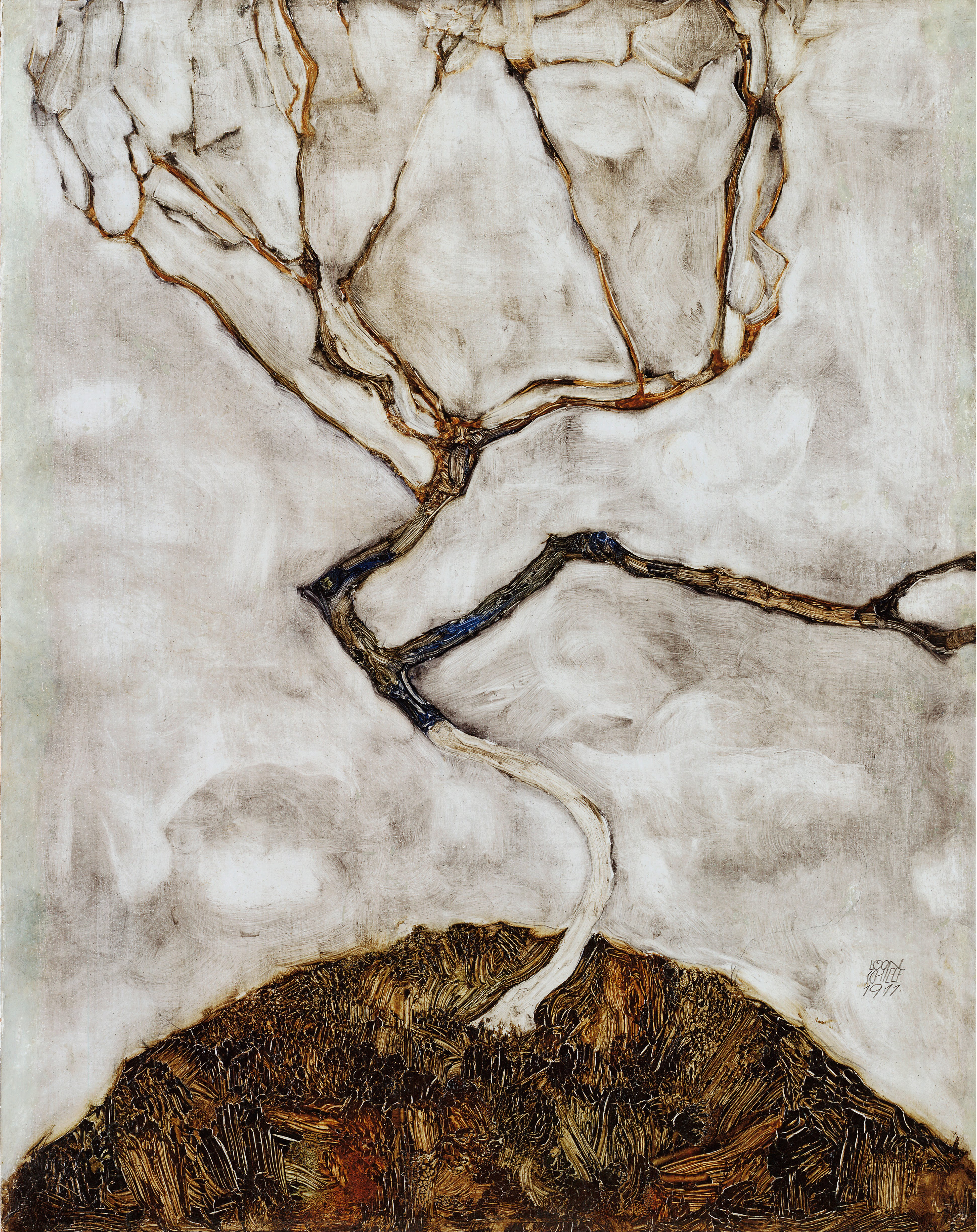
Small Tree in Late Autumn is a painting by Egon Schiele from 1911: one bare young tree with a pale, crooked trunk rising from a mound of dark earth against an almost white ground. We paint it by hand in oils at the size you choose, and before dispatch we send you a photograph of the finished work for approval.
| Title: | Small Tree in Late Autumn |
| Other titles: | Kleiner Baum im Spätherbst · Majhno drevo v pozni jeseni |
| Painter: | Egon Schiele (1890–1918) |
| Year: | 1911, signed and dated lower right “EGON SCHIELE 1911” |
| Original size (width × height): | 33.5 cm x 42 cm |
| Original technique: | Oil on wood |
| Style: | Expressionism |
| Location: | Leopold Museum, Vienna |
| Our reproduction: | hand-painted oil on canvas, 13 sizes from 50 x 65 cm to 160 x 205 cm, or a made-to-measure size |
Small Tree in Late Autumn – Egon Schiele
What does the painting show?
One young tree and nothing else. It stands on a rounded mound of earth that fills the bottom of the picture, laid on in short, thick strokes of dark brown, ochre and black. The trunk is almost white and climbs in sharp bends, first to the left and then back to the right, with a blue-black edge along its upper part. One long branch reaches out to the right edge; above it a web of thin brown and rust-red branches spreads towards the top, where the edge cuts it off. There are no leaves. Everything else is a pale grey-white ground with the brushwork left visible, and the signature and year sit at the lower right, just above the earth.
Why do people love it?
Because it is quiet and strong at the same time. The Austrian painter used very few colours – white, grey, brown and a touch of rust red – so the work sits easily in a modern room, next to wood or a plain white wall. The bent trunk gives it tension: the tree looks as if something pushed it sideways and it simply kept growing. Because the branches run off the edges, the tree seems bigger than the panel it is painted on, which is why it also works on a large wall. The title says late autumn, and the bare branches show it without a word.
Provenance
The painting was owned by Arthur Roessler in Vienna, then by Richard Lanyi and by Otto Nirenstein in Vienna (before 1930 to 1938); from 1939 to 1954 it was with the Galerie St. Etienne in New York, and then with Rudolf Leopold (1954–1994); it is now at the Leopold Museum in Vienna.
Where does it sit among Schiele’s works?
Among the other Schiele works in our shop, you can compare it with The Lyricist, Cardinal and Nun (Caress) and House Wall (Windows); if you are choosing between them, open them side by side. The full selection is in the Egon Schiele gallery, with more on his life in our article about Egon Schiele.
How is our hand-painted version made?
One of our artists paints it by hand in oils, stroke by stroke, for your order – it is not a print. Two places decide the result. The first is the earth, which has to keep its short, thick strokes instead of turning into a flat brown field. The second is the trunk: it is lighter than the ground behind it, and any painter is tempted to darken it; we keep it pale. The original is painted on a wooden panel and ours is oil on canvas, so the surface will not be identical. When it is finished we photograph it and send you the photograph for approval, and only then does it ship. This work has not yet been photographed in our workshop; we will add pictures to this page once we have them.
Which size for which wall?
Short answer: the colours are pale and the subject is simple, so the work stays light even when it is large. We offer it in thirteen sizes, from 50 x 65 cm to 160 x 205 cm. For a narrow wall, a hallway or the space between two windows, 50 x 65 cm or 60 x 75 cm; above a chest of drawers or a desk, 70 x 90 cm or 80 x 100 cm; above the sofa in a living room, 100 x 130 cm or 120 x 150 cm; on a large wall or in a stairwell, 140 x 180 cm or 160 x 205 cm. A canvas painting of this size needs some distance: close up you see the single strokes in the earth, and the tree comes together from a few steps back. A hand-painted painting hangs best with its centre at eye level, roughly 145–150 cm from the floor; above a sofa, 15–25 cm above the backrest.
Custom size, stretcher bar and frame
If none of the thirteen sizes suits your wall, we paint the work to your own measurement. If you choose “YES” under the Stretcher option, the canvas comes stretched on a wooden stretcher bar, ready to hang. Our 3D application is for choosing a frame only, not for showing the work on your wall. The frame is chosen separately and need not be part of the order.
Delivery and guarantee
We paint to order and deliver to sixteen countries in the European Union, among them Slovenia, Croatia, Austria, Italy, Hungary, Germany and France; the United Kingdom and Ireland are not currently among them. The work travels protectively packed. Before dispatch we send you a photograph of the finished work to approve. Production time depends on the size and on the studio’s workload. Every order is covered by our Returns and Refund Policy.
Frequently asked questions
What does Small Tree in Late Autumn mean?
The Leopold Museum reads the bare, isolated tree not as a realistic landscape but as a feeling: being exposed and lonely, and the will to survive. In that reading it stands for the growth and persistence of nature, and so also of people, in the face of adversity.
Why does the tree look like a human figure?
Schiele often gave nature human shapes and moods; in the summer of 1913 he wrote that he was mainly observing the “bodily movements” of mountains, water, trees and flowers. Here the trunk and the branch reaching to the right can be read as legs, and the branches of the crown as arms, like a lone figure in the wind.
When did Schiele paint Small Tree in Late Autumn?
In 1911: the panel is signed and dated at the lower right “EGON SCHIELE 1911”. It is painted in oils on wood and measures only 33.5 x 42 cm.
Why is Small Tree in Late Autumn so small?
Schiele’s friend and supporter, the critic Arthur Roessler, had advised him to make smaller works that would sell more easily. According to Roessler’s 1922 book on Schiele, the artist asked him in 1911 to sell five small oils on wooden panels quickly, and this tree was one of them.
Where is Small Tree in Late Autumn today?
In the Leopold Museum in Vienna, under inventory number 459. The museum’s record lists its earlier owners in this order: Arthur Roessler, Richard Lanyi and Otto Nirenstein in Vienna, the Galerie St. Etienne in New York and Rudolf Leopold, who held it from 1954 to 1994.
Does it work as a gift?
Yes; if you are unsure which size to choose, there is a gift voucher.