


Description
| Title: | Tiger in a Tropical Storm |
| Other titles: | Surprised! (the title it carries in London) · Tiger v tropski nevihti |
| Painter: | Henri Rousseau (1844–1910) |
| Year painted: | 1891 |
| Original size: | 162 cm x 130 cm |
| Original technique: | oil on canvas, unlined |
| Painting style: | naive art (primitivism), Post-Impressionist Paris |
| Located at: | The National Gallery, London (inv. NG6421) |
| Our reproduction: | hand-painted in oil on canvas, eight sizes or a size made to order |
Tiger in a Tropical Storm (Surprised!) – Henri Rousseau
Tiger in a Tropical Storm is Henri Rousseau’s canvas of 1891, in which a tiger crouches in tall grass while a storm bends every leaf one way. The original hangs in the National Gallery in London under inventory number NG6421 and under the title the painter gave it himself, Surprised! With us it is made as a hand-painted reproduction in oil, on canvas, in eight sizes from 70 x 60 cm to 200 x 160 cm or in a size of your own. Before it is dispatched we send you a photograph of the finished canvas for approval.
What is on the canvas?
The canvas is horizontal and filled to the edges with foliage. The tiger sits low in the left third, back arched and teeth bared, its stripes answering the grass around it. Above it the leaves part just enough to show lightning in the top right corner, the only bright point in a closed scene. There is no aerial perspective: the leaves at the back are as sharp as those in front, so the thicket reads as a wall, not as depth. The colour is laid in flat planes with no soft transitions, and that flatness is what gives the scene its tension. What the tiger hunts is not shown; the London record notes that darker passages above the grass on the right may be traces of prey later covered over.
Did Rousseau ever see a jungle?
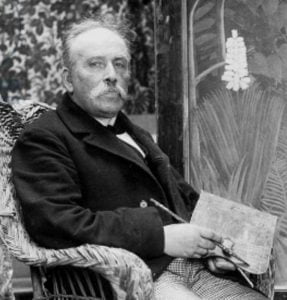
He did not. It is the question almost everyone asks in front of this work, and the answer is documented: the National Gallery’s record states that Rousseau’s jungles are entirely imaginary, as he never left France. He served four years in the army from 1863, and his claim to have been with a French expedition in Mexico has no basis. He studied plants in the Paris botanical garden, the Jardin des Plantes, where tropical species grew beside ordinary house plants; he painted both with the same precision, on one canvas. The same garden held a run-down zoo with lions, tigers and jaguars. The tiger here is therefore assembled: partly from animals he could see, partly from illustrations in magazines, partly from watching a domestic cat. That is why this jungle is botanically exact in its parts and impossible as a whole.
How is the tropical storm painted?
The storm is not painted as an event behind the scene but as a mesh laid across everything else. Once the foliage and the animal were finished, Rousseau drew diagonal, semi-transparent silver-grey stripes over the whole surface to stand for tropical rain. The rain therefore sits above the leaves rather than beneath them, and its strokes rhyme with the tiger’s stripes and the long blades of grass. Every branch and blade leans the same way, which is the only sign of wind; the sky is almost entirely hidden. Depth is carried by the size of the leaves and by the way the planes of foliage overlap, never by light. Naive art is often described as clumsy, yet the order of work here is deliberate: the scene first, the weather over it.
Why does this painting matter?
It is the first of about twenty jungle scenes Rousseau painted in his life, and the starting point of the motif he is best known for today. It was shown at the Salon des Indépendants in Paris in 1891, an exhibition founded in 1884 under the slogan “no jury, no awards”, which is why it could admit painters the official Salon would have refused. Rousseau was self-taught and took his work seriously while critics mocked it for years. To see where the motif had travelled a decade later, look at The Equatorial Jungle, where no single animal holds the scene and only foliage and light remain.
What does the painting mean?
The tension of the scene lies in what is withheld. The London record leaves the question open: the tiger may be cowering from the lightning, or it may be stalking prey. The title Surprised! names a surprise without saying who is surprised: the animal, its quarry, or the viewer in front of it. The canvas was reworked while the painter was at it, which is a trace of deliberation rather than haste. That openness is why the work stays in the memory; a canvas painting that answered its own question would be exhausted at first glance. An equally taut meeting with a beast is The Hungry Lion Throws Itself on the Antelope.
Where was the work before London bought it?
The National Gallery’s record names two stations, and that document is the only source cited here. The first is the Salon des Indépendants of 1891, its first public showing. The second is the purchase: the Gallery bought the work in 1972 with the aid of a substantial donation from the Hon. Walter H. Annenberg, and gave it the number NG6421. What happened between those dates is not in the record we read, so we do not describe it: an empty space beats a filled-in guess.
Is Surprised! the same work as Tiger in a Tropical Storm?
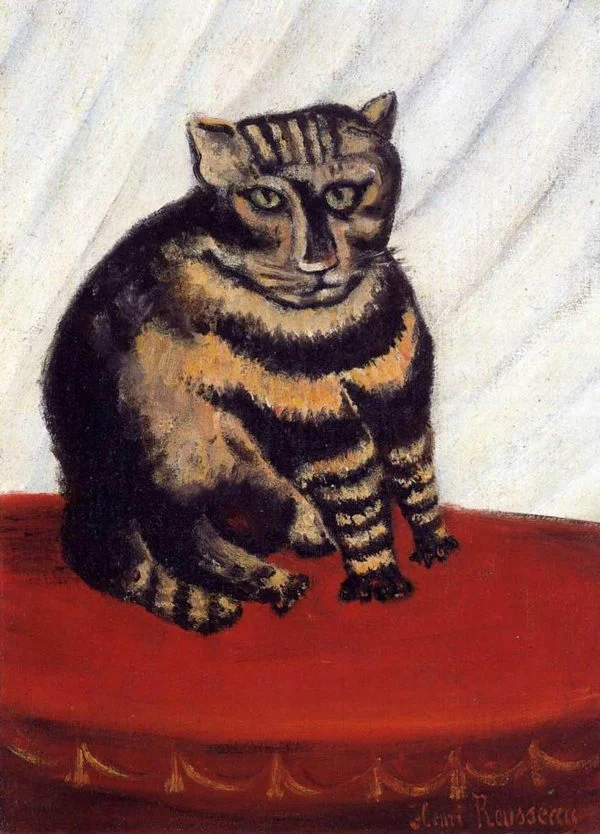
Yes, it is one canvas with two titles. In London it hangs as Surprised!, the title the painter chose; the descriptive title Tiger in a Tropical Storm came into use later and is how the work circulates in catalogues and here. Do not confuse it with the other jungle canvases we offer: Scouts Attacked by a Tiger is a later attack scene, and The Tiger Cat is a smaller work with a single animal. A late version of the same motif, a waterfall among leaves, is at the Art Institute of Chicago (inv. 1926.262, 1910, 116.2 x 150.2 cm).
How is your canvas made here?
Your canvas is begun only after your order, in our workshop in Slovenia. The oil is built up in layers so the mesh of rain arrives last, as in the source, which is why this motif cannot be printed and no two versions are alike. We do not print, and no machine application is used. The canvas is stretched on a wooden frame and arrives ready to hang. Before packing we photograph it and send you that photograph for approval; only then does it travel. The full range is in the Henri Rousseau gallery, and the background to his work is described in our article about the painter.
Which size for which wall?
For a living room the usual choice is 120 x 100 cm. This horizontal motif needs width: below 90 x 70 cm the mesh of rain and the small leaves merge, so those sizes suit narrow walls. Eight sizes: 70 x 60, 90 x 70, 100 x 80, 120 x 100, 140 x 110, 162 x 130, 180 x 140 and 200 x 160 cm. The 162 x 130 cm size matches the original as the London record gives it, rounded to whole centimetres. Above a sofa the work usually takes about two thirds of the width of the furniture.
How do I order a custom size, a stretcher and a frame?
Custom sizes go through the painting made by order page, where you enter width and height. The proportions matter here: change them sharply and the tiger moves towards the edge, so we suggest keeping the ratio and changing only the scale. The canvas is always stretched on a wooden frame. A frame is not in the price and is chosen separately; unframed, the work is ready to hang on arrival.
How is it delivered and what do we guarantee?
We deliver to Slovenia, Croatia, Italy, Austria, Hungary and Germany. The canvas travels rolled in a tube or stretched on its frame, always in protective wrapping. We guarantee that every work is painted by hand and that you see a photograph of it before dispatch; if anything there is wrong, we correct it first.
Frequently asked questions
Where is the original?
In the National Gallery in London, under inventory number NG6421. The record gives 1891, oil on canvas (unlined) and measurements of 129.8 x 161.9 cm.
Is the tiger the hunter or the hunted?
The Gallery’s record leaves both readings open: the animal may be cowering from the lightning or stalking. No second animal is painted on the canvas to settle it.
Why does the work have two names?
Because the painter titled it Surprised! and the descriptive name came later. You will find the same motif here under both.
Is this a print?
It is not. Every canvas is painted by hand in oils, to order. A hand-painted copy differs from a print to the touch, because the paint stands on the surface.
Which size should I choose?
120 x 100 cm or larger for a living room, 90 x 70 cm for a narrow wall. Above three metres of wall the largest size carries well.
Can I have a size that is not listed?
Yes, with no surcharge for a non-standard size. We recommend keeping the proportions of the original.
How is it delivered?
Rolled in a tube or stretched on its frame, tracked. The making time depends on the size and is confirmed when you order.
What is the painting about, in one sentence?
That a jungle nobody had seen could be assembled from a botanical garden, a zoo and a few magazines, and is the more gripping for it.
Is the original for sale?
No. It is in a public collection in London and not on the market; we give no valuation, having no source for one.
How high should I hang it?
The centre of the canvas about 145 cm above the floor, eye level for a standing viewer. Above a sofa leave 20 to 25 cm above the seat back.
Does it work as a gift?
An animal motif is a frequent gift. To leave the choice to the recipient, there is a voucher.
- Subject: a tiger in tall grass in a tropical storm, lightning in the top right corner, rain drawn as a mesh across the whole surface
- Original: 1891, oil on an unlined canvas, 129.8 x 161.9 cm, The National Gallery, London, inv. NG6421
- Ours: hand-painted in oils, eight sizes from 70 x 60 to 200 x 160 cm or made to measure, photograph for approval before dispatch
- Worth knowing: the painter never left France – this jungle is assembled from house plants, a botanical garden and illustrations