







































Description
| Title: | Mauvaise surprise |
| Other titles: | Unpleasant Surprise (the museum’s English title) |
| Painter: | Henri Rousseau |
| Year painted: | 1899–1901 |
| Original size: | 194.5 cm x 129.5 cm (height x width) |
| Original technique: | oil on canvas |
| Painting style: | naive art (primitivism) |
| Held at: | Barnes Foundation, Philadelphia, USA (inv. BF281) |
| Our reproduction: | hand-painted oil on canvas, eight sizes or a size made to order |
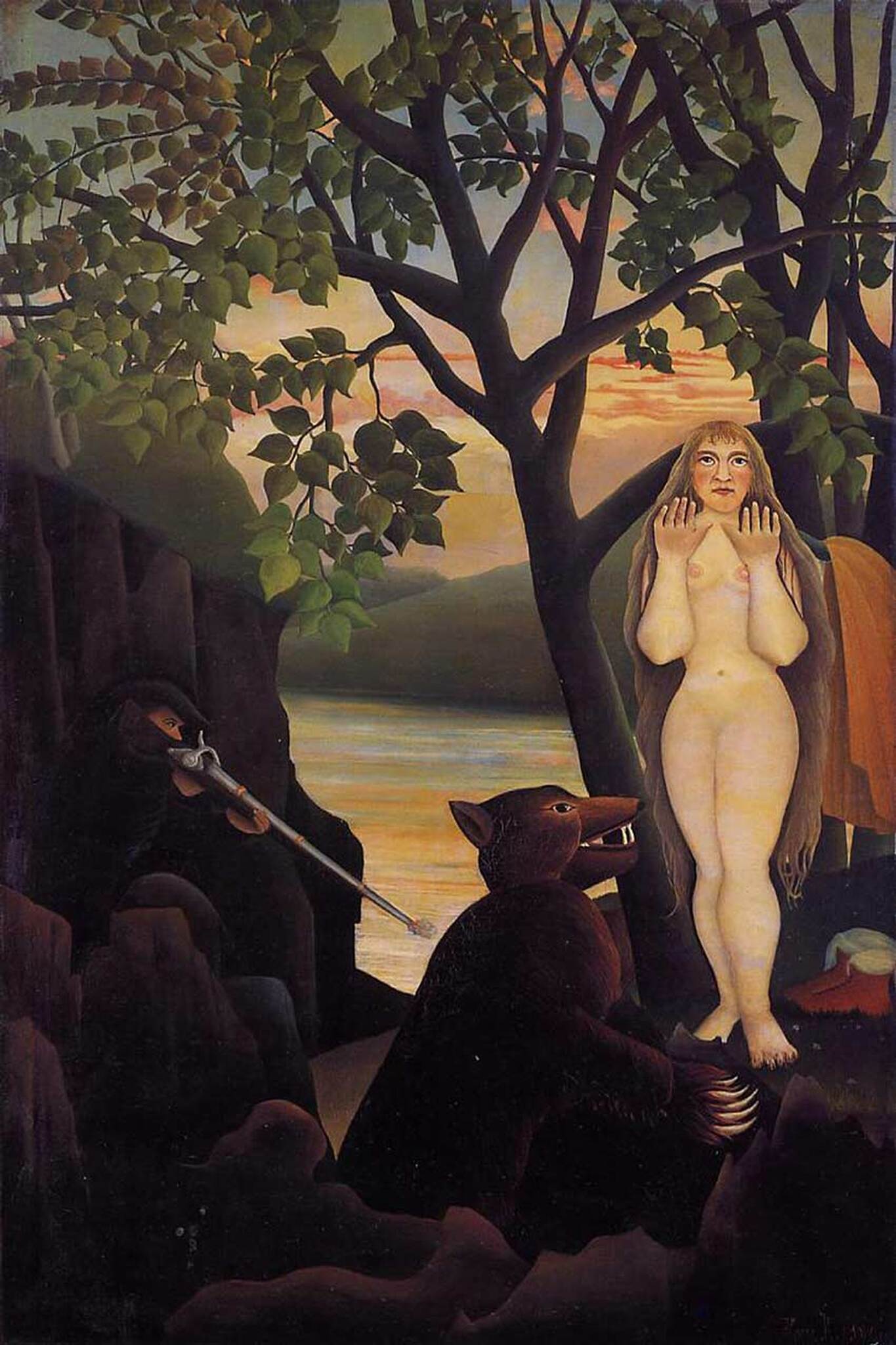
Mauvaise surprise is a painting by Henri Rousseau, oil on canvas, dated by its museum to 1899–1901. The original measures 194.5 cm high and 129.5 cm wide and is held by the Barnes Foundation in Philadelphia under inventory number BF281. What you see: a nude woman with long hair and raised palms, a bear with open jaws, and a hunter aiming a gun from behind rocks on the left, with a lake in evening light behind them.
Mauvaise surprise
What is on the canvas?
The canvas is upright, half as tall again as it is wide. Dark rocks fill the lower left, and behind them, half hidden, a hunter in dark clothes aims a long gun to the right. In the centre a large brown bear rises out of the shadow, its jaws open and its teeth showing, with pale claws below. On the right stands a nude woman whose hair falls to her knees. She is barefoot on a stone, her hands raised to shoulder height with the palms turned outwards. An orange-red cloth hangs behind her, and a heap of clothes lies on the ground at her feet. Beyond them a lake opens towards green hills on the far shore, under a pink and orange sky like that of a sunset, and two trees with dark trunks frame the scene from above, their leaves painted one by one.
What is the scene about?
The French title means an unpleasant surprise, and the museum’s English title is Unpleasant Surprise. The museum’s own text first reads the scene as a classic damsel in distress: a hunter saving a bather from a sharp-clawed bear. It then points out that the woman stands in a gesture of calm surrender, showing dirty palms, and concludes that the longer one looks, the stranger the painting becomes and the harder its story is to decipher. We add no reading of our own. The same museum also holds the painting Woman Walking in an Exotic Forest.
Why does the museum give a span of years?
The Barnes Foundation dates the canvas not to a single year but to the period 1899–1901, so we give the span too and do not shorten it to one date. The later end is supported by the museum’s own bibliography, which lists the catalogue of the 17th Salon des Indépendants in Paris, 1901, with the painting under number 867. Rousseau therefore showed it in public that year. Another large canvas we offer in which an animal attacks is The Hungry Lion Throws Itself on the Antelope.
How large is the original, and what does that mean on a wall?
The original is 194.5 cm high and 129.5 cm wide, taller than most people. Eight sizes are available: 50 x 75, 60 x 90, 70 x 100, 80 x 120, 90 x 130, 100 x 150, 110 x 160 and 130 x 193 cm. Four of them, 50 x 75, 60 x 90, 80 x 120 and 100 x 150 cm, keep an exact proportion of two to three, which the original matches very closely. The largest size, 130 x 193 cm, is the nearest to the original but not the same: 1.5 cm lower and 0.5 cm wider. An upright format suits a narrow wall between windows or beside a staircase, where a landscape format would not fit. Even at the smallest size the bear’s teeth and the woman’s raised palms read clearly. Custom sizes are ordered through the made-to-order painting page. Another nude figure among leaves appears in Eve in the Garden of Eden.
How is a hand-painted reproduction made?
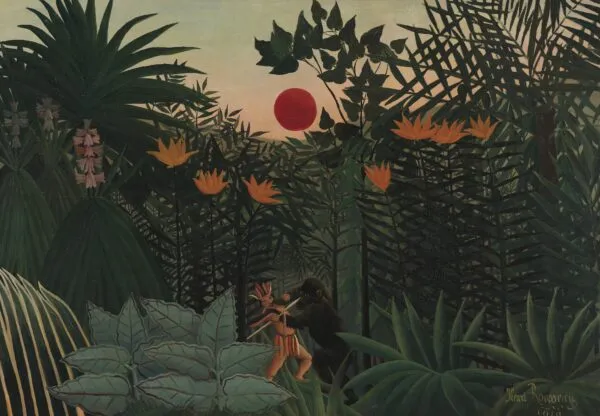
Every canvas painting is made by hand in oils, to order, in the size you choose. The painter works from a high-resolution image of the original, layer by layer, so that the single leaves on the trees, the fur on the bear’s back and the folds of the orange cloth stay distinct at the smaller sizes too. Because it is handwork, two canvases of the same size always differ a little; that is not a fault but the difference between a painting and a print. The canvas is stretched over a wooden frame and prepared for hanging. A person attacked by an animal in the forest is the subject of Virgin Forest at Sunset, and the full collection is in the Henri Rousseau gallery.
Frequently asked questions
Where is the original kept?
At the Barnes Foundation in Philadelphia, under inventory number BF281. The canvas has recently been exhibited in Paris as well, so check with the museum before a visit that it is on view.
Who is the woman in the painting?
The museum does not name her; its text describes her as a bather. We give her no name either.
What are the original’s measurements in centimetres?
194.5 cm high and 129.5 cm wide, oil on canvas.
Is this a print?
No. Every canvas is painted by hand, in oils, to order. The body of the paint is visible and can be felt, which a print cannot imitate.
Is the painting suitable as a gift?
It can be, but a nude figure and a bear baring its teeth are not for every home. If in doubt, leave the choice to the recipient with a gift voucher.
- Subject: a nude woman with raised palms, a bear with open jaws and a hunter with a gun behind rocks, with a lake at sunset behind.
- Original: oil on canvas, 194.5 x 129.5 cm (height x width), Barnes Foundation, Philadelphia, inv. BF281; dated 1899–1901.
- Our version: hand-painted oil, eight sizes from 50 x 75 to 130 x 193 cm, or a size made to order.
- Of note: the painting was shown at the Salon des Indépendants in Paris in 1901 as number 867.