







































Description
| Title: | Woman Walking in an Exotic Forest |
| Other titles: | Femme se promenant dans une forêt exotique (the original French title) |
| Painter: | Henri Rousseau (1844–1910) |
| Date of creation: | c. 1910, as the museum dates it |
| Original size: | 81 cm x 100 cm |
| Original technique: | oil on canvas |
| Painting style: | naive art (primitivism), Paris after Impressionism |
| Located at: | Barnes Foundation, Philadelphia (inv. BF388) |
| Our reproduction: | hand-painted oil on canvas, eight sizes or a size made to order |
Woman Walking in an Exotic Forest – Henri Rousseau
Woman Walking in an Exotic Forest is one of those paintings by Rousseau in which there is no beast at all and still nothing looks familiar. A single figure walks through a forest that exists nowhere, dressed as if for a Paris park. The original is held by the Barnes Foundation in Philadelphia under inventory number BF388; the museum dates it c. 1910 and gives a height of 100 cm and a width of 81 cm. Here it is made as a hand-painted reproduction in oil, on canvas, in eight sizes from 50 x 60 cm to 160 x 200 cm or to your own measurement. Before dispatch we send you a photograph of the finished canvas for approval.
What is on the canvas?
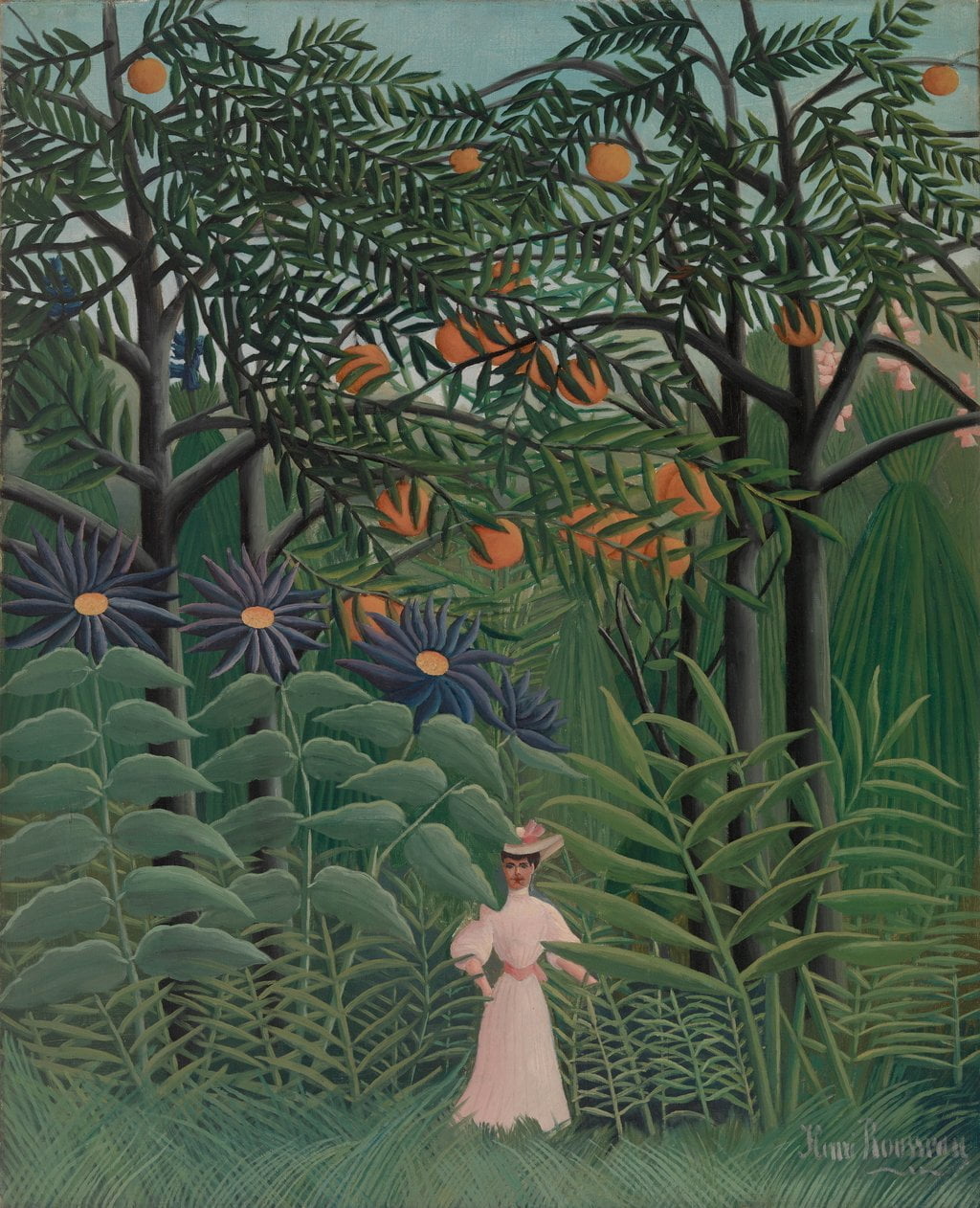
In the middle of the canvas stands a woman in a hat and a long pink dress gathered at the waist. Everything around her is too large. Single leaves are as wide as her torso and cover part of her face, and the oranges hanging from the branches above are almost twice the size of her head. Purple flowers of a kind that does not exist grow among the plants. It is that proportion which makes the scene strange: the figure is not small because she is far away but because everything else has grown. And there is no path along which she might go on. A comparable sense of an arranged world is in The Merry Jesters.
Why does the museum say c. 1910 and not 1905?
Because it changed the dating, and on this work that is worth saying plainly. The museum’s record now reads c. 1910, with the hedge. In the same record, its exhibition history lists this painting in the large touring show of 1993–1995 with the date 1905. So the older year was the museum’s own. Our page has been giving exactly that. We now give the one the institution gives today, and say where the previous one came from. The difference is not trivial: c. 1910 places the canvas in the last year of the painter’s life, 1905 five years earlier.
How large is the original?
The museum gives a height of 100 cm and a width of 81 cm. This too we corrected: our page had been giving 80.7 x 99.9 cm, which is close but is not what the institution publishes. The museum’s two statements agree with each other, since 39 3/8 inches is 100 cm and 31 7/8 inches is 81 cm. So the 81 x 100 cm size in our range is exactly the measurement of the original rather than a rounding. Anyone who wants the canvas at the size it was painted should choose that one.
Why is the figure so small?
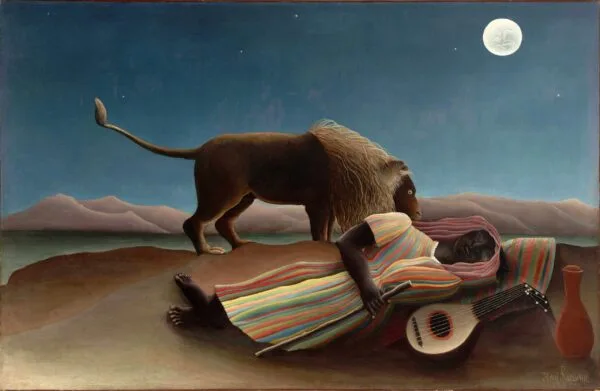
Because the painter did not paint distance but proportion. In a real forest the plants would diminish towards the background and the figure would look larger the nearer she stood. Here nothing diminishes: the leaves at the back are as sharp as those in front, so there is no telling how far anything is. All that remains is the comparison of sizes, and that puts the woman in the position of a visitor who has wandered in. The result reads as a dream rather than as a report from a place. The same method on a larger canvas is The Dream.
What does the painting mean?
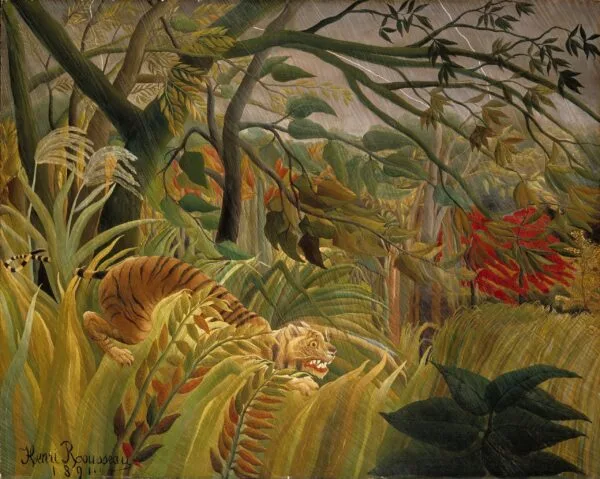
The painting does not say whether the woman is in danger or out for a walk, and that uncertainty is the easiest thing to read as its subject. She is dressed for a city and standing in growth that no city park contains. Some viewers read a joke at the expense of the bourgeois stroll, others a quiet unease: the figure is alone and the path has ended. The painter helps neither party. A meeting of a person and a forest that ends in an attack is Virgin Forest at Sunset.
Where is the original, and what does the museum publish?
In the Barnes Foundation, Philadelphia, under inventory number BF388. The museum publishes oil on canvas, the measurements, the hedged date and an extensive bibliography, including the exhibitions the work has travelled to. It also publishes which room of the collection the work hangs in, and that we do not repeat here: the same record says the work is not currently on view in the permanent display because it is travelling, so a room number would send a reader to an empty wall. The institution’s record is on the museum’s page for the work.
What does naive art mean in this work?
Naive art is the name for painting by self-taught artists who trained in no academic studio and kept to none of its rules on perspective, shading and anatomy. In this canvas it shows above all in the proportions: the plants are bigger than the person because the painter made them bigger, not because they are nearer. Rousseau was a customs clerk who began to paint seriously only in his forties. The label naive art therefore does not mean ignorance, but a style you recognise at first glance. There is more on the painter’s path in our article about the painter.
How is your canvas made here?
Your canvas is begun only after your order, in our workshop in Slovenia. The oil is built up in layers, from the background towards the plants and last of all towards the figure, so that the dress and the hat arrive at the end. With this subject the hardest thing is exactly that proportion: were the figure even slightly larger the effect would be lost, so she is measured against the leaves around her. We do not print and we use no mechanical application; a hand-painted canvas differs from a print by touch alone, because the body of the paint is visible and can be felt. The canvas is stretched on a wooden frame. The full range by this painter is in the Henri Rousseau gallery.
Which size for which wall?
Eight sizes: 50 x 60, 60 x 75, 70 x 90, 81 x 100, 100 x 125, 120 x 150, 140 x 170 and 160 x 200 cm. Being an upright canvas with one figure, it works on a narrower wall, between a door and a corner, or in a hallway. For a living room the usual choice is 100 x 125 cm or larger. Below 60 x 75 cm the leaves and flowers begin to merge, and with them goes the very proportion the painting stands on. The 81 x 100 cm size is the measurement of the original.
How do I order a custom size, a stretcher and a frame?
Custom sizes go through the painting made by order page, where you enter width and height. Proportions matter here: the figure stands at the centre with growth above and below her, so widening the canvas adds plants the source does not have, while shortening it cuts off the oranges over her head. For non-standard measurements we therefore suggest keeping the ratio and changing only the scale. The canvas is always stretched on a wooden frame. A frame is not included in the price and is chosen separately.
How is it delivered and what do we guarantee?
We deliver to Slovenia, Croatia, Italy, Austria, Hungary and Germany. The canvas travels rolled in a hard tube or stretched on its frame, depending on the size, always in protective wrapping. We guarantee that every work is painted by hand and that you will see a photograph of the finished piece before dispatch; if something there is not as you wish, we correct it before the work leaves the workshop. Production time depends on the size and is confirmed when you order.
Frequently asked questions
Which museum holds the original today?
The Barnes Foundation in Philadelphia, under inventory number BF388. The museum gives oil on canvas, 100 cm high and 81 cm wide.
What year is the painting from?
The museum now dates it c. 1910. The older year, 1905, was also its own and still appears in its exhibition history.
Why is there a c. in front of the year?
Because the museum does not fix the making to a single year. A year without the hedge would look more precise than the record is.
Which size is closest to the original?
The 81 x 100 cm size. That is exactly the measurement the museum publishes.
Is this a print?
No. Every canvas is painted by hand in oils, to order. The body of the paint is visible and can be felt, which a print cannot imitate.
Which size should I choose?
For a living room 100 x 125 cm or larger, for a narrower wall 70 x 90 cm. The upright format asks for height, not width.
Can I have a size that is not on the list?
Yes, a made-to-order size carries no surcharge for a non-standard format. We recommend keeping the proportions.
Can the original be seen?
The museum is open to the public, but the work is not always in the permanent display because it travels to exhibitions. Check with the museum before a visit.
How is the painting delivered?
Rolled in a tube or stretched on its frame, with tracked shipping. Production time is confirmed when you order.
Is the original for sale?
No. The work is in the foundation’s collection and is not for sale; we give no value, having no source for one.
Is it suitable as a gift?
The subject is calm and colourful, which makes it a rewarding choice for a gift. If you would rather leave the choice to the recipient, there is a gift voucher.
- Subject: a woman in a hat and long dress among plants larger than she is
- Original: c. 1910, oil on canvas, 100 x 81 cm (height x width), Barnes Foundation, Philadelphia, inv. BF388
- Our version: hand-painted oil, eight sizes from 50 x 60 to 160 x 200 cm or made to measure
- Worth knowing: the museum formerly dated the work 1905 and now dates it c. 1910