







































Description
| Title: | The Hungry Lion Throws Itself on the Antelope |
| Other titles: | The Hungry Lion Attacking an Antelope (the foundation’s own title), Le Lion, ayant faim, se jette sur l’antilope |
| Painter: | Henri Rousseau (1844–1910) |
| Date of creation: | 1898–1905, as the foundation dates it |
| Original size: | 301 cm x 200 cm |
| Original technique: | oil on canvas |
| Painting style: | naive art (primitivism), Paris after Impressionism |
| Located at: | Fondation Beyeler, Riehen/Basel (inv. 88.4) |
| Our reproduction: | hand-painted oil on canvas, eight sizes or a size made to order |
The Hungry Lion Throws Itself on the Antelope – Henri Rousseau
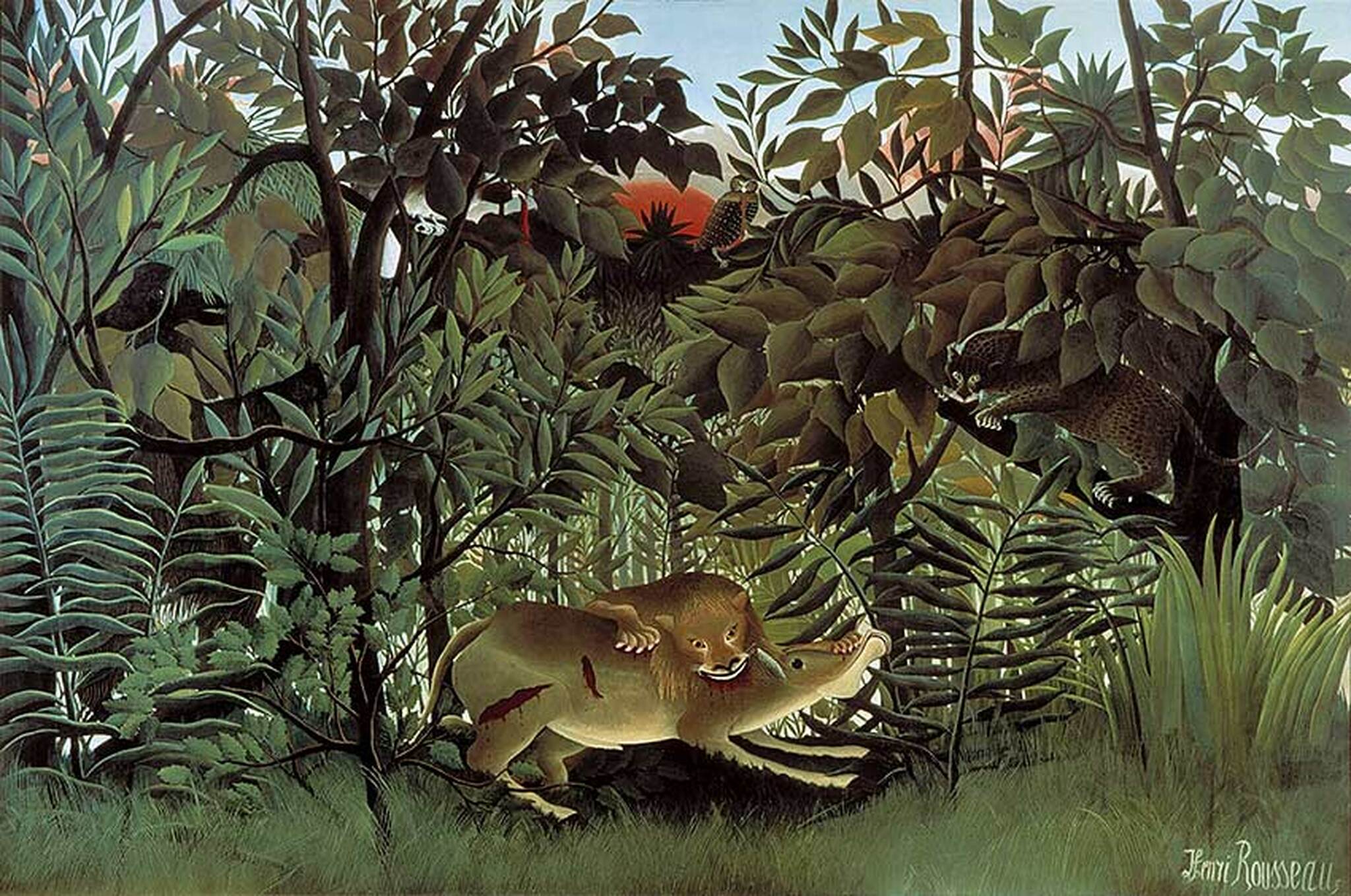
The Hungry Lion Throws Itself on the Antelope is the largest canvas by this painter in our range and one of his best-known jungle scenes. The lion has just taken hold of the antelope, and around the two of them the foliage stands as calmly as if nothing were happening. The original is held by the Fondation Beyeler in Riehen near Basel under inventory number 88.4; the foundation dates it to the span 1898–1905 and gives its measurements as 200 cm high and 301 cm wide. Here it is made as a hand-painted reproduction in oil, on canvas, in eight sizes from 90 x 60 cm to 301 x 200 cm or to your own measurement. Before dispatch we send you a photograph of the finished canvas for approval.
What is on the canvas?
The lion has brought the antelope down and has taken hold of its neck; the antelope still stands, its head thrown back, its legs not yet buckled, so the scene is caught before the outcome is settled. Around them grows a dense wall of leaves in which every leaf is drawn separately and nothing is blurred: the foliage is painted as precisely as the two animals, so the scene has none of the focus you would expect. In the branches above sit birds and other creatures watching calmly, and it is that calm which makes the scene uneasy. The sun is low, the sky red and orange, and that band of light is the only place where any depth opens at all. The same method on a smaller canvas is Tiger in a Tropical Storm.
Why does the foundation give two years?
Because it dates the work to a span rather than to a year: 1898–1905. The record does not fix when exactly the canvas was made, only within what period. Seven years is a long stretch, and the span is not a rounding but a fact: the making cannot be pinned to one season. So we give it as the institution gives it. A single year would look more precise while being narrower than what is known, and would leave a reader believing the question was settled.
How large is the canvas really?
The foundation gives a height of 200 cm and a width of 301 cm. That is the size of a wall, not of a picture over a sofa: the original is about as wide as a three-seater and as tall as a door. Our largest size, 301 x 200 cm, is therefore literally the original’s measurement, not a rounding upwards, while the smallest, 90 x 60 cm, is under a tenth of its area. This is not a detail for collectors: the scene is built so the foliage surrounds you, and that depends on how much of your field of view it takes up.
Why is this jungle different from the earlier ones?
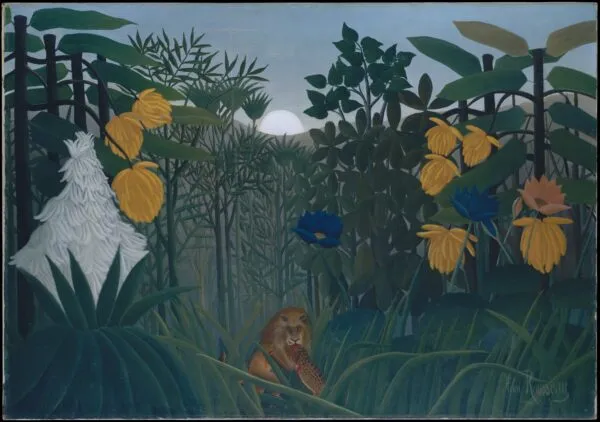
The painter came back to the jungle after a long gap that followed the cool reception of his earlier tiger. The difference is immediate: larger, denser, full of animals absent from the earlier works. Instead of one animal in a storm there is a whole stage with an audience. The foliage comes from the same vocabulary – layers of leaves, hard outlines, no aerial perspective – except that there is now so much of it that it becomes the subject. A quieter version of the same world is The Repast of the Lion.
What does the painting mean?
The scene is violent and painted without agitation. Nothing flees, nothing cries out, and the animals in the branches look on as they might at a sunset. Some viewers read the cruelty of nature in it, shown as a fact and not judged; others notice that the scene is too orderly to be real, and read it as a dream of a jungle imagined by a man who never saw one. Both can be argued, and the painting takes no side. The most dreamlike version of this world is The Dream.
Where is the original, and under what title?
In the Fondation Beyeler in Riehen near Basel, Switzerland, as part of the Beyeler Collection, under inventory number 88.4. The foundation gives oil on canvas and adds that the work is signed at the lower right with the painter’s name. It is worth knowing that the foundation lists the work in English as The Hungry Lion Attacking an Antelope – different from the title under which it became established here and elsewhere. We do not change the title, because the work is established under it, but we give both so a reader can connect them. The institution’s record is on the foundation’s page for the work.
What does naive art mean in this work?
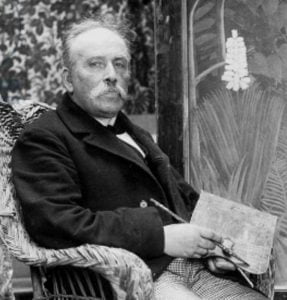
Naive art is the name for painting by self-taught artists who trained in no academic studio and kept to none of its rules on perspective, shading and anatomy. In this canvas it shows in foliage without depth, in flat colour, and in animals assembled from observation and invention rather than from study of life. Rousseau was a customs clerk who began to paint seriously only in his forties. The label naive art therefore does not mean ignorance, but a style you recognise at first glance. There is more on the painter’s path in our article about the painter.
How is your canvas made here?
Your canvas is begun only after your order, in our workshop in Slovenia. The oil is built up in layers, from the sky and the foliage towards the two animals, so that the lion and the antelope arrive last. At the large sizes that means several weeks of work, because there are literally hundreds of leaves and each is painted separately. We do not print and we use no mechanical application; a hand-painted canvas differs from a print by touch alone, because the body of the paint is visible and can be felt. The canvas is stretched on a wooden frame, ready to hang. The full range by this painter is in the Henri Rousseau gallery.
Which size for which wall?
Eight sizes: 90 x 60, 120 x 80, 150 x 100, 180 x 120, 210 x 140, 240 x 160, 270 x 180 and 301 x 200 cm. Being a landscape canvas, it needs a wide and uninterrupted wall: above a sofa, above a dining table, or in a hallway where it is seen from a distance. For a living room the usual choice is 180 x 120 cm or larger. Below 120 x 80 cm the leaves begin to merge into a green plane and the scene loses the very thing that makes it work: the density of separate leaves. If you have the wall for it, 301 x 200 cm is the measurement of the original and the picture works as it was meant to.
How do I order a custom size, a stretcher and a frame?
Custom sizes go through the painting made by order page, where you enter width and height. Proportions matter here: the scene is wide, and bringing it closer to a square loses the foliage at the sides and with it the sense of a wall of leaves. For non-standard measurements we suggest keeping the ratio and changing only the scale. The canvas is always stretched on a wooden frame. A frame is not included in the price and is chosen separately.
How is it delivered and what do we guarantee?
We deliver to Slovenia, Croatia, Italy, Austria, Hungary and Germany. The large sizes travel rolled in a hard tube, the smaller ones may travel stretched on the frame, always in protective wrapping. We guarantee that every work is painted by hand and that you will see a photograph of the finished piece before dispatch; if something there is not as you wish, we correct it before the work leaves the workshop. Production time is longer at the largest sizes and is confirmed when you order.
Frequently asked questions
Where is the original?
In the Fondation Beyeler in Riehen near Basel, under inventory number 88.4. The foundation gives oil on canvas, 200 cm high and 301 cm wide.
What year is the painting from?
The foundation dates it to the span 1898–1905, not to a single year, so we do not give one.
Why does the foundation use a different title?
It lists the work in English as The Hungry Lion Attacking an Antelope. It is the same painting; we do not change the title but we give both.
How large is the original?
200 cm high and 301 cm wide. Our largest size, 301 x 200 cm, is exactly that measurement.
Is this a print?
No. Every canvas is painted by hand in oils, to order. The body of the paint is visible and can be felt, which a print cannot imitate.
Which size should I choose?
For a living room 180 x 120 cm or larger, for a narrower wall 120 x 80 cm. The landscape format asks for width, not height.
Can I have a size that is not on the list?
Yes, a made-to-order size carries no surcharge for a non-standard format. We recommend keeping the proportions.
Is the canvas signed?
The original is signed at the lower right, according to the foundation’s record. Our version is a reproduction and does not counterfeit the painter’s signature.
How is the painting delivered?
Rolled in a hard tube or stretched on its frame, with tracked shipping. Production time is confirmed when you order.
Is the original for sale?
No. The work is in the foundation’s collection and is not for sale; we give no value, having no source for one.
Is it suitable as a gift?
At these sizes it is a gift for a wall you already know. If you would rather leave the choice to the recipient, there is a gift voucher.
- Subject: a lion that has brought down an antelope, in a dense wall of leaves, with animals looking on
- Original: 1898–1905, oil on canvas, 200 x 301 cm (height x width), Fondation Beyeler, Riehen/Basel, inv. 88.4
- Our version: hand-painted oil, eight sizes from 90 x 60 to 301 x 200 cm or made to measure
- Worth knowing: the foundation dates the work across a seven-year span and lists it in English under a different title