







































Description
| Title: | The Equatorial Jungle |
| Other titles: | La giungla equatoriale · Der äquatoriale Dschungel |
| Painter: | Henri Rousseau (1844–1910) |
| Year painted: | 1909 |
| Original size: | 129.5 cm x 140.6 cm |
| Original technique: | oil on canvas |
| Painting style: | naive art (primitivism), Paris after Impressionism |
| Located at: | National Gallery of Art, Washington (inv. 1963.10.213) |
| Our reproduction: | hand-painted oil on canvas, eight sizes or a size made to order |
The Equatorial Jungle – Henri Rousseau
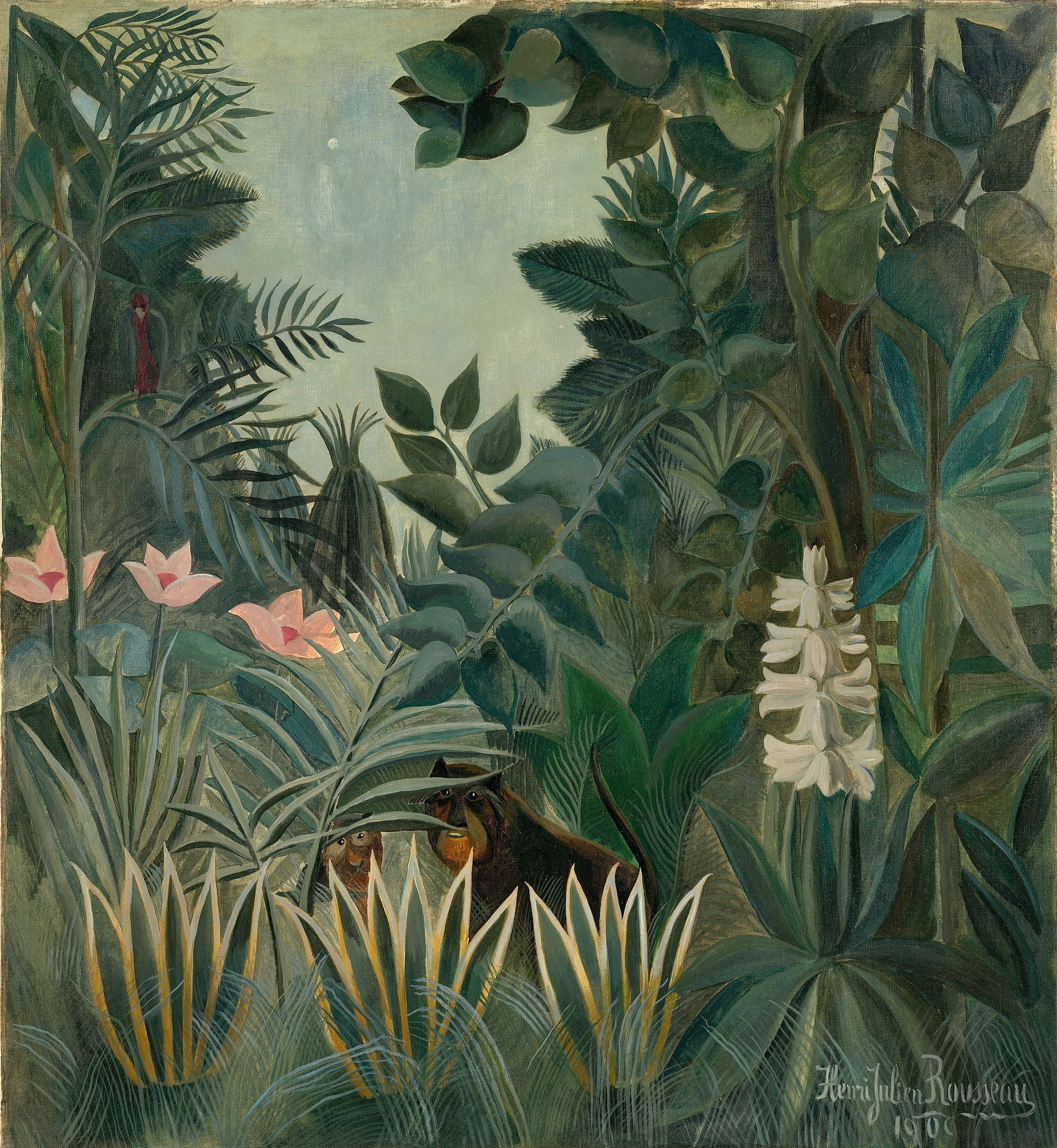
The Equatorial Jungle is an upright painting by Henri Rousseau from 1909, in which the forest closes into a wall of leaves, with a single bright opening far back. The original is held by the National Gallery of Art in Washington, inventory number 1963.10.213, in the Chester Dale Collection. Here it is made as a hand-painted reproduction in oil on canvas, in eight sizes from 50 x 55 cm to 150 x 160 cm or to your own measurement. Before dispatch we send you a photograph of the finished canvas for approval.
What is on the canvas?
The canvas stands upright and is filled with vegetation to the edge. No single animal holds the scene and nothing has just happened; in front of the viewer hangs a dense curtain of leaves, branches and trunks. Rousseau built the scene in layers: large, sharply outlined leaves at the bottom, a belt of trunks behind them, and at the back a lighter opening through which the sun falls. That opening is the only place that works as depth; everything else stands close against the viewer. Stay a while and small shapes appear among the leaves that were missed at first glance. The colour is laid in flat areas, with no soft transitions between one green and the next: green beside green, separated only by an outline.
Did Rousseau ever see a jungle?
He never saw one. Almost every viewer asks this, and the answer is documented: the painter never left France, and his jungles are assembled, not observed. He studied the plants in the Jardin des Plantes, the Paris botanical garden, where tropical species grew in the hothouses and ordinary potted plants stood beside them. He painted both with the same precision, on the same canvas. That is why this forest is convincing in detail and impossible as a whole: each leaf is recognisable, the relations between the plants are not. The same method, carried further, is in The Dream.
How is depth built without perspective?
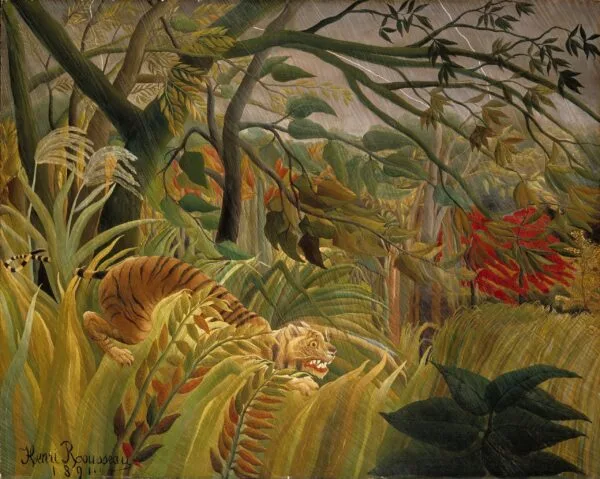
Rousseau used no aerial perspective. The leaves at the back are as sharp and as strong in colour as those at the front, so the thicket reads as a wall rather than as space receding. He produced depth by two means: size, since the foreground leaves are larger, and overlap, since each layer partly hides the one behind it. The result is a forest that seems near and endless at once. This is not clumsiness but the mark by which these paintings are recognised, and why the work behaves on a wall like stretched fabric rather than a window onto distance. For the same handling with an animal, see Tiger in a Tropical Storm.
Why does this particular canvas matter?
It was painted in 1909, a year before the painter’s death, among the last large forest canvases he made. In these he gave up the dramatic event: no attack, no lightning, no animal fighting for its life. Only vegetation remains, and the light working through it. Some viewers hold these quiet late canvases to be his finest, others prefer the earlier scenes with beasts; the painting itself takes no side. The louder pole of the same motif is The Hungry Lion Throws Itself on the Antelope.
What does the painting mean?
The painting tells no story and does not try to. It has no hero and no instant in which anything is decided, and so it holds a viewer longer than a scene with a clear event would. What it offers is a condition: a dense, silent, entirely inhabited space whose only way out is the light at the back. Its meaning is closer to a mood than a message, completed by each viewer alone. If you see calm in it, that is its truth; if you see the pressure of a closed space, that is its truth as well.
Who owned the painting before Washington?
The path of this canvas is recorded by the collection that holds it today, and is unusually well documented. From the painter it passed to Robert Delaunay. The record also leaves open that it was for a time with the dealer Paul Guillaume. It was then owned by the Paris dealer Ambroise Vollard, who sold it in 1925 to Mrs Juliana Force; she returned it the same year. The Paris Galerie Étienne Bignou followed, and in 1928 sold it to the New York collector Chester Dale. With his bequest the work came to Washington in 1963, where it remains. Where the record leaves a question open, we leave it open too.
What does naive art mean in this work?
Naive art is the name for painting by self-taught artists who trained in no academic studio and kept to none of its rules on perspective, shading and anatomy. Rousseau stayed outside that tradition to the end, though he took painting very seriously. Here the naive element shows in exactly two things: flat colour without modelling, and the perspective that is not there. Everything else is considered – the order of the layers, the position of the bright opening, the size of the leaves in front. The label does not mean ignorance, but a style recognisable at first glance. There is more in our article about the painter.
How is your canvas made here?
Your canvas is begun only after your order, in our workshop in Slovenia. The oil is built up in layers, from the lower leaves towards the opening of light at the back, in the same order as the painting. We do not print and use no machine application; a hand-painted canvas differs from a print on touch alone, and no two versions are quite alike. The canvas is stretched on a wooden frame, ready to hang. Before packing we photograph the work and send you that photograph for approval; only then does it travel. The full range by this painter is in the Henri Rousseau gallery.
Which size for which wall?
Eight sizes: 50 x 55, 60 x 65, 70 x 80, 80 x 90, 90 x 100, 110 x 120, 130 x 141 and 150 x 160 cm. This upright format asks for height, not width: it sits well on a narrow wall, between a door and a corner, or in a hallway where a horizontal motif would not fit. For a living room the usual choice is 110 x 120 cm or larger. Below 60 x 65 cm the small shapes among the leaves merge and the forest loses what rewards close looking. The 130 x 141 cm size matches the original, rounded to whole centimetres. Above a sofa the picture should take about two thirds of the furniture’s width; above a bed it should stay narrower than the headboard.
How do I order a custom size, a stretcher and a frame?
Custom sizes go through the painting made by order page, where you enter width and height. Proportions matter here: the forest is built in horizontal layers stacked upwards, and pulling the canvas wide flattens them. For non-standard measurements we suggest keeping the ratio and changing only the scale. The canvas is always stretched on a wooden frame. A frame is not included in the price and is chosen separately; unframed, the work is ready to hang on arrival.
How is it delivered and what do we guarantee?
We deliver to Slovenia, Croatia, Italy, Austria, Hungary and Germany. The canvas travels rolled in a tube or stretched on its frame, always in protective wrapping. We guarantee that every work is painted by hand and that you will see a photograph of the finished piece before dispatch; if something there is not as you wish, we correct it before the work leaves the workshop. This motif is popular for its quiet, dense green, which stays calm in a room even at a large size.
Frequently asked questions
Where is the original?
In the National Gallery of Art in Washington, under inventory number 1963.10.213. The record gives 1909, oil on canvas, and a size of 140.6 x 129.5 cm.
Why is there no animal in the painting?
Because it is a late canvas in which the painter gave up the event. Other forest scenes of his have beasts; here the forest is the only protagonist.
Is the forest a real place?
No. It is assembled from plants the painter saw in Paris hothouses and in illustrations, arranged into a scene that does not exist.
Is this a print?
No. Every canvas is painted by hand in oils, to order. The body of the paint is visible and can be felt, which a print cannot imitate.
Which size should I choose?
For a living room 110 x 120 cm or larger, for a narrow wall or hallway 70 x 80 cm. The upright format asks for height, not width.
Can I have a size that is not on the list?
Yes, a made-to-order size carries no surcharge for a non-standard format. We recommend keeping the proportions of the original.
Which size is closest to the original?
The 130 x 141 cm size, which matches the original rounded to whole centimetres. The original measures 129.5 x 140.6 cm.
How is the painting delivered?
Rolled in a tube or stretched on its frame, with tracked shipping. Production time depends on size and is confirmed when you order.
What does the painting say in one sentence?
That a forest which exists nowhere on earth can be assembled out of a Paris hothouse, and that this is exactly why it is hard to walk away from.
Is the original for sale?
No. The work is in the public collection of the Washington gallery and is not for sale; we give no value, having no source for one.
Is it suitable as a gift?
Quiet green is a rewarding choice for a gift. If you would rather leave the choice to the recipient, there is a gift voucher.
- Subject: dense tropical thicket in an upright format, with an opening of light at the back and no single animal
- Original: 1909, oil on canvas, 129.5 x 140.6 cm, National Gallery of Art in Washington, inv. 1963.10.213, Chester Dale Collection
- Our version: hand-painted oil, eight sizes from 50 x 55 to 150 x 160 cm or made to measure, photograph for approval before dispatch
- Worth knowing: the painter never left France – this forest is assembled from the hothouses of the Paris botanical garden