


Description
| Title: | The Repast of the Lion |
| Other titles: | Le Repas du lion (French title) |
| Painter: | Henri Rousseau |
| Year painted: | about 1907 |
| Original size: | 113.7 cm x 160 cm (height x width) |
| Original technique: | oil on canvas |
| Painting style: | naive art (primitivism) |
| Held at: | The Metropolitan Museum of Art, New York, USA (acc. 51.112.5) |
| Our reproduction: | hand-painted oil on canvas, ten sizes or a size made to order |
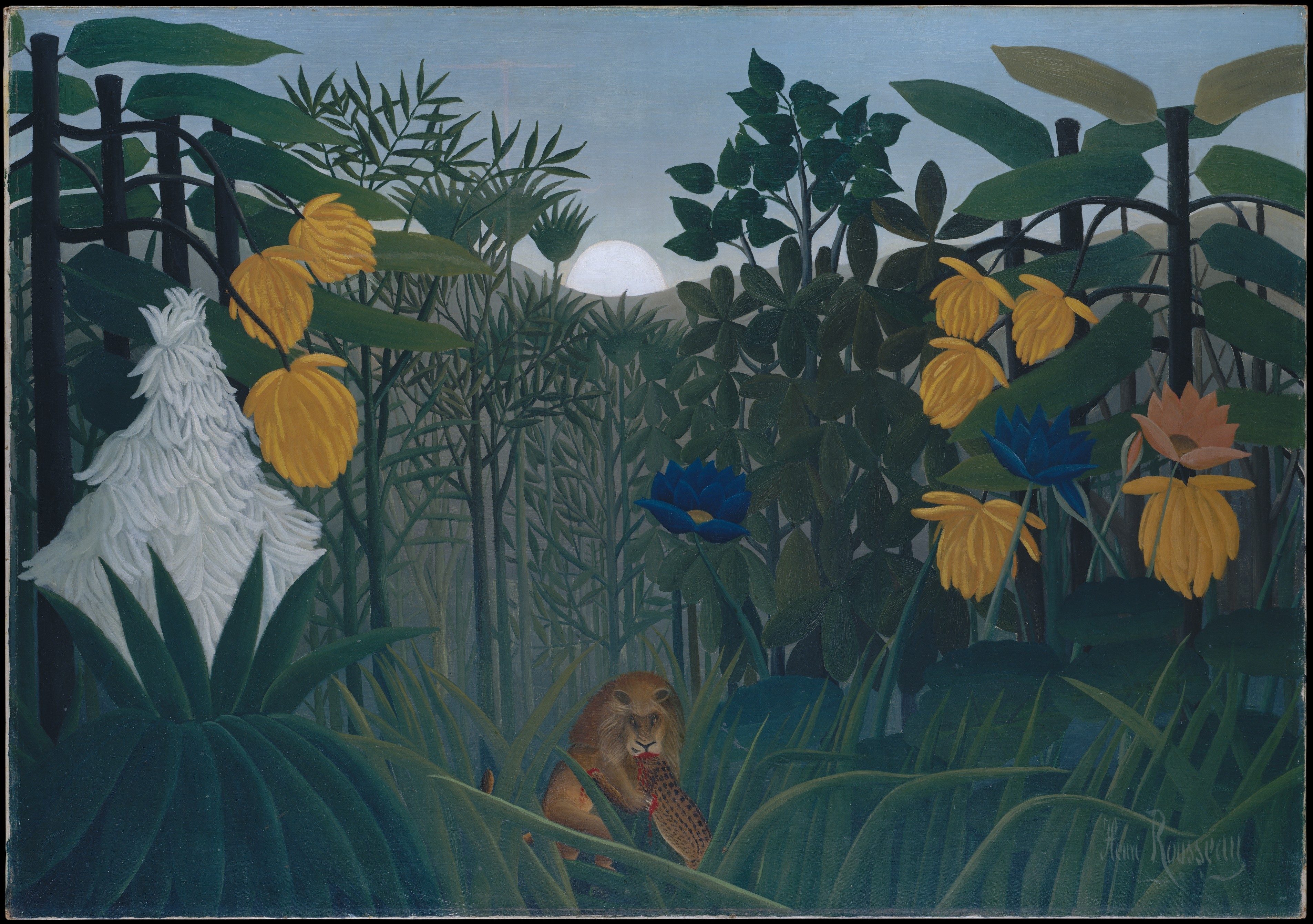
The Repast of the Lion is a painting by Henri Rousseau, oil on canvas, dated by the Metropolitan Museum of Art to about 1907. The original measures 113.7 cm high and 160 cm wide and is held by the Met in New York under accession number 51.112.5. What you see: a lion in tall grass biting into a spotted animal, a pale disc low between hills above it, and white, yellow, blue and pink flowers all around.
The Repast of the Lion
What is on the canvas?
The canvas is wide, roughly seven parts across to five high, and cool in colour: greens and blue-greens under a pale grey-blue sky. At the top centre a white disc sits low between dark hills; the painting does not say whether it is the sun or the moon. On the left a tall white plume, feathery like a crest, rises out of a dark rosette of spiky leaves. Yellow clusters shaped like bananas hang at left and right, and between them open two deep blue flowers and one salmon-pink. Dark straight trunks close the scene at both edges. Low in the centre, in tall grass, a lion looks straight out at the viewer and bites into a spotted animal held under its forepaws; red shows at its mouth. The signature, Henri Rousseau, is at the lower right.
Did Rousseau ever see a jungle?
No. The National Gallery in London, which owns his first painting of the kind, writes that his jungles are entirely imaginary: Rousseau never left France, although he claimed to have served with the French army in Mexico. The plants, the same text says, are a mix of house plants and tropical species he had seen at the Jardin des Plantes, the botanical garden in Paris, whose grounds also held a zoo with lions, tigers and jaguars. This canvas should be read the same way: the flowers are painted with care, but the scene is assembled, not observed. We offer the National Gallery’s painting as Tiger in a Tropical Storm.
When was it painted, and how did it enter the museum?
The Metropolitan Museum of Art dates the canvas to about 1907 rather than to a single year, so our table says “about 1907” as well. The museum’s record states how the work entered the collection: as the bequest of Sam A. Lewisohn in 1951. The record we read lists no earlier owners, so we name none. Another canvas we offer in which a lion attacks is The Hungry Lion Throws Itself on the Antelope.
How large is the original, and what does that mean on a wall?
The original is 113.7 cm high and 160 cm wide. Ten sizes are available: 74 x 55, 87 x 62, 100 x 70, 110 x 80, 130 x 90, 140 x 100, 160 x 110, 210 x 150, 250 x 170 and 299 x 207 cm. The 160 x 110 cm size has the original’s width and is 3.7 cm lower; 87 x 62, 140 x 100 and 210 x 150 cm come closest to its proportion. A format this wide works well above a sofa or a sideboard, where it can run horizontally. The lion takes up only a small part of the canvas: at 74 x 55 cm it is about eight centimetres tall, at 140 x 100 cm about fifteen. Custom sizes are ordered through the made-to-order painting page. Another dense jungle is The Equatorial Jungle.
How is a hand-painted reproduction made?
Each canvas painting is made by hand in oils when you order it, at the size you pick. Working layer by layer from a high-resolution image of the original, the painter keeps the fine cuts in the white plume, the veins of the large leaves and the spots on the lion’s prey legible even at the smaller sizes. No two hand-painted canvases come out identical, and the small differences are the trace of a brush rather than a printer. The finished canvas is stretched on a wooden frame, ready to hang. More of Rousseau’s jungles, among them Tropical Forest with Monkeys, are in the Henri Rousseau gallery.
Frequently asked questions
Where is the original kept?
At the Metropolitan Museum of Art in New York, accession number 51.112.5, in the department of European Paintings. Whether it is on view on a given day is for the museum to say.
What animal is the lion eating?
A spotted animal. The museum’s title does not name it, and we do not guess.
What are the original’s measurements in centimetres?
113.7 cm high and 160 cm wide, oil on canvas.
Is this a print?
No. It is painted by hand in oils, to order, and the paint stands on the surface, which no print can copy.
Is the painting suitable as a gift?
Yes, if the recipient does not mind a lion at its kill: the colours are calm, but the scene shows prey. A gift voucher leaves the choice to them.
- Subject: a lion in tall grass with a spotted animal, a white disc between hills, and white, yellow, blue and pink flowers.
- Original: oil on canvas, 113.7 x 160 cm (height x width), The Metropolitan Museum of Art, New York, acc. 51.112.5; about 1907.
- Our version: hand-painted oil, ten sizes from 74 x 55 to 299 x 207 cm, or a size made to order.
- Of note: the painting entered the Met in 1951 as the bequest of Sam A. Lewisohn.