







































Description
| Title: | A Carnival Evening |
| Other titles: | Carnival Evening (catalogue) |
| Painter: | Henri Rousseau |
| Year painted: | 1886 (as published) |
| Original size: | 117.4 cm x 89.6 cm (height x width, as published) |
| Original technique: | oil on canvas |
| Painting style: | naive art (primitivism) |
| Held at: | Philadelphia Museum of Art, Philadelphia, USA (acc. 1963-181-22, as published) |
| Our reproduction: | hand-painted oil on canvas, eight sizes or a size made to order |
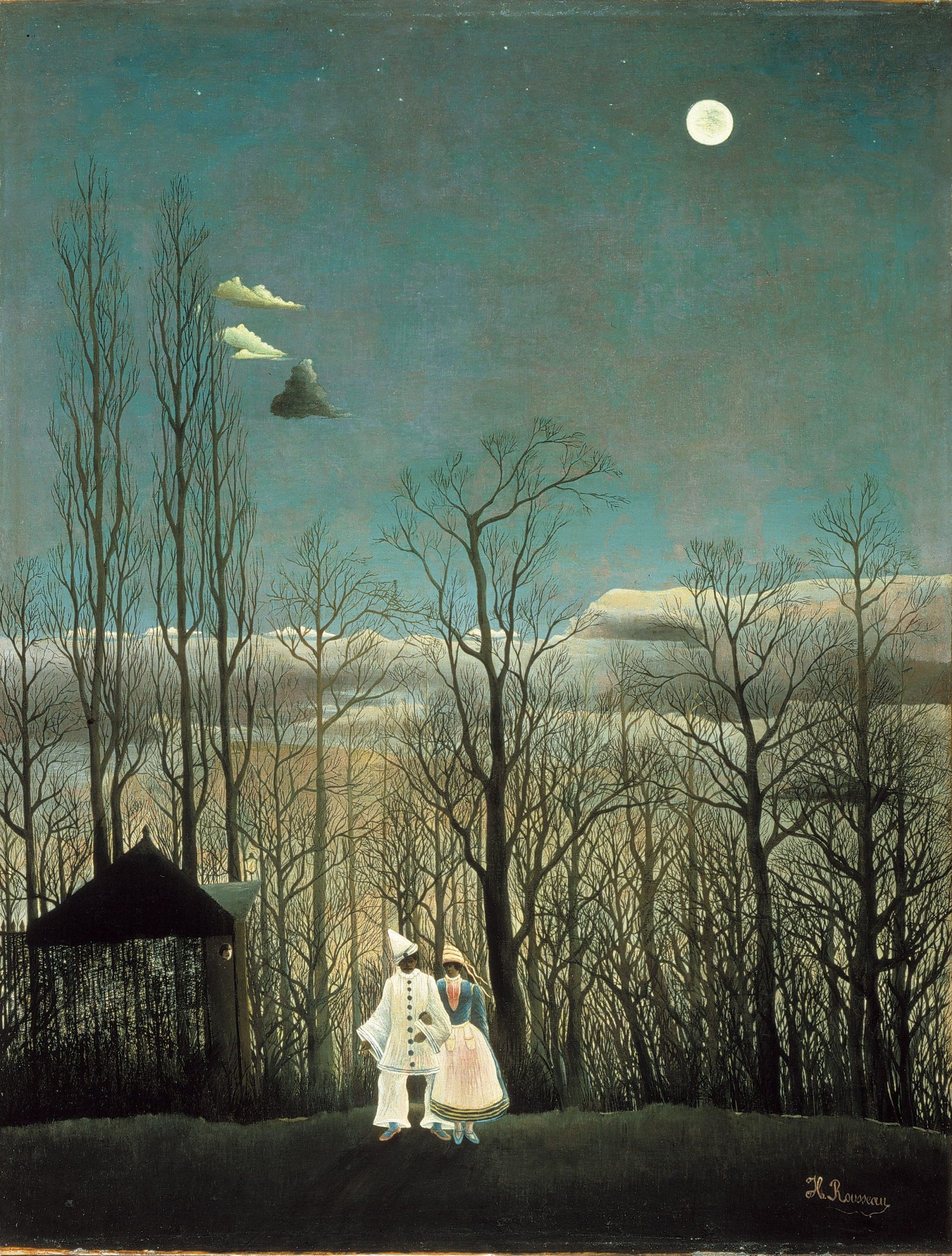
A Carnival Evening is a painting by Henri Rousseau, oil on canvas; according to published records it dates from 1886 and is held by the Philadelphia Museum of Art. What you see: a winter night under a full moon, a tall wood of bare trees, and in front of it two small figures in carnival costume, a white Pierrot and his companion, who almost glow in the dark. We paint it by hand in oils, in eight sizes or to measure, and send you a photograph of the finished painting before dispatch.
A Carnival Evening
What is on the canvas?
At the upper right a full moon shines in a dark green-blue sky scattered with small stars, and at the left drift three little clouds, two pale and one dark. Almost the whole painting is filled by a tall wood of bare winter trees with thin branches, and between the trunks a band of pale cloud runs low above the horizon. At the left stands a small dark hut with a pointed roof and a fence. In the foreground, on the dark grass, stand side by side a Pierrot in a white costume with a pointed hat and dark buttons, and a woman in a blue bodice and pale skirt with a small hat. The signature, H. Rousseau, is at the lower right. Another Rousseau couple in a wood is Rendezvous in the Forest.
What does the painting mean?
A carnival night is a time for disguises, and Rousseau places two masked strollers in a silent, almost fairy-tale winter wood. The white of their costumes is the brightest thing in the painting, so they seem to glow from within, while everything around them sinks into blue and darkness. The trees are painted branch by branch, like lace against the sky, and the moon hangs over everything like a lantern. The painting is quiet and mysterious, more a dream of carnival than its noise. Another Rousseau scene with small figures out of doors is The Football Players.
Which size suits which wall?
The published size of the original is 117.4 cm high and 89.6 cm wide, an upright format; 150 x 190 and 80 x 100 cm come closest to its proportion, and at 89 x 107 cm the painting is about as wide as the original. Eight sizes are available: 50 x 60, 60 x 70, 70 x 85, 80 x 100, 89 x 107, 110 x 130, 130 x 160 and 150 x 190 cm. The upright, dark night scene suits the wall beside a door, a hallway or a bedroom; for a living room we recommend 110 x 130 cm or larger, so that the two small figures can hold their own. Above a sofa the painting usually takes about two thirds of the width of the furniture; above a bed it should stay narrower than the headboard. Custom sizes are ordered through the made-to-order painting page, where you enter the width and height; we suggest keeping the proportion of the original and changing only the scale. A Paris park by the same painter is Jardin du Luxembourg.
How is the painting made, and does it come framed?
Your canvas is begun only after you order it, and is painted by hand in oils in our workshop in Slovenia, at the size you choose. The painter lays in the night sky with its moon, stars and little clouds first, then the band of pale cloud and the wood of bare trees branch by branch, then the hut and the grass, and last the two strollers in costume. We do not print, and no machine application is used, so no two versions are exactly alike. The canvas is stretched on a wooden frame and arrives ready to hang; a picture frame is not included in the price and is chosen separately. Before packing we photograph the finished painting and send you the photograph for approval; only then does it travel. A sleeping figure under a full moon, this time in the desert, is The Sleeping Gypsy. The whole collection is in the Henri Rousseau gallery.
How is it delivered, and what do we guarantee?
We deliver to Slovenia, Croatia, Italy, Austria, Hungary and Germany. Depending on its size, the canvas travels rolled in a rigid tube or stretched on its frame, always in protective wrapping and as a tracked parcel. The making time depends on the size and is confirmed when you order. We guarantee that every painting is painted by hand and that you see a photograph of the finished work before dispatch; if anything in it is not as you wish, we correct it before it leaves the workshop.
Frequently asked questions
Where is the original, and why is there no link to it?
The work is listed as held by the Philadelphia Museum of Art, accession number 1963-181-22. We found these details, with the year and the size, in the Wikidata entry, which ties the accession number to the museum. We could not open the museum’s own page in a readable form, so we give no link to it and say so here, rather than link a page we could not check.
When was it painted?
In 1886, according to published records; the canvas itself carries no date, only the signature at the lower right.
Is a frame included?
No. The canvas is stretched on a wooden frame and ready to hang without a picture frame; a frame can be chosen separately.
Is this a print?
No. It is painted by hand in oils, and the layers of paint can be seen and felt.
Is the painting suitable as a gift?
Yes, especially for a couple, an anniversary, or anyone who loves night and winter scenes. If you would rather the recipient chose, there is a gift voucher.
- Subject: a Pierrot in white and his companion in blue stand by moonlight before a wood of bare winter trees; a dark hut at the left.
- Original: oil on canvas, 117.4 x 89.6 cm (as published), Philadelphia Museum of Art, acc. 1963-181-22; 1886 (as published).
- Our version: hand-painted oil, eight sizes from 50 x 60 to 150 x 190 cm or to measure, unframed, photograph before dispatch.
- Of note: the museum’s own page could not be read from here, so this page names the museum and accession as published and carries no link.