


Description
| Title: | Scouts Attacked by a Tiger |
| Other titles: | Scouts Attacked by a Tiger; Éclaireurs attaqués par un tigre (the museum’s titles) |
| Painter: | Henri Rousseau |
| Year painted: | 1904 |
| Original size: | 121.6 cm x 161.9 cm (height x width) |
| Original technique: | oil on canvas |
| Painting style: | naive art (primitivism) |
| Held at: | Barnes Foundation, Philadelphia, USA (inv. BF584) |
| Our reproduction: | hand-painted oil on canvas, ten sizes or a size made to order |
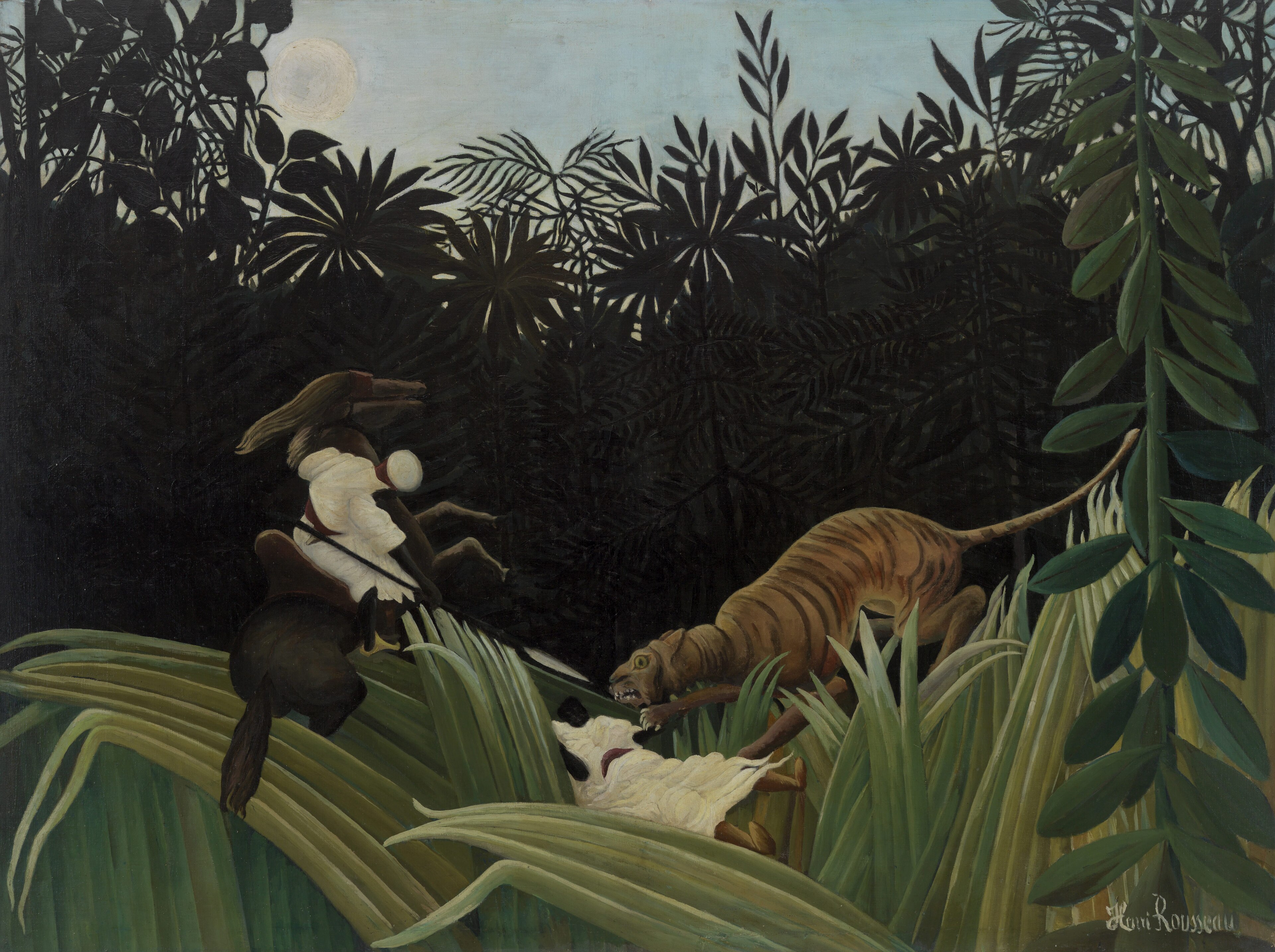
Scouts Attacked by a Tiger is a painting by Henri Rousseau, oil on canvas, 1904, held by the Barnes Foundation in Philadelphia under inventory number BF584. The original is 121.6 cm high and 161.9 cm wide. What you see: a jungle at dusk under a pale moon, at the left a rider in white on a rearing dark horse, and on the ground a second scout in white with a tiger standing over him from the right, jaws open, all among tall blades of grass.
Scouts Attacked by a Tiger
What is on the canvas?
The canvas is wide and large. At the upper left a pale moon hangs above the black silhouettes of palms and ferns, with the sky behind them still grey-blue. At the left a dark horse rears, its rider in white leaning back, and his lance runs diagonally across the centre of the picture. From the right a tiger with a striped coat comes down through the grass, jaws wide and one yellow eye showing, its paw on a second scout in white who lies on his back among broad green leaves. Long, curving blades of grass fill the foreground, and a tall leafy stalk closes the right edge. The signature, Henri Rousseau, is at the lower right.
How did Rousseau paint a jungle he never saw?
The Barnes Foundation writes that Rousseau created his enormous jungle scenes by studying the plants and the taxidermy animals in the natural history museums of Paris. On its page for his Surprised!, the National Gallery in London adds that he never left France. The jungle on this canvas was therefore put together in Paris: the leaves are exact and the proportions invented, since the blades of grass in the foreground are larger than the tiger. The painting the London museum is writing about is, in our collection, Tiger in a Tropical Storm.
Why were scenes like this popular?
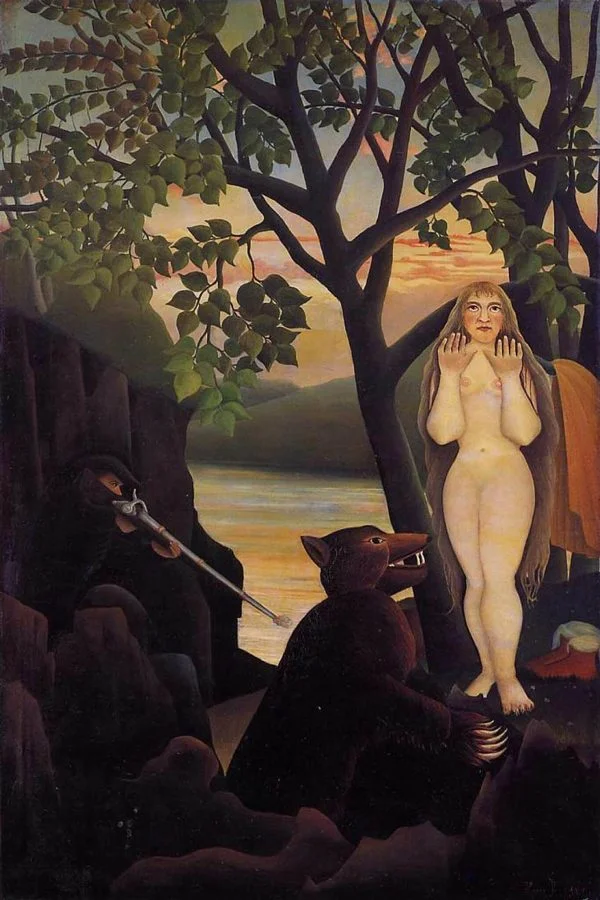
According to the museum, such works were painted at the height of the colonial period and were popular with Parisian audiences for their theatrical presentation of France’s faraway territories as exotic and violent. The museum’s record gives the painting’s first showing as the Salon des Indépendants in Paris in 1904, the year it was painted. Another Rousseau fight in a forest is Virgin Forest at Sunset.
How large is the original, and what does that mean on a wall?
The original is 121.6 cm high and 161.9 cm wide. Ten sizes are available: 70 x 55, 80 x 61, 90 x 70, 110 x 80, 120 x 90, 140 x 105, 160 x 120, 200 x 150, 240 x 180 and 300 x 221 cm. The 160 x 120 cm size is nearest the original, within a centimetre or two. This is a painting for a large wall: at full size the tiger is more than half a metre long, while the smaller sizes bring the scene into a smaller room. Custom sizes are ordered through the made-to-order painting page. Another large Rousseau jungle is The Equatorial Jungle.
How is a hand-painted reproduction made?
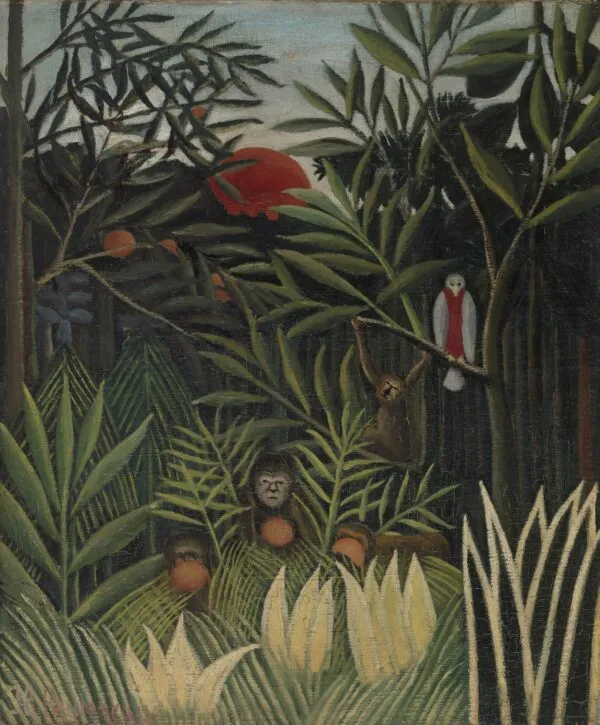
We paint your canvas painting by hand in oils after you order it, at the size you choose. From a high-resolution image of the original, the painter lays in the sky and the moon first, then the dark silhouettes of the palms, one leaf at a time, then the horse, the rider, the tiger and the fallen scout, and paints the blades of grass in the foreground last. A hand-painted canvas always differs slightly from the next, and that difference is exactly what a print cannot give you. It is stretched on a wooden frame, ready to hang. A jungle without a fight is Monkeys and Parrot in the Virgin Forest, and the whole collection is in the Henri Rousseau gallery.
Frequently asked questions
Where is the original kept?
At the Barnes Foundation in Philadelphia, inventory number BF584.
When was it painted?
In 1904, the date the museum gives; it was shown at the Salon des Indépendants in Paris that same year.
Where else has it been exhibited?
The museum’s record lists, among others, the Galerie Bernheim-Jeune in Paris in 1912, an exhibition at Paul Rosenberg’s in 1923, the Lefevre Gallery in London in 1927, and the touring exhibition of paintings from the Barnes Foundation in 1993–1995, which included the Musée d’Orsay.
Is this a print?
No. It is painted by hand in oils, and the layers of paint can be seen and felt.
Is the painting suitable as a gift?
Yes, especially for someone who loves dramatic scenes and the jungle. If you would rather the recipient chose, there is a gift voucher.
- Subject: a rider on a rearing horse and a tiger over a fallen scout in tall grass, a pale moon above the dark jungle.
- Original: oil on canvas, 121.6 x 161.9 cm (height x width), Barnes Foundation, Philadelphia, inv. BF584; 1904.
- Our version: hand-painted oil, ten sizes from 70 x 55 to 300 x 221 cm, or a size made to order.
- Of note: according to the museum, Rousseau painted his jungles from the plants and taxidermy animals in the natural history museums of Paris.