



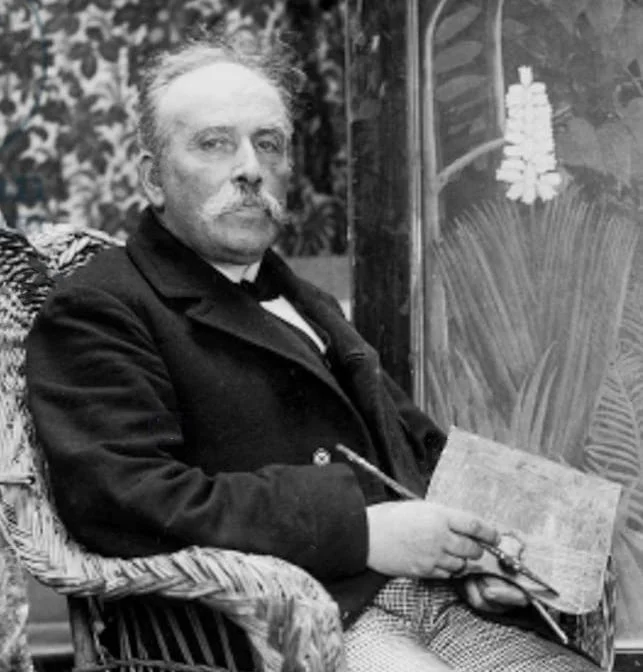
Henri Rousseau – the customs officer who was never a customs officer
Henri Rousseau was born in Laval on 21 May 1844 and died in Paris on 2 September 1910. He is the best-known self-taught painter in the history of modern art: a man who never attended an academy, never left France, and nevertheless painted the most recognisable jungles in European art. On these pages we give his style in two parts – naive art (Primitivism), Post-Impressionist period – because the first says how he painted and the second when. Post-Impressionism is the period, not the style.
The nickname Le Douanier, the customs officer, was coined by the writer Alfred Jarry, and it is the most persistent error in his biography. Rousseau was not a customs officer. He was an employee of the Paris municipal toll service, the octroi, which collected duty on goods entering the city. He said so himself: in the only interview published in his lifetime he told the critic Arsène Alexandre that he had been an octroi employee and not a customs officer, as had always been said (Comœdia, 19 March 1910).
A late start and a salon with no jury
He joined the toll service in the early 1870s and stayed until he retired in 1893, at forty-nine. He began to paint seriously only in his forties, which is precisely why no academy ever got hold of him. In 1884 he obtained a permit to copy in the Louvre, apparently with the help of the painter Félix Auguste Clément (1826–1888); he also took advice from Jean-Léon Gérôme.
The decisive event was the founding of the Salon des Indépendants in 1884: an exhibition with no jury, where anyone could pay a subscription and hang what they liked. Rousseau showed there almost every year from 1886, and from 1905 at the Salon d’Automne as well. Without those two jury-free exhibitions his work would in all likelihood be unknown: the official salons would never have let it through the door. Among the first things he showed was A Carnival Evening of 1886, a small night scene that already contains everything he would later do on a large scale.
Jungles he never saw
The legend says that Rousseau served as a soldier in Mexico and saw a tropical forest there. No document supports it and he never claimed it himself. The truth is closer to home and more interesting: Rousseau never left France. Everything he needed he found in the Paris hothouses of the Jardin des Plantes, in botanical atlases, in illustrated magazines and at the zoo.
Alexandre checked this with him in person and wrote that he obtained the admission without difficulty: the painter had never travelled further than the hothouses of the Jardin des Plantes. In the same conversation Rousseau produced the most exact description of his own work that we have. He did not know, he said, whether other people were like him, but when he went into those hothouses and saw the strange plants of exotic countries, it seemed to him that he was entering a dream. The sentence is recorded in French in Comœdia on 19 March 1910, in the only interview with Rousseau published while he was alive.
That is the key to pictures such as The Equatorial Jungle and Tiger in a Tropical Storm: they are not travel reports but a Paris hothouse enlarged by imagination to the size of a canvas. The same material produced The Merry Jesters, where monkeys in the undergrowth handle odd objects as though they were people.
How the jungle canvases were actually built
Alexandre described the painter’s palette during a studio visit and recorded two technical facts found nowhere else. First: Rousseau mixed all the tones of a picture at once, not as he went. Second: the critic remarked that he had never seen a palette streaming with so many greens. That is not an anecdote about colour, it is a description of a method.
He did not build depth by shading but by layering. Leaves, branches and grasses sit one in front of another in clear, sharply outlined layers, each in its own shade of green, and the sense of space comes from that sequence rather than from light and shadow. This is why his forests are flat and deep at once. The outlines stay crisp all the way back, where an academic eye would expect them to soften.
In Tiger in a Tropical Storm the rain was painted over the finished surface in thin diagonal strokes, so that the storm lies on top of the scene like a veil. No academy teaches that sequence; he arrived at it on his own. Our reproductions are hand-painted in oil on canvas for exactly this reason: the method shows, layer by layer, in the same order as the original.
Ridicule first, then the avant-garde
For years the reviews were brutal. Rousseau was accused of childish drawing, faulty perspective and wooden figures, and his pictures were a standing joke at the Salon des Indépendants. He sold little and lived modestly; after retiring he supplemented a small pension by teaching drawing and music.
The reversal came from younger artists. In 1907 Berthe, Countess de Delaunay, the mother of the painter Robert Delaunay, commissioned The Snake Charmer from him. In 1908 Pablo Picasso held a banquet in his honour at the Bateau-Lavoir studio, an event contemporaries described as half tribute, half joke, which it was. Guillaume Apollinaire, Robert Delaunay and later the Surrealists saw in his work what the academic critics had missed: that the flatness and the hard outlines were a decision, not an incapacity.
The last year, and The Dream
In March 1910 he sent The Dream to the Salon des Indépendants, his last large painting: a woman on a velvet couch in the middle of a jungle, among lotuses, lions, birds and a dark figure with a pipe. He accompanied it with a short poem. Alexandre wanted to know where the sleeping woman’s name came from, and Rousseau told him it had belonged to a young Polish woman he had known in his youth. It was in that same answer that he corrected the nickname: an octroi employee, not a customs officer.
In March that year an inflammation developed in his leg. He ignored it; in August he was admitted to the Necker hospital in Paris, where gangrene was found. He died on 2 September 1910, aged sixty-six, and painted until close to the end.
The grave at Laval
He was buried in a communal grave at Bagneux, a detail most biographies leave out. On 12 October 1947 his remains were moved to his native Laval, to the Jardins de la Perrine, where they are today. The headstone carries no reference to the customs service but a poem written for him by Guillaume Apollinaire, cut into the stone by the sculptor Constantin Brâncuși and the painter Ortiz de Zárate.
Where the paintings hang today
The Snake Charmer is now in the Musée d’Orsay in Paris. Its route there explains a common mistake: Jacques Doucet bought it in 1922, it was bequeathed to the Louvre in 1936, and when the Musée d’Orsay opened in 1986 it moved there with the rest of the post-1848 painting. It was in the Louvre; it is not there now.
The Sleeping Gypsy and The Dream are in the Museum of Modern Art in New York, The Repast of the Lion in the Metropolitan Museum of Art in the same city, Tiger in a Tropical Storm in the National Gallery in London and Bouquet of Flowers in Tate. Individual works are also held by the Kunstmuseum Basel and the Artizon Museum in Tokyo, called the Bridgestone until 2020 – a rename that makes his pictures hard to trace in older catalogues. The full range is in our collection of Henri Rousseau reproductions.
Frequently asked questions about Henri Rousseau
Did Henri Rousseau ever see a tropical forest?
No. Rousseau never left France. The story of military service in Mexico rests on no document and he never cited it himself. He studied plants in the hothouses of the Paris Jardin des Plantes and animals at the zoo, and copied leaf shapes from botanical books and magazines.
Why is he called Le Douanier, the customs officer?
The writer Alfred Jarry gave him the nickname, and it is inaccurate. Rousseau worked for the Paris municipal toll service, the octroi, not for customs. He corrected this himself in his Comœdia interview of 19 March 1910; the nickname stuck all the same.
When did Rousseau start painting?
Seriously only in his forties, alongside the toll service he worked in until retiring in 1893. He had no academic training; in 1884 he obtained a permit to copy in the Louvre, and took advice from the painters Félix Auguste Clément and Jean-Léon Gérôme.
What was his painting method?
He mixed all a picture’s tones at once and built depth by layering rather than shading: leaves and branches sit one in front of another in sharply outlined layers, each in its own green. The outlines stay crisp even in the distance. In Tiger in a Tropical Storm the rain went over the finished surface.
Which is his most famous painting?
Usually The Dream of 1910, his last large canvas, and The Sleeping Gypsy of 1897; both are in the Museum of Modern Art in New York. Among the jungle scenes the best known is Tiger in a Tropical Storm of 1891, in the National Gallery, London.
Where is Henri Rousseau buried?
Initially in a communal grave at Bagneux near Paris. On 12 October 1947 his remains were moved to his native Laval, to the Jardins de la Perrine, where he rests today. The headstone carries a poem by Guillaume Apollinaire, cut into the stone by Constantin Brâncuși and Ortiz de Zárate.