







































Description
| Title: | The Banks of the Bièvre near Bicêtre |
| Other titles: | The Banks of the Bièvre near Bicêtre (the museum’s title) |
| Painter: | Henri Rousseau |
| Year painted: | about 1908–1909 |
| Original size: | 54.6 cm x 45.7 cm (height x width) |
| Original technique: | oil on canvas |
| Painting style: | naive art (primitivism) |
| Held at: | The Metropolitan Museum of Art, New York, USA (inv. 39.15) |
| Our reproduction: | hand-painted oil on canvas, eight sizes or a size made to order |
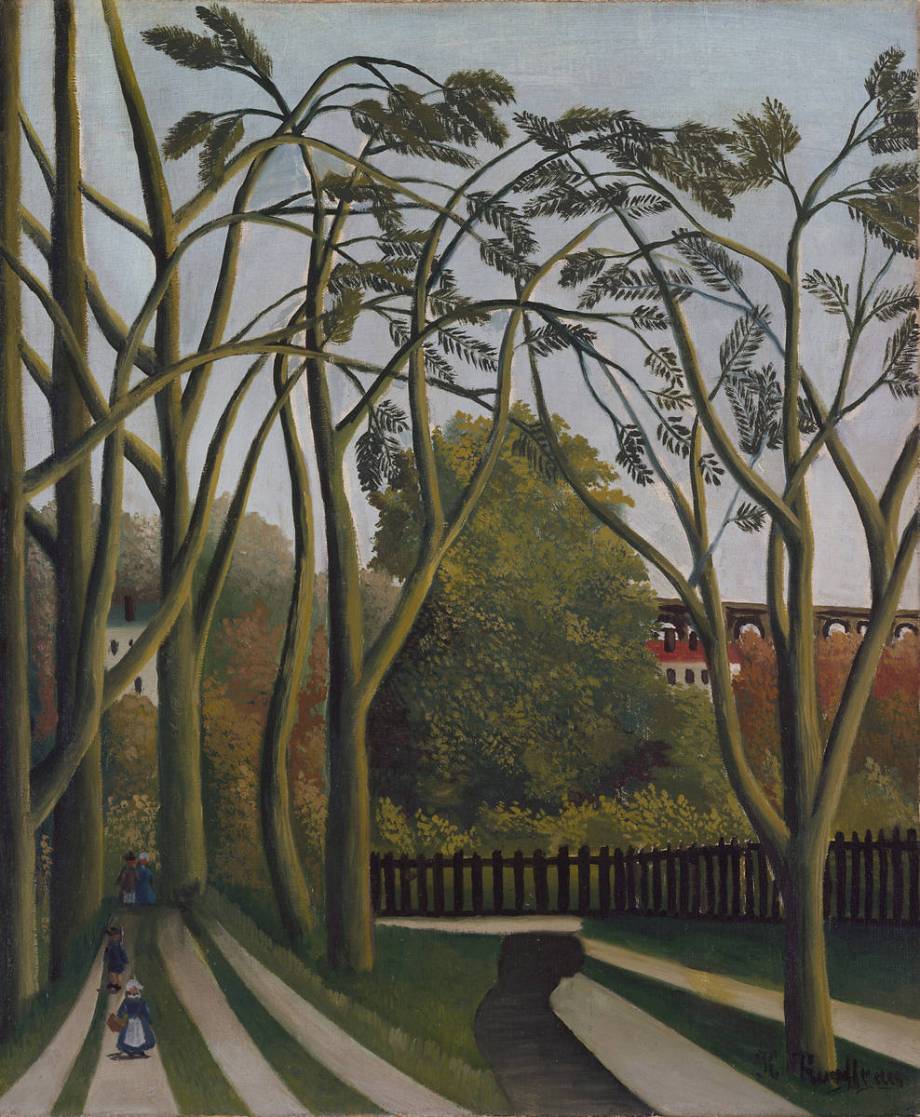
The Banks of the Bièvre near Bicêtre is a painting by Henri Rousseau, oil on canvas, dated about 1908–1909 by the Metropolitan Museum of Art in New York, which holds it under inventory number 39.15. The original is 54.6 cm high and 45.7 cm wide. What you see: tall, slender trees arching like vaults over a path with small figures, a dark wooden fence, a great round tree, and the arches of an aqueduct in the distance.
The Banks of the Bièvre near Bicêtre
What is on the canvas?
The canvas is upright. Tall, slender trunks with pale bark rise across the whole picture, bending and crossing like vaults, with feathery tufts of leaves at the ends of their branches against a pale grey-blue sky. At the lower left runs a path of pale and green stripes, and small figures walk along it: two in the distance and, nearer, a child in dark clothes and a little girl in a blue dress with a white apron and white cap, carrying a basket. In the centre stands a great round green tree, and a dark curving band swings into the foreground. A dark wooden fence runs along the right, beyond the trees the arches of an aqueduct show in the distance above a red-roofed building, and a white house stands far back at the left. The bushes are autumn brown and orange. The signature, H. Rousseau, is at the lower right.
Where is this place?
The museum’s record describes it: the country around Bicêtre, a working-class community on the southern edge of Paris near the Bièvre, a river now buried underground as it runs through the city. In Rousseau’s day the waterway was heavily polluted, but certain spots still offered picturesque views, as the figures in peasant dress on the tree-lined path at the left suggest, along with the glimpse of the seventeenth-century aqueduct of Arcueil in the background. Another tree-lined walk is The Avenue in the Park at Saint-Cloud.
How is the painting dated?
According to the museum’s record, Rousseau identified the subject himself in a handwritten note fixed to the stretcher, dated 1909, the year he consigned the painting for sale to the dealer Ambroise Vollard. The museum therefore dates it to about 1908–1909 rather than to a single year. A late Rousseau landscape with trees, dated 1910, is Meadowland.
How large is the original, and what does that mean on a wall?
The original is 54.6 cm high and 45.7 cm wide. Eight sizes are available: 46 x 55, 50 x 60, 60 x 70, 70 x 80, 80 x 100, 110 x 130, 130 x 150 and 150 x 180 cm. The smallest, 46 x 55 cm, matches the original to within a few millimetres. The figures on the path are only a few centimetres tall on the original, so it takes the larger sizes to show them from across the room, and the tall trees fill a narrow wall well in the upright format. Custom sizes are ordered through the made-to-order painting page. Tall trees above small strollers also appear in Jardin du Luxembourg.
How is a hand-painted reproduction made?
We paint your canvas painting by hand in oils after you order it, at the size you choose. From a high-resolution image of the original, the painter lays in the sky and the distance with its aqueduct first, then the trunks, one tuft of leaves at a time, then the fence and the path, and paints the small figures last. A hand-painted canvas always differs slightly from the next, and that difference is exactly what a print cannot give you. It is stretched on a wooden frame, ready to hang. An earlier Rousseau wood, from 1889, is Rendezvous in the Forest, and the whole collection is in the Henri Rousseau gallery.
Frequently asked questions
Where is the original kept?
At the Metropolitan Museum of Art in New York, inventory number 39.15, a gift of Marshall Field in 1939.
When was it painted?
About 1908–1909, the dating the museum gives; the painter’s note on the stretcher is dated 1909.
Who owned the painting before the museum?
The museum lists the dealer Ambroise Vollard from 1909, who bought it directly from the painter, then Alex Reid and Lefevre in London until 1936, the dealer Étienne Bignou, and Marshall Field in New York from 1936 to 1939; two further stages, a private collection in France in 1901 and Paul Guillaume in Paris, carry a question mark in the record.
Is this a print?
No. It is painted by hand in oils, and the layers of paint can be seen and felt.
Is the painting suitable as a gift?
Yes, especially for someone who loves walks, trees and Paris. If you would rather the recipient chose, there is a gift voucher.
- Subject: tall, slender trees over a path with small figures, a dark fence, a great round tree and the aqueduct of Arcueil far off.
- Original: oil on canvas, 54.6 x 45.7 cm (height x width), Metropolitan Museum of Art, New York, inv. 39.15; about 1908–1909.
- Our version: hand-painted oil, eight sizes from 46 x 55 to 150 x 180 cm, or a size made to order.
- Of note: Rousseau named the subject himself on a note on the stretcher dated 1909, when he consigned the painting to Ambroise Vollard.