Description
The Doni Tondo is Michelangelo’s round painting of the Holy Family, made around 1505–1506: Mary sits on the grass and twists back to hold the Christ Child with Joseph above her shoulder, the young John the Baptist looks up from behind a low wall, and five nude youths rest in the distance. The original, oil on a round wooden panel 120 cm across, is in the Uffizi Gallery in Florence, still in its original carved frame. Our painter paints the round composition by hand in oils on a square canvas, in 5 sizes from 110 x 107 to 180 x 175 cm or made to measure, and before dispatch we send you a photograph of the finished painting.
| Title: | The Doni Tondo |
| Other titles: | Tondo Doni · Holy Family |
| Painter: | Michelangelo Buonarroti (1475–1564) |
| Year painted: | c. 1505–1506 |
| Original size: | 120 cm x 120 cm (height x width; round panel, 120 cm in diameter) |
| Original technique: | Oil on panel |
| Painting style: | High Renaissance |
| Located at: | Galleria degli Uffizi, Florence, Italy |
| Our reproduction: | Hand-painted oil on canvas, 5 sizes or made to measure |
The Doni Tondo – Michelangelo
What does the Doni Tondo show?
Mary fills the centre of the circle. She sits right on the grass, with no cushion beneath her, in a pink dress fastened at the chest with a blue clasp. A wide, light blue mantle covers her crossed legs, a green cloth lies beside her, and a closed book rests on it.
She turns her whole upper body and raises both arms over her right shoulder, where the Christ Child sits, naked and curly-haired, held between her hands and Joseph’s. Joseph is placed higher, behind her: bald, with a grey beard, in a grey-blue robe, an orange-yellow cloth falling over his knees. Mary sits between his legs, as if he were shielding her.
A low band of stone runs behind the family. At the right, just beyond it, the small John the Baptist looks up towards them. Further back, on a curved ledge, five nude young men sit and lean, and behind them blue mountains fade under a pale sky.
What is the meaning of the scene?
The Holy Family is Jesus as a child with his mother Mary and Joseph. Michelangelo gives them no throne; he seats them out of doors, on the ground, in what looks like a country setting.
Whether Mary is taking the Child from Joseph or handing him over is still debated. The three bodies stack into a tight pyramid.
John the Baptist, patron saint of Florence, often joins the Virgin and Child in Florentine paintings; here he stands between the family and the background. The five nudes behind the wall remain a puzzle, and none of them looks at the Child.
Why is it so famous?
Because it is the only finished panel painting by the mature Michelangelo to survive. Michelangelo was above all a sculptor, the maker of the David and the Pietà, and few panel paintings by him exist. He is believed to have painted this one without assistants, and its attribution to him has never been questioned.
The sculptor shows in every figure. The bodies are modelled so firmly that they seem carved from marble. Bright colours sit side by side, pink against blue, green against orange, and the strongest are kept for Mary’s clothes, which marks her out as the most important figure.
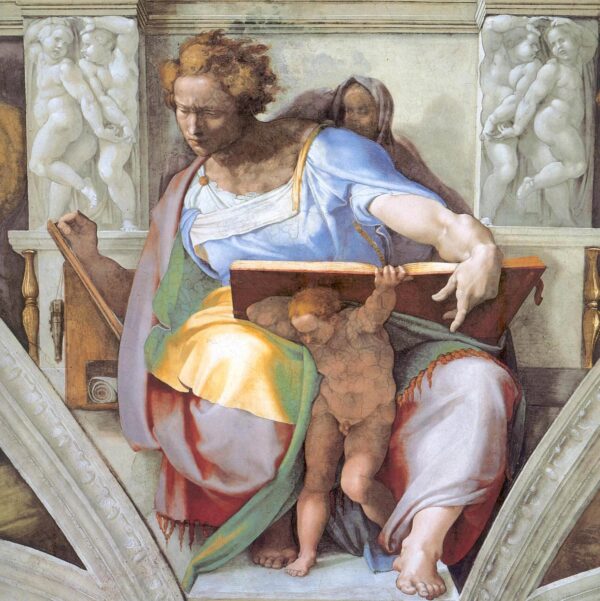
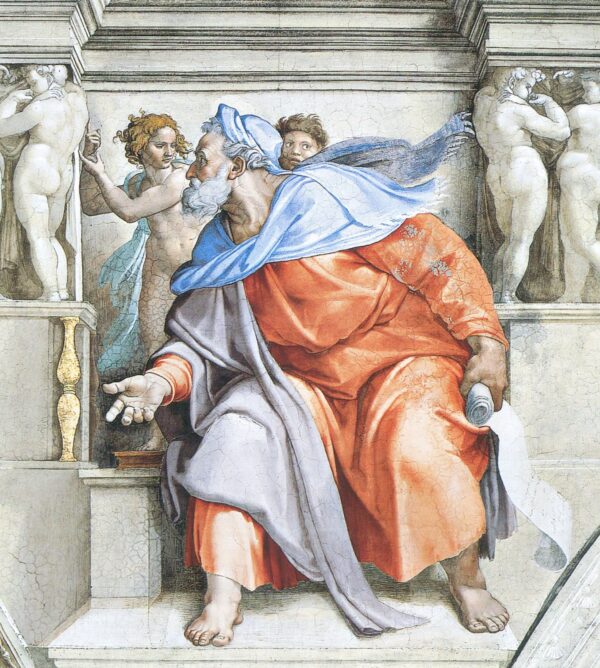
The nudes in the background look forward to the ignudi, the nude youths Michelangelo painted a few years later on the Sistine Chapel ceiling. Wikipedia also notes how close this Mary is to the Sibyls up there, such as The Delphic Sibyl. The English Wikipedia article on the painting tells the full story.
Where is the original, and who commissioned it?
The original belongs to the Uffizi Gallery in Florence, inventory number 00287181. The panel is 120 cm across.
Giorgio Vasari names Agnolo Doni as the patron. The occasion may have been his marriage to Maddalena Strozzi in January 1504, or the birth of their daughter Maria in 1507; either way, Michelangelo finished it before starting the Sistine ceiling in 1508.
Five heads project from the carved frame, among crescent moons, stars, plants and lions’ heads, possibly taken from the coats of arms of the Doni and Strozzi families. That frame stays in Florence: what we paint is the composition inside it.
The Doni Tondo or another Michelangelo?
The Doni Tondo is a canvas painting for a home built around family. Because it was probably made for a wedding or the birth of a child, it suits a living room, a dining room or the bedroom of a young couple.
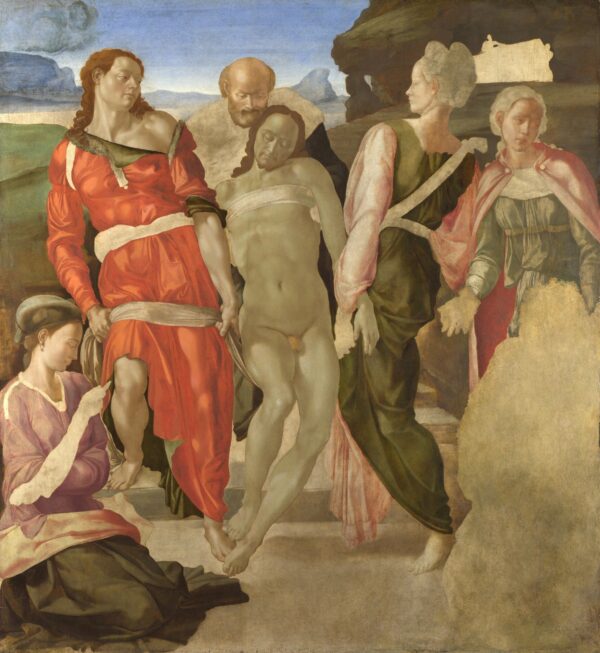
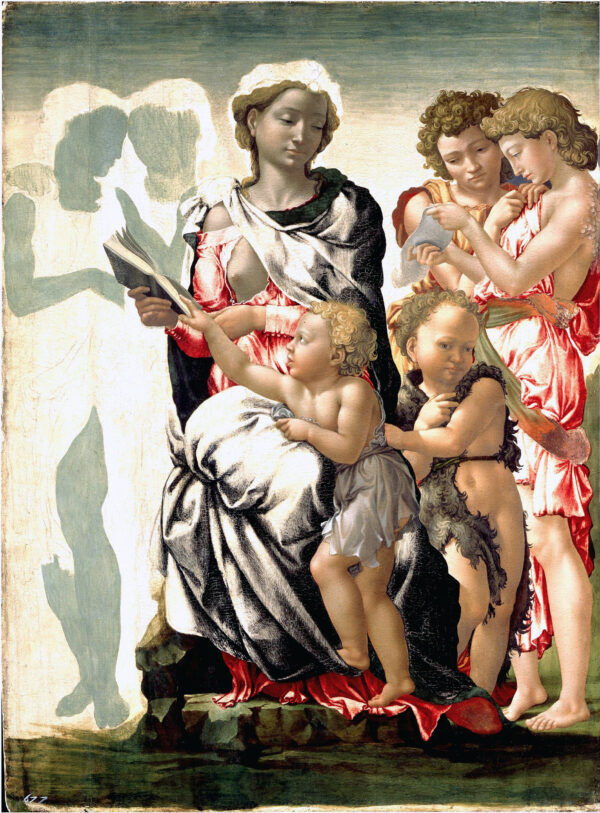
If a mother and child draw you, look at The Manchester Madonna, where Mary sits with Jesus and the young John too, though that panel was never finished. Graver, and also unfinished, is The Entombment, in which the dead Christ is carried to his tomb.
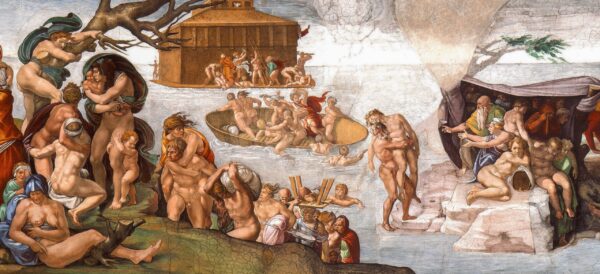
For a large, dramatic scene from the Sistine ceiling, choose The Deluge, with people climbing to high ground as the water rises. Every one of the famous Michelangelo paintings we offer is gathered on the Michelangelo page.
How does our painter paint the Doni Tondo?
Work begins only once you order: oils on canvas, built up one layer at a time.
First the painter draws the circle on the square canvas and places the figures inside it, checking proportions against the original; then the colour is built up from dark shadows towards the lights.
The drapery takes the longest: the pink dress that turns almost white where the light falls, the blue mantle with its deep folds, the orange cloth across Joseph’s knees.
This Michelangelo reproduction has a real paint surface, with brush marks you can see when light falls across it. As an oil painting reproduction in clear, light colours it looks its best in daylight.
Which size suits which wall?
In short: 110 x 107 or 122 x 122 cm above a bed, a sideboard or a dining table, 140 x 135 cm above a sofa, and 160 x 155 or 180 x 175 cm for a large empty wall or a stairwell.
We paint the Doni Tondo in 5 near-square sizes (width x height): 110 x 107, 122 x 122, 140 x 135, 160 x 155 and 180 x 175 cm. The original panel is 120 cm across; 122 x 122 cm is our size closest to it.
Please note: the original is round, our painting is square. We paint the round composition on a square canvas, and the four corners outside the circle stay plain and light. The carved frame of the original is not included.
As a painting for the living room it works best at 140 x 135 or 160 x 155 cm above a sofa. Hang it so that the three faces sit a little above eye level.
Can I order another size or a frame?
Yes. If you need a different size, we place the circle on the canvas so that it stays whole and the corners stay even. Send us the size you have in mind, and a price and lead time for your Holy Family will follow.
Your Doni Tondo can travel rolled, stretched on a stretcher bar or already framed. The stretching and framing happen in our own workshop in Slovenia. The moulding is chosen in our 3D app, which is there purely for frame choice; a view of the painting on your own wall is a separate service.
For the square canvas, a plain gold moulding or a dark wood frame suits the light corners and strong colours.
When will it arrive, and how is it delivered?
Once you confirm the order, the painter starts work, and the painting is ready to ship in 15 to 45 working days. Before dispatch we send you a photograph of the finished painting, and if you want changes we make them first. There are no customs charges within Slovenia and the EU, and our returns policy covers every order.
As the original may have marked a wedding, the Doni Tondo makes a fitting gift for newlyweds, for the birth of a child or for an anniversary. If you would rather the couple chose the size, a wall art voucher leaves the decision to them.
Frequently asked questions
Where is the original kept?
In the Uffizi Gallery in Florence, still set in its original carved frame.
Who are the people in the painting?
Mary, Joseph and the Christ Child, the young John the Baptist, and five nude youths in the distance.
Is it printed?
No. You receive a hand-painted copy, worked in oil paint with a brush on canvas by our painter.
Is your painting round?
No, it is square: the round composition is painted on a square canvas with plain light corners, without the carved frame.
How big is the original panel?
It is round, 120 cm in diameter; our closest size is 122 x 122 cm.
What do the nude figures at the back mean?
Nobody knows for sure; their meaning is still debated.
Is it a good choice for a bedroom?
Yes. A quiet family subject suits the wall above a double bed.
How long does it take?
Between 15 and 45 working days, and you see a photograph of the finished painting before it ships.
- Subject: Mary, seated on the grass, holds the Christ Child with Joseph above her shoulder; the young John the Baptist behind a low wall, five nude youths beyond.
- Original: c. 1505–1506, oil on panel, round, 120 cm in diameter, Uffizi Gallery, Florence.
- Ours: hand-painted to order in oils on a square canvas, 5 sizes from 110 x 107 to 180 x 175 cm or made to measure, without the carved frame.
- Worth knowing: the only finished panel painting of Michelangelo’s maturity to survive.