







































Description
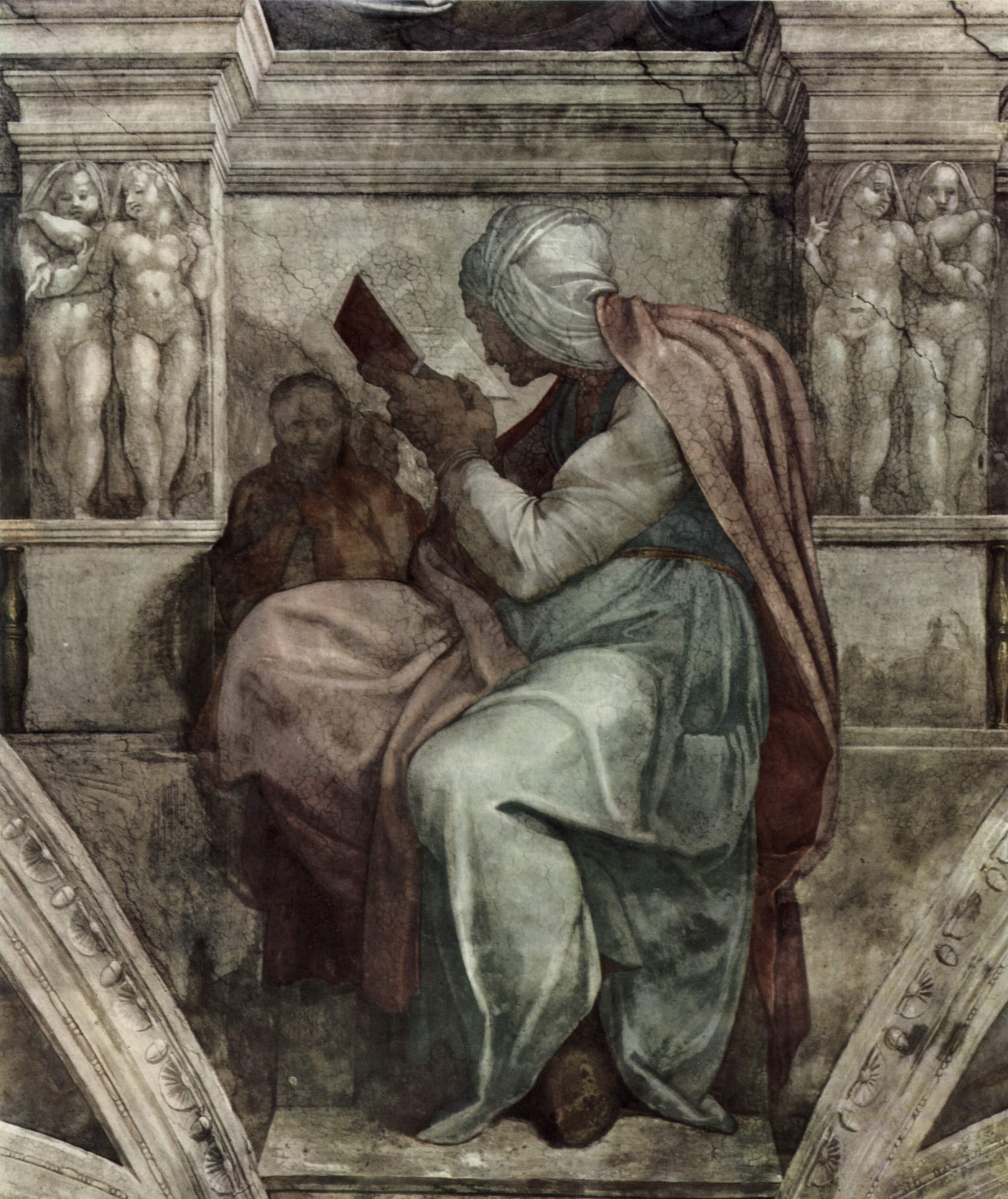
The Persian Sibyl is a fresco Michelangelo painted around 1511 on the ceiling of the Sistine Chapel in the Vatican: a stooped old woman in a white head cloth holds a small book right up to her eyes and reads. On the ceiling the field with this figure is about 400 cm high and 380 cm wide, larger than any size we paint. Our painter paints it to order in oils on canvas, in 8 portrait sizes from 40 x 49 to 172 x 200 cm or made to measure, and before dispatch you receive a photograph of the finished painting.
| Title: | The Persian Sibyl |
| Other titles: | La Sibilla Persica · Die Persische Sibylle |
| Painter: | Michelangelo Buonarroti (1475–1564) |
| Year painted: | c. 1511 |
| Original size: | about 400 cm x 380 cm (height x width) |
| Original technique: | Fresco |
| Painting style: | High Renaissance |
| Located at: | Sistine Chapel, Vatican City |
| Our reproduction: | Hand-painted oil on canvas, 8 sizes or made to measure |
The Persian Sibyl – Michelangelo
What does The Persian Sibyl show?
An old woman sits in a painted stone niche, in profile, facing left. A white cloth is wound round her head like a turban; her back is bent and her whole upper body leans towards the book.
With both hands she raises a small book bound in dark red, so close that her nose almost touches the page. Her dress is a pale greenish grey with white sleeves; a rose-red mantle falls down her back to the floor, and a pale pink cloth lies across her knees.
One foot, hidden under the hem, rests on a stone. Behind her on the left a dark figure emerges from the shadow, only its face and a hand clearly visible. On each side of the niche stand two naked putti, painted as small statues of white marble.
Who were the sibyls, and what does the fresco tell us?
The sibyls were prophetic women of the ancient world who lived at shrines and temples; they were seen as the mouthpiece of the gods.
Renaissance readers saw in the sibyls’ words a foretelling of the birth of Christ. On the ceiling Michelangelo set them among the prophets: twelve figures who foretold the Messiah, seven prophets of Israel and five sibyls, sit around its edges as the largest figures of all.
Why he chose these five out of ten known sibyls is not known. The historian John O’Malley suggests that the four besides the Cumaean were picked to cover Africa, Asia, Greece and Ionia; in that reading the Persian sibyl stands for Asia.
Why is The Persian Sibyl so well known?
Artists began copying the Sistine ceiling as soon as it was unveiled, and they still do today.
Among the prophets and sibyls she is one of the quietest figures. She does not turn, point or speak; Michelangelo put all the tension into her bent posture and into the hands that lift the book to her eyes.
Candle soot and varnish had darkened the ceiling for centuries; the restoration of 1980 to 1992 cleared them away and brought back the greenish dress, the white cloth and the warm rose-red mantle.
The English Wikipedia article on the Sistine Chapel ceiling tells the story of the whole ceiling, from commission to restoration, rather than of this figure alone.
Where is the original, and when was it painted?
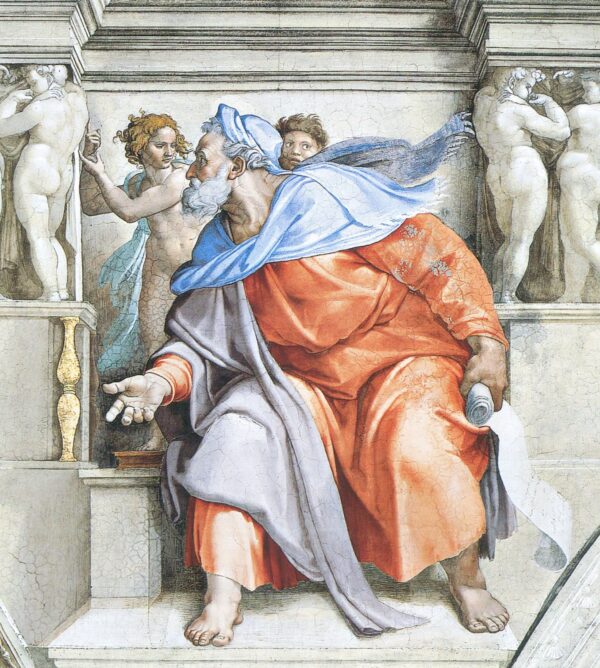
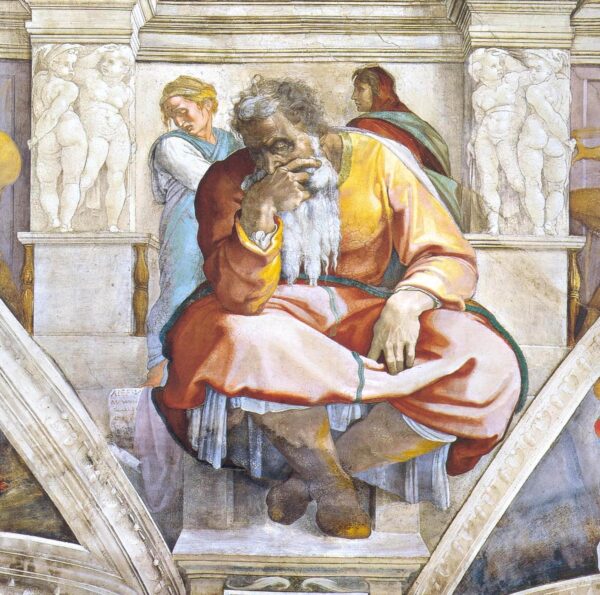
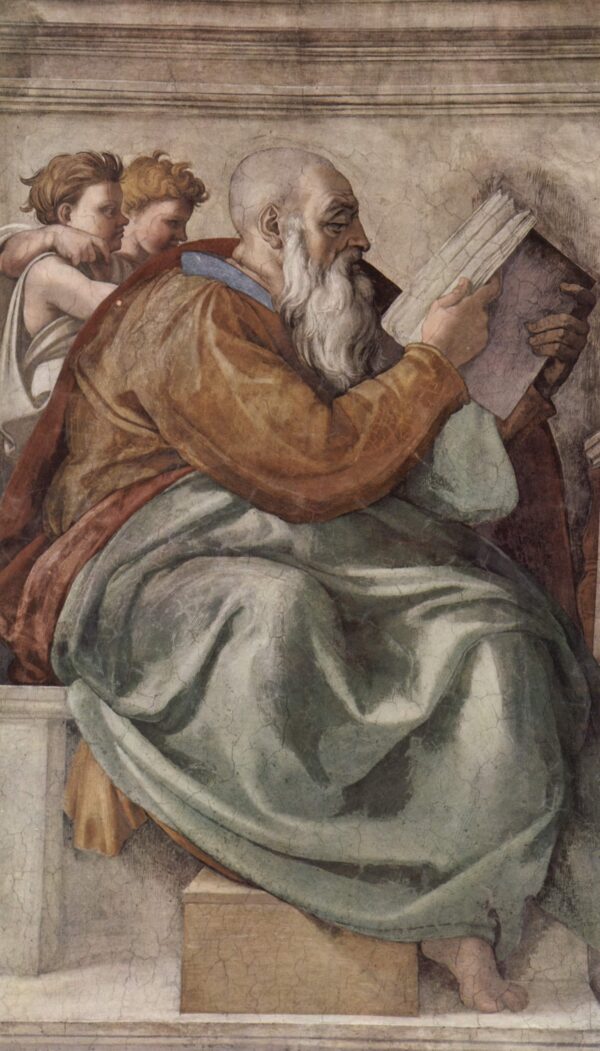
The original is still where Michelangelo painted it, on the vault of the Sistine Chapel in the Vatican, along one of the long sides near the altar end. Her neighbours are the prophets Jeremiah and Ezekiel; the latter, in a turban, is available as The Prophet Ezekiel.
It is a fresco. The colours were laid into fresh, still wet plaster and fused with it for good as it dried.
Pope Julius II originally wanted twelve apostles in these places. Michelangelo argued for a far richer scheme and, in his own words, was allowed to do as he liked. He painted the ceiling from 1508 to 1512.
Beneath the sibyl a putto holds a painted marble tablet with her name, PERSICHA. Our model ends just above that tablet, so it does not appear on the painting.
The Persian Sibyl or another Michelangelo?
The Persian Sibyl is a canvas painting for people who love to read and for rooms where it is quiet: a home library, a reading corner, a study or a bedroom.
Another old woman in a white head cloth is The Cumaean Sibyl, more massive and muscular, reading a large book held open beside her. The Erythraean Sibyl sits in profile, legs crossed, leafing through a book on a lectern while a putto lights a lamp above her.
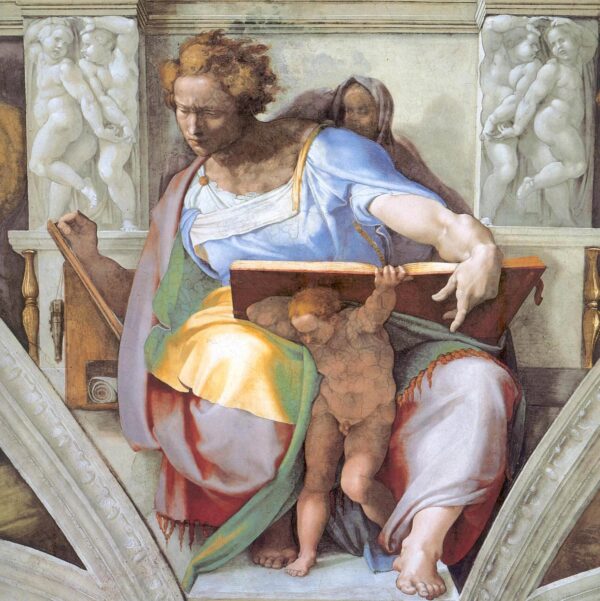
For a young face, choose The Prophet Daniel: a youth with thick curls holds a huge open book on his lap, propped up by a naked child. All the famous Michelangelo paintings we paint to order are gathered on the Michelangelo page.
How do we bring a ceiling fresco onto canvas?
To put it plainly: the original is a fresco in the plaster of a curved vault, while your painting is a hand-painted oil painting reproduction on canvas. You receive real oil on canvas, ready to be stretched, framed and hung.
We paint it only once you order it. The painter first draws the outlines of the figure, the book, the dark figure behind her and the putti, then builds up the colour layer by layer, from dark to light.
The profile and the hands holding the book need the most care, because they are small and yet carry the whole meaning of the scene. The rose-red mantle needs warm, deep shadows, the greenish dress cool, silvery lights along its folds.
Being real oil paint, the surface shows brushstrokes that come out best in light from the side.
Which size for which wall?
Short answer: 40 x 49 or 46 x 55 cm for a shelf or a reading corner, 64 x 76 or 70 x 87 cm for a bedroom or hallway, 90 x 107 or 120 x 140 cm above a sofa, and 130 x 162 or 172 x 200 cm for a tall wall or a stairwell.
We paint The Persian Sibyl in 8 portrait sizes (width x height): 40 x 49, 46 x 55, 64 x 76, 70 x 87, 90 x 107, 120 x 140, 130 x 162 and 172 x 200 cm. The fresco on the ceiling is about 380 cm wide and 400 cm high, so even our largest size, 172 x 200 cm, is still far smaller.
As a painting for the living room she works best at 90 x 107 or 120 x 140 cm above a sofa or sideboard.
Because the sibyl sits low and looks down into her book, hang her so that her face is at eye level or a little above.
Is another size or a frame possible?
Of course. For a different proportion we adjust the crop so that her head, the book, the hands and the foot stay whole, and this Michelangelo reproduction keeps the reader’s stooped posture. Tell us the width and height you need and we will send you a price and a lead time.
She travels rolled, on a stretcher bar or ready framed; our workshop in Slovenia does the stretching and framing. The 3D app is for choosing the frame only; seeing the painting on your own wall is a separate service.
How long does it take, and how is it delivered?
The painter starts once you confirm the order, and the finished painting is ready to ship within 15 to 45 working days. Before we pack it we send you a photograph and make any changes you ask for. No customs duty is charged within Slovenia or anywhere else in the EU, and The Persian Sibyl, like every order, is covered by our returns policy.
The Persian Sibyl makes a lovely gift for a keen reader or a grandmother who never sleeps without a book. If you are unsure about the size, give a wall art voucher and let them choose the painting and the size themselves.
Frequently asked questions
Where can I see the original?
In the Sistine Chapel in the Vatican, high up on the vault.
What is the sibyl reading?
The fresco does not say; we see only a small dark red book.
Will I receive a print?
No. Every piece is a hand-painted copy, made with brush and oil paint on canvas.
How big is the fresco on the ceiling?
About 400 cm high and 380 cm wide; our largest size is 172 x 200 cm.
What does a sibyl mean on a chapel ceiling?
The sibyls were ancient seers in whose words Renaissance readers saw a foretelling of Christ.
Is she a good choice for a bedroom or as a present?
Yes, as it is calm and quiet; people who love reading are especially fond of it.
Could you paint her at a width and height of my own?
Yes. Send us the width and height, and we will reply with a price and the date it will be ready.
When will the painting reach me?
Painting takes 15 to 45 working days and shipping follows; you see a photograph of the finished work first.
- Subject: a stooped old woman in a white head cloth, greenish dress and rose-red mantle reads a small book held close to her eyes; marble putti at the sides.
- Original: c. 1511, fresco, about 400 x 380 cm (height x width), Sistine Chapel ceiling, Vatican City.
- Ours: painted by hand to order in oils on canvas, 8 portrait sizes from 40 x 49 to 172 x 200 cm or made to measure.
- Worth knowing: on the ceiling a putto below her holds a tablet reading PERSICHA, which is not part of our painting.