







































Description
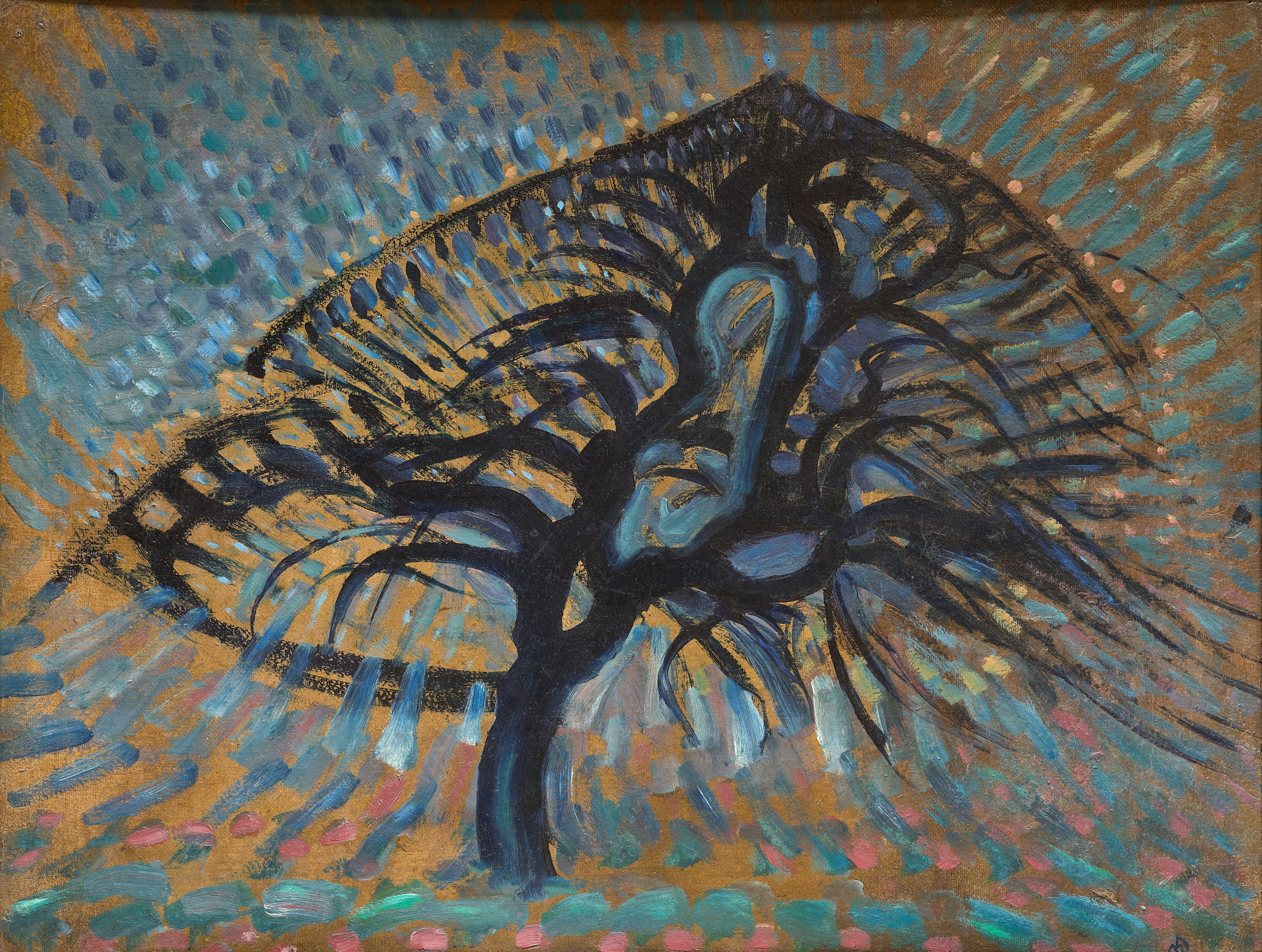
Apple Tree, Pointillist Version is a painting by Piet Mondrian from 1908: a dark blue tree with twisting branches stands against an ochre-gold ground, and the space around it is strewn with short, separate dabs of blue, turquoise, pink and white. The original, oil on canvas, is 56.8 cm high and 74.9 cm wide and belongs to the Dallas Museum of Art. Our painter paints it for you by hand in oil on canvas, in one of 8 landscape sizes between 40 x 30 and 190 x 145 cm or made to measure, and you receive a photograph of the finished painting before dispatch.
| Title: | Apple Tree, Pointillist Version |
| Other titles: | Apfelbaum, pointillistische Fassung · Melo, versione puntinista |
| Painter: | Piet Mondrian (1872–1944) |
| Year painted: | 1908 |
| Original size: | 56.8 cm x 74.9 cm (height x width) |
| Original technique: | Oil on canvas |
| Painting style: | Pointillism, early modernism |
| Located at: | Dallas Museum of Art, Dallas (acc. no. 1982.26.FA) |
| Our reproduction: | Hand-painted oil on canvas, 8 sizes or made to measure |
Apple Tree, Pointillist Version – Piet Mondrian
What does Apple Tree, Pointillist Version show?
In the middle of the canvas grows an apple tree, painted entirely in dark blue. Its branches twist and reach out to both sides, so the crown takes up much of the surface. The tree reads like a dark, supple drawing that stands out sharply from the warm ground behind it.
That ground is ochre gold, but nowhere flat. The whole space around the tree is filled with short, separate dabs of blue, turquoise, pink and white, set side by side without merging into an even field. Above the crown a dark curved line rises in an arc and covers the tree like a dome.
Close up you see every brushstroke. Step back a few paces and the dabs join into a shimmering surface, where cool blue and turquoise flicker against the warm gold.
What does the name pointillist version mean?
In pointillism the painter does not spread colour into a smooth field but lays it on in small, separate dabs of pure tone. Mondrian used this touch here for the space around the tree, while he painted the apple tree itself with dark, continuous strokes.
The year 1908 was a turning point for him. It was then that he began to paint in bright colours that do not copy nature: he was taken with the luminism of Jan Toorop, and Van Gogh influenced him too. The blue tree on a golden ground shows this clearly, because the colours here do not describe the tree, they set a mood.
Why does this apple tree matter in Mondrian’s work?
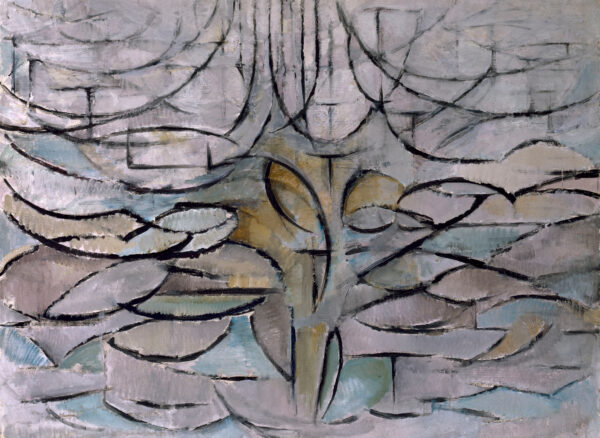
Because it stands at the start of a road that ends with his celebrated grids of black lines and pure fields of colour. Mondrian painted the tree again and again and simplified it year by year: first in strong colours, in 1911 only in grey, black and white strokes, and a year later almost dissolved into a pattern of curved lines.
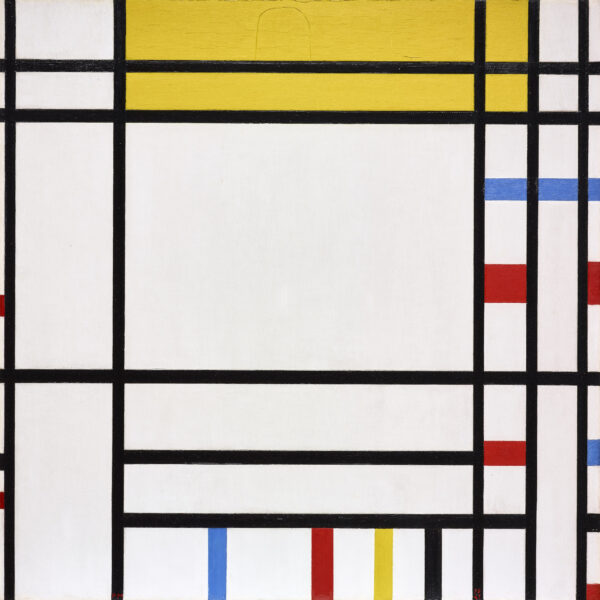
From there it was not far to the horizontal and vertical lines of Neoplasticism, which he developed around 1920. In this apple tree you can watch his way of looking at nature begin to change. At the same time it is a picture that holds its own: warm, alive and full of light.
Where is the original?
The original belongs to the Dallas Museum of Art in Dallas, in the United States, where its accession number is 1982.26.FA. At 56.8 x 74.9 cm it is a fairly small landscape format that also suits a smaller room.
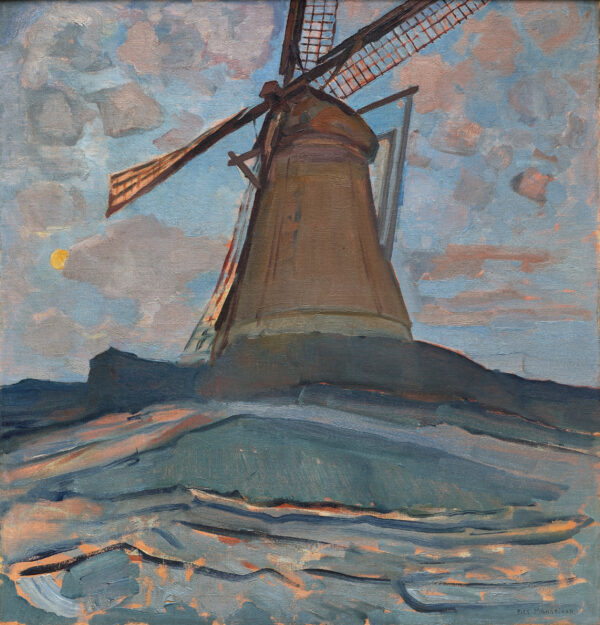
The same museum holds another early work by Mondrian, a tall windmill from 1917. Both belong to the years when he still painted the Dutch landscape recognisably, but already in colours brighter than nature.
Apple Tree or another Mondrian?
This apple tree belongs in a calm room: a living room with wooden furniture, a bedroom or a reading corner. The golden ground and blue dabs sit well with wood, linen and light walls.
If you want to see where Mondrian’s road with trees led, choose Gray Tree from 1911, where the colour is reduced to greys, or Blossoming Apple Tree from 1912, where the crown nearly melts into a web of arcs.
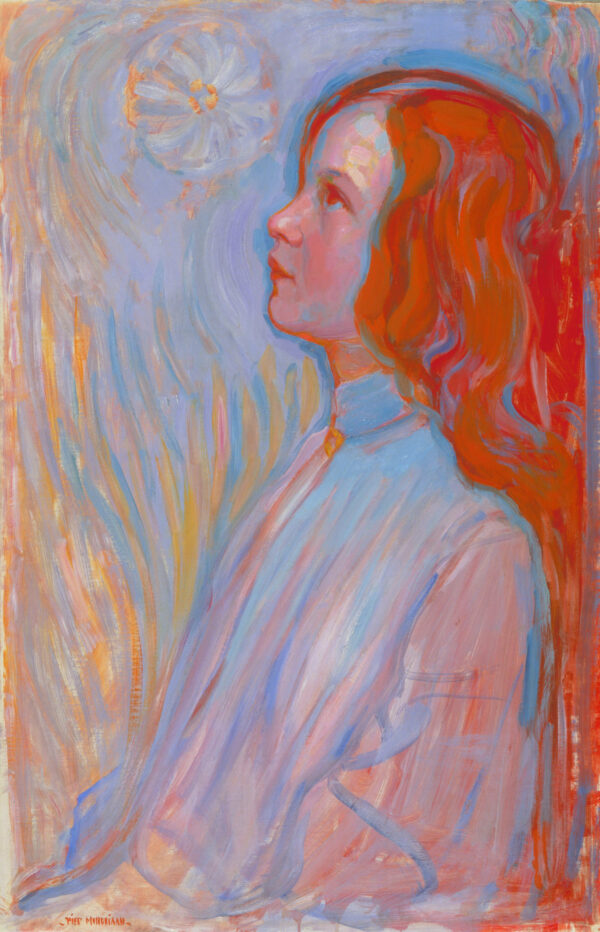
From the same years of bright colour come Devotion, a red-haired girl who looks up in profile towards a flower, and the tall dark mill of Windmill against a blue sky with pink clouds. The Piet Mondrian page gathers the famous Mondrian paintings we paint, from early landscapes to late grids.
How does our painter paint your apple tree?
This painting is not about crisp edges and flat planes but about the free, visible brushstroke. The painter first transfers the outline of the tree and the arc over the crown to the canvas in the right proportions, then lays in the warm ochre ground in oil.
He paints the dark blue branches in continuous, springy strokes so they keep the sweep of the original. Only then does he start placing the dabs, one at a time, in blue, turquoise, pink and white, close together, without mixing and without smoothing. It is precisely because they stay separate and visible that the painting glows.
He works in layers until the balance between the warm ground and the cool dabs matches the original. The result is a Mondrian reproduction with a real oil surface you can feel as soon as you step closer, an oil painting reproduction that a paper print cannot match.
Which size for which wall?
In short: 40 x 30 or 45 x 35 cm for a shelf or a narrow wall, 63 x 48 and 81 x 60 cm above a chest of drawers, a desk or a bedside table, 99 x 78 and 115 x 89 cm above a sofa or a bed, and 145 x 113 and 190 x 145 cm for a large wall.
You choose from 8 landscape sizes (width x height): 40 x 30, 45 x 35, 63 x 48, 81 x 60, 99 x 78, 115 x 89, 145 x 113 and 190 x 145 cm. The original measures 74.9 x 56.8 cm; our nearest size, 81 x 60 cm, is 6.1 cm wider and 3.2 cm taller.
As a painting for the living room above a sofa about two metres wide, 115 x 89 and 145 x 113 cm work best. The dabs open up more in the larger formats, so with this subject it pays to choose bigger rather than smaller. Hang its centre about 150 cm from the floor.
Can I have another size or a frame?
Of course. The original is roughly 4 : 3 in proportion, so we recalculate a custom size to keep the arc over the crown and the tips of the branches in their place. Tell us your width and height for the apple tree, and a price and date come back to you.
We send the painting rolled, stretched on a stretcher bar or already framed, and our workshop in Slovenia does the stretching and framing for every canvas painting we make. Frames for the apple tree can be compared in our 3D application, which exists for frame choice alone; a view of it on your own wall is a separate service.
The warm gold suits a slim gilded frame or natural oak, the dark blue branches plain dark wood. If you like a clean look without a frame, hang the apple tree simply stretched on its bar.
When will the apple tree reach me?
Your apple tree goes on the easel once the order is in, and it is ready to ship within 15 to 45 working days. Before that we send you a photograph of the finished painting; anything you would like different, we change.
It travels customs-free to any EU country, and our returns policy applies to every order.
The warm, bright apple tree makes a lovely gift for anyone who loves nature, gardens and early modern art. If you would rather the recipient chose the size and frame, give a wall art voucher.
Frequently asked questions
Where can I see the original?
At the Dallas Museum of Art in Dallas, under accession number 1982.26.FA.
What is on the canvas?
A dark blue apple tree with twisting branches on an ochre-gold ground, surrounded by blue, turquoise, pink and white dabs.
Is it a print or a poster?
No. It is a hand-painted copy in oil on canvas, where the painter sets every dab by brush, one at a time.
How big is the original?
It is 56.8 cm high and 74.9 cm wide. Our nearest size is 81 x 60 cm, and all our sizes run from 40 x 30 to 190 x 145 cm.
Does it suit a bedroom?
Yes. The warm tones and the quiet tree suit a bedroom, a living room or a reading corner.
Why is the background made of dabs?
In 1908 Mondrian was trying out pointillism: short, separate dabs of pure colour instead of blended fields.
Can the apple tree be painted in a size not listed here?
Yes. Tell us the size you want and we will send an offer with a price and a date.
How long does it take to make?
Allow 15 to 45 working days for the apple tree; a photograph of it reaches you before it ships.
- Subject: a blue apple tree with winding branches against a golden ground scattered with blue, turquoise, pink and white dabs.
- Original: 1908, oil on canvas, 56.8 x 74.9 cm, Dallas Museum of Art, Dallas.
- Ours: painted by hand in oil on canvas, in 8 landscape sizes from 40 x 30 to 190 x 145 cm or made to measure.
- Worth knowing: the apple tree belongs to Mondrian’s series of trees that led him to his grids of black lines.