







































Description
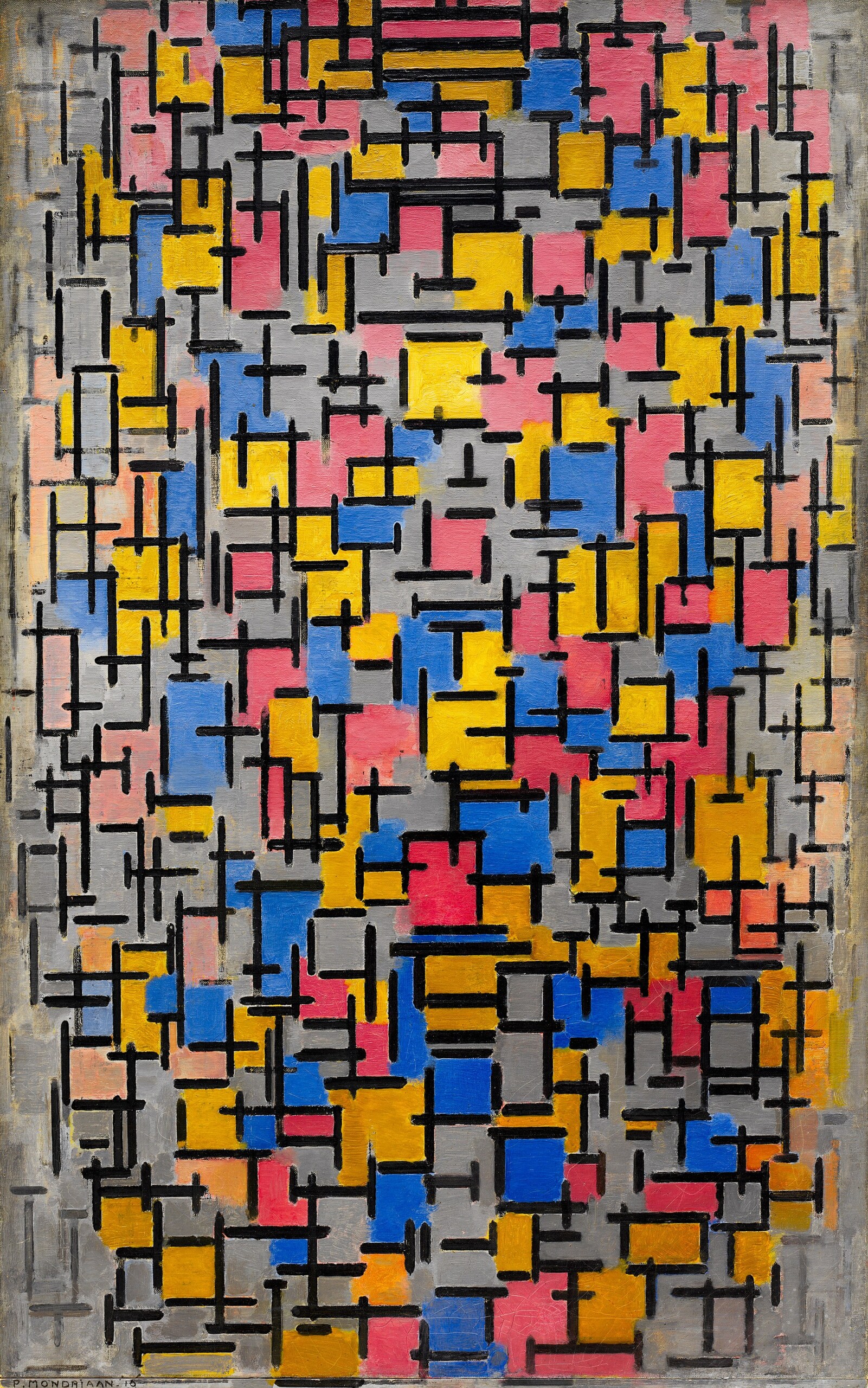
Composition (1916) is a tall painting by Piet Mondrian, made in the Netherlands in the middle of the First World War: a dense field of short black horizontal and vertical lines and small crosses lies over little rectangles of red, blue, yellow, pink and grey, whose tones are still soft and broken. The original, oil on canvas, is 119 cm high and 75.1 cm wide and belongs to the Solomon R. Guggenheim Museum in New York. Our painter paints it for you by hand in oil on canvas, in one of 8 portrait sizes between 29 x 46 and 116 x 180 cm or made to measure, and we send you a photograph of the finished painting before dispatch.
| Title: | Composition (1916) |
| Other titles: | Komposition (1916) · Compositie (1916) |
| Painter: | Piet Mondrian (1872–1944) |
| Year painted: | 1916, the Netherlands |
| Original size: | 119 cm x 75.1 cm (height x width) |
| Original technique: | Oil on canvas |
| Painting style: | Cubism, early abstraction |
| Located at: | Solomon R. Guggenheim Museum, New York (inv. 49.1229) |
| Our reproduction: | Hand-painted oil on canvas, 8 sizes or made to measure |
Composition (1916) – Piet Mondrian
What does Composition (1916) show?
The canvas is taller than it is wide, and at first glance it looks like a fine weave of marks. Short black strokes run across the whole surface, some horizontal, some vertical, and in many places they cross to form small plus signs. No line runs from edge to edge; each is a short segment that stops and leaves room for the next.
Beneath this mesh lie small rectangles of red, blue, yellow, pink and grey. They are not the pure, flat planes known from Mondrian’s later work but soft, broken tones that the eye senses more than sees. At the lower left, small, sits the signature: a monogram and the date.
Where does it stand in Mondrian’s development?
In 1915 Mondrian painted almost only in black lines on white; the best-known example is Composition 10 in Black and White, which grew from his drawings of the sea and the breakwaters. A year later he brought colour back into the same web of short strokes.
Composition (1916) is therefore a bridge between two phases. The strokes are still short and scattered, as in 1915, but the coloured rectangles already announce the large colour planes that came a few years later. Standing in front of it, you see a painter in the middle of a search, shortly before he found the strict form by which everyone knows him today.
He painted it in the Netherlands during the First World War, after the years from 1911 to 1914 that he had spent in Paris. There, under the influence of Cubism, he had reduced buildings and façades to grids of lines and planes; back in the Netherlands he carried that path further.
Why does this painting matter?
Because it shows the moment when abstraction took on colour. From about 1920 Mondrian painted only horizontal and vertical black lines, the three primary colours red, blue and yellow, and white and grey; this style is called Neoplasticism and grew up around the De Stijl group.
In Composition (1916) every ingredient is already present but not yet in order: red, blue and yellow mix with pink and grey, the lines are short, the fields small and soft. That unfinished quality is what makes it precious beside the famous Mondrian paintings of later years, because it shows how a style we now recognise at a glance came into being.
Where is the original?
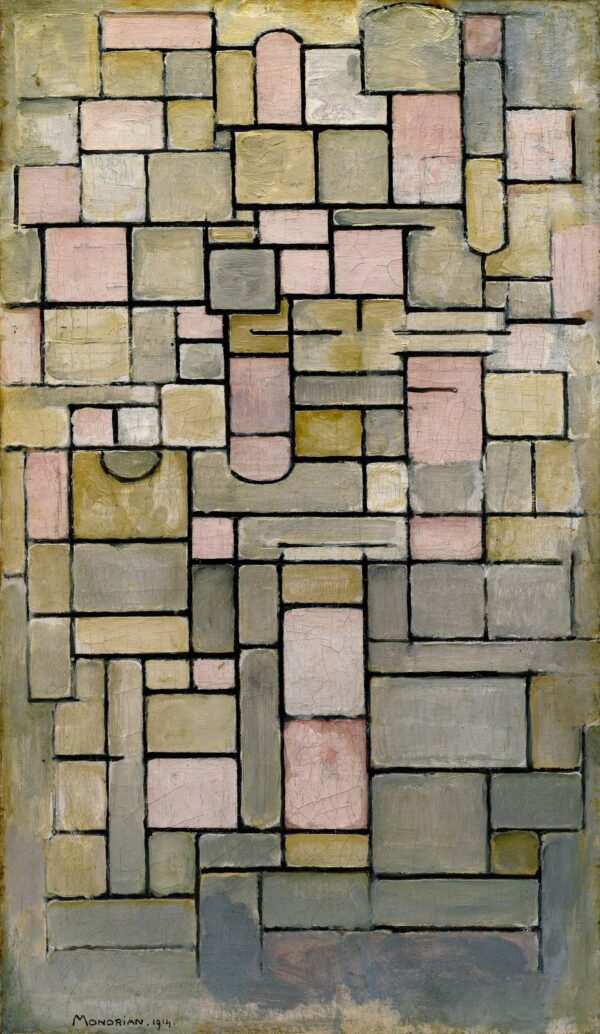
The original belongs to the Solomon R. Guggenheim Museum in New York, inventory number 49.1229. The same collection also holds Composition 8 of 1914, a Paris work in which façades dissolve into a grid, so the two can be compared as two steps along one road.
The original is 119 cm high and 75.1 cm wide, a narrow upright format that reads on the wall as a tall rectangle. Mondrian signed it at the lower left with his monogram and the date, so small that you notice them only close up.
Composition (1916) or another Mondrian?
This piece suits modern, minimalist or Scandinavian interiors and offices, where you want order and calm without coldness. The narrow upright format works well between two windows, beside a bookcase or in a hallway, where a wider painting would not fit.
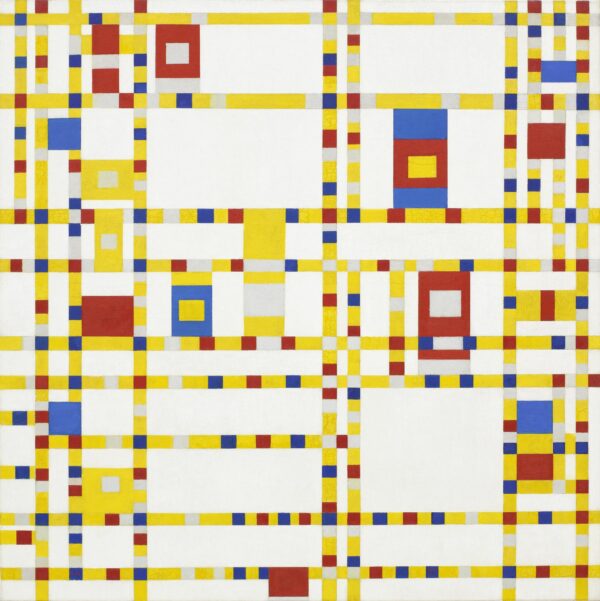
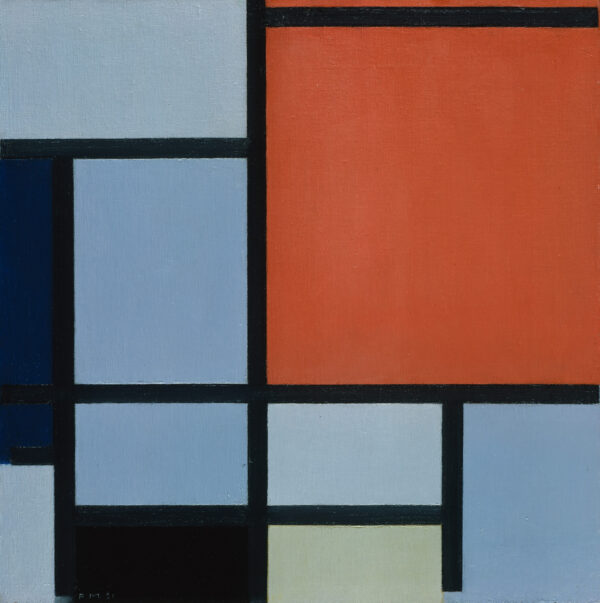
If you prefer the grid in its final, strict form, choose Composition (1921), one of his first Neoplastic works, with a large orange-red field. For the most movement and colour there is the New York Broadway Boogie Woogie of 1942–1943.
Every Mondrian we paint to order, from the early landscapes to the late grids, is gathered on the Piet Mondrian page.
How does our painter paint your Composition (1916)?
With this painting everything depends on proportion. First the painter transfers from the original to the canvas the position and length of every short stroke and every coloured rectangle, because the rhythm falls apart as soon as a few of them shift.
He lays in the colour fields in thin coats and keeps the soft, broken tones of the original: pink, grey and yellow stay restrained, never loud. Only when the fields are dry does he draw the black lines; he masks the edges with tape so that they stay sharp and straight, and applies the paint evenly and opaquely.
The result is a Mondrian reproduction with the slight sheen of oil and real depth of colour. An oil painting reproduction like this is something other than a print: every stroke is drawn with a brush and shows in the light as paint, not as a dot screen.
Which size for which wall?
In short: 29 x 46 or 40 x 62 cm for a narrow wall or a shelf, 48 x 75 and 55 x 85 cm between windows or beside a wardrobe, 64 x 100 and 80 x 126 cm above a chest of drawers or a bed, and 90 x 140 and 116 x 180 cm for a tall wall in a living area or office.
There are 8 portrait sizes (width x height): 29 x 46, 40 x 62, 48 x 75, 55 x 85, 64 x 100, 80 x 126, 90 x 140 and 116 x 180 cm. The original measures 75.1 x 119 cm; the closest size is 80 x 126 cm, which is 4.9 cm wider and 7 cm taller.
As a painting for the living room, beside the sofa or between two windows, 80 x 126 and 90 x 140 cm work well. In small sizes the short strokes crowd together, so we suggest at least 55 x 85 cm if you want the rhythm to read from the other end of the room.
Can I have another size or a frame?
Yes. The original is about 1.6 times as tall as it is wide; if you keep that ratio, the spacing of the strokes stays as in the original. Send us the width and height you need and we will reply with a price and a date.
This canvas painting leaves us rolled, stretched on a stretcher bar or framed. Our workshop in Slovenia stretches it and, if you wish, frames it. You choose the frame in our 3D application, which is for choosing the frame only; seeing the painting on your own wall is a separate service.
The soft tones suit a slim frame in light wood or white; a dark, heavy frame would squeeze the fine mesh. Stretched on its bar without a frame, it looks most modern.
When will the painting arrive?
We start painting your Composition (1916) once your order arrives, and within 15 to 45 working days it is ready to ship. Before that you receive a photograph of the finished painting, and whatever you would like changed, we correct.
It travels without customs within Slovenia and the rest of the EU, and our returns policy applies to every order.
As a gift it suits a lover of modern art, an architect or a designer. If you would rather leave the size to the person receiving it, give a wall art voucher.
Frequently asked questions
Which museum holds the original Composition (1916)?
The Solomon R. Guggenheim Museum in New York, inventory number 49.1229.
Is it a print or a poster?
No. It is a hand-painted copy in oil on canvas; our painter paints every stroke and every colour field with a brush.
How big is the original?
It is 119 cm high and 75.1 cm wide. Our sizes run from 29 x 46 to 116 x 180 cm.
Which colours are in the painting?
Black lines and crosses, with small rectangles of red, blue, yellow, pink and grey.
What does the painting mean?
It is an abstract composition and a step between Mondrian’s black-and-white works of 1915 and his later compositions of pure colour planes.
Is it suitable for a bedroom?
Yes. The soft tones are calm, so it suits a bedroom, but also an office, a hallway or a modern living area.
Do you paint it to a custom size?
Yes, in any size; it looks best if you keep the proportions of the original.
How long do painting and delivery take?
The painting is ready to ship in 15 to 45 working days, and we send you a photograph of it first.
- Subject: short black horizontal and vertical lines and crosses over small red, blue, yellow, pink and grey rectangles.
- Original: 1916, oil on canvas, 119 x 75.1 cm, Solomon R. Guggenheim Museum, New York.
- Ours: painted by hand in oil on canvas, in 8 portrait sizes from 29 x 46 to 116 x 180 cm or made to measure.
- Worth knowing: the painting links Mondrian’s black lines of 1915 to the colour planes that followed.