







































Description
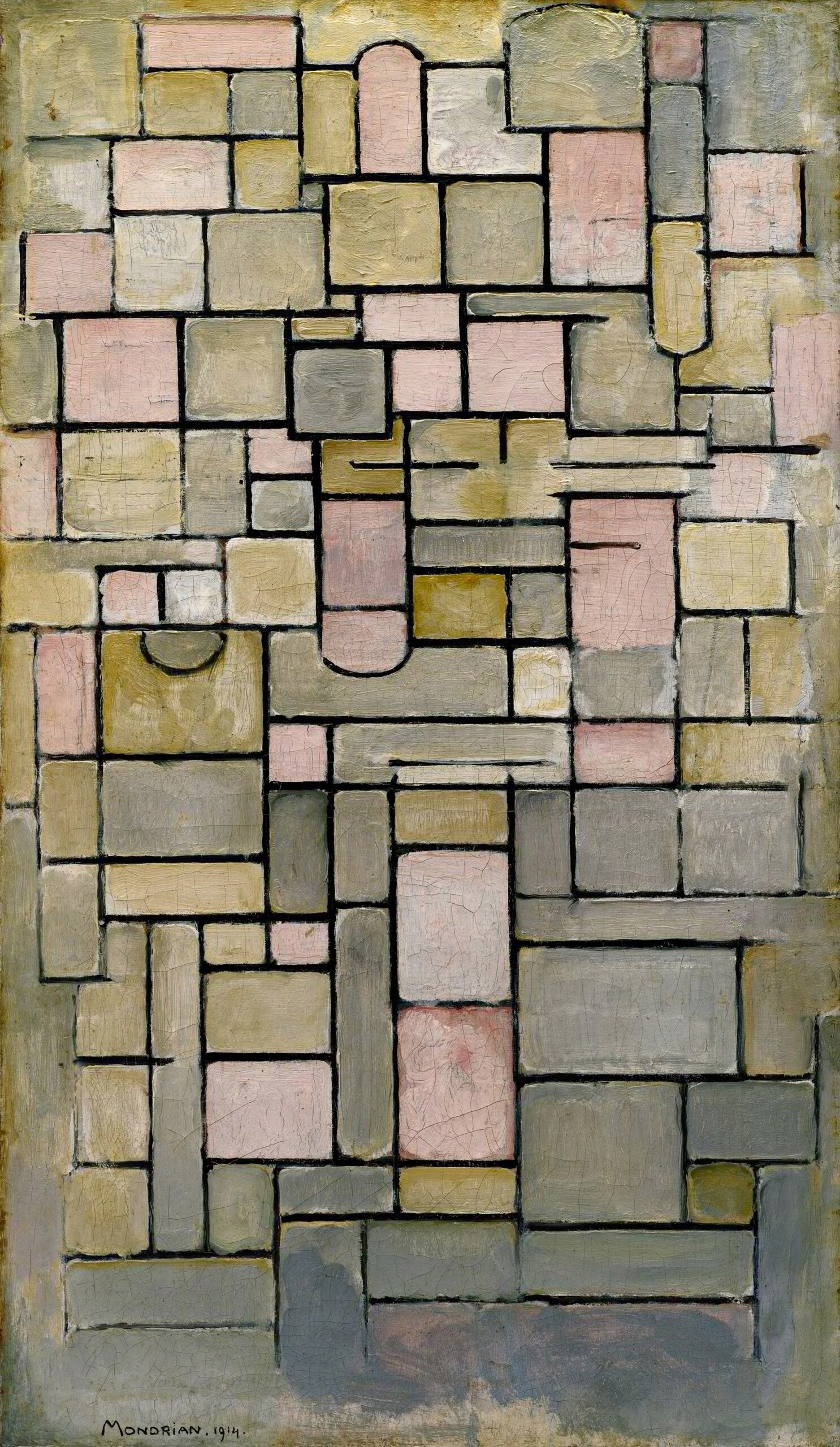
Composition 8 is a tall painting by Piet Mondrian from 1914, made in Paris: a high field of rectangles and rounded arches outlined in black, in soft pinks, ochres, pale yellows and greys, which recalls a façade dissolved into a grid of windows. The original, oil on canvas, is 94.4 cm high and 55.5 cm wide and belongs to the Solomon R. Guggenheim Museum in New York. Our painter paints it by hand in oil on canvas in 8 portrait sizes, from 29 x 47 to 111 x 188 cm, or to your own measurement, and we send you a photograph of the finished painting before dispatch.
| Title: | Composition 8 |
| Other titles: | Komposition 8 · Composizione 8 |
| Painter: | Piet Mondrian (1872–1944) |
| Year painted: | 1914, Paris |
| Original size: | 94.4 cm x 55.5 cm (height x width) |
| Original technique: | Oil on canvas |
| Painting style: | Cubism, early abstraction |
| Located at: | Solomon R. Guggenheim Museum, New York (acc. no. 49.1227) |
| Our reproduction: | Hand-painted oil on canvas, 8 sizes or made to measure |
Composition 8 – Piet Mondrian
What does Composition 8 show?
The canvas is tall and narrow, so the eye reads it from the bottom up. Rectangles of different sizes, each edged with black lines, follow one another across the whole surface: some wide and low, others slim and upright, and hardly any the same as its neighbour.
The colours are quiet and warm. Pale pink, ochre, light yellow and several shades of grey dominate, all close to one another in brightness. No colour shouts, so the canvas reads as a calm surface with a black drawing running across it.
Near the top, rounded arches appear among the straight forms and recall arched windows. The whole suggests the front of a building, or a wall of windows, that has come apart into a grid of lines and fields. The signature MONDRIAN 1914 is visible at the lower left.
How did Composition 8 come about?
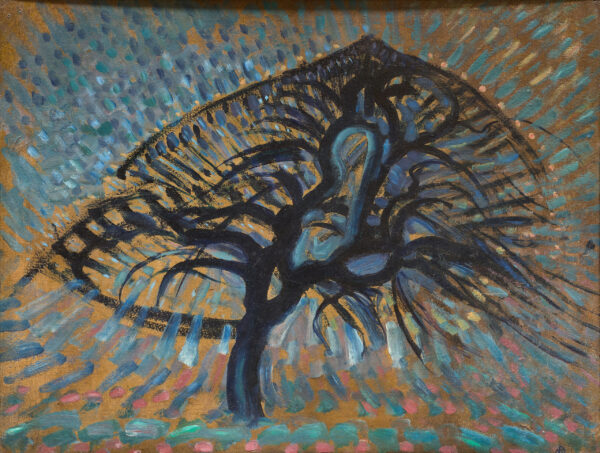
Mondrian started as a painter of the Dutch landscape. He painted windmills, trees and fields, and from about 1908 he turned to bright, non-natural colour, influenced by the luminism of Jan Toorop and by Van Gogh.
From 1911 to 1914 he lived in Paris, where Cubism took hold of him. Under its influence he simplified buildings and façades into grids of short lines and planes. Composition 8 was painted at the end of those Paris years, in 1914.
The painting tells no story and has no hero. Its subject is the transition itself: a recognisable form, a window or an arch, steps back behind the rhythm of lines and coloured fields. What you see is still a little architecture and already almost pure abstraction.
Why does this painting matter?
Because it shows the moment Mondrian chose the grid. The colours are not yet pure red, blue and yellow, and the lines are not yet only horizontal and vertical, since the arches remain. But the core idea, that lines and planes build the painting, is already there.
In the same year he stayed in the seaside resorts of Domburg and Scheveningen and drew the sea and the breakwaters. Those drawings led in 1915 to Composition 10 in Black and White, the first painting in which he used only black and white.
From about 1920 he developed Neoplasticism, the style of the De Stijl group: only horizontal and vertical black lines, red, blue and yellow, plus white and grey. Anyone who knows those later grids will recognise their beginning in Composition 8, still in the soft colours of Paris façades.
Where is the original?
The original belongs to the Solomon R. Guggenheim Museum in New York, accession number 49.1227. The canvas measures 94.4 cm in height and 55.5 cm in width.
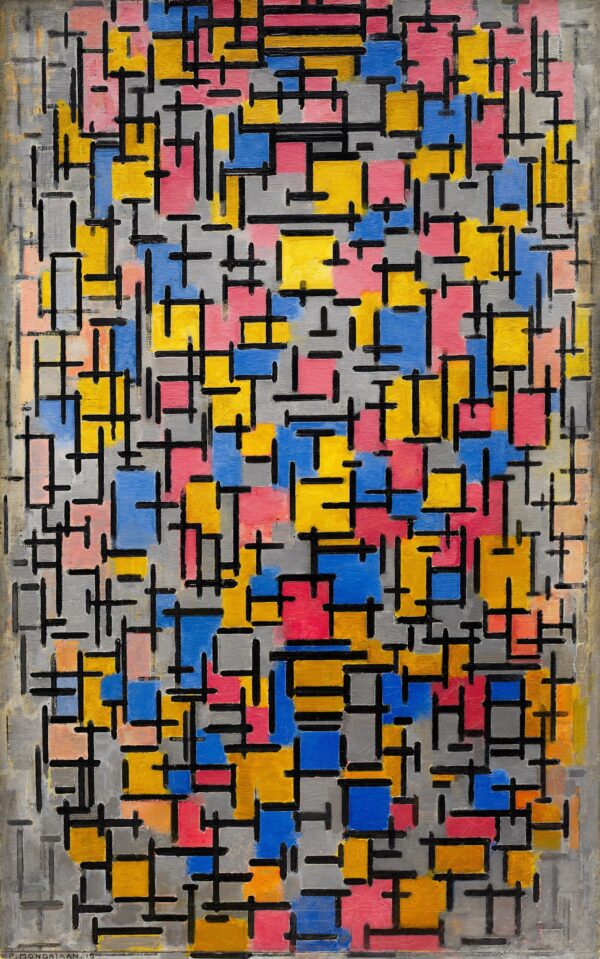
The same New York collection also holds Mondrian’s Composition (1916), painted two years later in the Netherlands during the First World War. There, short black lines and crosses lie over small rectangles of red, blue, yellow, pink and grey.
Composition 8 or another Mondrian?
This piece belongs in a modern, minimalist or Scandinavian room, and in an office or a study. Because it is tall and slim, it fills the strip of wall between two windows, beside a door or next to a tall cupboard, where a wide painting would have no room.
Its soft tones make it calmer than Mondrian’s later grids, so it also sits well in a bedroom or next to a reading corner.
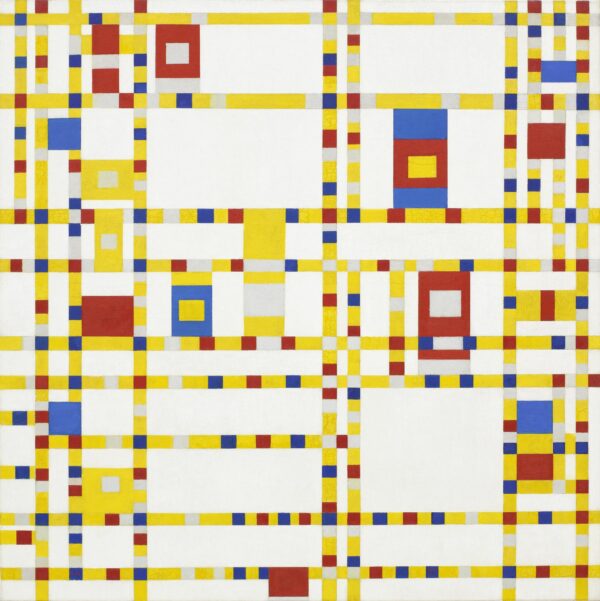
If mature Neoplasticism with strong colour appeals to you, choose Composition (1921), one of his first Neoplastic compositions, with a large orange-red plane. For a later grid named after a Paris square, there is Place de la Concorde.
The Piet Mondrian page gathers the famous Mondrian paintings we paint to order, from the early landscapes and trees to the late grids.
How does our painter paint your Composition 8?
With this painting, everything depends on proportion. The painter first transfers the grid from the original to the canvas: the position of every black line, the height of every rectangle and the course of the arches at the top. Only when the proportions match does he begin to lay in colour.
Pink, ochre, pale yellow and the greys are very close in brightness, so he mixes them on the palette and checks them against the original until every shade is right. Those small differences give the painting its warmth; lose them and the surface goes dull.
He lays the fields in thin, even coats. Along the straight lines he masks the edges with tape so they stay crisp, and on the arches he moves the brush slowly so the black outline keeps the same width everywhere.
The result is a Mondrian reproduction with clean edges and flat, even colour. An oil painting reproduction has body and a soft sheen on the wall that a paper print cannot reach.
Which size for which wall?
In short: 29 x 47 or 40 x 65 cm for a shelf or a narrow strip of wall, 45 x 80 or 55 x 90 cm between windows or beside a door, 60 x 105 and 77 x 129 cm above a chest of drawers or a bed, and 88 x 146 and 111 x 188 cm for a tall wall or a stairwell.
There are 8 portrait sizes (width x height): 29 x 47, 40 x 65, 45 x 80, 55 x 90, 60 x 105, 77 x 129, 88 x 146 and 111 x 188 cm. Closest to the original, 55.5 cm wide and 94.4 cm high, is 55 x 90 cm: 0.5 cm narrower and 4.4 cm lower.
As a painting for the living room beside a sofa or in a corner with an armchair, 60 x 105 and 77 x 129 cm work well. A tall format draws the eye upwards and makes the room feel higher; hang it with its centre about 150 cm from the floor.
Can I have another size or a frame?
Yes. The original is roughly 3 : 5 in proportion; keep to that and every rectangle and arch stays in the same relation as on the original. Tell us the width and height you need, and you will get a price and a date back from us.
Your canvas painting travels rolled, stretched on a stretcher bar or framed. Stretching and framing happen in our own workshop in Slovenia.
Frames can be tried in our 3D application, which exists only for picking a frame; showing Composition 8 on your own wall is a separate service. A thin frame in pale wood or white suits the soft tones of Composition 8, but you can also hang it unframed, simply stretched.
How long do painting and delivery take?
We start painting Composition 8 when your order arrives, and within 15 to 45 working days it is ready to ship. A photograph of your finished Composition 8 reaches you before it ships, and anything you want altered, we alter.
Within Slovenia and across the EU it arrives with no customs to pay, and our returns policy covers each order.
It makes a good gift for someone who loves architecture, design or modern art. For a friend who should pick the format of this Paris grid, a wall art voucher works well.
Frequently asked questions
Where can I see the original?
In the Solomon R. Guggenheim Museum in New York, accession number 49.1227.
What do the arches at the top mean?
They recall arched windows. The whole reads like a façade that Mondrian broke down into a grid of lines and planes.
Is this a print or a poster?
No. It is a hand-painted copy in oil on canvas, made by our painter when you order.
How big is the original?
It is 94.4 cm high and 55.5 cm wide. Our closest size is 55 x 90 cm.
Can I get a size that is not on the list?
Yes. Give us the width and height, and we will come back with a price and a delivery date.
How is the painting delivered?
Rolled, stretched on a stretcher bar or framed; within 15 to 45 working days it is ready to ship.
Does it suit a bedroom or a living room?
Yes. The soft pinks, ochres and greys are calm, so it sits well in either room.
Is it a good gift?
Yes, especially for lovers of architecture and modern art; with a voucher they pick the size themselves.
- Subject: black-edged rectangles and arches in pink, ochre, pale yellow and grey, like a façade of windows dissolved into a grid.
- Original: 1914, oil on canvas, 94.4 x 55.5 cm, Solomon R. Guggenheim Museum, New York.
- Ours: hand-painted in oil on canvas, in 8 portrait sizes from 29 x 47 to 111 x 188 cm or made to measure.
- Worth knowing: Mondrian painted it in Paris and signed it MONDRIAN 1914 at the lower left.