







































Description
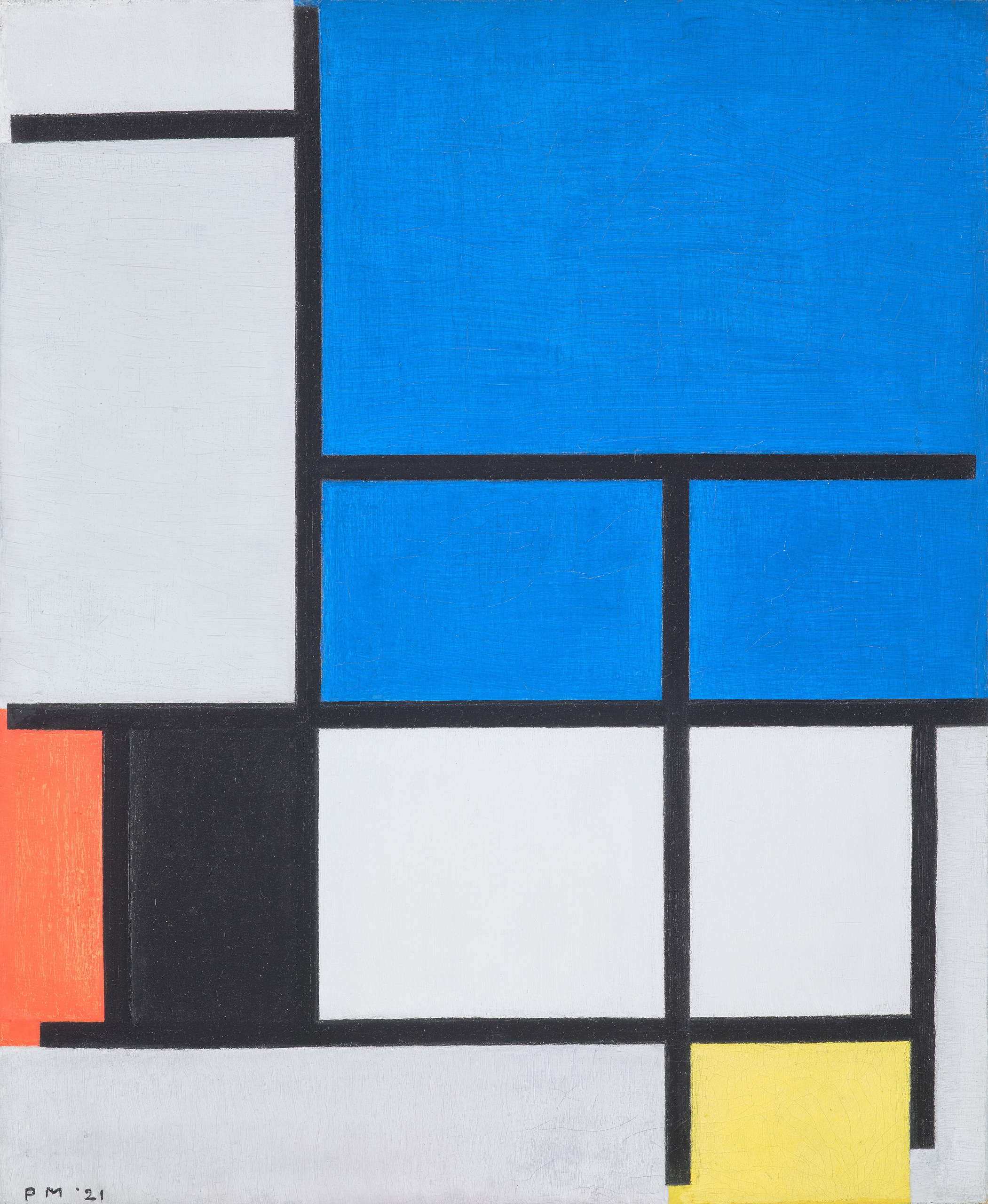
Composition with Large Blue Plane is a painting by Piet Mondrian from 1921: a large bright blue plane fills the upper right of the canvas, smaller blue planes lie below it, a red strip sits at the left edge beside a black rectangle, and a small yellow square holds the lower right, with black lines between light grey and white fields. The original, oil on canvas, is 60.5 cm high and 50 cm wide and belongs to the Dallas Museum of Art in Texas. Our painter paints it by hand in oil on canvas in 8 upright sizes from 36 x 43 to 152 x 193 cm or to measure, and before dispatch you receive a photograph of the finished painting.
| Title: | Composition with Large Blue Plane |
| Other titles: | Komposition mit großer blauer Fläche · Composizione con grande piano blu |
| Painter: | Piet Mondrian (1872–1944) |
| Year painted: | 1921 |
| Original size: | 60.5 cm x 50 cm (height x width) |
| Original technique: | Oil on canvas |
| Painting style: | Neoplasticism (De Stijl), abstract painting |
| Located at: | Dallas Museum of Art, Dallas, Texas (acc. no. 1984.200.FA) |
| Our reproduction: | Hand-painted oil on canvas, 8 sizes or made to measure |
Composition with Large Blue Plane – Piet Mondrian
What does Composition with Large Blue Plane show?
The eye goes to the blue first. A single large plane of bright blue takes up the upper right, the biggest field of colour in the painting, and the same blue returns lower down in smaller planes, like an echo.
The other colours stay at the edges: a red strip at the left edge with a black rectangle right beside it, and in the lower right corner a small yellow square, the brightest accent and also the smallest. Everything else is light grey and white.
Black lines run between the fields, only horizontally and vertically, and divide the canvas into rectangles of different sizes. No two are quite alike, and nothing is placed in the centre. That is why the painting feels calm and lively at once: the large blue weighs against the small yellow and the narrow red.
What was Mondrian looking for in this composition?
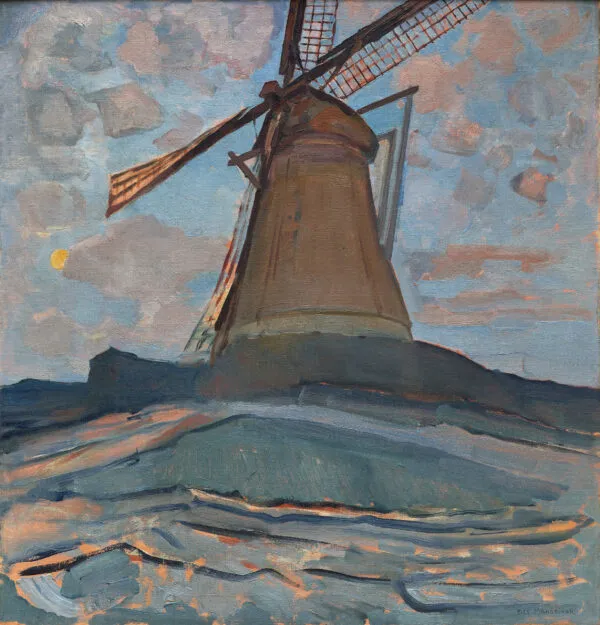
By 1921 Mondrian no longer painted trees, mills or farms. He had reduced his painting to horizontal and vertical lines, to the primary colours red, blue and yellow, and to white, grey and black. This way of painting is called Neoplasticism, and it is linked with the Dutch De Stijl movement.
The painting depicts nothing outside itself. Its subject is relation: how much blue a canvas can carry, how small a yellow square may be and still hold its own, how a red strip at one edge balances a large field in the opposite corner. The meaning lies in that balance, reached without symmetry.
Why is this composition so admired?
Among the famous Mondrian paintings, the grids of black lines and pure colour come to mind first. This one dates from the first years of those grids, when the painter was still testing his system, and it still gives a large share of the canvas to light grey.
What sets it apart is the colour that leads. In many of his compositions one colour dominates, and in Composition II in Red, Blue and Yellow from 1930 it is a big red square. Here the leading role goes to blue, which gives the painting a cool, quiet mood.
On the wall that matters. Red wakes a room up; blue lets it rest. If a big red square would be too loud for your room, this composition offers the same clarity in a calmer key.
Where is the original, and how is it signed?
The original belongs to the Dallas Museum of Art in Dallas, Texas, accession number 1984.200.FA. It is oil on canvas, 60.5 cm high and 50 cm wide: an upright format of modest size that would fit a hallway at home.
At the lower left the painter added his initials and the year in short form: PM ’21. The letters are small and do not compete with the colour.
Composition with Large Blue Plane or another Mondrian?
This canvas painting suits modern, minimalist and Scandinavian rooms, a home office or a consulting room: anywhere clean lines and calm colour help you concentrate.
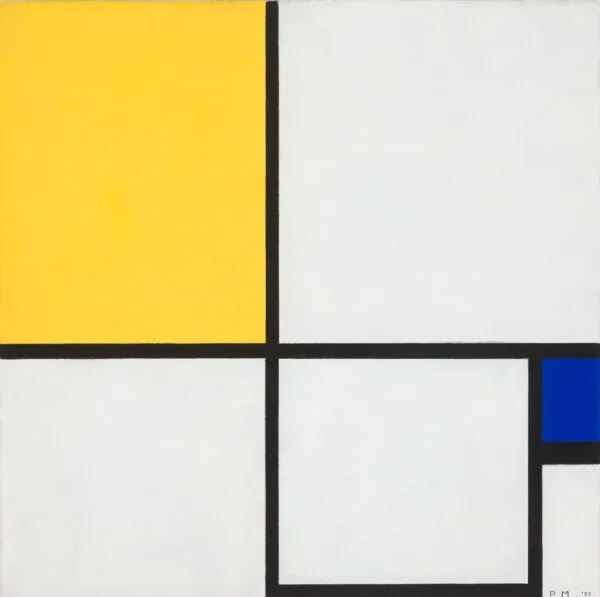
For a square format from the same years, Composition A of 1920 is a dense grid of red, blue, yellow, greys and black. In Composition No. II (1929) yellow leads, set against white fields and a small blue rectangle. The late grid Place de la Concorde, with its yellow band, belongs to the same museum in Dallas.
Every Mondrian reproduction we paint to order, from the early farms to the late New York grids, is on the Piet Mondrian page.
How does our painter paint your Composition with Large Blue Plane?
A grid like this forgives nothing: if a line drifts by a few millimetres or the blue turns patchy, the balance shifts. So our painter starts with the proportions, measuring the divisions of the original and transferring them to your canvas size, so that the large blue plane keeps its share of the surface.
Then he masks each field along its edges and paints it in oil in thin, even coats, layer by layer, until the colour lies flat without streaks. The blue, red and yellow are mixed to the original, and the light greys get the same care, since a grey too warm or too cool changes the mood.
The black lines are painted against masked edges too, so they stay sharp where they meet the colour. The result is an oil painting reproduction with clean borders and a solid surface of real paint.
Which size for which wall?
In short: 36 x 43 cm for a shelf or desk, 46 x 55 and 54 x 65 cm, close to the original, for a hallway or beside a window, 68 x 85 and 89 x 105 cm above a chest of drawers or a bed, 97 x 122 cm beside a sofa, 124 x 150 and 152 x 193 cm for a tall, empty wall.
There are 8 sizes (width x height): 36 x 43, 46 x 55, 54 x 65, 68 x 85, 89 x 105, 97 x 122, 124 x 150 and 152 x 193 cm. The original measures 50 x 60.5 cm; 46 x 55 cm is 4 cm narrower and 5.5 cm lower, and 54 x 65 cm is 4 cm wider and 4.5 cm taller.
All eight are upright like the original, and 124 x 150 cm comes nearest to its proportions. As a painting for the living room beside the sofa, 89 x 105 or 97 x 122 cm gives the blue presence without filling the wall.
Can I order a different size or a frame?
Yes. If your wall needs other measurements, we paint the composition in the size you choose and keep the planes in balance as far as the new proportion allows. Send us your width and height, and we reply with a price and a lead time.
It can come rolled in a tube, stretched on a stretcher bar, or framed and ready to hang. Stretching and framing for this blue composition are done in our own workshop in Slovenia. For the frame you use our 3D app, which is there only for choosing frames; a view of the painting on your own wall is a separate service.
When will my Composition with Large Blue Plane be ready?
We begin as soon as your order is in, and the painting is ready to ship within 15 to 45 working days. Before it leaves you get a photograph of the finished painting, and if you want a line or a shade of blue adjusted, we change it.
Shipped within Slovenia or to any other EU country, your blue composition crosses no customs border, and our returns policy applies.
It is a thoughtful gift for someone who works at a desk all day, loves design or has just moved into a modern flat. Or give a wall art voucher and leave the choice of size to them.
Frequently asked questions
Which museum has the original?
The Dallas Museum of Art in Dallas, Texas, accession number 1984.200.FA.
What does the small yellow square at lower right do?
It is the smallest field of colour, a bright accent that balances the large blue plane at upper right.
Is this a print?
No. It is a hand-painted copy in oil on canvas, with every plane laid down by our painter in even coats.
How big is the original?
It is 60.5 cm high and 50 cm wide; our nearest upright sizes are 46 x 55 and 54 x 65 cm.
Can you paint a size that is not listed?
Yes. Give us the width and height you need, and we paint it to those measurements.
How long do making and delivery take?
Ready to ship within 15 to 45 working days; you see a photograph of it first.
Does it suit an office or a bedroom?
Yes. The cool blue and light greys keep a study or a bedroom calm, and the upright format fits narrow walls.
What do the colours mean?
They do not stand for objects. Mondrian used them to build balance: one large blue field against small red, black and yellow accents.
- Subject: a large bright blue plane at upper right, smaller blue planes, a red strip, a black rectangle and a small yellow square.
- Original: 1921, oil on canvas, 60.5 x 50 cm (height x width), Dallas Museum of Art.
- Ours: painted by hand in oil on canvas, in 8 upright sizes from 36 x 43 to 152 x 193 cm, or to measure.
- Worth knowing: the initials and date PM ’21 are at the lower left.