







































Description
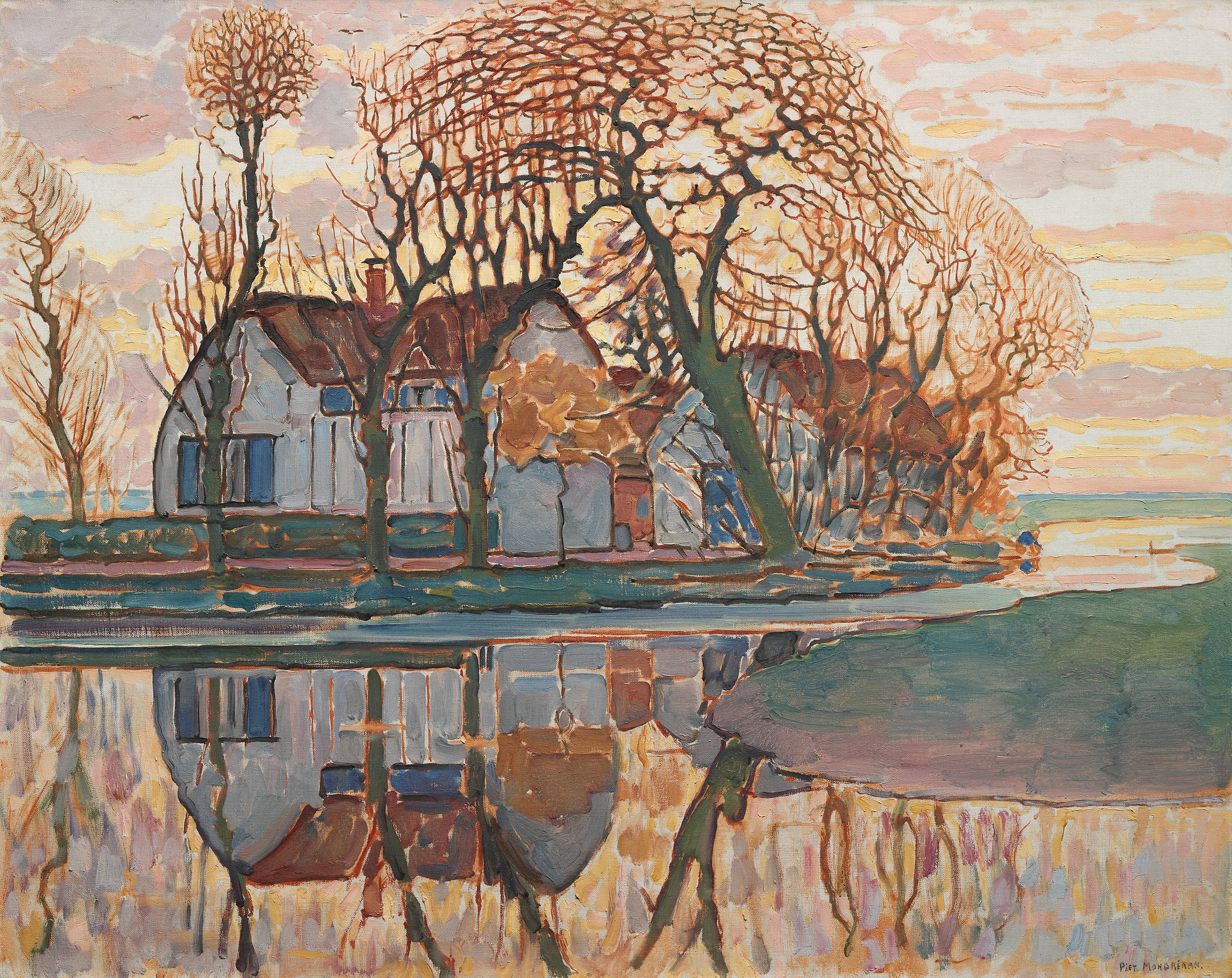
Farm near Duivendrecht is a painting by Piet Mondrian from about 1916: a long white farmhouse with a dark roof stands behind a row of tall, bare trees whose thin branches spread in orange-brown and pink against a pale pink and grey sky, while house and trees are mirrored in still water. The original, oil on canvas, is 107.9 cm wide and 86.3 cm high and belongs to the Art Institute of Chicago. Our painter paints it for you by hand in oil on canvas, in 8 sizes from 40 x 31 to 200 x 159 cm or made to measure, and you get a photograph of the finished painting before we send it.
| Title: | Farm near Duivendrecht |
| Other titles: | Bauernhof bei Duivendrecht · Fattoria vicino a Duivendrecht |
| Painter: | Piet Mondrian (1872–1944) |
| Year painted: | c. 1916 |
| Original size: | 86.3 cm x 107.9 cm (height x width) |
| Original technique: | Oil on canvas |
| Painting style: | Naturalism, Hague School |
| Located at: | The Art Institute of Chicago, Chicago (acc. no. 2001.479) |
| Our reproduction: | Hand-painted oil on canvas, 8 sizes or made to measure |
Farm near Duivendrecht – Piet Mondrian
What does Farm near Duivendrecht show?
A long white farmhouse with a dark roof runs across the middle of the canvas, and in front of it stands a row of tall, bare trees.
Mondrian did not paint the branches black but in orange-brown and pink, so against the light sky they read not as hard lines but as a warm, almost see-through veil.
Still water fills the lower part of the canvas. House and trees are reflected in it, so the row of trunks carries on downwards and the composition gains a double, nearly symmetrical structure. On the right a green bank curves away towards open water.
Why did Mondrian keep coming back to this farm?
The farm stands near Duivendrecht, a village just outside Amsterdam. Mondrian first sketched it around 1905. Twenty paintings and drawings related to the farm are known, and nine of them were made later, during the years of the First World War.
The museum in Chicago explains why he returned to the subject: in wartime his patrons generally preferred his earlier naturalistic compositions to his recent Cubist experiments. So he painted house, trees and water once more as the eye sees them.
The row of vertical trunks, the horizontal roof and the flat sheet of water show how deeply his vision was rooted in the flat landscape of Holland. Out of verticals and horizontals like these he built his grids a few years later.
What makes this painting special?
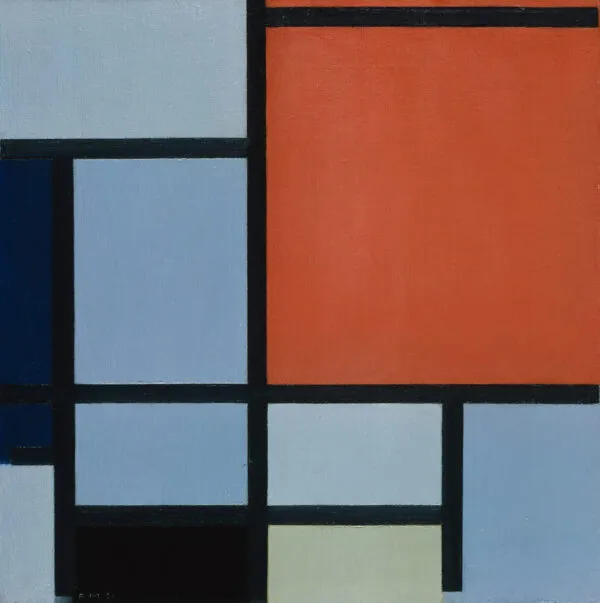
For most people the name Mondrian means black lines and fields of red, blue and yellow, the kind he painted from about 1920. Among the famous Mondrian paintings those grids take the spotlight, yet this canvas reveals where such a painter came from: the tradition of the Hague School, quiet Dutch farms, trees and water.
The orange-brown and pink branches chime with the rosy sky, and the white house lights up among the warm tones like a bright patch.
Where is the original, and who owned it?
The original is in the collection of the Art Institute of Chicago, where it is recorded under accession number 2001.479. It is oil on canvas, 107.9 cm wide and 86.3 cm high, which is almost exactly a ratio of 5 : 4.
Around 1916 it belonged to the Amsterdam collectors Eduard and Lea van der Hoop; it then stayed in the family and passed down to their descendants. In 2001 Dolly J. van der Hoop Schoenberg gave it to the museum.
At the lower right the canvas is signed PIET MONDRIAAN, the Dutch spelling of the painter’s surname.
This farm or another Mondrian landscape?
This is a canvas painting for rooms where you want calm: a living room with wood and linen, a bedroom, a country-style dining room or a reading corner. Its landscape format hangs beautifully above a sofa, a bed or a long sideboard.
Mondrian painted the same farm in evening light as well. Farm Near Duivendrecht, in the Evening of 1916, held by a museum in Dallas, shows the houses as dark silhouettes under an orange and pink sky. The Chicago daylight version is lighter and airier, and on one wall the two make a fine pair.
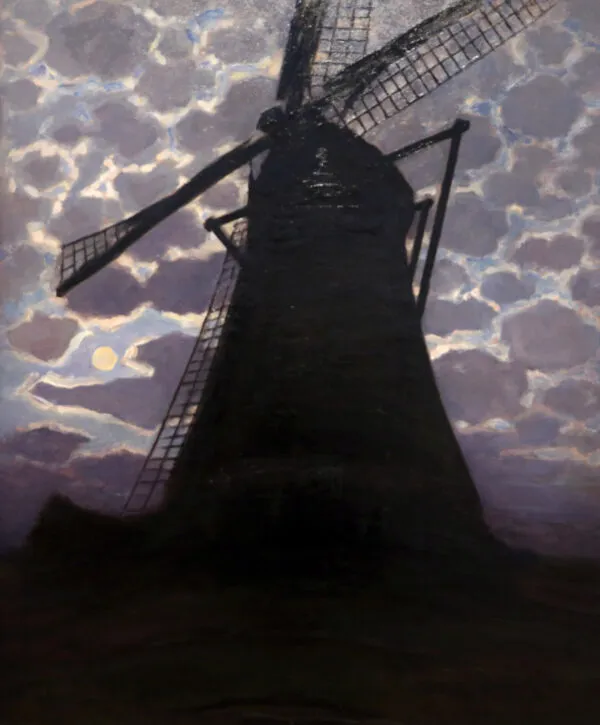
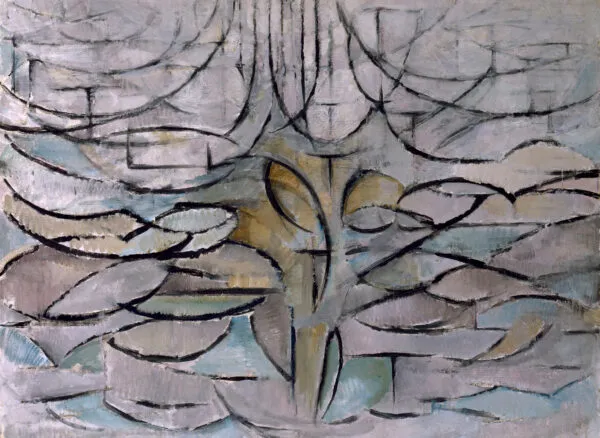
If water by night appeals to you, look at Oostzijdse Mill by Moonlight from about 1903, and for a taller wall at Windmill of 1917. The story of trees on their way to the grid continues in Apple Tree, Pointillist Version.
Every Mondrian reproduction we paint to order, from the early landscapes to the late grids, is gathered on the Piet Mondrian page.
How does our painter paint your farm?
He starts by setting out the composition. He transfers the waterline, the length of the house and the spacing of the trunks onto the canvas, because every vertical strip has to match the original or the rhythm of the trees falls apart.
Then he paints in oil, layer by layer. First the sky in pale pink and grey, then the white house with its dark roof, and last, with a fine brush, the branches in orange-brown and pink. He lays in the reflection with softer horizontal strokes so the water stays calm.
The brushstrokes stay visible, because they bring the branches and the water to life. The result is an oil painting reproduction with a real layer of paint that glows faintly under a lamp, with a depth and warmth that no print can match.
Which size suits your wall?
In short: 40 x 31 or 50 x 40 cm for a small wall or a shelf, 64 x 50 and 80 x 64 cm above a chest of drawers or in a hallway, 100 x 81 and 125 x 103 cm above a sofa or a bed, 160 x 126 and 200 x 159 cm for a large bare wall.
You can choose from 8 sizes (width x height): 40 x 31, 50 x 40, 64 x 50, 80 x 64, 100 x 81, 125 x 103, 160 x 126 and 200 x 159 cm. The original measures 107.9 x 86.3 cm. The 100 x 81 cm size is 7.9 cm narrower and 5.3 cm lower, while 125 x 103 cm is 17.1 cm wider and 16.7 cm taller.
The sizes 50 x 40 and 80 x 64 cm have a ratio of 5 : 4, almost the same as the original, so house and trees keep their spacing. As a painting for the living room above a three-seater, 125 x 103 cm works best; above a double bed, 100 x 81 cm; and 200 x 159 cm fills a dining-room wall on its own.
Can I have a different size and a frame?
Yes. If you need another proportion, we adapt the composition with care so that the house and the row of trees stay in balance. Tell us the width and height you need and we answer with the price and the time it takes.
You can receive the painting rolled, stretched on a stretcher bar, or framed and ready to hang. Stretching and framing are done by our workshop in Slovenia, for every painting we make. You choose the frame in our 3D app, which is only for picking a frame; seeing the painting on your own wall is a separate service.
A natural wooden frame or a slim dark moulding suits this landscape and brings out the white house and the light sky.
When will my painting arrive?
Making it takes 15 to 45 working days from the day your order reaches us. When the painting is finished we send you a photograph of it; if you would like a change, we make it before packing.
Within Slovenia and to the other EU countries the parcel travels free of customs. Our returns policy covers this order like any other.
The farm is a lovely gift for anyone who loves Holland, the countryside and quiet landscapes. With a wall art voucher, whoever receives it can pick the size that fits their wall.
Questions from our customers
Where does the original hang?
At the Art Institute of Chicago, in Chicago, under accession number 2001.479.
What does this landscape show?
A long white farmhouse behind a row of tall, bare trees, all of them reflected in still water.
Is it a print?
No. You receive a hand-painted copy in oil on canvas, with brushstrokes you can see and feel under your fingers.
How big is the original?
It is 107.9 cm wide and 86.3 cm high. Our nearest sizes are 100 x 81 and 125 x 103 cm.
Can you paint a size that is not listed?
Yes. Tell us the width and height you need and we will prepare a quote.
How long will I wait for my painting?
Between 15 and 45 working days. Before dispatch you get a photograph of the finished painting, which we can still touch up.
Is it right for a bedroom or a living room?
For both. The calm pinks, greys and greens and the landscape format look as good above a bed as above a sofa.
Why did Mondrian paint farms at all?
Because he grew out of the Hague School and the Dutch landscape. He sketched this farm as early as 1905, and in wartime his patrons preferred naturalistic scenes.
- Subject: a long white farmhouse behind bare trees with orange-brown branches, a pink and grey sky and a reflection in still water.
- Original: c. 1916, oil on canvas, 86.3 x 107.9 cm (height x width), The Art Institute of Chicago.
- Ours: painted by hand in oil on canvas, in 8 sizes between 40 x 31 and 200 x 159 cm, or made to measure on request.
- Worth knowing: the evening version of the same farm is in a Dallas museum; this daylight one hangs in Chicago.