







































Description
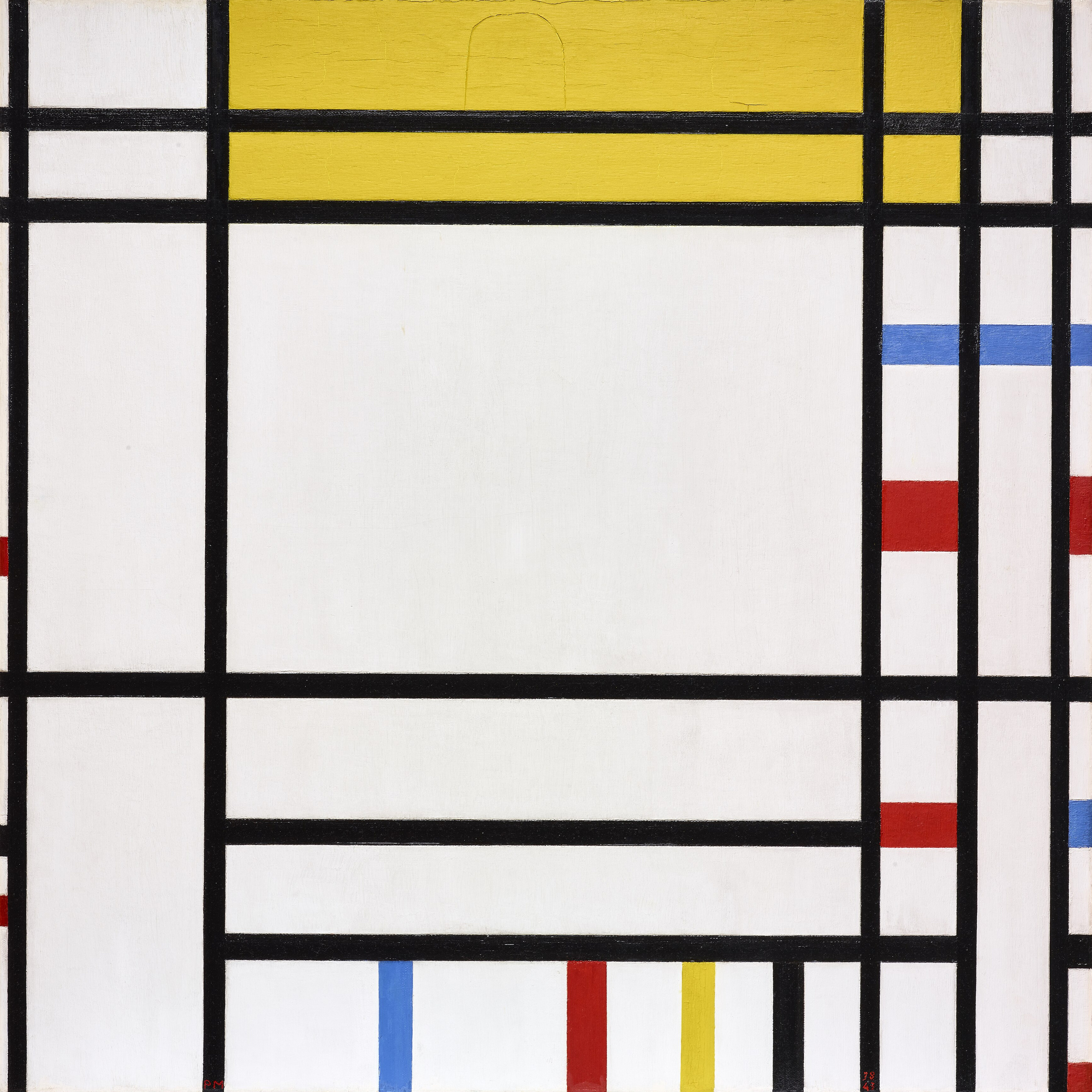
Place de la Concorde is a painting by Piet Mondrian that he began in Paris in 1938 and finished in New York in 1943: a grid of black lines on a white ground, crossed at the top by a yellow band, with small red and blue blocks and short coloured bars along the right and lower edges. The original, oil on canvas, is 94 cm high and 94.4 cm wide, so almost square, and belongs to the Dallas Museum of Art. Our painter paints it for you in oil on canvas in one of 8 sizes, from 35 x 35 to 200 x 200 cm, or to your own measurement, and you receive a photograph of the finished painting before dispatch.
| Title: | Place de la Concorde |
| Other titles: | Place de la Concorde, 1938–1943 · Place de la Concorde (Dallas Museum of Art) |
| Painter: | Piet Mondrian (1872–1944) |
| Year painted: | 1938–1943, Paris and New York |
| Original size: | 94 cm x 94.4 cm (height x width) |
| Original technique: | Oil on canvas |
| Painting style: | Neoplasticism (De Stijl), abstract painting |
| Located at: | Dallas Museum of Art, Dallas (acc. no. 1982.22.FA) |
| Our reproduction: | Hand-painted oil on canvas, 8 sizes or made to measure |
Place de la Concorde – Piet Mondrian
What does Place de la Concorde show?
Straight black lines, horizontal and vertical, cross the white canvas and divide it into rectangular fields of different sizes. No line runs at a slant or in a curve; every one follows the edges of the canvas.
A yellow band runs across the upper part. Along the right edge and the bottom edge sit small red and blue blocks and short coloured bars; some reach the very edge and stop there, as though they carried on beyond the frame.
Most of the surface stays white. That is exactly why the few colours are so strong: yellow above, red and blue below hold the composition in balance, although it is not symmetrical.
Where does the name come from, and what is the story?
The painting is named after the great square in Paris, the city where Mondrian lived for many years. He began this canvas there in 1938.
That same year he moved to London, and in 1940 to New York, where he stayed until his death in 1944. He took the unfinished canvas with him and completed it in New York in 1943.
Last of all he added the small bars of colour. Place de la Concorde is therefore one of the paintings he started in Europe and finished in America.
Why is this painting special?
Because it brings two periods together on one canvas. The black grid on white is typical of his Paris years, when he developed Neoplasticism: only straight lines, the three primary colours, and black, white and grey.
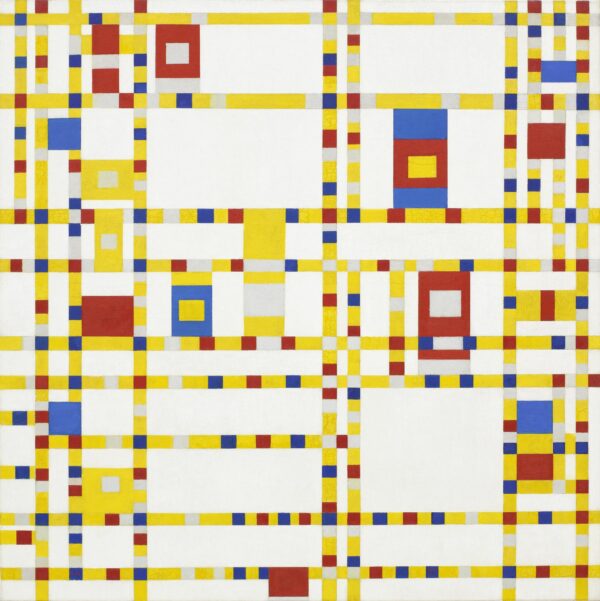
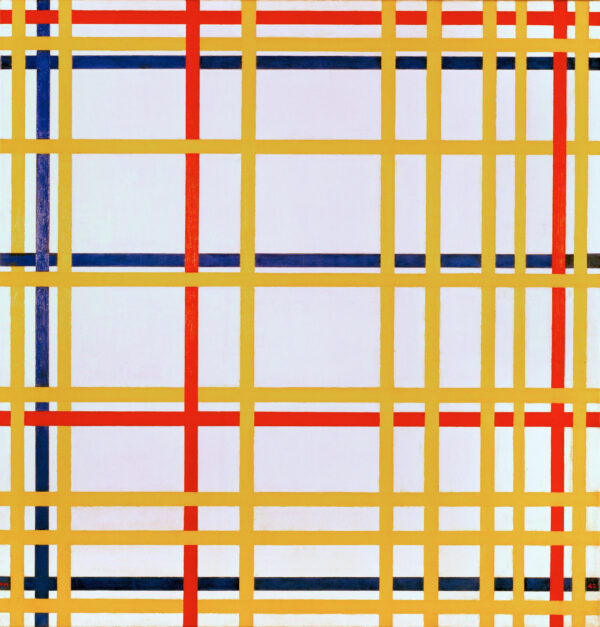
The short bars of colour added in New York point to where he went next. In New York City and Broadway Boogie Woogie the black lines disappear and coloured lines carry the grid.
For anyone who loves Mondrian, this canvas shows the step between those two worlds, in a format that is almost exactly square.
Where is the original?
The original is in the Dallas Museum of Art in Dallas, in the United States, under accession number 1982.22.FA. The canvas is 94 cm high and 94.4 cm wide.
Mondrian began it in Paris and finished it in New York; today it hangs in an American collection, far from the square it is named after.
His paintings of those years are spread across the world: New York City now hangs in Paris, and Broadway Boogie Woogie in New York.
Place de la Concorde or another Mondrian?
Place de la Concorde suits bright, modern rooms: a white wall in the living room, a minimalist or Scandinavian home, an office or a reception area. The square format hangs well centred above a sofa or a bed.
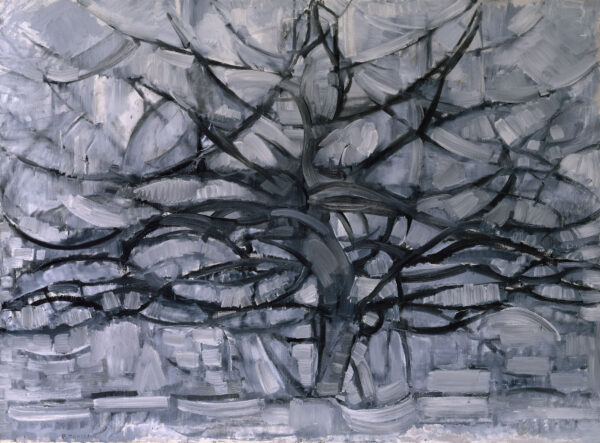
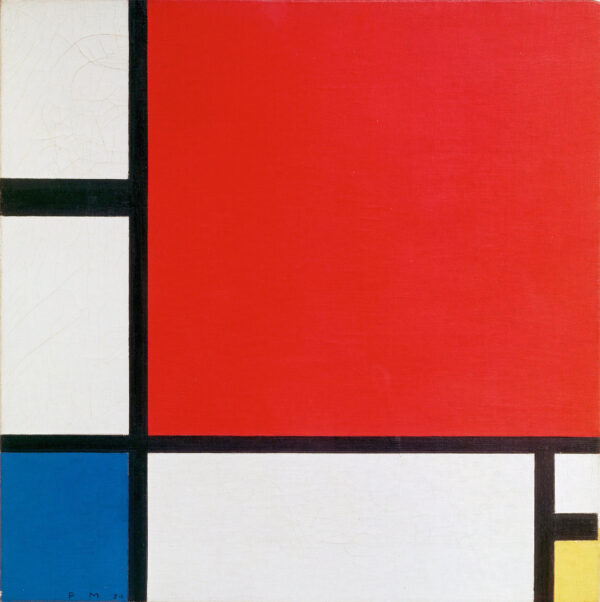
If you want more colour and less white, choose Composition II in Red, Blue and Yellow, where a large red square dominates the upper right. For a calmer bedroom there is Gray Tree of 1911, a tree in nothing but greys, black and white.
The Piet Mondrian page gathers all the famous Mondrian paintings we paint to order.
How does our painter paint your Place de la Concorde?
The grid looks simple, but its effect depends on exact proportions, straight crisp edges and flat, even colour. So before any paint goes on, the painter transfers the proportions of every field and the width of every line from the original to the canvas.
He masks the edges of the lines and colour blocks with tape so that they stay crisp. White, yellow, red and blue go on in several thin, even coats, so that each field is flat and free of patches, and the bars at the margin run right to the edge of the canvas, as in the original.
A Mondrian reproduction made this way shows a fine trace of the brush on its surface and a depth of colour that a paper print lacks. An oil painting reproduction also catches daylight differently from a printed surface, so the white fields stay alive.
Which size for which wall?
In short: 35 x 35 or 45 x 45 cm for a shelf or a narrow wall, 60 x 57 or 70 x 70 cm above a chest of drawers or a desk, 100 x 100 or 120 x 115 cm above a sofa or a bed, and 160 x 155 or 200 x 200 cm for a large wall.
There are 8 sizes (width x height): 35 x 35, 45 x 45, 60 x 57, 70 x 70, 100 x 100, 120 x 115, 160 x 155 and 200 x 200 cm. The closest to the original is 100 x 100 cm, which is 5.6 cm wider and 6 cm taller.
As a painting for the living room above a sofa about two metres wide, 120 x 115 cm works well. Hang it centred, with its lower edge some 20 to 30 cm above the backrest.
Can I have another size or a frame?
Yes. The original is almost square, so we can easily carry it over to a square size that is not on the list; for a different proportion we check with you how the fields and the edge bars will fall. Send us the width and height you need, and a price and a date for your grid will follow.
We send the painting rolled, stretched on a stretcher bar or framed. The stretching and the framing of this grid are done in our workshop in Slovenia, the same hands that finish every canvas painting we send out. Our 3D application lets you pick the frame around the grid and does nothing else; a view of the painting on your own wall is a separate service.
Mondrian’s grid looks best in a narrow white or black frame that does not compete with the lines on the canvas.
When will the painting arrive, and how is it delivered?
We start painting once you order, and within 15 to 45 working days it is ready to ship. Before the parcel leaves, a photograph shows you the finished grid; if a line or a block should change, we correct it.
No customs are charged on the way to Slovenia or any other EU country, and our returns policy covers every order of this grid.
Place de la Concorde makes a fine gift for someone who loves Paris or modern art. If they would rather choose the size themselves, give them our gift voucher.
Frequently asked questions
Where can I see the original Place de la Concorde?
In the Dallas Museum of Art in Dallas, accession number 1982.22.FA.
What is in the painting?
A grid of black lines on white, a yellow band at the top, and small red and blue blocks and coloured bars along the right and lower edges.
Is it a print or a poster?
No. Every one we make is a hand-painted copy, in oil colours on canvas.
What are the measurements of the original?
It is 94 cm high and 94.4 cm wide; our 100 x 100 cm size is a few centimetres larger.
Which size suits the wall above a bed?
Above a double bed, 100 x 100 or 120 x 115 cm, hung centred, work well.
Will you paint the grid in a size not on the list?
Yes. Write to us with the width and height, and we will send you an offer with a price and a date.
How long does it take to make?
Between 15 and 45 working days; before dispatch you receive a photograph of the finished painting.
Why is it named after a Paris square?
Mondrian began it in Paris, where he lived for many years, and named it after the city’s great square.
- Subject: a grid of black lines on white, with a yellow band at the top and red and blue blocks along the right and lower edges.
- Original: 1938–1943, oil on canvas, 94 x 94.4 cm, Dallas Museum of Art.
- Ours: painted by hand in oil on canvas, in 8 sizes from 35 x 35 to 200 x 200 cm or made to measure.
- Worth knowing: Mondrian began the painting in Paris and added the bars of colour only in New York.