







































Description
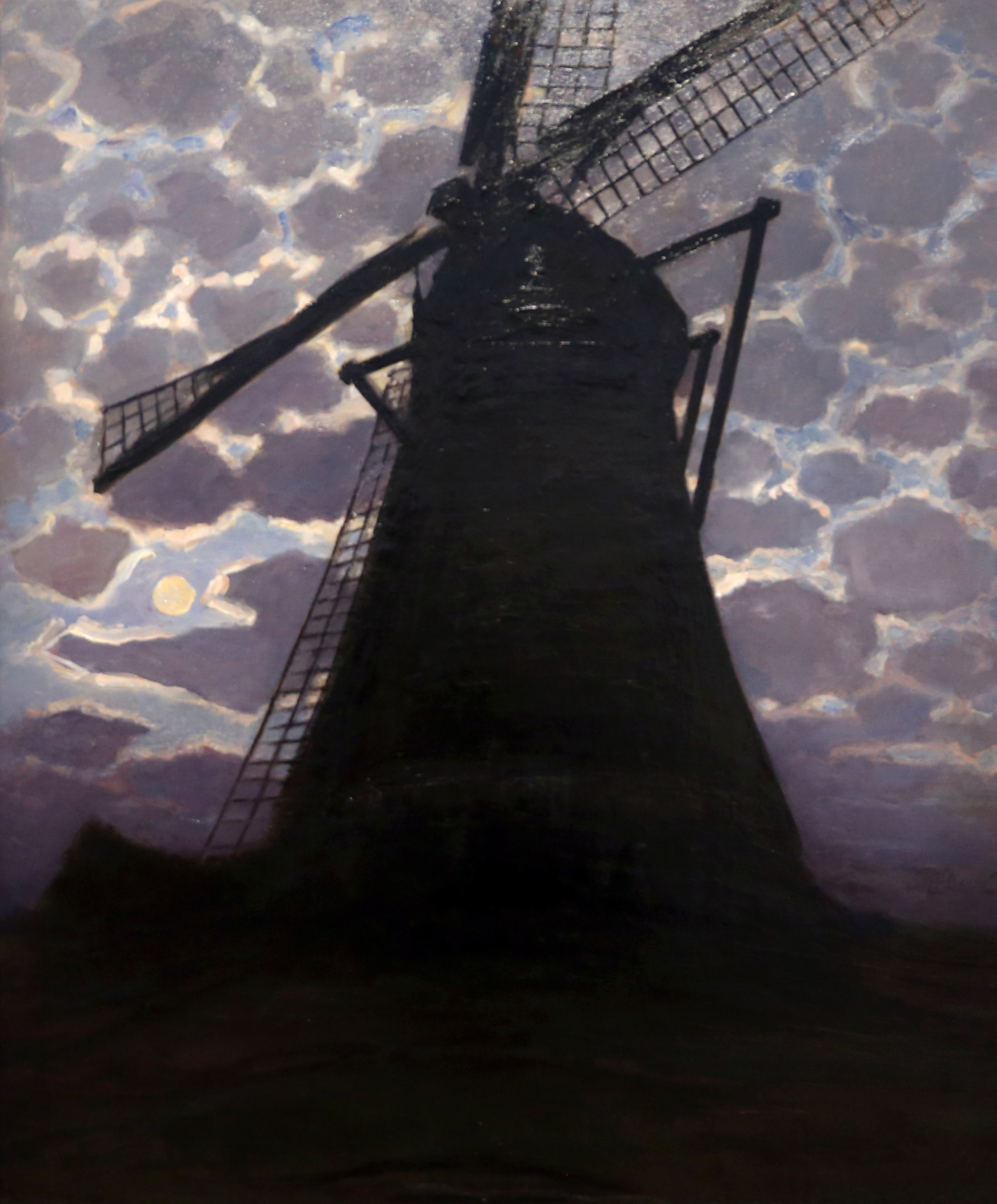
Mill at Evening is a painting by Piet Mondrian from 1917: the dark silhouette of a tall Dutch windmill, seen from below, fills almost the whole canvas, its sails cross on the diagonal, a ladder leans against it, and behind it opens a night sky of lilac and grey clouds, each edged with pale light. The original, oil on canvas, is 103 cm high and 86 cm wide and belongs to the Kunstmuseum Den Haag. Our painter paints it by hand in oil on canvas in 8 upright sizes from 36 x 43 to 160 x 190 cm or made to measure, and a photograph of the finished painting reaches you before it ships.
| Title: | Mill at Evening |
| Other titles: | Windmill in the Evening · Mühle am Abend |
| Painter: | Piet Mondrian (1872–1944) |
| Year painted: | 1917 |
| Original size: | 103 cm x 86 cm (height x width) |
| Original technique: | Oil on canvas |
| Painting style: | Luminism, early modernism |
| Located at: | Kunstmuseum Den Haag, The Hague, Netherlands (acc. no. 0334320) |
| Our reproduction: | Hand-painted oil on canvas, 8 sizes or made to measure |
Mill at Evening – Piet Mondrian
What can you see in Mill at Evening?
A single mill takes up almost the full height of the canvas. Mondrian paints it from below, so it looks even taller and heavier.
The sails cross at a slant over the upper part of the painting and draw a large dark cross against the sky. A ladder leans on the body of the mill. At the bottom the ground is almost black and melts into the foot of the mill without a border.
The sky is built of lilac and grey clouds, and each one carries a rim of pale light. A small round moon glows low to the left of the mill. The brushwork is free and visible, so the sky is no smooth surface but a living, gently moving skin of paint.
What does the evening mill mean in Mondrian’s work?
Windmills were among Mondrian’s favourite subjects in his early years. He came back to them again and again, at different times of day and in different colours.
In this painting the mill becomes almost a sign. The dark vertical of the body and the slanting cross of the sails stand against a calm sky, and the evening hour strips away everything extra until only the outline remains.
The work belongs to Luminism and early modernism, to the years when colour in Mondrian’s hands no longer simply copied nature.
Why does this mill hold a special place in Mondrian’s work?
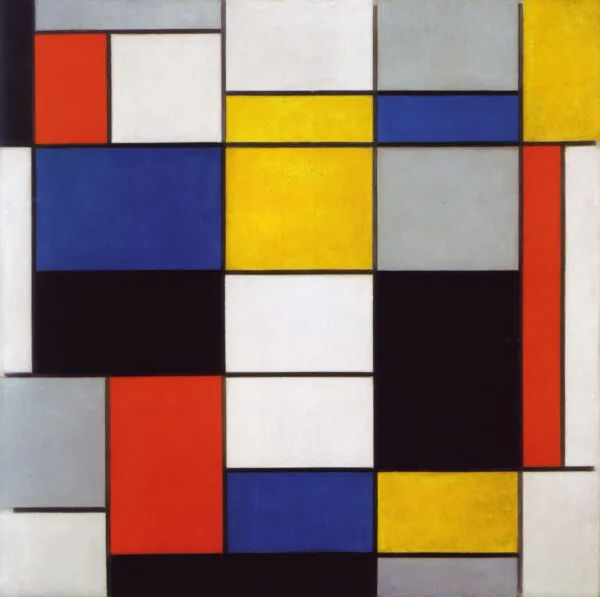
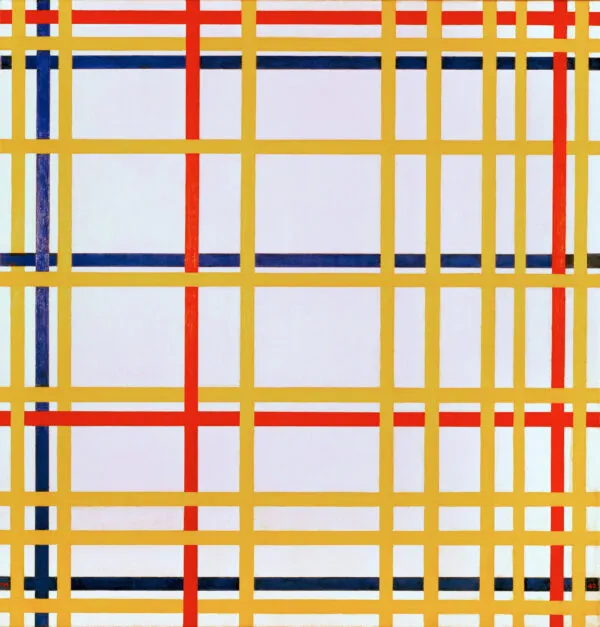
Today Mondrian is known above all for compositions made only of horizontal and vertical lines and pure primary colours with white. Mill at Evening shows where he came from: the flat Dutch landscape and the motifs he painted over and over until they became almost geometry to him.
The shape is still recognisable, yet it is built from large masses of dark colour set side by side like planes.
Among famous Mondrian paintings the grids get the headlines, but you can follow the whole road on your own wall. Hang the mill next to Blossoming Apple Tree of 1912, where the tree almost dissolves into a web of curved lines.
Where is the original of Mill at Evening?
The original is in the collection of the Kunstmuseum Den Haag in The Hague, under accession number 0334320. It is oil on canvas, 103 cm high and 86 cm wide: an upright format that suits the tall mill well.
The painting came to the museum as a bequest of Salomon B. Slijper.
The title says exactly what you see: the hour when the mill turns into an outline and only the moon and the bright cloud edges still light the sky.
Mill at Evening or another Mondrian?
Mill at Evening is a canvas painting for rooms where you want calm and a touch of mystery: a bedroom, a reading corner, a hallway with soft light or a country-style room.
If you would rather have a mill under a daytime sky, there is Windmill from the same year, now in Dallas, with a blue sky and pink clouds; it is a different work. An even earlier night scene is Oostzijdse Mill by Moonlight of about 1903, a mill on the river Gein mirrored in silver water.
Evening light also fills Farm Near Duivendrecht, in the Evening of 1916, where dark houses and trees are reflected in water under an orange sky. Every Mondrian reproduction we paint to order, from the early landscapes to the late compositions, is gathered on the Piet Mondrian page.
How does our painter paint your Mill at Evening?
With this painting the point is mood and the free stroke, not crisp edges. So our painter first transfers the main shapes onto the canvas: the outline of the mill, the angle of the crossed sails, the ladder and the place of the moon, so that the proportions stay as they are in the original.
Then he works in oil, layer by layer. First he lays in the dark masses of the mill and the ground, then the sky with its lilac and grey clouds, and last he adds the pale rims of light and the moon, which have to shine out of the darkness around them. He leaves the brushstrokes visible, because they give the painting movement and a night-time breath.
The result is an oil painting reproduction in which the paint truly sits on the surface and has its own thickness. A print is completely flat; this one carries a relief of strokes.
Which size suits your wall?
In short: 36 x 43 or 46 x 55 cm for a small wall or a shelf, 54 x 65 and 68 x 85 cm above a bedside table or a chest of drawers, 90 x 103 and 100 x 120 cm above a bed or a sofa, 127 x 150 and 160 x 190 cm for a tall wall by the stairs.
You choose from 8 sizes (width x height): 36 x 43, 46 x 55, 54 x 65, 68 x 85, 90 x 103, 100 x 120, 127 x 150 and 160 x 190 cm. The original measures 86 x 103 cm; the nearest size, 90 x 103 cm, is 4 cm wider and exactly as tall.
Every size is upright like the original, so the mill keeps its tall, slender build in each one. As a painting for the living room above a sofa, 100 x 120 cm works best; above a double bed, 90 x 103 cm; in a narrow hallway or beside a door, 54 x 65 cm.
Can I choose another size or a frame?
Of course. If your wall needs a different proportion, we paint the mill to measure and adjust the composition with care so that it stays at the centre. For a price and a lead time, send us the width and height you have in mind.
The painting can come rolled, stretched on a stretcher bar, or framed and ready to hang. Every painting we make, this evening mill included, is stretched and framed in our workshop in Slovenia. You pick the frame in our 3D app, which is meant for choosing frames only; seeing the painting on your own wall is a separate service.
A night sky looks good in a dark wooden frame or a slim black moulding that brings out the bright cloud edges.
When will my painting be ready to ship?
We start painting as soon as your order comes in, and after 15 to 45 working days the painting is ready to go. Before we pack it, we send you a photograph of the finished painting, and anything you would like changed, we still change.
It travels without customs within Slovenia and to every other EU country, and every order is covered by our returns policy.
Mill at Evening is a lovely gift for anyone who loves Holland, night landscapes or early modern painting. To let them pick the size themselves, give a wall art voucher instead.
Frequently asked questions
Where is the original on show?
At the Kunstmuseum Den Haag in The Hague, accession number 0334320.
What is the bright dot to the left of the mill?
A small round moon glowing low in the night sky.
Will I get a print?
No. You get a hand-painted copy in oil on canvas, with visible brushstrokes.
How big is the original?
It is 103 cm high and 86 cm wide; our nearest size is 90 x 103 cm.
Can I have a size that is not listed?
Yes. Any other width and height we paint to measure, and we quote the price first.
How long do I wait for my painting?
Usually 15 to 45 working days, and you see a photograph of the finished painting before we send it.
Is it good for a bedroom?
Very. The dark tones and the soft lilac of the sky make a calm evening corner above a bed.
Is this the same painting as the mill in Dallas?
No. The Dallas mill stands under a blue daytime sky; this evening mill is in The Hague.
- Subject: the dark silhouette of a tall Dutch windmill seen from below, with a ladder, a lilac night sky and a small moon.
- Original: 1917, oil on canvas, 103 x 86 cm (height x width), Kunstmuseum Den Haag.
- Ours: hand-painted in oil on canvas, in 8 upright sizes from 36 x 43 to 160 x 190 cm or made to measure.
- Worth knowing: not the Dallas Windmill, even though both paintings date from 1917.