Description
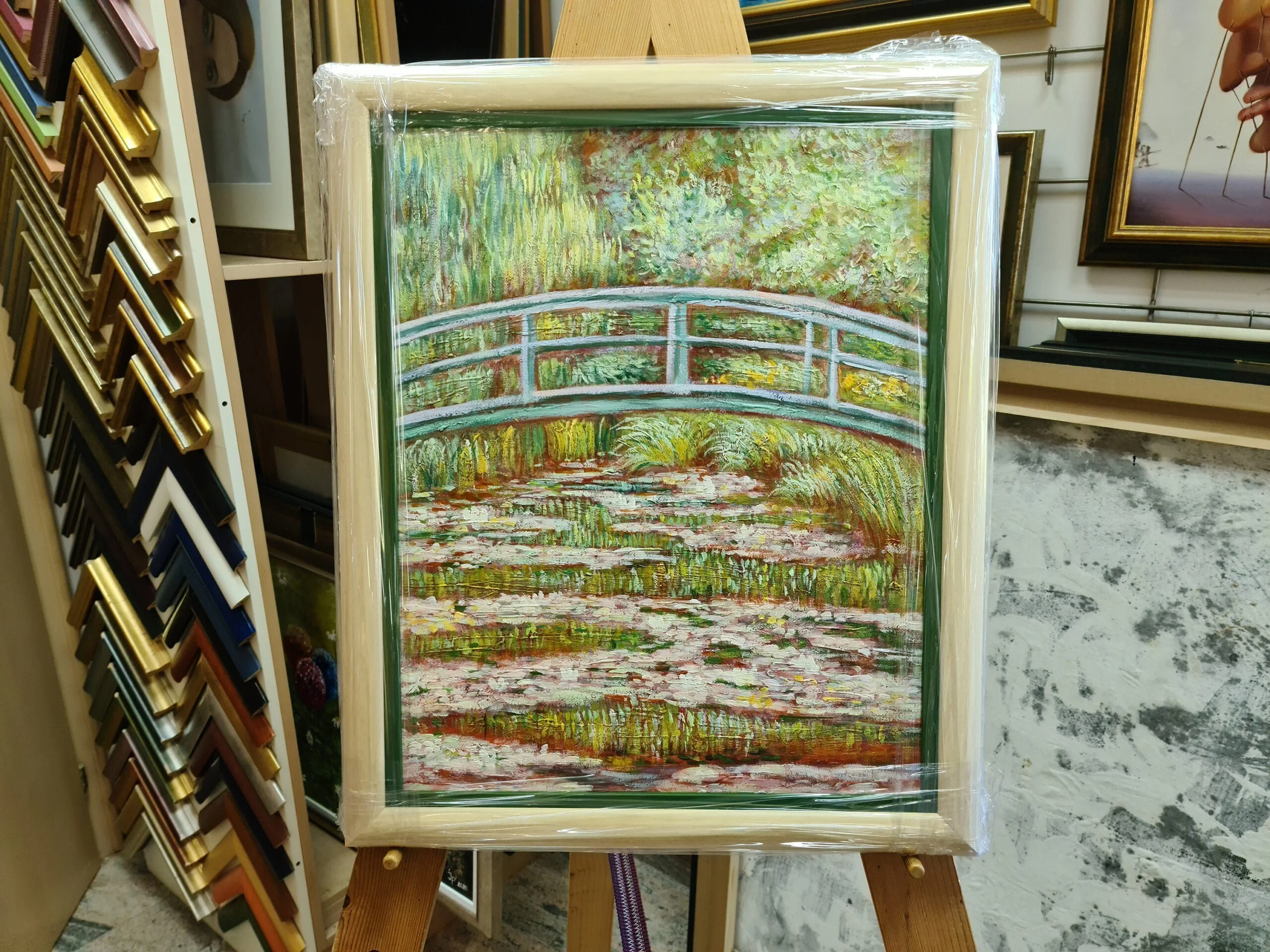
| Title: | The Water Lily Pond (Japanese Bridge) |
| Other titles: | Bridge over a Pond of Water Lilies · Le Bassin aux nymphéas |
| Painter: | Claude Monet (1840–1926) |
| Year painted: | 1899 |
| Original size: | 73.7 cm x 92.7 cm |
| Original technique: | Oil on canvas |
| Painting style: | Impressionism |
| Located at: | Metropolitan Museum of Art, New York (inv. no. 29.100.113) |
| Our reproduction: | Hand-painted oil on canvas, eight sizes from 40 x 50 to 150 x 190 cm or made to measure |
The Water Lily Pond (Japanese Bridge) is Monet’s garden subject of 1899: the arc of a wooden footbridge spans the upright canvas, a dense wall of foliage above it and the pond below, scattered with lily pads. There is no sky in the work. The original is held by the Metropolitan Museum of Art in New York under accession number 29.100.113 and listed as oil on canvas, 73.7 x 92.7 cm. We make it as a hand-painted reproduction in oil on canvas, in eight sizes or to your own measurements, with a photograph of the finished work sent to approve before dispatch.
The Water Lily Pond (Japanese Bridge), 1899 – Claude Monet
What is the painting of?
The water garden Monet laid out at Giverny, and the wooden footbridge he had built across it. No people appear in the scene. The museum record lists the work as Bridge over a Pond of Water Lilies and dates it to 1899 — the year Monet painted this bridge over and over, from the same spot and at different hours. So this is a garden, not a landscape: a subject the painter planted for himself and then painted for the rest of his life.
What is on the canvas?
The canvas is upright, and there is no sky on it. The top third is closed by a dense wall of foliage — yellow-green, ochre and pale pink strokes falling from above like a curtain; on the left the long hanging strands of a willow can be made out among them. Across that wall, in a shallow arc, runs a wooden bridge with a pale green-grey railing: two horizontal rails and between them a close row of short uprights. The arc rises towards the middle and both ends run off the edge of the canvas, so you cannot see where the bridge begins or ends. Below it lies the pond. The lily pads are painted as short horizontal dashes in cream, white and green, stacked into bands that widen towards the bottom edge. Clumps of iris and grasses rise along both banks in upright yellow-green strokes. The lower part of the water is darker, with red-brown and green reflections.
Why does this painting matter?
Because here the bridge is a horizontal tie, not a crossing. Both ends are cut by the edge, so it leads nowhere: it holds the foliage above and the water below together. With no sky and no horizon there is no depth in the usual sense either — space comes only from the pads being larger and further apart at the bottom and small and crowded at the top. As an impressionist painting it is therefore built rather than observed: the horizontals of the bridge and the bands of pads run parallel, and the upright clumps at the banks interrupt them. It was this subject that led Monet to the late water lilies, where the bridge disappeared and only the surface remained.
Why does the accession number start with 29?
Because the work did not come to the museum straight from the studio. According to the museum record the canvas belongs to the H. O. Havemeyer Collection, bequeathed to the museum by Louisine Havemeyer in 1929 — hence accession number 29.100.113, which opens with the year of the bequest, thirty years after the painting was made. The Havemeyer gift is one of the largest in the museum’s history, and it brought this bridge to New York. The work hangs today in Gallery 819.
Which of Monet’s Japanese bridges is this?
Monet painted the same bridge more than once, so it helps to know which canvas you are looking at. This is the upright version of 1899, 73.7 x 92.7 cm, with no sky and both ends of the bridge cut by the edge — the one in the Metropolitan Museum. From the same year there is also a landscape-format version, The Water-Lily Pond in the National Gallery, London, which measures 88.3 x 93.1 cm and is almost square: the same bridge, the same year, a different format and a different museum. The same pond without the bridge, as surface alone, is Water Lilies; seen from the bank it is The Water Lily Pond. How far Monet later broke the subject down into pure colour is shown by Blue Water Lilies and The Water Lilies – Green Reflections.
How is our hand-painted version made?
The painter works with a brush and oil colour, not a printer, and builds the canvas in two applications: first the foliage and the water in dense short touches, then the railing of the bridge as a thin, almost smooth stroke over them. In the first photograph under the description the finished work stands on the easel in our workshop, framed in a pale natural-wood moulding with a green inner edge and already wrapped in protective film for dispatch — exactly as it leaves the studio. That difference in application is what a print cannot give: an impression lays the colour in an evenly thin film, so foliage, railing and water come out equally smooth and nothing lights up before anything else as you walk past. Each copy is made separately, so a hand-painted copy is always a work of its own, and every oil painting reproduction is photographed in daylight before dispatch.
Which size for which wall?
If you are unsure: 73 x 92 cm. That size is the closest to the original, which measures 73.7 x 92.7 cm, and is therefore the most faithful choice. The format is upright, roughly 4 : 5. 40 x 50 cm and 50 x 60 cm suit a hallway or a narrow wall between doors; 60 x 70 cm is the usual size above a chest of drawers; 80 x 100 cm and 90 x 110 cm are balanced over a sofa or a bed; 120 x 150 cm and 150 x 190 cm are meant for tall walls, where the bridge spans the whole width. Because the top third is darker and denser, this kind of canvas painting hangs better a little higher, so the weight of the foliage does not fall at eye level. As impressionist wall art it lives best on a light, quiet wall with no pattern. This Monet reproduction brings green into a room without cooling it, which is why it works as a painting for living room walls.
How high to hang the painting: centre at eye level, roughly 145–150 cm from the floor — with this upright format rather a little higher, so the weight of the foliage does not sit at eye level.
Made to measure, stretcher and frame
If none of the eight sizes fits your room, we paint the work in the size you specify; that is our painting made to order. We keep the ratio of the sides, so the arc of the bridge stays whole. Every copy arrives stretched on a wooden bar frame and ready to hang. For the frame, use our 3D application: on this subject it shows all our mouldings, so you can compare gold, silver, black, white and natural wood before deciding — it is for choosing the frame only and does not show the work in your room. If you want to see how it will look on your wall, that is our separate room-placement service.
Delivery and guarantee
Every copy is made to order in our studio in Slovenia, so allow 15 to 45 days, depending on the size. We ship it stretched and protected for transport, framed if you chose a frame, within Slovenia and the EU with no customs. Before dispatch you receive a photograph of the finished work to approve, and every order is covered by our returns policy. The full range is in the Claude Monet gallery, the painter’s path in the article on Claude Monet.
If the painting is a gift and you are unsure of the size, there is a wall art voucher: the recipient chooses the size and the subject.
Frequently asked questions
Where is the original?
At the Metropolitan Museum of Art in New York, accession 29.100.113, in the H. O. Havemeyer Collection: oil on canvas, 73.7 x 92.7 cm, on view in Gallery 819.
What year is it from?
1899. The museum gives that year without qualification, so we give it without qualification too.
How many times did Monet paint the Japanese bridge?
Many times. According to the Metropolitan Museum, in 1899 he began eighteen views of the footbridge over the pond and finished twelve of them that summer, this canvas among them.
Why did Monet paint the Japanese bridge?
Because it was his own: he had the wooden Japanese-style footbridge built over the pond he dug in his garden at Giverny, and from 1899 he painted it again and again.
Where did Monet paint the bridge?
In his own garden at Giverny in Normandy, from the bank of the water-lily pond he had dug across the road from his house.
Is the original for sale, and what is it worth?
No. The original is in a museum collection and is not for sale, so it has no market price. Monet’s major canvases are among the most expensive paintings ever sold at auction: one of his Haystacks paintings (Meules, 1890) sold at Sotheby’s in May 2019 for 110.7 million dollars.
- Subject: the wooden bridge over the pond at Giverny, no sky, both ends of the bridge cut by the edge, 1899.
- Original: 73.7 x 92.7 cm, oil on canvas, Metropolitan Museum of Art, New York (inv. 29.100.113), Gallery 819.
- Our version: hand-painted oil on canvas, eight sizes from 40 x 50 to 150 x 190 cm; 73 x 92 cm is the closest to the original.
- Worth knowing: a landscape-format version of the same year hangs in London — the same bridge, a different format.