







































Description
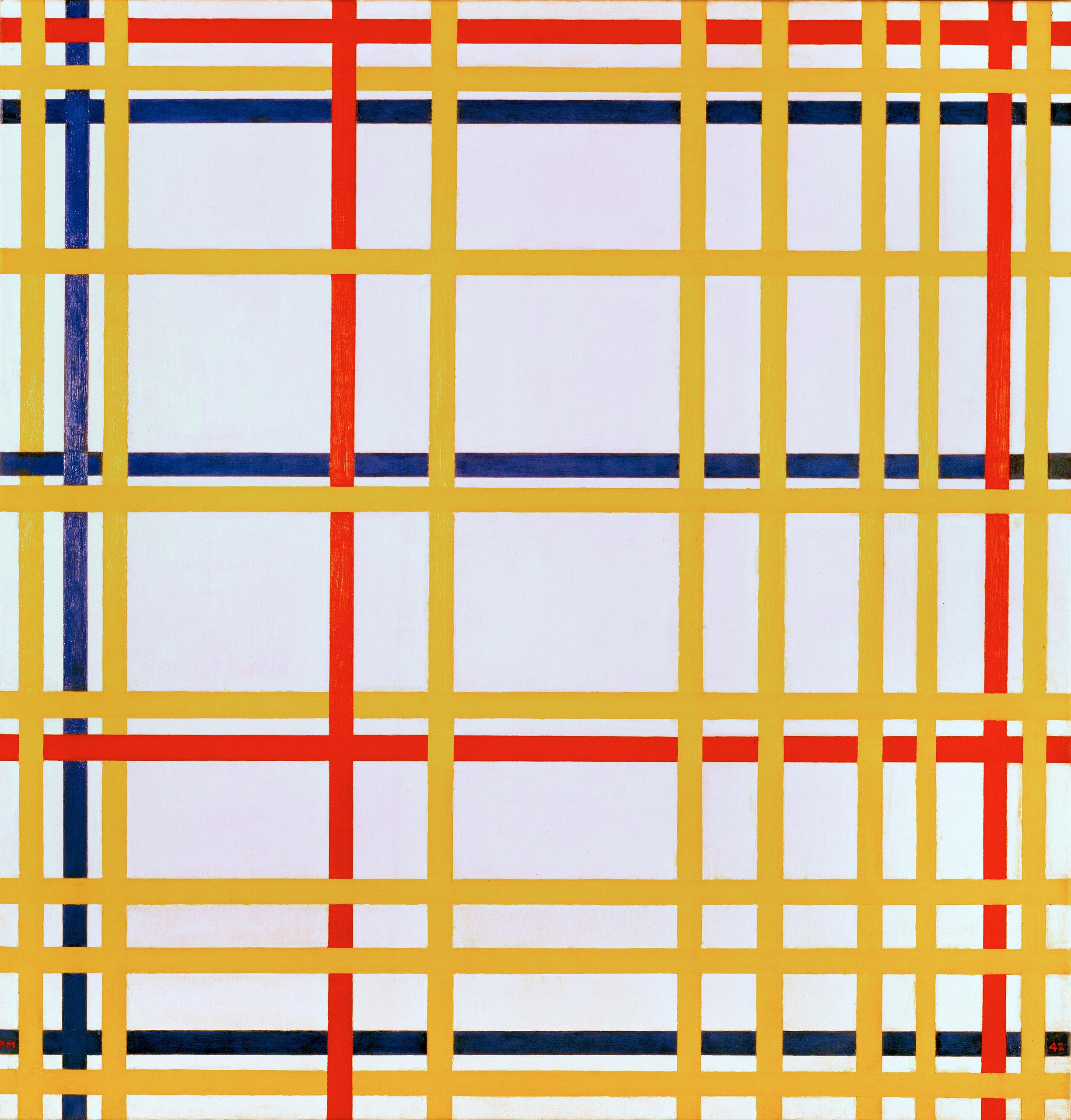
New York City is a painting by Piet Mondrian from 1942, made two years after he arrived in New York: there is not a single black line in it; yellow lines cross the white canvas from edge to edge, and a few red and blue ones weave through them like the streets and traffic of a great city. The original, oil on canvas, is 119.3 cm high and 114.2 cm wide and belongs to the Centre Pompidou in Paris. Our painter paints it for you by hand in oil on canvas, in 8 sizes from 35 x 35 to 190 x 200 cm or to your own measurement, and you see a photograph of the finished painting before it is dispatched.
| Title: | New York City |
| Other titles: | New York City, 1942 · New York City (Centre Pompidou) |
| Painter: | Piet Mondrian (1872–1944) |
| Year painted: | 1942, New York |
| Original size: | 119.3 cm x 114.2 cm (height x width) |
| Original technique: | Oil on canvas |
| Painting style: | Neoplasticism (De Stijl), abstract painting |
| Located at: | Centre Pompidou, Musée national d’art moderne, Paris (acc. no. AM 1984-352) |
| Our reproduction: | Hand-painted oil on canvas, 8 sizes or made to measure |
New York City – Piet Mondrian
What do you see in New York City?
A white, almost square canvas crossed by nothing but straight lines, every one of them horizontal or vertical. Most are yellow and run across the whole surface, so they are what the eye picks up first. Some sit close together, others leave wide white bands between them, and it is this change between crowded and empty that gives the painting its pulse.
Among the yellow lines run a few red and blue ones. They do not simply lie on top: at one crossing a red line passes over the yellow, at the next it seems to slip underneath, as if the lines had been woven like threads. There are no coloured fields, no filled squares and no black anywhere.
Near the bottom Mondrian left two small marks: the monogram PM at lower left and the year 42 at lower right, as the museum records.
What did Mondrian want to say with it?
Piet Mondrian (1872–1944), the Dutch painter who had lived for many years in Paris and from 1938 in London, came to New York in 1940. The city struck him hard: the giant buildings, the regular grid of streets and the constant rush of traffic.
According to the Centre Pompidou, the right-angled structure of the painting translates exactly that. Instead of the black grid of his earlier years he now draws with coloured lines, and the density of crossing blue, yellow and red lines over the whole surface expresses the new energy he found in America.
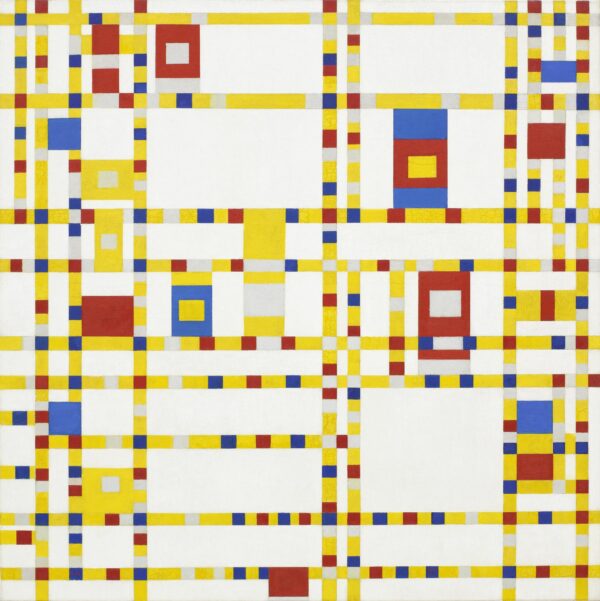
Music had its part too. Mondrian loved boogie-woogie, the fast piano style, and the museum hears its frantic rhythm in the beat of the lines. The same music gave its name to Broadway Boogie Woogie, which he completed a year later.
Why does this painting matter so much?
For two decades Mondrian had built his compositions on black lines and fields of red, blue and yellow. Here the black disappears and the colour moves into the lines themselves. That turn marks his last years in New York; he died in the city in 1944.
The painting holds together opposites that work as one: strict geometry and a lively rhythm, only three colours and yet a sense of depth where the lines cross. The Wikipedia article (in English) sums up the background of New York City.
Where is the original, and how did it come to Paris?
In the Centre Pompidou, in the Musée national d’art moderne in Paris, inventory number AM 1984-352. The museum bought it in 1984 with the support of the Scaler Foundation.
Do not confuse it with New York City I in Düsseldorf, held by the Kunstsammlung Nordrhein-Westfalen. That is an unfinished version made of strips of coloured tape, and in 2022 it was found to have hung upside down for decades.
Our hand-painted copy follows the finished work in Paris, not the Düsseldorf version.
New York City or another Mondrian?
This one is for someone who loves the city, architecture or jazz, and for a modern room with white walls: a Scandinavian or minimalist home, an office, a reception area. Because it is light and airy, it does not weigh down even a small room.
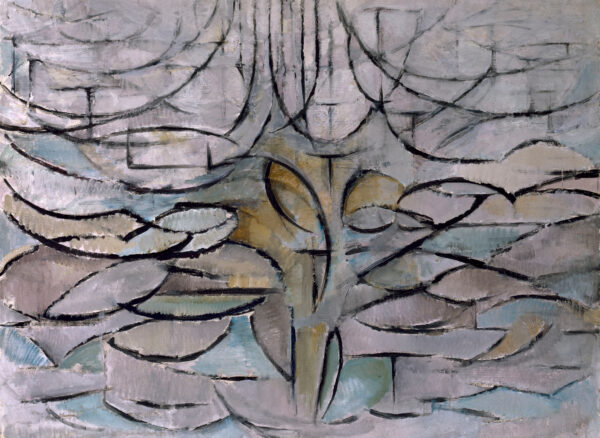
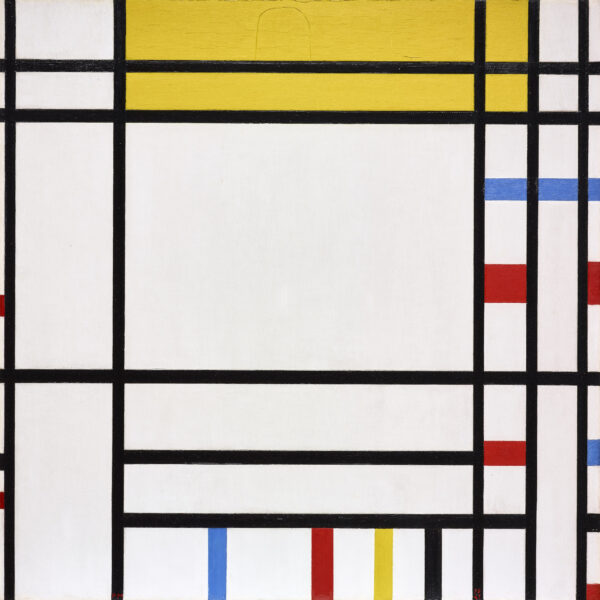
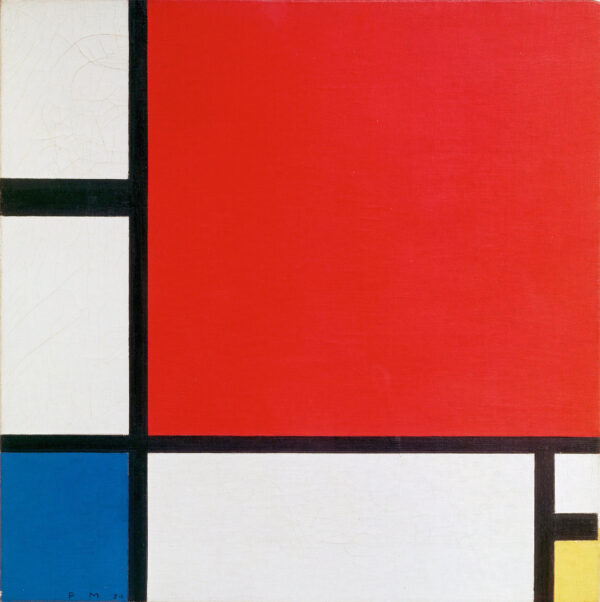
The black grid is still there in Place de la Concorde, which Mondrian began in Paris and finished in New York. The classic Mondrian with a large red square is Composition II in Red, Blue and Yellow from 1930, and for a softer early work there is Blossoming Apple Tree.
The rest of the famous Mondrian paintings in our range, each one painted when you order it, wait on the Piet Mondrian page.
How does our painter paint your New York City?
A painting made only of lines looks easy and forgives nothing. Every line has to be straight, of even width and at the right distance from its neighbours, or the rhythm falls apart. So the painter first transfers the proportions from the original to the canvas: the position and width of each line are measured, not guessed.
Then he masks the edges and lays the white ground and the colours in several thin, even coats, layer by layer in oil on canvas, so that the surface stays flat and the edges crisp. At every crossing he follows the original as to which line runs over and which runs under.
A Mondrian reproduction made this way keeps the slight sheen and texture of oil paint; a print on paper or canvas cannot give the yellow the same depth. A painting like this stands or falls on that yellow, which has to be equally full from one end of the canvas to the other.
Which size for which wall?
In short: 35 x 35 or 43 x 47 cm for a shelf, a desk or a narrow wall, 60 x 60 or 70 x 70 cm for a hallway or above a chest of drawers, 90 x 90 or 110 x 120 cm above a sofa or a bed, and 150 x 150 or 190 x 200 cm for a large white wall or an office.
There are 8 sizes (width x height): 35 x 35, 43 x 47, 60 x 60, 70 x 70, 90 x 90, 110 x 120, 150 x 150 and 190 x 200 cm. Five are exactly square, while 43 x 47, 110 x 120 and 190 x 200 cm are, like the original, slightly taller than wide. Closest to the original is 110 x 120 cm: 4.2 cm narrower and 0.7 cm taller.
As a painting for the living room, hang 90 x 90 or 110 x 120 cm centred above the sofa, about 20 to 30 cm above the backrest. Lines need room to breathe, so keep the wall around it clear.
Can I have another size or a frame?
Yes. Because the original is almost square, a custom size fits easily into an alcove or the wall between two windows; we keep the distances between the lines in proportion so that the rhythm stays the same. Send us the width and height you need, and we will quote a price and a delivery time.
We send it rolled, stretched on a stretcher bar or framed; our workshop in Slovenia does the stretching and framing, as it does for every canvas painting we ship. Try frames for the yellow lines in our 3D application, which exists only for frame choice; a view of New York City on your own wall is a separate service.
When will the painting be with me?
We start on New York City as soon as your order arrives; it is ready for dispatch within 15 to 45 working days. Before it leaves we send you a photograph of the finished painting, and if you would like something changed, we change it.
Within Slovenia and to every other EU country it travels without customs, and our returns policy applies to every order.
For a friend who has lived in New York or dreams of going there, it is a gift with a story behind it. If the size should be their choice, a wall art voucher leaves it open.
Frequently asked questions
Where can I see the original?
In the Centre Pompidou in Paris, in the Musée national d’art moderne, inventory number AM 1984-352.
Is this the painting that hung upside down?
No. That was New York City I in Düsseldorf, an unfinished version in coloured tape. Ours follows the finished work in Paris.
Why are there no black lines?
In New York Mondrian replaced the black grid with coloured lines, mostly yellow, with a few red and blue ones.
Is it a print?
No. It is an oil painting reproduction, every line laid on the canvas with a brush.
How big is the original?
It is 119.3 cm high and 114.2 cm wide; our closest size is 110 x 120 cm.
Which size suits the wall above a bed?
Above a double bed, choose 90 x 90 or 110 x 120 cm and hang it centred.
Does it suit an office?
Yes. The clean lines suit offices, meeting rooms and minimalist spaces; for a large wall, choose 150 x 150 cm.
How long does it take?
From 15 to 45 working days until dispatch; before that you receive a photograph of the finished painting.
- Subject: yellow, red and blue lines cross on a white ground, with no black anywhere.
- Original: 1942, oil on canvas, 119.3 x 114.2 cm, Centre Pompidou, Paris.
- Ours: painted by hand in oil on canvas, in 8 sizes from 35 x 35 to 190 x 200 cm or made to measure.
- Worth knowing: the museum bought it in 1984 with the support of the Scaler Foundation.