



















Description
Harlequin – when the painter takes away his son’s face
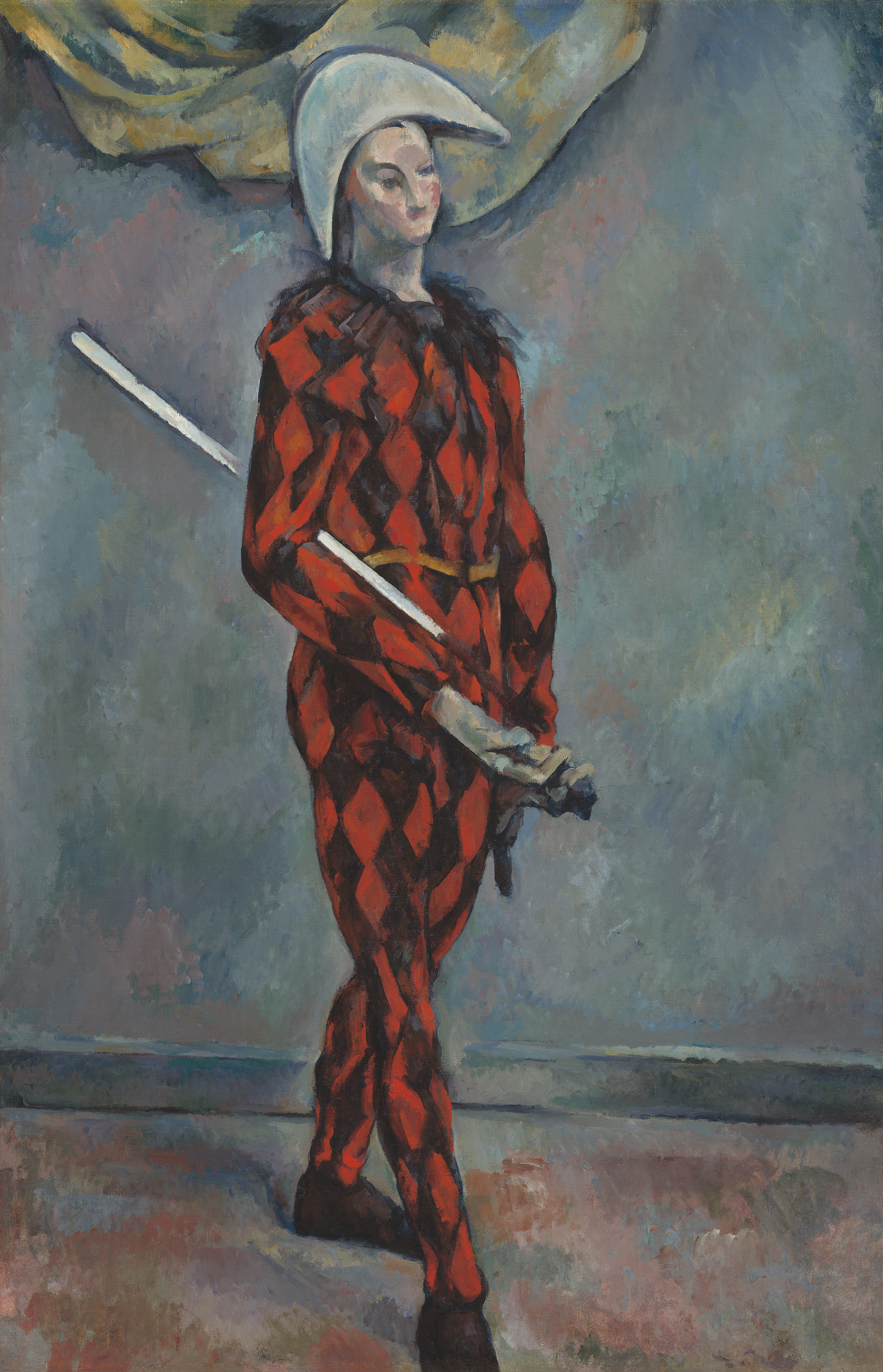
Harlequin stands alone in front of a grey-blue wall, in tights of red and black diamonds, a white crescent-shaped hat on his head and a slender baton in his hand. The canvas measures 101 × 65 cm, was painted between 1888 and 1890, and is held by the National Gallery of Art in Washington (inv. 1985.64.7). The painter’s son Paul sat for it. With us it is painted in oil; every hand-painted painting on canvas is made specifically for the order.
The face that became a mask
In Mardi Gras, from the same years, Cézanne still gave his son’s face as a portrait: recognisable, soft, with an expression of its own. In Harlequin he replaces it with an unmoving mask. This is not hesitation but the next, more abstract stage of the same theme: first the father paints the son, then he takes the likeness away until only a figure in costume is left. Harlequin is therefore not the portrait of a boy but a rendering of solitude.
A figure that refuses to stand straight
Linger on the pose and the harlequin seems to be sliding away: the body is turned and tipped forward, the baton cuts the scene on a diagonal, the forward foot is larger than you would expect. Cézanne stretched and tilted the figure because what concerned him was balance on the canvas, not anatomical correctness. That is exactly why the work looks tense although nothing in it is happening.
Four costume canvases
Harlequin belongs to a group of four costume canvases from 1888-1890: besides Mardi Gras, where harlequin and pierrot appear together, Cézanne painted three further versions of the harlequin figure alone. The canvas passed from the dealer Ambroise Vollard to the painter Émile Schuffenecker and the collector Auguste Pellerin, later into the American collection of Paul Mellon, who gave it to the Washington gallery in 1985.
At home Harlequin earns its place precisely through the upright format: it sits well in a narrow alcove, beside a door, or between two windows, where a landscape canvas would look squeezed. The red is strong, so the scene carries quieter furniture around it. The fifteen formats run from 42 × 65 cm to 116 × 180 cm; if you need a measurement in between, we stretch the canvas to a custom size. How the figure sits inside a frame is shown by our 3D preview application. If among our reproductions on canvas other Cézanne figures interest you, look at Mardi Gras (Fastnacht), Boy in a Red Waistcoat and Boy with Skull.
- Subject: Harlequin, Paul Cézanne, 1888-1890, National Gallery of Art, Washington (1985.64.7)
- Technique: hand-painted painting, oil on canvas, reproduction
- Sizes: 15 upright dimensions, custom size on request
- Of note: the painter’s son sat for it, yet the face ended up as a mask