








Description
Milk Can and Apples – the catalogue knows which room it was painted in
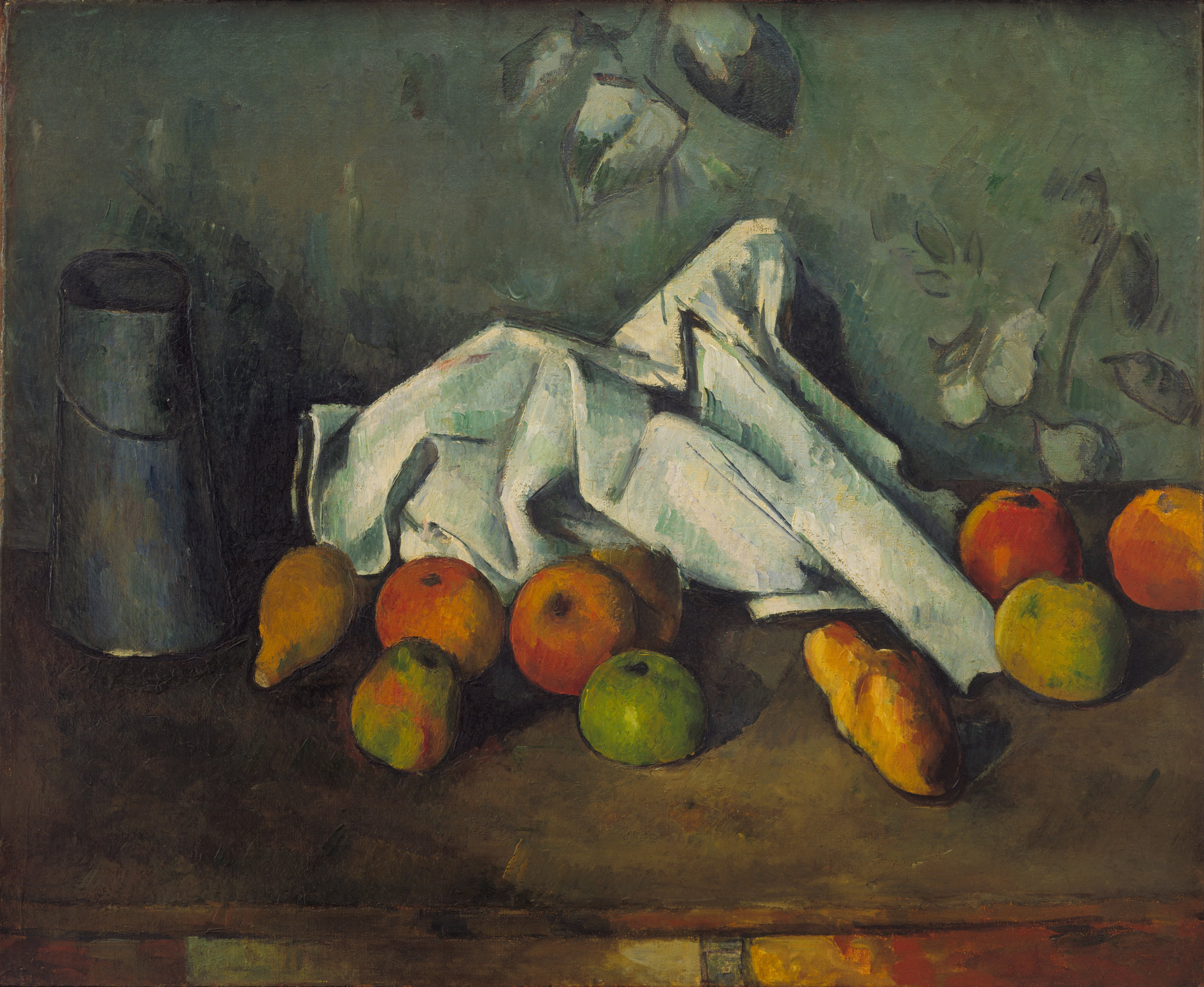
At the left stands a tall cylindrical milk vessel, blue-grey, with a flat lid and a dark seam down its side. The centre is held by a white napkin, folded into sharp edges that do not fall but stand upright. Apples are spread across the dark brown table – red, orange-red, green and yellow-green – with a pear lying at the front left and a second, larger and yellow-orange, at the right. The canvas measures 50 × 61 cm, was made between 1879 and 1880 and is held by the Museum of Modern Art in New York (the William S. Paley Collection). Every copy is painted afresh by a painter; a hand-painted painting on canvas, oil on canvas, stretched over a solid stretcher frame.
An address written into the catalogue
For this canvas the catalogue raisonné fills in a field that stays empty for most entries: the studio. The address recorded is 2, place de la Préfecture, Melun. The entry therefore says not only when the work was made but in which room the table of fruit stood. And the address agrees with the date: Cézanne was working at Melun in exactly those years, so the dating and the room confirm one another – which is a rarity, because with this painter the sources more often diverge than coincide.
The wallpaper and the chest
Among the motifs the catalogue lists, besides the fruit and the napkin, two things that surprise in a still life: a floral wallpaper and a wooden chest. The wallpaper really is visible on the canvas – pale outlines of leaves and blossoms run across the blue-green wall, painted so lightly that you notice them only once you look for them. Along the bottom edge, meanwhile, runs a band of vivid red, yellow, green and blue patches. What exactly that band is the catalogue does not say; it records only that a wooden chest was among the furniture of the room. In short: the background of this still life is not invented, it is the furnishing of a rented room.
The napkin that stands like paper
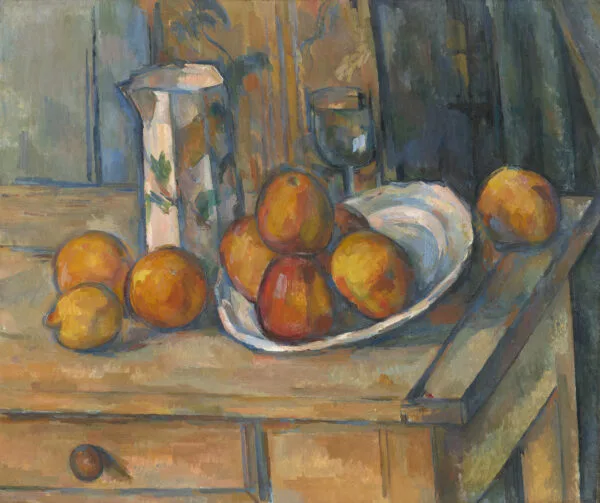
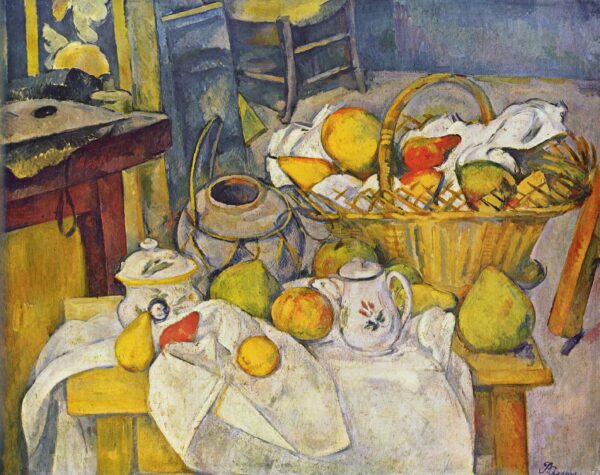
The strangest object on the canvas is the napkin. Cézanne did not paint it as cloth falls, but as though it were folded paper: the peaks are sharp, the faces flat, the shadows between them cleanly cut. It is this hardness that makes it the third support of the work, alongside the vessel and the table. A milk vessel of a different shape you will also meet in Still Life with Milk Jug and Fruit, and the apples in this arrangement in The Basket of Apples.
The work is built on three dark bands – the wall, the table and the shadow beneath the fruit – between which only the napkin and the fruit shine. It therefore carries weaker light well and does not demand a strong wall: it works in a kitchen, a dining room or a café. The fifteen sizes run from 50 × 41 cm to 180 × 148 cm; intermediate measurements we stretch to custom size on the stretcher frame, and how it will look framed is shown by our 3D rendering application. If you want a second table to go with this one, among our reproductions of famous paintings it is Fruit and a Jug on a Table.
- Subject: Milk Can and Apples, Paul Cézanne, 1879-1880, Museum of Modern Art, New York
- Technique: hand-painted painting, oil on canvas, reproduction
- Sizes: 15 dimensions, custom size on request
- Of note: the catalogue names the studio too – 2, place de la Préfecture, Melun