


Description
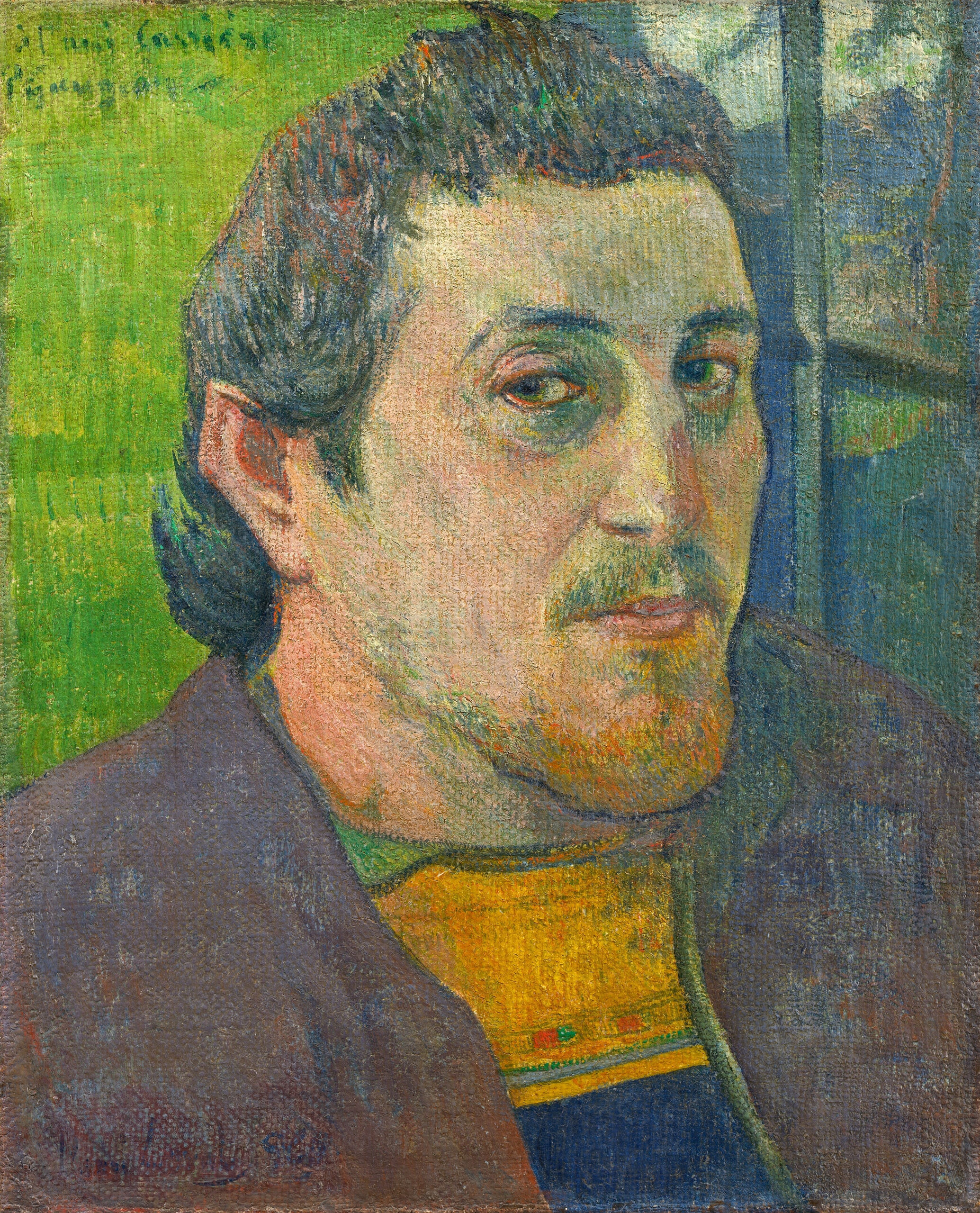
Self-Portrait Dedicated to Carrière – a painter who does not return the look
Head and shoulders take up almost the full height of the canvas. The painter is turned three-quarters to the right in a dark violet jacket, under which a strong yellow garment appears, with a narrow band of small coloured squares across the chest. The ground is divided vertically: an area of sharp green on the left, a blue-grey strip on the right that reads as a window frame, with a lighter zone behind it. A dedication is written into the canvas at the upper left, and a second, reddish inscription stands at the lower left. The work is held by the National Gallery of Art in Washington under inventory number 1985.64.20, as oil on canvas; the museum dates it “1888 or 1889” and does not narrow it to a single year.
The eyes pass by us
A self-portrait is made in front of a mirror, which is why the painter usually looks straight out at the viewer, as he was looking at himself. Not here. The head is turned, the pupils are pushed towards the right-hand edge of the eye, and they pass by us towards something outside the canvas. Sitter and viewer meet at no point.
The ground is two areas
There is no space behind him, only two areas of colour meeting without transition. The left is green and almost even, the right blue-grey and divided by verticals. Neither explains where the painter is standing, yet both cut the outline of the head sharply out of the picture.
The green of the ground returns in the face
The same green that fills the left half of the ground also lies in the shadow under the eyes, at the temple and along the jaw. The skin is therefore not mixed on its own account but out of the colour standing behind it. That is exactly why the face looks paler from a distance than it is close up.
The yellow garment and its band of squares
The lightest area on the canvas is not the face but the yellow garment under the jacket. A narrow band of small red, green and blue squares runs across the chest. That tiny row is the only ornamental motif in the picture and the only place where the colours meet at so small a scale.
How a hand-painted reproduction is made
Every painting here is made by hand, stroke by stroke. In this motif the skin is the hardest part: the green in the shadows has to stay visible, or the face turns brown and loses its connection to the ground. Before dispatch you receive a photograph of the finished work for approval. Everything here is painted by hand on canvas and never printed.
- Subject: the painter’s head and shoulders before a green area and a blue-grey one.
- Technique: oil on canvas, green shadow in the skin and a yellow garment under the dark jacket.
- Sizes: portrait format, from 42 x 50 cm to 164 x 200 cm; 75 x 90 cm and 90 x 110 cm are often chosen.
- Of note: in this self-portrait the painter does not look at the viewer but past them.
Other heads and figures on this shelf: Self-portrait (Near Golgotha), Portrait of Madeleine Bernard and Still Life with Profile of Laval. The museum gives the measurement as height by width: 46.5 x 38.6 cm.