







































Description
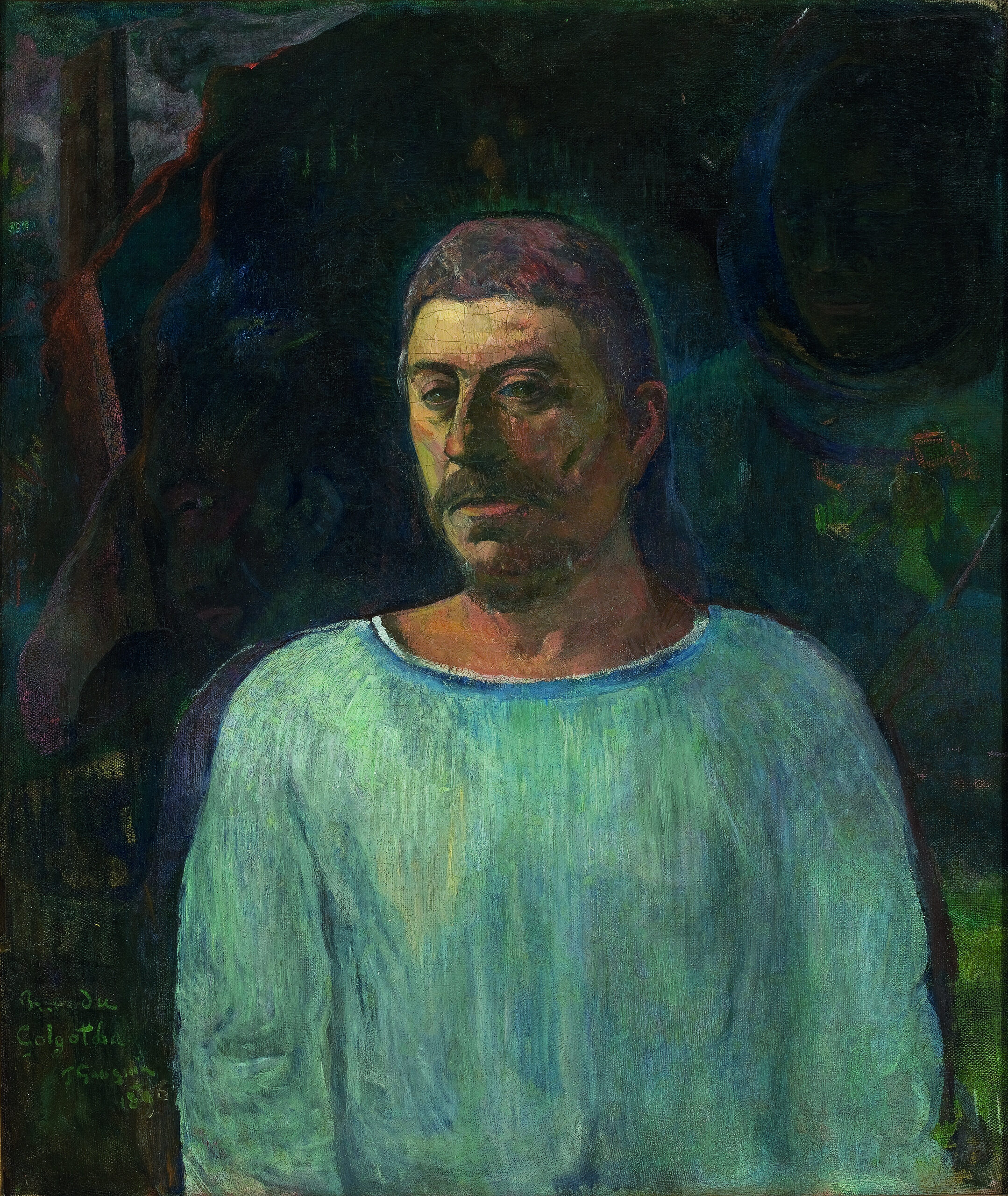
Self-portrait (Near Golgotha) – the dark behind him never resolves
The painter is shown to the waist, turned slightly to the left, in a loose pale shirt with a rounded neck opening. The face is gaunt, with a moustache and a high forehead, and the eyes stay in shadow. The shirt is the only light area on the canvas; everything else is blue-green and dark. At the lower left an inscription and, below it, a signature with a year are painted onto the canvas in pale green. The work is held by the Sao Paulo Museum of Art under inventory number MASP.00108; it was painted in 1896.
What lies behind him cannot be made out
The ground is not an empty wall. In the upper right corner there is a dark oval form in which something like a face appears; along the left edge runs a reddish vertical stroke, and below it a mass that could be a figure or a rock. None of these shapes can be identified with any confidence. Nor do we try to name them: describing what can be seen is not the same as settling what it is. It is precisely that uncertainty which gives the painting its tension.
The shirt carries all the light
The pale shirt takes up the lower half of the canvas and is the one place the light falls. It is painted in vertical strokes of pale blue, green and yellowish tones that never merge into a white. Because the face above it stays in shadow, the eye falls on the cloth first and only afterwards on the eyes.
The museum was given it in 1952
The museum record states that the canvas was not bought but given. It lists four donors by name, and the year of the gift is 1952. The painting therefore reached Brazil as a private gift rather than through a purchase by the museum.
The inscription on the canvas
At the lower left a text and a signature with a year are painted onto the canvas itself, in a green lighter than the ground. They are written by hand, and are neither printed nor added later onto the frame; they belong to the painted surface.
How a hand-painted reproduction is made
Every painting here is made by hand in oil on canvas, stroke by stroke. In this motif the ground is the hardest part: the dark has to stay alive and must not become an even black area, or the very shapes the painting depends on are lost. Before dispatch you receive a photograph of the finished work for approval. Nothing on these pages is printed; the colour is mixed and laid on again for each canvas.
- Subject: the painter at half length in a pale shirt against a dark blue-green ground.
- Technique: oil on canvas, a single light area in the dark.
- Sizes: portrait format, from 42 x 50 cm to 164 x 200 cm; 75 x 90 cm and 90 x 110 cm are often chosen.
- Of note: the museum received the work as a gift in 1952, not by purchase.
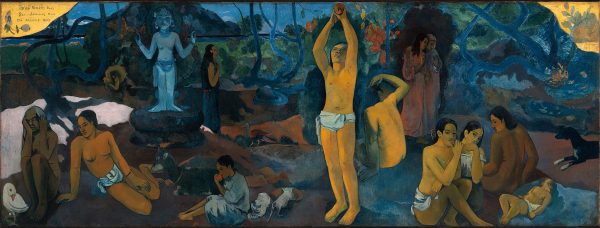
From the same late years, see also Portrait of the Artist with the Yellow Christ, Nevermore (O Tahiti) and Where Do We Come From? What Are We? Where Are We Going?. The museum record gives the measurement as height by width: 75.5 x 63 cm.