







































Description
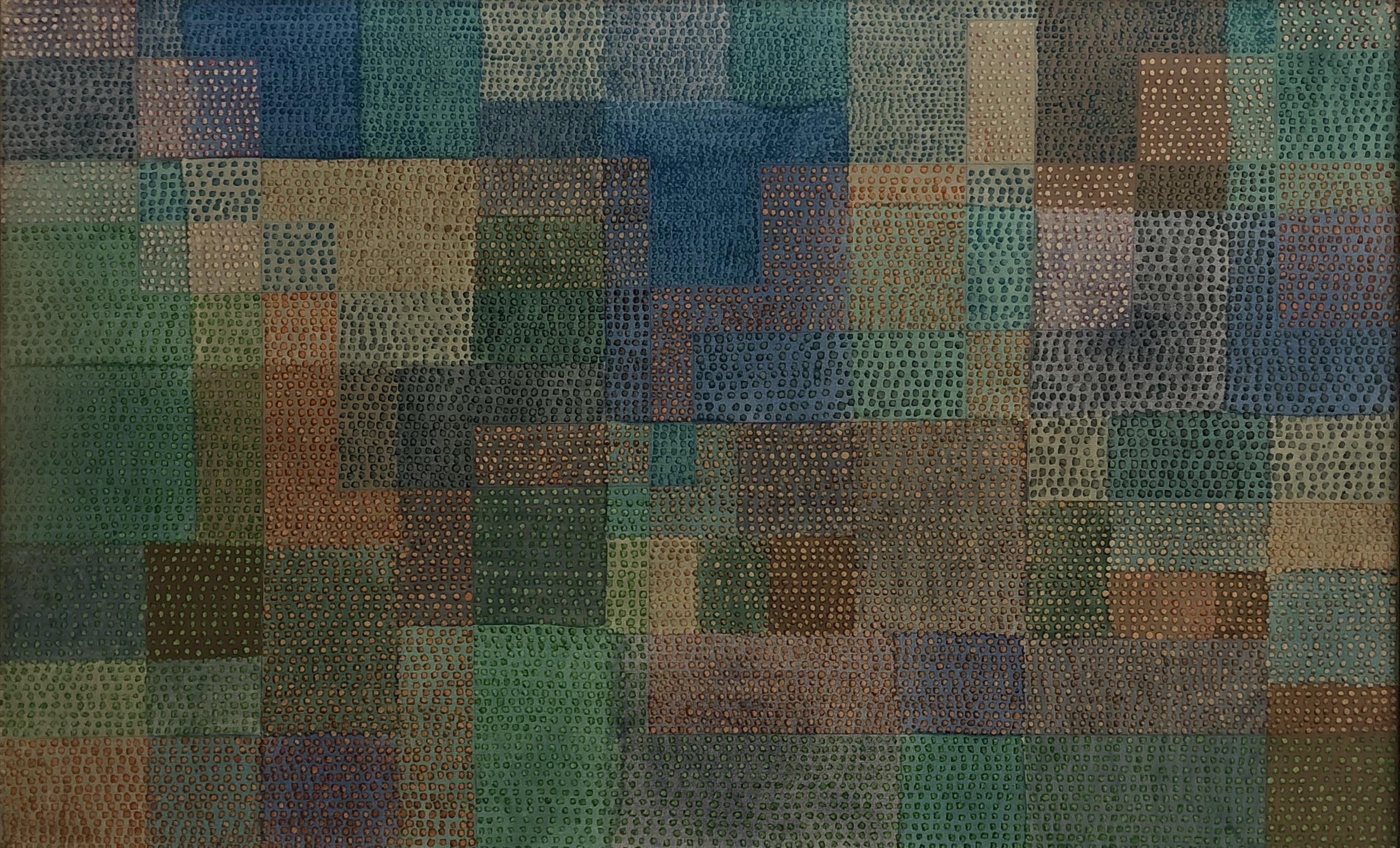
Polyphony is a painting by Paul Klee from 1932: soft rectangles of blue, teal, green, ochre and plum overlap and sit side by side, and across them thousands of tiny dots run in rows. The original is tempera on linen, 66.5 x 106 cm, held by the Kunstmuseum Basel (Emanuel Hoffmann Foundation). Our painter paints it for you by hand on canvas, in oil or acrylic, in 4 landscape sizes from 110 x 72 to 200 x 130 cm or made to measure. When it is finished, we send you a photograph of it before dispatch.
| Title: | Polyphony |
| Other titles: | Polyphonie (German title) · Polifonia (Italian title) |
| Painter: | Paul Klee (1879–1940) |
| Year painted: | 1932 |
| Original size: | 66.5 cm x 106 cm (height x width) |
| Original technique: | Tempera on canvas |
| Painting style: | Modernism |
| Located at: | Kunstmuseum Basel, Basel, Switzerland |
| Our reproduction: | Hand-painted in oil or acrylic on canvas, 4 sizes or made to measure |
Polyphony – Paul Klee
What does Polyphony show?
Polyphony has no figure and no horizon. The whole surface is covered by a grid of rectangles and squares of different sizes: some deep blue, others teal, green, sandy ochre, brownish or a muted plum. The edges are not sharp, and here and there the colours melt into one another, as if transparent layers had been laid one on top of the next.
Over this coloured ground Klee set thousands of small dots. They stand in more or less regular rows, but the rows are not ruler-straight: they ripple slightly, crowd together and thin out again. On the dark fields the dots are often light, orange or pink; on the paler ones they turn dark green or blue.
What matters is that the dots ignore the borders of the rectangles. They run straight across the edges as if they had not noticed them, so the painting has two layers, each living its own life: calm fields of colour below, the rhythm of tiny marks above.
What does the title Polyphony mean?
Polyphony is a musical term: two or more independent voices sounding at the same time, each with its own melody, together making a whole.
Klee knew music from the inside. He was the son of a German music teacher and a Swiss singer, and he played the violin from childhood, in an orchestra too. Rainer Maria Rilke felt that his drawings were like transcriptions of music, and English Wikipedia speaks of the polyphonic character of his drawing method between 1920 and 1932.
In this work you can see the idea of several voices almost literally: the coloured rectangles are one voice, the rows of dots another. Each keeps its own beat, yet together they sound like a single piece. This is a reading, not Klee’s own explanation; he never wrote down what he meant.
Why do Klee lovers value Polyphony so highly?
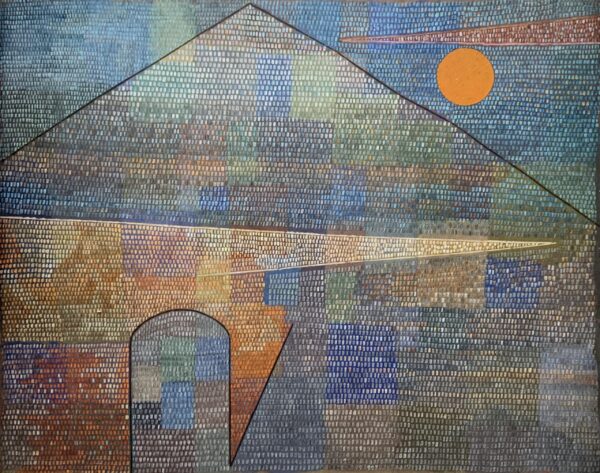
Polyphony belongs to Klee’s dotted works of 1931 and 1932, sometimes called his divisionist works. In the same period he made the well-known Ad Parnassum, built in a similar way from fields of colour with tiny marks on top.
These works are quiet yet rich. They tell no story; they offer a rhythm the eye can wander through again and again.
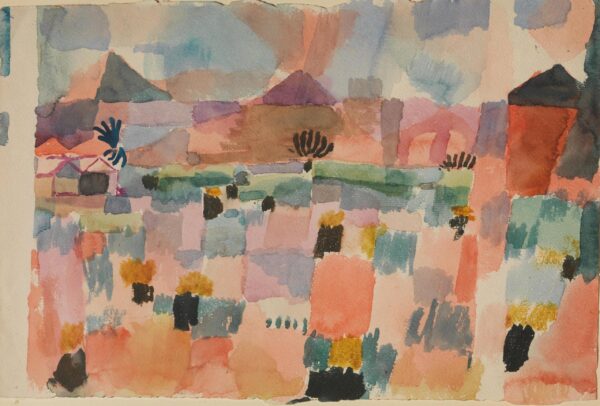
Klee was a Swiss-born German artist shaped by expressionism, cubism and surrealism. The turning point in his use of colour was the 1914 trip to Tunisia with August Macke and Louis Moilliet; from that journey comes Hammamet with Its Mosque, a watercolour full of light.
For more on the painter, see the English Wikipedia article on Paul Klee; it is about the artist, since there is no separate article on this work.
Where is the original kept, and when was it painted?
The original is in the Kunstmuseum Basel in Switzerland, where it belongs to the Emanuel Hoffmann Foundation.
Klee painted it in 1932, during his Düsseldorf years. After the Bauhaus, where he taught alongside Wassily Kandinsky from January 1921 to April 1931, he taught at the Düsseldorf Academy from 1931 to 1933.
The technique is tempera on linen and the format 66.5 x 106 cm (height x width). For Klee, who often worked small on paper, gauze or board, that is a fairly large piece.
Polyphony or another Klee?
Polyphony is a canvas painting for anyone who wants not a scene but a field of colour where the eye can rest.
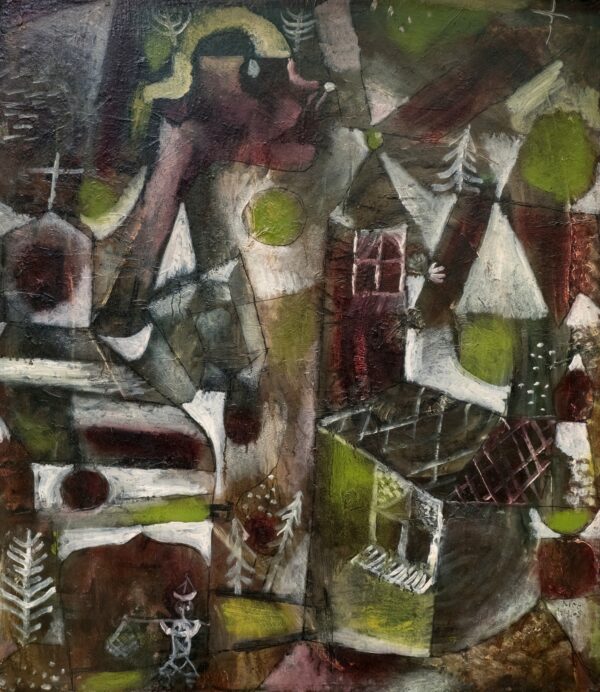
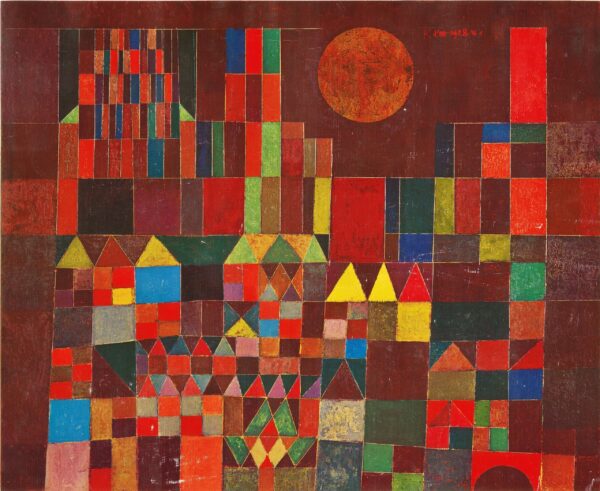
If you prefer recognisable subjects, look at Castle and Sun, a town of small coloured shapes beneath a big sun, or Villa R, with a white villa by a road and a large letter R. For a darker, fairy-tale scene there is Swamp Legend from 1919.
All the famous Paul Klee paintings we paint to order, the related Ad Parnassum among them, are on our Paul Klee page.
How do we hand-paint Polyphony?
First, plainly: Klee’s original is not an oil painting but tempera on linen. Ours is an oil painting reproduction on new canvas, which the painter works in oil or acrylic, building it up layer by layer.
The painting is made in two stages, mirroring how Klee’s composition is built. First the painter divides the canvas into rectangles and covers them with thin, slightly translucent glazes of blue, green, ochre and violet, so that the edges meet softly. Once that layer is dry, he starts placing the dots with the tip of a fine brush, row after row.
There are thousands of dots and each one is made separately, so this is long, patient work. The painter makes sure the rows cross the borders of the fields, as Klee’s do, and that the colour of the dots changes with the ground beneath.
Which size suits which wall?
In short: 110 x 72 cm above a chest of drawers or in a home office, 130 x 80 cm above a sofa or a bed, 165 x 100 cm for a wide empty wall, and 200 x 130 cm for a large living area, a dining room or an entrance hall.
We paint Polyphony in 4 landscape sizes (width x height): 110 x 72, 130 x 80, 165 x 100 and 200 x 130 cm. We do not offer smaller ones, because the thousands of dots need space: on a small surface they would turn into mere noise and the painting would lose its second voice.
The original measures 106 x 66.5 cm (width x height), so it is already large. Our smallest size is only a little wider, the largest almost twice as wide, and at 200 x 130 cm you get a wall of colour that truly fills a room.
As a painting for the living room it is most convincing above a long sofa at 165 x 100 cm, where the blue-green tones calm the space.
Can I order a custom size or a frame?
Yes. Because Polyphony has no central motif, it adapts well to other proportions: at the edge we add or drop a row of rectangles and the grid of dots carries on. With dots this dense we advise keeping the shorter side at 72 cm or more. Send us your custom size and we will reply with a price and a date.
It reaches you rolled, stretched on a stretcher bar or framed. Our workshop in Slovenia does the stretching and framing and packs each painting carefully for transport. You pick the frame in our 3D app, which is for choosing the moulding only; seeing the painting on your own wall is a separate service.
When will my painting arrive?
The painter starts as soon as you confirm the order. Polyphony takes time, but it is ready to ship within 15 to 45 working days. Before packing we send you a photograph of the finished painting, and if you would like anything changed, we see to it.
Within Slovenia and to every other EU country there are no customs duties, and each order is covered by our returns policy.
Polyphony makes a fine gift for a musician, a choir singer or anyone who loves listening to music. If you are not sure which size would suit their home, give them a gift voucher and let them choose.
Frequently asked questions
Where is the original of Polyphony?
In the Kunstmuseum Basel in Switzerland, where it belongs to the Emanuel Hoffmann Foundation.
What do I see in it?
A grid of soft blue, green, ochre and violet rectangles, with thousands of small dots running across them in rows.
What does the word polyphony mean?
Several independent voices sounding together; here they are the fields of colour and the rows of dots.
Is it a print?
No. Our painter sets every dot with a brush: you get a hand-painted copy in oil or acrylic.
How big is the original?
It measures 66.5 x 106 cm (height x width), an unusually large format for Klee.
Why does the range start at 110 x 72 cm?
Because the dots need space; on a smaller surface they would get lost and the painting would look dull.
How long does it take?
It is ready to ship in 15 to 45 working days, and you see it in a photograph first.
Is Polyphony right for a bedroom, or as a present?
Yes. The calm blues and greens suit a bedroom or a study, and as a present it delights anyone who loves music.
- Subject: a grid of blue, green, ochre and violet rectangles under thousands of small dots in rows.
- Original: tempera on linen, 1932, 66.5 x 106 cm, Kunstmuseum Basel.
- Ours: a Paul Klee reproduction hand-painted in oil or acrylic on canvas, 4 landscape sizes from 110 x 72 to 200 x 130 cm, or made to measure.
- Worth knowing: because of its thousands of dots, Polyphony starts at 110 x 72 cm.