







































Description
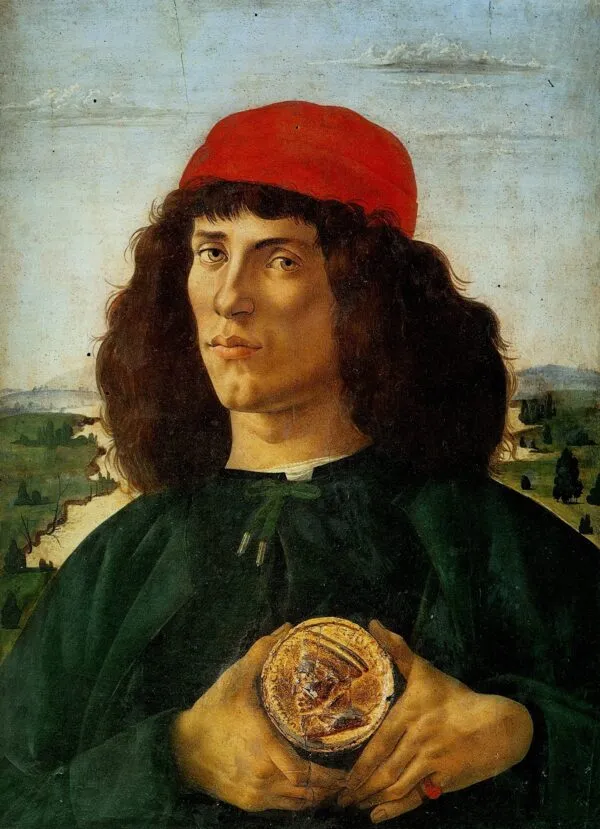
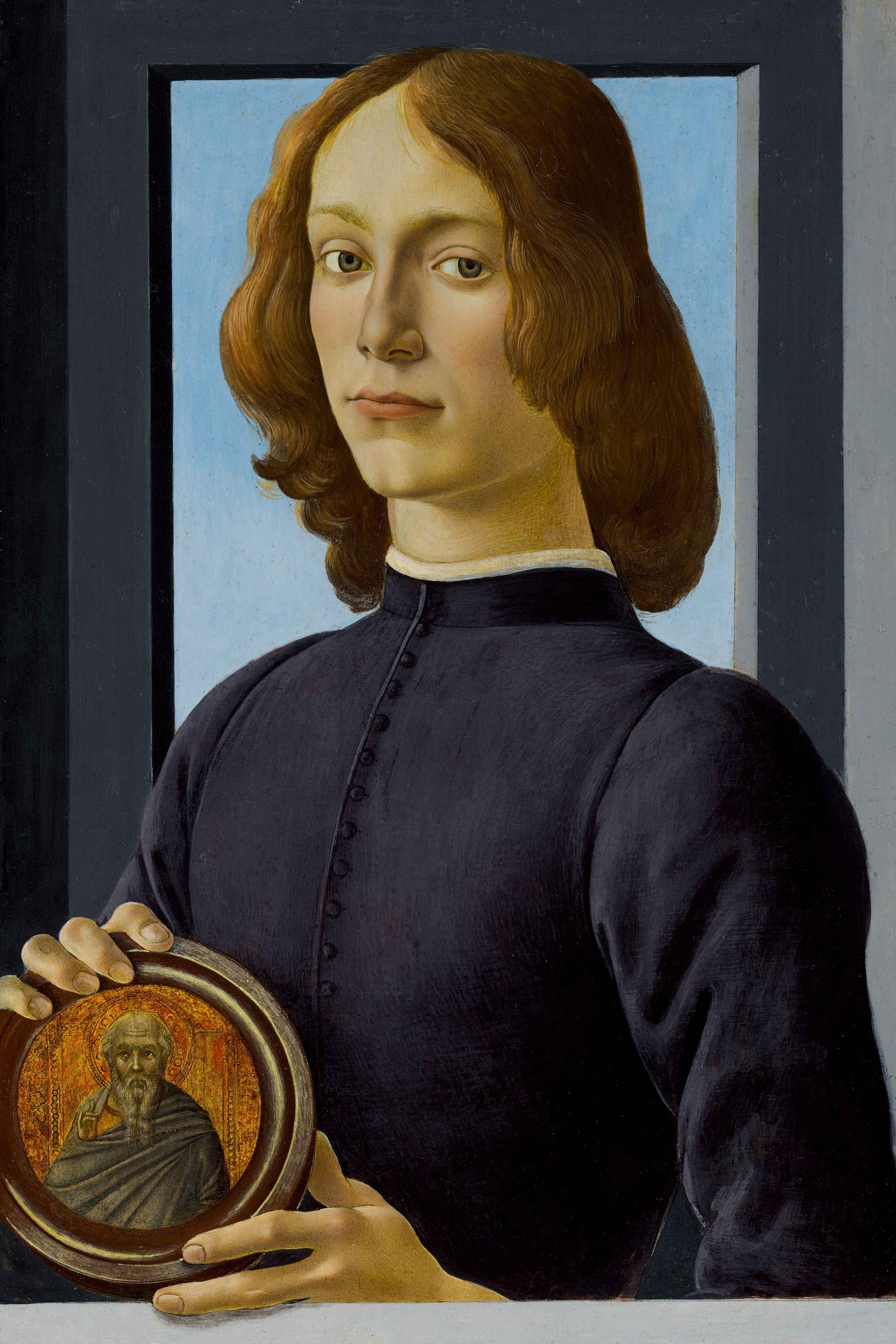
Portrait of a Young Man Holding a Roundel is a painting by Sandro Botticelli from around 1480: a young man with long brown hair, in a dark blue tunic, looks us straight in the eye and holds before him a small round medallion with a bearded saint on a gold ground. The original, tempera on poplar panel measuring 58.7 x 38.9 cm, is in a private collection. Our painter paints it for you by hand in oil on canvas, in 8 portrait sizes from 30 x 45 to 127 x 185 cm or made to measure. You will see a photograph of your finished portrait before we ship it.
| Title: | Portrait of a Young Man Holding a Roundel |
| Other titles: | Giovane uomo con in mano una medaglia (Italian title) · Portret mladeniča z medaljonom (Slovene title) |
| Painter: | Sandro Botticelli (c. 1445–1510) |
| Year painted: | c. 1480 |
| Original size: | 58.7 cm x 38.9 cm (height x width) |
| Original technique: | Tempera on poplar panel |
| Painting style: | Early Renaissance |
| Located at: | Private collection |
| Our reproduction: | Hand-painted in oil on canvas, 8 sizes or made to measure |
Portrait of a Young Man Holding a Roundel – Sandro Botticelli
What does Portrait of a Young Man Holding a Roundel show?
The young man is shown half-length and fills almost the whole panel. His body turns slightly aside, but his gaze goes straight to the viewer. His brown hair, with a reddish sheen, is parted in the middle and falls in soft waves to his shoulders.
He wears a plain dark blue tunic with a low stand-up collar, edged by a thin strip of white shirt, and a long row of small round buttons runs down his chest.
Behind him opens a window: a dark grey outer frame, a lighter inner one and a clear blue sky. The inner frame looks bluish on the left and darker grey on the right, so the planes of colour shift from side to side.
At lower left he holds a round medallion with a broad dark rim in both hands. Inside, on a gold ground, a bearded saint with a halo, wrapped in a grey-blue cloak, raises his right hand. One finger rests on a pale grey strip along the bottom edge, like a window sill.
Who is the young man, and what does the medallion mean?
His name is not known. Because Lorenzo de’ Medici was one of Botticelli’s main patrons, some scholars suggest the sitter may have belonged to the Medici family.
The portrait is thought to show the ideal of beauty of Florentine high society in the Renaissance. The tunic is simply cut but of fine cloth, and its blue was very rare at the time.
The medallion is not by Botticelli. It was set into the panel only after the portrait was finished and is believed to be an original 14th-century work by Bartolomeo Bulgarini, also called the Ovile Master. It was probably cut from a larger rectangular picture.
The hand supporting the medallion from below works as a repoussoir: it makes the medallion seem to sit on a different plane from the young man, a little nearer to us.
Why is the portrait so well known?
It holds the eye through the direct gaze, the rare blue and an unusual idea: a portrait of around 1480 carries a 14th-century picture inside it.
Under Sir Thomas Merton it was first called a Botticelli; later monographs left it out, but most art historians now accept it.
In January 2021 the portrait was sold at auction at Sotheby’s in New York, and the sale drew attention around the world. The Wikipedia article in English traces its path from the first record to the present day. Buyers also know it as Portrait of a Young Man Holding a Medallion.
His quiet faces return in Portrait of a Young Woman.
Where is the original today?
The original is in a private collection and belongs to no museum.
The first modern record dates from 1938, when the portrait was owned by Baron Newborough. Art historians assume it entered the family while the 1st Baron Newborough, Thomas Winn, lived in Florence between 1782 and 1791. In 1941 it passed to the collector Sir Thomas Merton.
Later it was lent to major museums: the Metropolitan Museum of Art in New York, the National Gallery in London and the Städel Museum in Frankfurt, which showed it in a Botticelli exhibition in 2009–2010.
Botticelli himself was born around 1445 in the Ognissanti quarter of Florence, a tanner’s son. Vasari says he trained first as a goldsmith and learned painting under Filippo Lippi. He died in 1510.
This portrait or another Botticelli?
This is a canvas painting for anyone who prefers a single face to a crowded scene; its upright format and calm blues and greys suit a study, a hallway or a bedroom.
A related idea appears in Portrait of a Man with a Medal of Cosimo the Elder, where a man likewise holds out a round medal. For the Medici circle, see Portrait of Giuliano de’ Medici.
As a female counterpart, Idealized Portrait of a Lady (Simonetta Vespucci) can hang beside him.
Our full choice of famous Botticelli paintings opens on the Sandro Botticelli page.
How do we hand-paint Portrait of a Young Man Holding a Roundel?
Botticelli’s original is not an oil painting: it is tempera on a poplar panel of 58.7 x 38.9 cm, and the medallion is set into it as a separate, older picture.
Ours is a Sandro Botticelli reproduction painted by hand in oil on canvas, layer by layer, with the medallion on the same canvas, so it can travel rolled, stretched on a stretcher bar or framed.
He first draws the young man, the window frame and the circle of the medallion, then lays in the grey planes and the sky, and builds the tunic in several thin layers so the dark blue gains depth.
Last come the face and the wavy hair, strand by strand, then the white shirt edge, the buttons and the saint’s gold ground.
Which size suits which wall?
In short: small sizes for a desk or a narrow wall, middle sizes above a chest of drawers or a bed, the largest for a big living-room wall.
We paint the portrait in 8 portrait sizes (width x height): 30 x 45, 35 x 50, 48 x 70, 54 x 81, 69 x 100, 88 x 131, 100 x 145 and 127 x 185 cm. The original measures 38.9 x 58.7 cm (width x height), so 30 x 45 and 35 x 50 cm are smaller than it, and every size from 48 x 70 cm upwards is larger.
At 30 x 45 or 35 x 50 cm it suits a narrow wall or the space above a desk. The 54 x 81 and 69 x 100 cm sizes fill the wall above a chest of drawers or a bed.
As a painting for the living room it comes into its own from 88 x 131 cm; at 127 x 185 cm the face is far larger than life.
Can I have another size, and which frame suits it?
Yes. For other proportions we keep the young man and the medallion whole and adjust only the grey window frame and the sky at the edges, so even a resized oil painting reproduction keeps everything that matters. Send us the size you have in mind and we will quote a price and a date.
We ship the painting rolled in a tube, stretched on a stretcher bar or framed; our workshop in Slovenia does the stretching and framing. In our 3D app you pick the moulding; a view of the painting on your own wall is a separate service.
A slim dark frame suits the blue tunic; a gilded one echoes the medallion’s gold.
When will your portrait arrive?
We dispatch Portrait of a Young Man Holding a Roundel 15 to 45 working days after you confirm your order. When the painter has finished, we send you a photograph and make any changes before packing.
Within Slovenia and the rest of the EU the portrait travels without customs duties, and our returns policy applies to every order.
The quiet young man with his golden medallion makes a fine gift. Not sure which size would suit? Give a gift voucher and let them choose.
Frequently asked questions
Where is the original kept?
In a private collection. It was sold at auction at Sotheby’s in New York in January 2021.
Who is the young man in the portrait?
His name is unknown; scholars suggest he may have belonged to the Medici family.
Who painted the saint in the medallion?
It is believed to be by Bartolomeo Bulgarini, a 14th-century painter.
Is it a print?
No. It is a hand-painted copy: our painter brushes every stroke in oil paint on canvas.
How large is the original?
58.7 x 38.9 cm (height x width); our 48 x 70 cm size is already larger.
Can you paint the young man in a size that is not listed?
Yes. Give us the width and height you need, and we will reply with a price and a date for the portrait.
How long does the young man take to paint, and how is he sent?
It leaves us 15 to 45 working days after your order, rolled, stretched or framed.
Does it suit a bedroom or a study?
Yes. The calm blues and greys and a single face bring quiet to a room.
- Subject: a young man in a dark blue tunic before a window with blue sky, holding a medallion with a bearded saint.
- Original: tempera on poplar panel, c. 1480, 58.7 x 38.9 cm, private collection.
- Ours: hand-painted in oil on canvas, 8 sizes from 30 x 45 to 127 x 185 cm, or made to measure.
- Worth knowing: the medallion is an older 14th-century picture that was set into the panel later.