







































Description
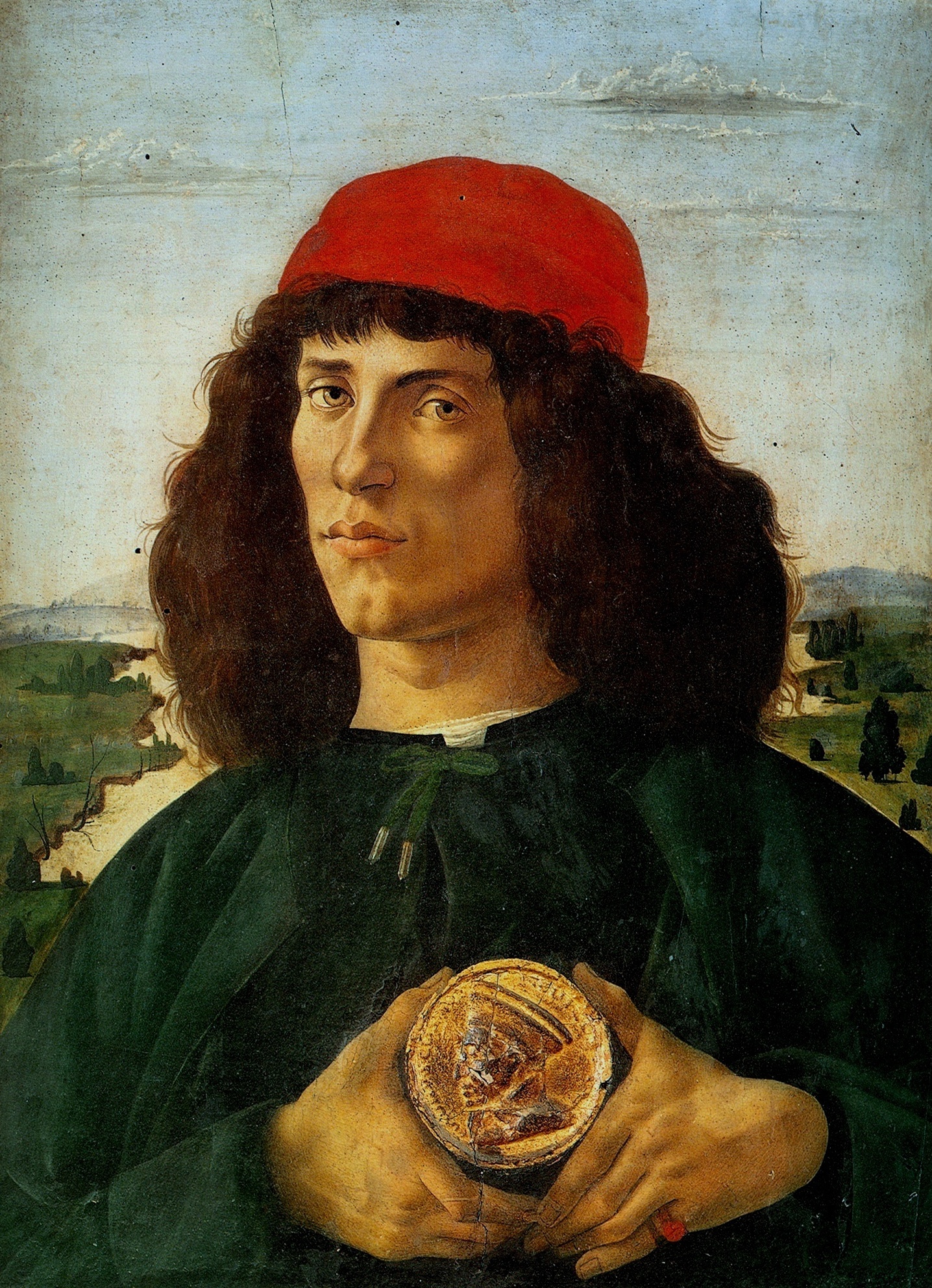
Portrait of a Man with a Medal of Cosimo the Elder is a painting by Sandro Botticelli from about 1474–1475: a young man with long dark curls, a red cap and a dark green coat looks straight at us and holds a large gold medal with the profile of Cosimo de’ Medici before his chest. Nobody knows for certain who he is. The original, tempera on panel measuring 57.5 x 44 cm, hangs in the Uffizi Gallery in Florence. Our painter paints it for you by hand in oil on canvas, in 8 upright sizes from 30 x 40 to 124 x 157 cm or made to measure, with a photograph sent to you before dispatch.
| Title: | Portrait of a Man with a Medal of Cosimo the Elder |
| Other titles: | Ritratto d’uomo con medaglia di Cosimo il Vecchio (Italian title) · Portrait of a Youth with a Medal |
| Painter: | Sandro Botticelli (c. 1445–1510) |
| Year painted: | c. 1474–1475 |
| Original size: | 57.5 cm x 44 cm (height x width) |
| Original technique: | Tempera on panel |
| Painting style: | Early Renaissance |
| Located at: | Uffizi Gallery, Florence, Italy, inv. 1890 no. 1488 |
| Our reproduction: | Hand-painted in oil on canvas, 8 sizes or made to measure |
Portrait of a Man with a Medal of Cosimo the Elder – Sandro Botticelli
What does Portrait of a Man with a Medal of Cosimo the Elder show?
Painted to the waist, the young man turns three-quarters to the left, his head turning back towards us. Dark brown curls fall from under a bright red cap to his shoulders. Large brown eyes, a long straight nose, full lips and a dimpled chin give him a grave, faintly melancholy look.
His dark green coat is tied at the throat with a green cord ending in two small metal tips.
At the centre he holds a large gilded medal in both hands, his fingers forming a kind of triangle around it. On it Cosimo de’ Medici appears in profile, wearing a cap, with an inscription round the rim. Lower right, a ring with a red stone glints on one finger.
Behind him a river winds through a green valley towards bluish hills under a pale sky.
What does the medal in his hands mean?
Cosimo de’ Medici, known as the Elder, died in 1464. A year later Florence named him Pater Patriae, father of the fatherland, and between 1465 and 1469 a medal inscribed MAGNUS COSMVS MEDICES PPP was struck in his memory.
Botticelli modelled the medal in gilded gesso, a technique called pastiglia, and set it into the panel, so it stands out in slight relief. As the profile is not reversed, he must have used the original mould or taken a cast from a real medal.
It seems to be the medal possibly designed by Donatello and cast in 1465; an example, Cosimo de’ Medici as Pater Patriae, is in the Victoria and Albert Museum in London.
Why he holds it over his heart is unrecorded. One reading sees loyalty to Cosimo’s branch of the Medici; another says he proudly shows his own work, because he made or gilded the medal himself.
Why is the portrait so well known?
Because nobody can say whom it shows. Also called Portrait of a Youth with a Medal, it has been taken for Pico della Mirandola, for Cosimo’s son Piero and for other Medici.
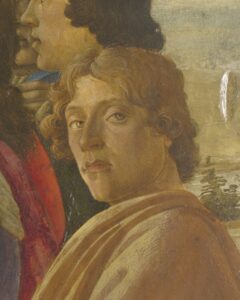
Many think the sitter made the medal: Niccolò Fiorentino, Cristoforo di Geremia or the painter’s brother Antonio, a goldsmith who recast and gilded medals for the Medici. The art historian Guido Cornini favoured Antonio, as the face is close to Botticelli’s self-portrait in Adoration of the Magi.
Frederick Hartt proposed Lorenzo di Pierfrancesco de’ Medici, of the junior Popolani branch. Others feel so direct a gaze could be the painter’s own, seen in a mirror.
Sean Connolly found the sitter almost as mysterious as Leonardo’s Mona Lisa. It is also among the first Italian portraits to make the hands part of the subject. The Wikipedia article on the portrait, in English, sets out each theory.
Where is the original today?
You will find it in Florence, in the Uffizi Gallery, where it is listed as inventory 1890 no. 1488.
It is first recorded with Cardinal Carlo de’ Medici and entered the ducal collection in the Uffizi on his death in 1666. Early inventories call it the work of an unknown master, that of 1825 gives it to Filippino Lippi, and Giovanni Morelli was the first to name Botticelli. It was restored in 1991.
Botticelli, born Alessandro Filipepi around 1445, spent almost his whole life in the Ognissanti district of Florence, and the Medici were among his chief patrons.
The medal portrait or another Botticelli?
Portrait of a Man with a Medal of Cosimo the Elder is a canvas painting for those who prefer one face to a crowd. Its upright format suits a study, a library or the wall by a fireplace.
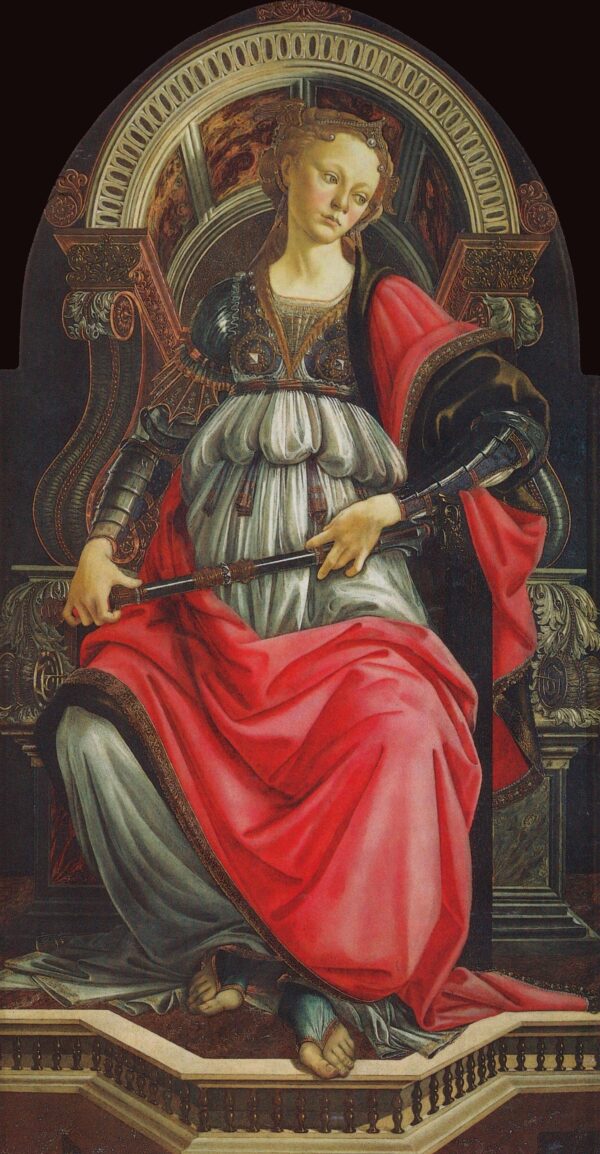
For another of his male portraits, see Portrait of Giuliano de’ Medici: the younger brother of Lorenzo the Magnificent, killed in the Pazzi conspiracy of 1478, shown in profile with lowered eyes. A gentle female counterpart is Portrait of a Young Woman, and his earliest documented work is Fortitude of 1470.
All the famous Botticelli paintings we paint to order are on the Sandro Botticelli page.
How do we hand-paint Portrait of a Man with a Medal?
Botticelli’s original is not an oil painting: it is tempera on a wooden panel, 57.5 x 44 cm, with the medal set in as gilded relief. Ours is a Sandro Botticelli reproduction painted by hand in oil on canvas, layer by layer, the medal and its raised rim rendered with the brush in gold and ochre. Being on canvas, it can travel rolled, stretched on a stretcher bar or framed.
The painter first draws the head, cap, hands and medal and fixes the horizon, then lays in the sky, the valley, the dark green coat and the red cap.
The face and the soft curls follow in small strokes; last come the hands, the ring, the cord and Cosimo’s profile, with glints of light that give the gold its depth.
Which size suits which wall?
In short: small sizes for a shelf, middle ones above a chest of drawers, the largest for a tall living-room wall.
We paint this portrait in 8 upright sizes (width x height): 30 x 40, 36 x 48, 48 x 60, 55 x 70, 70 x 87, 84 x 115, 95 x 128 and 124 x 157 cm. The original measures 44 x 57.5 cm (width x height). So 30 x 40 and 36 x 48 cm are smaller than it, 48 x 60 cm is about the size of the panel in the Uffizi, and every size from 55 x 70 cm upwards is larger.
The two smallest suit a bedroom or a bookcase, 48 x 60 to 70 x 87 cm a mantelpiece. As a painting for the living room it comes into its own from 84 x 115 cm, where the face and the medal read from across the room.
Can I have another size, and which frame suits it?
Yes. For other proportions we keep the head, hands and medal whole and adjust only the sky or the valley at the edges, so it stays an oil painting reproduction of the whole portrait. Send us your own width and height and we will quote a price and a date for your medal portrait.
Our workshop in Slovenia stretches and frames the canvas and packs it for the journey. In our 3D app you pick the moulding only, and seeing the painting on your own wall is a separate service. A slim gilded or dark wooden frame suits the red cap and the gold.
When will your medal portrait arrive?
It is ready for dispatch 15 to 45 working days after you confirm your order. When it is finished, we send you a photograph of it and make any changes you ask for before packing.
No customs charges apply anywhere in the EU, Slovenia included, and our returns policy protects your medal portrait as it does every order.
It makes a fine present for a coin collector or a lover of Florence. Unsure of the size? A wall art voucher leaves the choice of painting and size to the recipient.
Frequently asked questions
Where can I see the original?
It hangs in Florence, in the Uffizi Gallery (inventory 1890 no. 1488).
Who is the young man in the portrait?
Nobody knows; the painter’s brother Antonio and several Medici are among the names put forward.
Is it a print?
No. It is a hand-painted copy: our painter brushes the face, curls and medal by hand.
How large is the original?
57.5 x 44 cm (height x width); our 48 x 60 cm size comes closest.
Is the medal raised on your painting?
No. The original’s medal is gilded gesso in relief; ours is painted in oils.
How soon is the portrait sent, and in what form?
Within 15 to 45 working days, rolled, stretched or framed.
Does the portrait suit a study or a living room?
Yes. Its dark green, red and gold go well with wood, books and leather.
Who is the Cosimo on the medal?
Cosimo de’ Medici the Elder, who died in 1464 and was named Pater Patriae a year later.
- Subject: a young man in a red cap and dark green coat holding a gold medal with Cosimo de’ Medici’s profile, a river valley behind him.
- Original: tempera on panel with an inset gilded medal, c. 1474–1475, 57.5 x 44 cm, Uffizi Gallery, Florence.
- Ours: hand-painted in oil on canvas, 8 sizes from 30 x 40 to 124 x 157 cm, or made to measure.
- Worth knowing: scholars have argued about the sitter for more than a hundred years.