







































Description
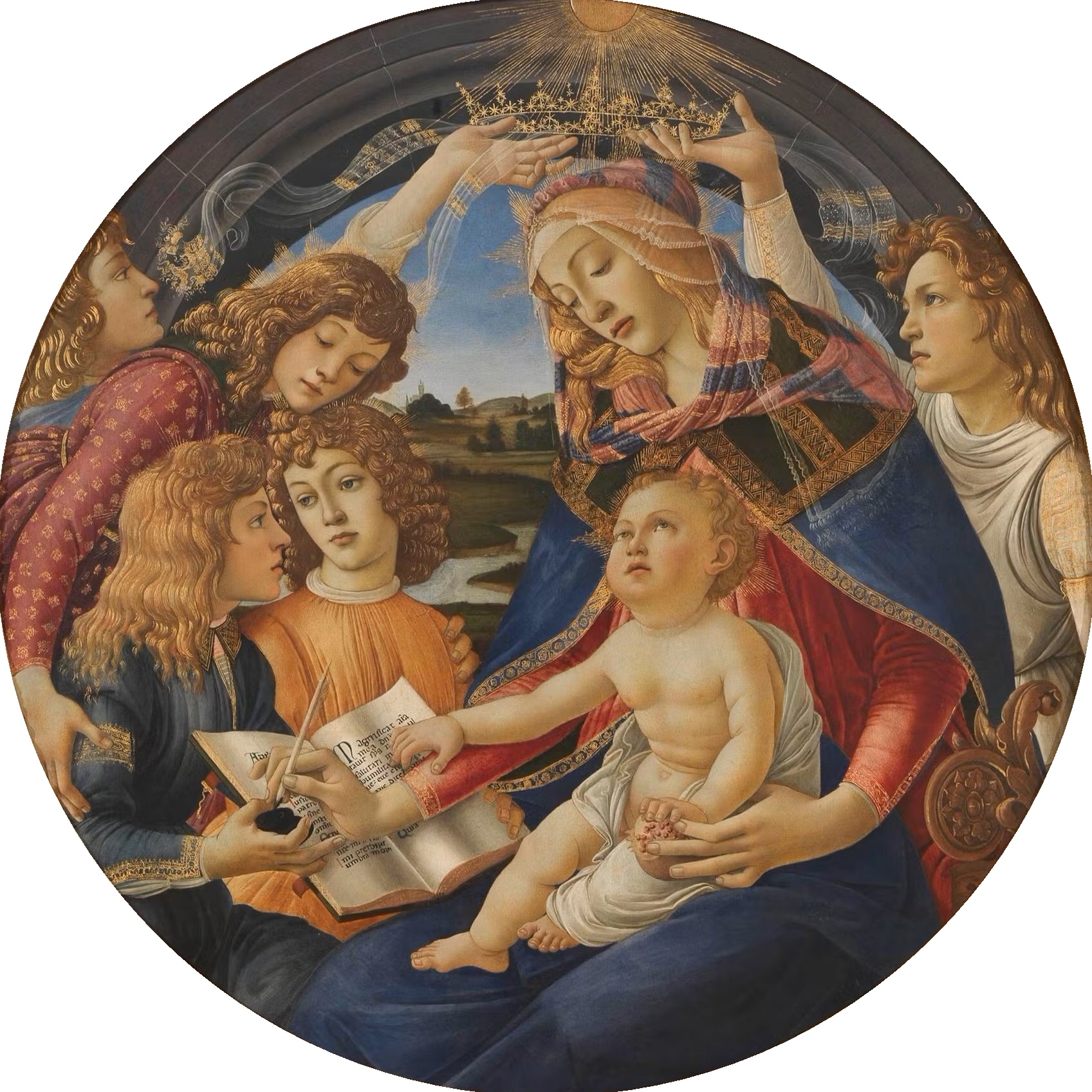
Madonna of the Magnificat is a round painting by Sandro Botticelli from about 1481–1483: the Virgin, with the Child on her lap, writes the hymn of the Magnificat in a book held by angels, as two of five young angels hold a gold crown over her. The original, tempera on panel 118 cm across, belongs to the Uffizi Gallery in Florence. Our painter paints it for you by hand in oil on a square canvas, in 8 sizes from 35 x 35 to 130 x 125 cm or made to measure. Before it is dispatched, you receive a photograph of your finished painting.
| Title: | Madonna of the Magnificat |
| Other titles: | Madonna del Magnificat (Italian title) · Virgin and Child with Five Angels |
| Painter: | Sandro Botticelli (c. 1445–1510) |
| Year painted: | c. 1481–1483 |
| Original size: | 118 cm x 118 cm (round panel, 118 cm in diameter) |
| Original technique: | Tempera on panel |
| Painting style: | Early Renaissance |
| Located at: | Uffizi Gallery, Florence, Italy |
| Our reproduction: | Hand-painted in oil on canvas, 8 sizes or made to measure |
Madonna of the Magnificat – Sandro Botticelli
What does the Madonna of the Magnificat show?
Inside the circle, right of centre, sits Mary in a dark blue mantle over a red dress, a sheer veil over her long fair hair and a striped, Byzantine-style scarf around her shoulders. With her right hand she dips her pen in the inkwell and writes on the right-hand page of the open book.
The Child sits naked on her lap. His right hand reaches for the book and guides his mother’s, and he looks upward, to the sky or to Mary. In her left hand Mary holds a split pomegranate full of red seeds, and the Child’s other hand rests on it.
On the left three angels with golden curls crowd round the book: the two in front, in dark blue and in orange, hold it open and offer the inkwell, while the third leans over them. A fourth angel high on the left and a fifth on the right raise a crown of gold stars above Mary, and gold rays fall from the top of the circle.
What is Mary writing, and what does the scene mean?
The Magnificat, the Song of Mary, comes from the Gospel of Luke (1:46–55). Mary speaks it on a visit to her cousin Elizabeth, then expecting John the Baptist. On the right-hand page Mary writes the opening of the hymn; the left page holds part of the Benedictus, the Song of Zechariah (Luke 1:68–79).
That Mary writes at all is unusual: painters normally showed her reading. Botticelli makes her both a mother tenderly holding her child and the author of a text, a choice scholars still discuss.
There is no settled explanation of the pomegranate in this painting. In Renaissance art it is often read as a sign of Christ’s suffering and resurrection, and for its many seeds also as a symbol of fertility. Some have seen in Mary a portrait of Lucrezia Tornabuoni, wife of Piero de’ Medici, and in the angels holding the book her sons Lorenzo and Giuliano, but no reliable source supports this and the idea is largely set aside.
Why is it one of Botticelli’s best-loved Madonnas?
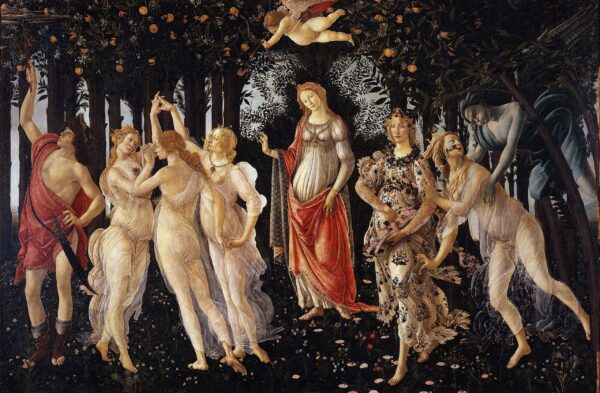
The 1480s were Botticelli’s most successful decade, the years of the large mythologies and of many Madonnas, a good number of them in the round tondo shape. Among the famous Botticelli paintings, the best known are still Primavera and the Birth of Venus, both also in the Uffizi.
His Madonnas have pale, almost porcelain faces with a light pink flush. The circle divides heaven from earth: rays and crown above, landscape below.
Several copies show how much the tondo was admired, among them one in the Louvre and one in the Morgan Library & Museum in New York. The English Wikipedia article, written in English, covers the painting in more depth.
Where is the original today?
The Madonna of the Magnificat hangs in the Uffizi Gallery in Florence, inventory 1890 no. 1609. Its early history is unknown. The Uffizi acquired it from a private collection in 1784, and it may have come from one of the many monasteries suppressed by Archduke Pietro Leopoldo.
Botticelli was born Alessandro di Mariano di Vanni Filipepi around 1445 in Florence, the son of a tanner. According to Vasari he first trained as a goldsmith, then learned painting under Filippo Lippi.
He worked in the Sistine Chapel in Rome in 1481–1482 and died on 17 May 1510; his fame then faded until the Pre-Raphaelites rediscovered him in the late 19th century.
The Madonna of the Magnificat or another Botticelli?
The Madonna of the Magnificat is a canvas painting for anyone who wants calm and tenderness on the wall: mother, child and young angels close into one ring of gold and blue.
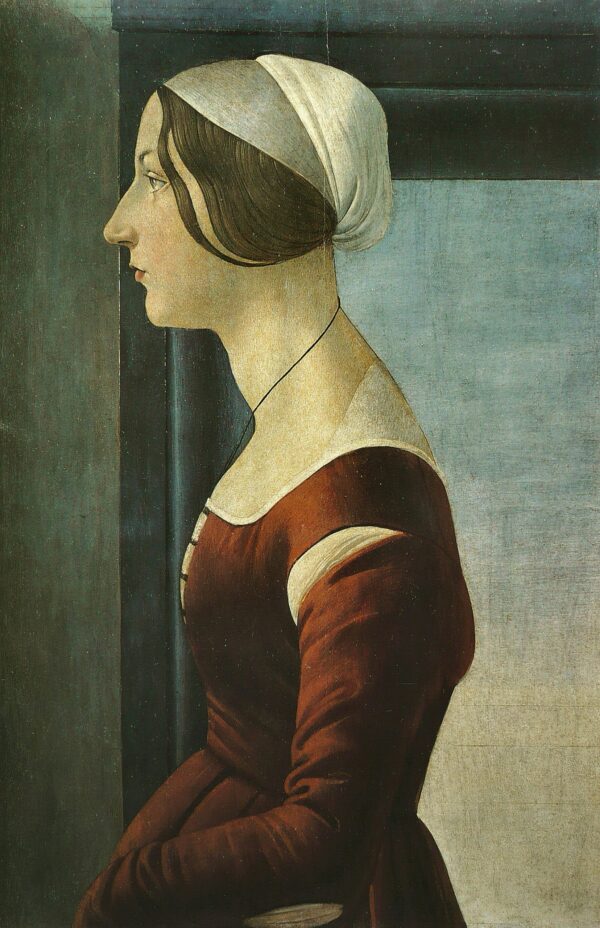
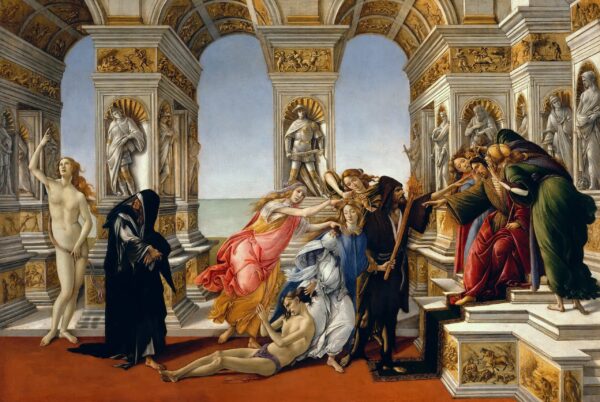
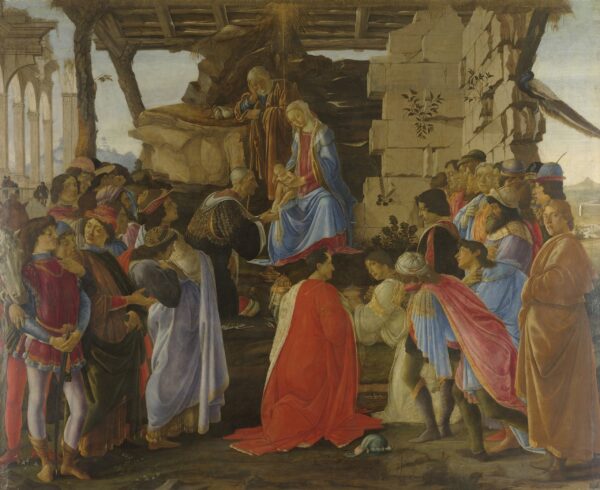
If Botticelli’s Florence draws you, look at the Adoration of the Magi, where tradition sees members of the Medici among the kings, or at the Portrait of a Young Woman, a quiet figure in profile. For drama there is the Calumny of Apelles, an allegory of slander set in a marble hall.
Every Botticelli we paint to order is gathered on our Sandro Botticelli page.
How do we hand-paint the Madonna of the Magnificat?
Botticelli’s original is tempera on a round wooden panel, 118 cm in diameter. Ours is a Sandro Botticelli reproduction painted by hand in oil on canvas, so it can travel rolled, stretched on a stretcher bar or framed.
Because the original is round, our painter sets the circular scene on a square canvas. The four corners outside the circle stay light, as in the photograph of the original on this page, or on request we paint them in a colour you choose.
He first draws the circle and places the figures, then lays in the blues and reds of the clothes and the landscape. The faces are built up in thin layers; the gold rays, the starry crown and the lettering in the book come last.
Which size suits which wall?
In short: the small sizes for a hallway or a desk, the middle ones above a chest of drawers or a bed, the largest for the main wall of a living room.
We paint the Madonna of the Magnificat in 8 square or nearly square sizes (width x height): 35 x 35, 40 x 39, 50 x 52, 60 x 57, 70 x 70, 90 x 88, 110 x 115 and 130 x 125 cm. The original is 118 cm across. Every size up to 110 x 115 cm is smaller than the panel, while our largest, 130 x 125 cm, is a little larger.
From 35 x 35 to 50 x 52 cm it suits a narrow wall or a child’s room; 60 x 57 to 90 x 88 cm sit well above a bed or a sideboard. As a painting for the living room it is at its best at 110 x 115 or 130 x 125 cm.
Can I have another size or a frame?
Yes. The circle with Mary and the angels always stays whole; other proportions change only the corners. Every oil painting reproduction we make shows the full scene. Tell us the size you want for your tondo and we will quote its price and date.
Your painting arrives rolled in a tube, stretched on a stretcher bar or framed; our workshop in Slovenia does the stretching and framing. In our 3D app you choose the frame moulding only; seeing the painting on your own wall is a separate service.
When will the Madonna of the Magnificat arrive?
Your Madonna is ready for dispatch 15 to 45 working days after you confirm the order. We send you a photograph of the finished painting and make any change you ask for before packing.
Within Slovenia and the rest of the EU it travels without customs duties, and our returns policy covers every order.
A Madonna and Child makes a fine gift for a wedding, a christening or a new home. If you are unsure of the right size, give a wall art voucher and let the recipient choose.
Frequently asked questions
Where can I see the original?
In the Uffizi Gallery in Florence, which holds it as inventory 1890 no. 1609.
Why is the original round and your painting square?
The original is a tondo, a round panel. We paint the circle on a square canvas, and the corners stay light or take a colour of your choice.
Is it a print?
No. Each Madonna of the Magnificat we make is a hand-painted copy, worked with a brush in oil paint on canvas.
How large is the original?
118 cm in diameter; our sizes up to 110 x 115 cm are smaller, 130 x 125 cm slightly larger.
Do you paint it in a size that is not on the list?
Yes. Tell us the width and height and we will send you a price and a date.
How long does the Madonna take, and how is it shipped?
15 to 45 working days, with a photograph of the painting before dispatch.
Does this Madonna suit a bedroom, or make a good gift?
Yes. This calm Madonna suits a bedroom and makes a lovely wedding or christening gift.
What does the pomegranate in Mary’s hand mean?
In Renaissance art it often stands for Christ’s suffering and resurrection; for this painting there is no settled reading.
- Subject: the Virgin and Child writing the Magnificat among five angels, two of them holding a crown.
- Original: tempera on panel, a round tondo 118 cm in diameter, c. 1481–1483, Uffizi Gallery, Florence.
- Ours: hand-painted in oil on a square canvas, 8 sizes from 35 x 35 to 130 x 125 cm, or made to measure.
- Worth knowing: Mary writes rather than reads, unusual in the painting of her time.